

What is a growth mindset?
A growth mindset is the belief that intelligence and abilities can be developed through effort, effective strategies, and support from others. Psychologist Carol Dweck at Stanford University originated this concept, and decades of research have confirmed its power to change how students learn and how educators teach.
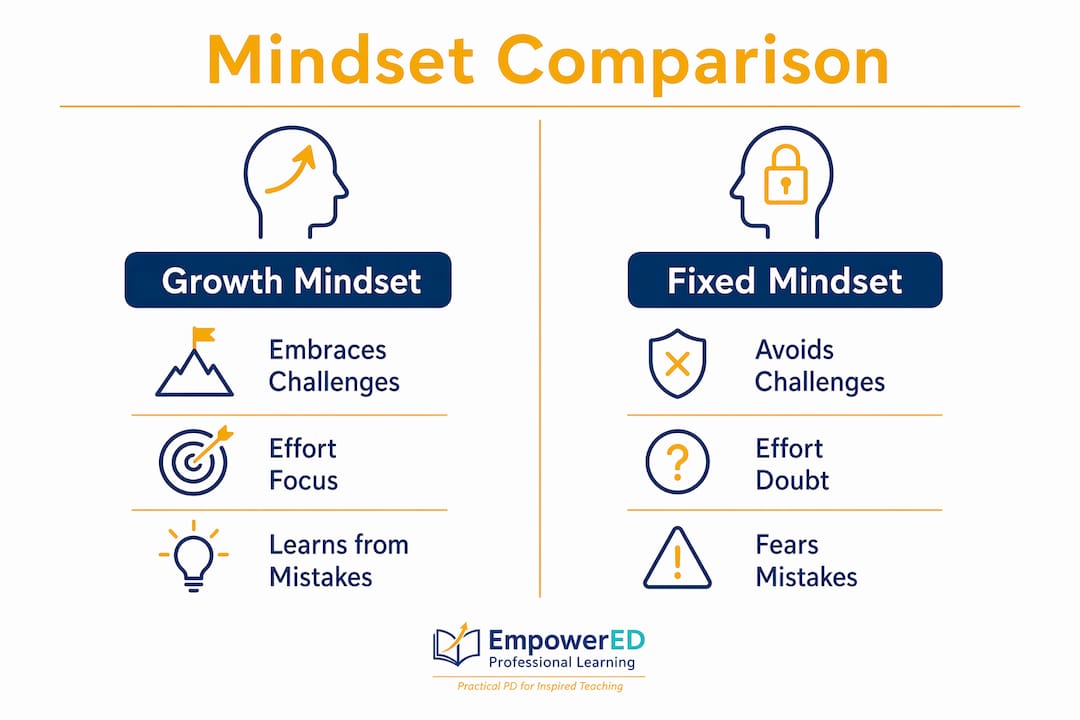
The core distinction is simple but significant. A fixed mindset treats intelligence as a static trait you either have or do not have. A growth mindset treats it as something you build over time.
- Belief that abilities grow through practice and feedback
- Willingness to take on challenges rather than avoid them
- Resilience when facing setbacks or mistakes
- Focus on learning processes, not just outcomes
fMRI studies show that students with a growth mindset actively process their errors, while those with a fixed mindset show little brain activity when reviewing mistakes. That neurological difference explains why mindset shapes learning so directly. Research from the University of Texas at Austin found that teachers who received brief growth mindset training improved outcomes for students in disadvantaged classes, demonstrating that the benefits extend well beyond individual learners.
Fixed vs. growth mindset: how they differ in practice

The contrast between these two mindsets shows up most clearly when things get hard. According to MIT’s Teaching and Learning Lab, fixed mindset individuals avoid challenges, give up when strategies fail, and tend to internalize setbacks as proof of limited ability. Growth mindset individuals do the opposite.
Fixed mindset behaviors:
- Avoids difficult tasks to protect self-image
- Gives up or repeats the same failed approach
- Views effort as a sign of weakness
- Reacts defensively to feedback
- Sets performance goals focused on looking capable
Growth mindset behaviors:
- Seeks out increasingly difficult challenges
- Tries new strategies when one does not work
- Views effort as part of the learning process
- Actively seeks feedback and uses it
- Sets mastery goals focused on skill development
Mindsets are also domain-specific. A teacher might hold a growth mindset about classroom management while holding a fixed mindset about technology. Recognizing that pattern is the first step toward addressing it.
How to build a growth mindset in yourself and your students
Process-focused praise is one of the most effective tools available. Praising a student’s specific strategy, persistence, or approach, rather than their intelligence or generic effort, builds the belief that their choices drive their results.
- Add “yet” to fixed mindset statements. “I can’t do this” becomes “I can’t do this yet.” That single word shifts the frame from permanent failure to temporary challenge.
- Teach neuroplasticity. When students understand that the brain forms new connections through learning, they have a concrete reason to believe in their own growth.
- Reframe mistakes as data. Routines that treat errors as useful information, not embarrassments, reduce the fear that blocks risk-taking.
- Use classroom questioning strategies that require thinking, not just recall. Questions that push students to explain their reasoning reinforce the idea that effort and strategy matter.
- Model your own learning process. When educators share how they work through difficulty, they signal that struggle is normal and productive.
Pro Tip: Avoid praising effort alone. Carol Dweck warns in Scientific American that over-praising effort without connecting it to strategy can mislead students. Effective feedback guides students toward better approaches, not just harder work.
For children with specific learning needs, approaches that connect persistence to real rewards can reinforce these habits. Resources like learning engagement strategies for children with ADHD offer practical methods that align well with growth mindset principles.

How Empowered Professional Learning applies growth mindset in education
Educators who adopt a growth mindset in their own practice create classrooms where students feel safe to take risks. That shift does not happen by accident. It requires intentional professional development, structural support, and a school culture that values learning over performance.
Mindset interventions aligned with educators’ core values are significantly more effective than generic training. When professional development connects to what teachers already care about, they adopt new practices more readily and sustain them longer.
Empowered Professional Learning’s Growth Mindset for Educators and Learners course is built on exactly this foundation. It delivers evidence-based strategies educators can apply immediately, from formative assessment practices that reinforce learning over grading to classroom routines that normalize effort and iteration.
- Practical tools for K-12 educators at every experience level
- Content grounded in Dweck’s research and current classroom realities
- Strategies applicable in both in-person and hybrid settings
Common challenges and misconceptions about growth mindset
The biggest misconception is that growth mindset simply means praising effort. It does not. Dweck herself has clarified that effort is the first step, not the destination. Students also need specific strategies, constructive feedback, and genuine opportunities to improve.
A second challenge is implementation without depth. Schools sometimes adopt growth mindset language, posters, and slogans without changing the underlying practices that signal whether ability is fixed or flexible. When grading systems punish mistakes and reward only correct answers, no amount of “yet” language will shift student beliefs.
False growth mindset occurs when the emphasis on effort is disconnected from guidance toward effective learning methods. Students who try hard but receive no useful direction often conclude that effort alone is not enough, which can actually reinforce helplessness.
What the research says about growth mindset
The evidence base for growth mindset is substantial. Research shows that mindset interventions can improve student motivation, grades, and graduation outcomes. Dweck’s original studies at Stanford demonstrated that students with a growth mindset consistently outperform peers with a fixed mindset, particularly when facing academic challenges.
Research published in Perspectives on Psychological Science traced mindset research from its early focus on challenge-seeking and resilience through large-scale national experiments in the United States. The National Study of Learning Mindsets, which included data from math teachers and students across the country, found that students in classes taught by teachers with a growth mindset showed stronger academic outcomes, particularly among students from underserved groups.
Neuroplasticity research provides the biological foundation. The brain forms new neural connections through learning, and growth mindset learners show increased brain activity when reviewing their mistakes, which promotes deeper learning.
How to assess your current mindset
Self-assessment starts with honest observation. Pay attention to your automatic reactions when you face a setback, receive critical feedback, or watch someone else succeed at something you find difficult.
Dweck’s original Mindset Assessment, available through Stanford resources, asks respondents to rate their agreement with statements like “You have a certain amount of intelligence and you really can’t do much to change it.” Your pattern of responses across multiple statements reveals your dominant orientation. Keep in mind that mindsets are not binary. Research confirms that individuals move between fixed and growth orientations depending on context, stress, and the specific domain involved. The goal is not to declare yourself a growth mindset person, but to notice when fixed mindset thinking appears and respond to it deliberately.
Long-term impact of maintaining a growth mindset
Over time, a growth mindset changes how people relate to learning itself. Students who develop this orientation tend to seek out more challenging work, persist longer through difficulty, and recover faster from academic setbacks. Those patterns compound. A student who embraces challenge in middle school builds skills and confidence that carry into high school, college, and career.
For educators, maintaining a growth mindset means continuing to learn alongside students. Teachers who model curiosity and openness to new approaches create classrooms where those qualities become the norm. Structural support from school leadership is what sustains that culture across years and staff changes, not individual motivation alone.
Key Takeaways
A growth mindset, grounded in Carol Dweck’s research, is the most evidence-supported framework for improving student motivation, resilience, and long-term academic achievement.
| Point | Details |
|---|---|
| Core belief | Growth mindset holds that intelligence develops through effort, strategy, and support, not fixed traits. |
| Fixed mindset contrast | Fixed mindset learners avoid challenges and repeat failed strategies; growth mindset learners seek feedback and try new approaches. |
| Effective praise | Process-focused praise targeting specific strategies outperforms generic effort praise or intelligence praise. |
| Research support | Meta-analyses show mindset interventions produce measurable gains in motivation, grades, and graduation rates. |
| Empowered Professional Learning | The Growth Mindset for Educators and Learners course delivers evidence-based, immediately applicable classroom strategies. |
Why growth mindset is more than a classroom slogan
Growth mindset has become so widely used in education that its meaning has blurred. Schools hang posters, teachers say “not yet,” and administrators cite Dweck in professional development sessions. None of that is wrong. But it misses the harder work.
The research is clear that mindset interventions fail when the surrounding environment contradicts them. A student told that mistakes are learning opportunities, then penalized on every quiz for getting something wrong, receives two conflicting messages. The environment wins. That means educators cannot simply teach growth mindset to students. They have to build systems where growth mindset is the lived experience of the classroom, not just its stated value.
The other underappreciated point is that educators need growth mindset development as much as their students do. Teachers who believe their students’ abilities are fixed, even unconsciously, communicate that belief through their grading, their feedback, and their expectations. The research on instructor mindset and student outcomes is direct: fixed mindset teaching practices produce larger achievement gaps, particularly for students from underserved groups.
Professional development that helps educators examine their own beliefs, not just their techniques, is where lasting change begins.
Practical growth mindset development for educators
Empowered Professional Learning offers a direct path from understanding growth mindset to applying it confidently in the classroom. The Growth Mindset for Educators and Learners course gives educators the research foundation and the practical tools to shift both their own practice and their students’ beliefs. Every strategy is grounded in evidence and designed for immediate use, whether you teach kindergarten or high school.
Educators who complete this course leave with concrete techniques for process-focused feedback, mistake reframing, and building a classroom culture where effort and strategy are genuinely valued. For a deeper look at K-12 applications, the Growth Mindset Teaching for K-12 Educators guide is a strong companion resource.