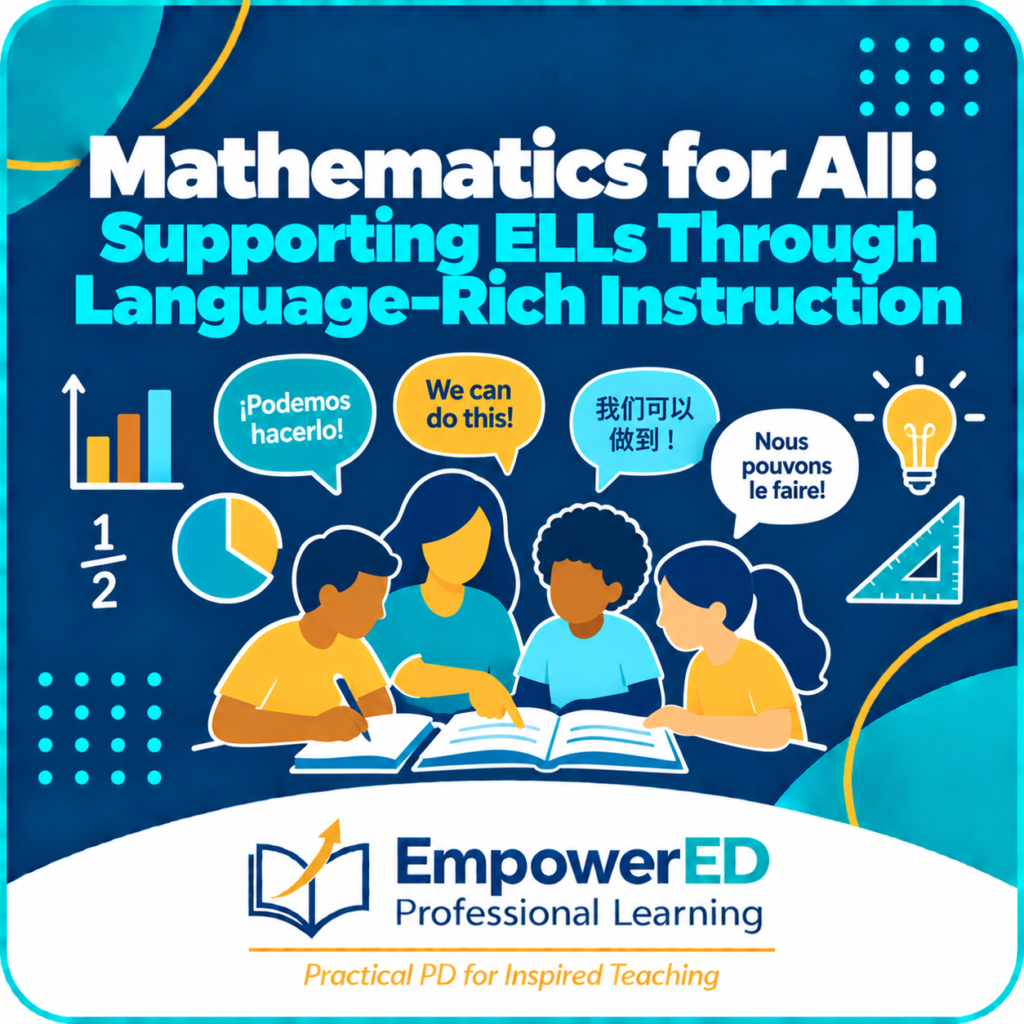
Mathematics for All: Supporting ELLs Through Language-Rich Instruction
Why This Learning Experience?
This instructor-guided professional learning experience is designed to help educators learn on their schedule while still receiving meaningful support. Participants complete practical activities, connect ideas to real classroom practice, and build confidence through application-focused learning.
Learning Experience Overview
This professional development course equips educators with practical strategies for supporting English Language Learners (ELLs) in mathematics classrooms. Participants explore how language development and mathematical understanding are interconnected and learn how to create learning experiences that make mathematics accessible to all students.
The course focuses on language-rich instructional practices, culturally responsive teaching, and multimodal learning strategies that help ELLs engage meaningfully with mathematical concepts. Participants learn how to identify language demands within mathematical tasks, provide appropriate scaffolds, and design lessons that leverage students’ linguistic and cultural assets.
Through video lessons, practical activities, downloadable resources, and classroom application exercises, educators develop strategies that promote equitable access to rigorous mathematics instruction while supporting language development and academic achievement.
Learning Outcomes
By the end of this course, participants will be able to:
- Identify language demands within mathematics tasks and instructional materials.
- Apply language scaffolds that support mathematical understanding and communication.
- Design culturally responsive mathematics lessons that connect to students’ experiences and backgrounds.
- Implement multimodal instructional strategies that increase accessibility and engagement.
- Facilitate collaborative learning experiences that support language development and mathematical discourse.
- Create equitable mathematics learning environments for multilingual learners.
Who Should Participate?
- Math teachers working with English Language Learners
- ESL and bilingual educators
- Instructional coaches supporting equity in math