The HyFlex classroom model is defined as an instructional design that gives students the freedom to choose their participation mode for every class session, whether in person, synchronously online, or asynchronously, without losing access to equivalent learning experiences. Developed in 2006 at San Francisco State University, the model is built on four core principles: learner choice, equivalency, reusability, and accessibility. Adoption accelerated sharply after the pandemic, and by 2026 the hybrid-flexible approach has become one of the most discussed frameworks in both K-12 and higher education. Understanding what is hyflex classroom model means understanding that it is not simply a scheduling option. It is a full redesign of how teaching and learning are structured.
What is the HyFlex classroom model and how does it work?
The HyFlex learning model gives students the power to choose their attendance mode daily or weekly without needing instructor permission. A student who commutes on Tuesdays attends in person. The same student, facing a family obligation on Thursday, joins the live stream. A third student in a different time zone completes the recorded session and discussion board on Friday night. All three receive equivalent learning experiences because the model requires it by design.
The four foundational principles work together as a system. Learner choice means students self-select their mode each session. Equivalency means the learning activities, materials, and assessments carry the same educational value regardless of mode. Reusability means content created for one mode, such as a recorded lecture, functions effectively in another. Accessibility means every student can fully participate regardless of technology access, disability status, or location.
The hybrid-flexible model is distinct from emergency remote teaching, which many schools adopted during the pandemic. Emergency remote teaching was a temporary workaround. HyFlex is a deliberate instructional architecture built for long-term use.
What are the key components of a HyFlex classroom?
Three participation modes define the structure: in-person attendance, synchronous online attendance via live video, and asynchronous participation through recorded content and digital activities. Each mode must be fully functional on its own. A student should never feel penalized for choosing asynchronous participation.
Equivalency is the hardest principle to execute well. It requires that digital-first content design be the starting point, not an afterthought. Materials must work equally well for a student in a lecture hall and one logging in late at night. Assessments must be accessible and fair across all three modes.
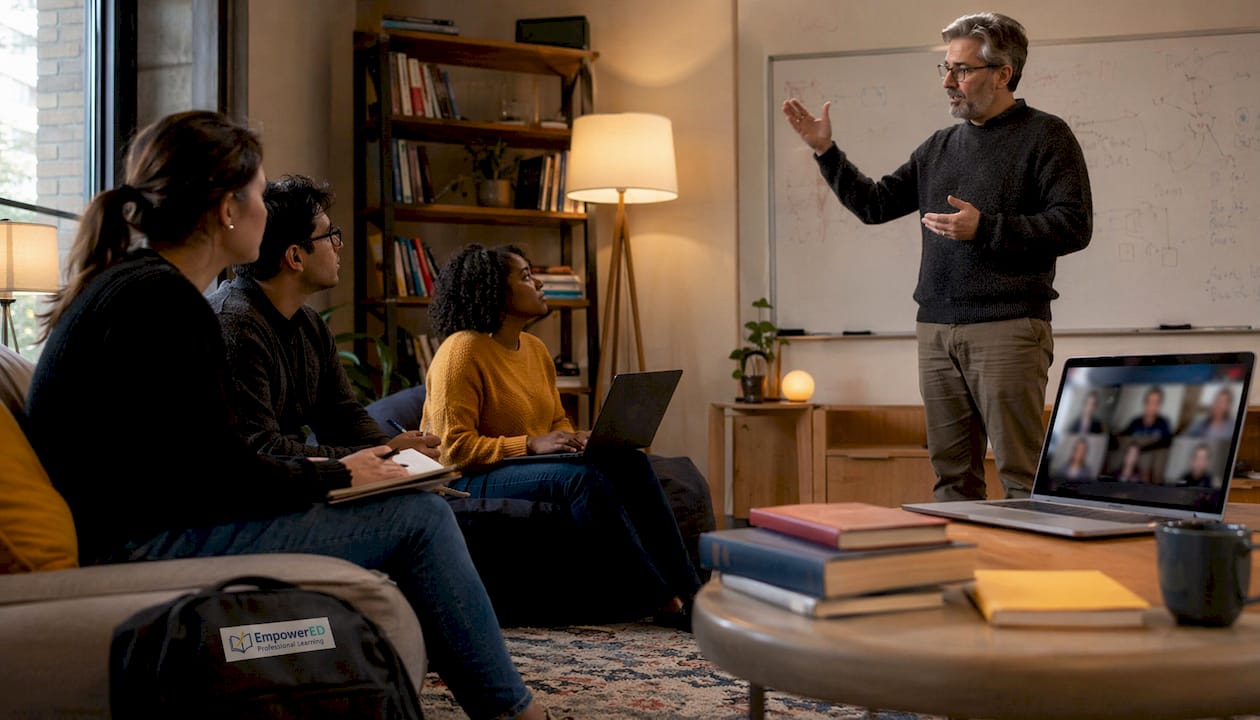
Instructor presence is a non-negotiable component. Educators must be hyper-visible and accessible to all learners simultaneously. That means actively monitoring the chat, calling on remote students by name, and designing activities that do not favor the physical room. Passive facilitation fails in HyFlex.
Key structural requirements include:
- Three fully functional participation modes with no hierarchy between them
- Reusable digital content such as captioned recordings, slide decks, and shared documents
- Equivalent assessments that measure the same outcomes regardless of how a student participates
- Technology infrastructure including webcams, microphones, captioning tools, and collaborative apps
- Clear student communication about expectations, mode-switching procedures, and deadlines
Pro Tip: Design every lesson as if all students will attend asynchronously first. Then layer in the live and in-person elements. This approach forces you to build content that works for everyone from the start.
What are the advantages and challenges of the HyFlex model?
The benefits of HyFlex education are real and well-documented. Institutions can increase student capacity without building new facilities or hiring additional faculty. Students with disabilities, caregiving responsibilities, or geographic barriers gain access to courses they could not otherwise attend. Attendance flexibility reduces the all-or-nothing dynamic that causes students to fall behind after a single missed class.
Research shows that HyFlex supports engagement levels comparable to traditional instruction when strict equivalency is maintained. That finding matters because it counters the assumption that in-person learning is always superior. When the model is implemented correctly, mode of attendance does not determine learning quality.
The challenges are equally real. Instructor workload increases significantly because educators must design and facilitate across three modes at once. Faculty time is routinely underestimated by institutions, and course redesign is time-intensive. Physical classroom attendance often declines as students shift to remote participation, which creates space utilization challenges and can reduce the energy of in-person sessions.
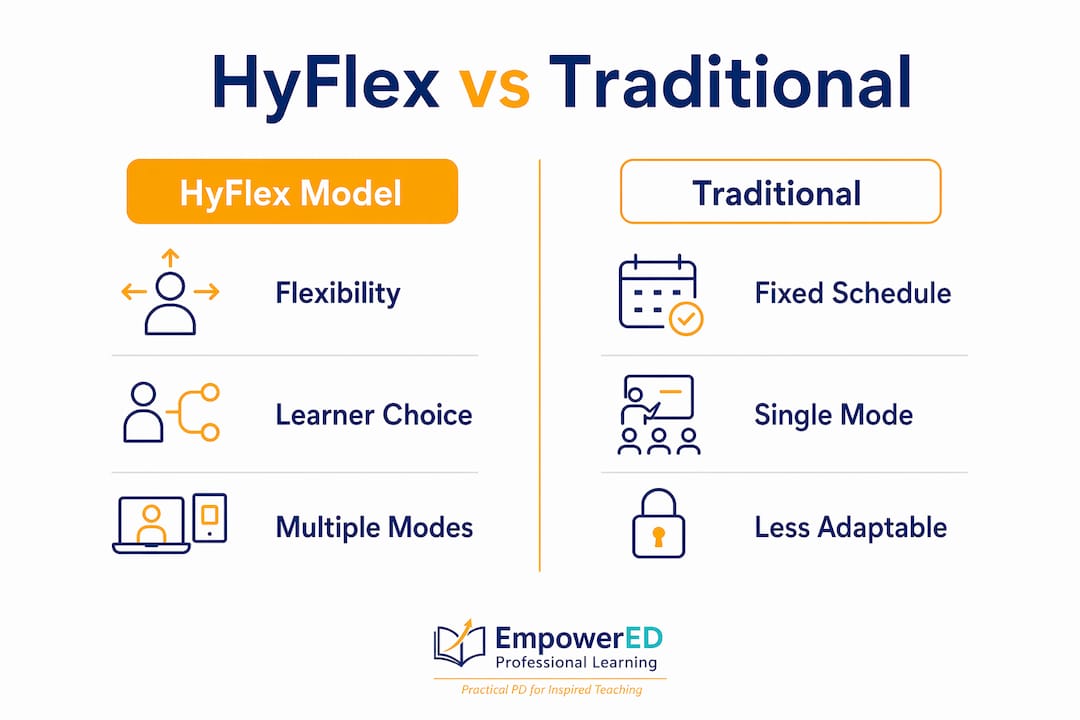
| Factor | HyFlex model | Traditional classroom |
|---|---|---|
| Student attendance flexibility | High: three modes available each session | Low: one required mode |
| Instructor workload | Higher: parallel design and facilitation | Standard: single mode |
| Institutional space needs | Reduced over time | Fixed and often constrained |
| Accessibility for diverse learners | Strong when equivalency is maintained | Limited by physical presence |
| Student self-regulation demand | High: students manage their own mode choices | Lower: structure is externally set |
A common misconception is that HyFlex is just live-streaming a classroom. That perception undersells the pedagogical transformation required for equity. Broadcasting a lecture to remote students while the instructor faces the room creates a two-tier system. True HyFlex dismantles that hierarchy through intentional design.
How does HyFlex enhance student engagement and inclusivity?
Learner autonomy is the engine of HyFlex engagement. Self-Determination Theory identifies autonomy as a primary driver of intrinsic motivation. When students control how they participate, they are more likely to engage with the material on their own terms. This is especially true for adult learners, students with chronic health conditions, and those managing work alongside school.
HyFlex aligns directly with Universal Design for Learning (UDL) principles, which call for multiple means of engagement, representation, and action. A well-designed HyFlex course provides multiple engagement pathways by default. Students who learn best through discussion can attend live. Students who need to pause and rewatch can engage asynchronously. Neither group is accommodated as an exception. Both are designed for from the start.
Case studies with deaf and hard-of-hearing (DHH) students demonstrate the model’s accessibility potential. Layered supports such as live captions, recorded sessions with transcripts, and instructor encouragement produced measurable engagement improvements for students who previously struggled in traditional lecture formats. The lesson applies broadly: designing for the most constrained learner improves the experience for everyone.
Reducing transactional distance, the psychological gap between instructor and learner, requires deliberate effort. Strategies that work include:
- Live chat monitoring with direct responses during synchronous sessions
- Interactive polls that all three participation modes can complete simultaneously
- Discussion boards that serve as the common meeting ground for all students
- Personal check-ins with asynchronous students who have not engaged in several days
- Classroom questioning strategies that invite participation from remote and in-person learners equally
Pro Tip: Use a shared digital whiteboard or collaborative document during every session. It gives remote and in-person students a common workspace and makes asynchronous students feel part of the conversation when they review it later.
What are best practices for designing a successful HyFlex classroom?
Effective HyFlex implementation starts before the first class session. Planning for equivalency upfront prevents the most common failure mode, which is building a great in-person lesson and then trying to adapt it for remote learners as a secondary step.
-
Audit your content for digital-first compatibility. Every handout, activity, and assessment should function fully online before you consider how it works in the room. This is the foundation of hybrid learning routines that hold up across all three modes.
-
Set up your physical space for visibility. Position your webcam so remote students see your face and the board simultaneously. Use a second monitor to keep the video feed visible while you teach. Treat the camera as a student in the front row.
-
Segment your lessons into short, focused blocks. Lectures longer than 15 minutes lose remote and asynchronous learners fastest. Alternate between direct instruction, small group work, and whole-class discussion to maintain pace and attention across modes.
-
Scaffold student self-regulation explicitly. Student freedom to switch modes can lead to procrastination without clear expectations and support structures. Publish a weekly participation guide that outlines what each mode requires and when deadlines apply.
-
Layer your communication channels. Use live chat for real-time questions, email for detailed follow-up, and a course management system for asynchronous discussion. Each channel serves a different need and reduces the chance that any student falls through the gap.
| Design element | Recommended practice |
|---|---|
| Lecture length | 10–15 minute segments with active breaks |
| Captioning | Auto-captions plus manual review for accuracy |
| Collaborative tools | Shared documents or digital whiteboards every session |
| Formative assessment | Daily formative checks accessible in all three modes |
| Student communication | Weekly mode-choice reminder with clear deadlines |
Intentional communication strategies and collaborative tools reduce the psychological distance that remote students often feel. Live polls, shared notes, and direct instructor acknowledgment of online participants signal that every mode is equally valued.
Key Takeaways
The HyFlex classroom model succeeds when educators design for equivalency first, scaffold student self-regulation, and treat every participation mode as equally valid from the start.
| Point | Details |
|---|---|
| HyFlex defined | Students choose in-person, synchronous online, or asynchronous participation each session. |
| Four core principles | Learner choice, equivalency, reusability, and accessibility must all be present for the model to work. |
| Biggest implementation barrier | Instructor workload and course redesign time are consistently underestimated by institutions. |
| Engagement is achievable | HyFlex matches traditional instruction engagement levels when strict equivalency is maintained. |
| Design starting point | Build every lesson digital-first, then layer in live and in-person elements. |
HyFlex in practice: what I’ve learned after years in flexible learning
I have watched schools adopt HyFlex with genuine enthusiasm and then quietly abandon it within a semester. The reason is almost always the same: the institution treated it as a technology upgrade rather than a teaching redesign.
The promise of HyFlex is real. It can make education more accessible to students who have historically been excluded by rigid scheduling. A working parent, a student managing a chronic illness, a learner in a rural district with unreliable transportation. These are the people HyFlex was built for. When it works, it works because an educator made deliberate choices about every element of the course, not because the school bought better cameras.
What I have found is that the educators who succeed with HyFlex share one habit: they ask “Does this work for my asynchronous student?” before they finalize any lesson plan. That single question forces the design discipline the model requires. It also tends to improve the in-person experience because clearer materials and better-structured activities benefit everyone.
Institutional support is not optional. Faculty cannot redesign courses, learn new facilitation techniques, and manage three participation modes simultaneously without training and time. Schools that invest in professional development for HyFlex see better outcomes. Schools that hand educators a webcam and wish them luck see burnout. The technology is the easy part. The pedagogy is the work.
— Brian Koster, Ed.D.
Professional development resources for HyFlex educators
Adopting the HyFlex model is a professional skill, not just a policy decision. Educators who implement it well have typically invested time in learning engagement strategies, UDL principles, and flexible instructional design before their first HyFlex session.
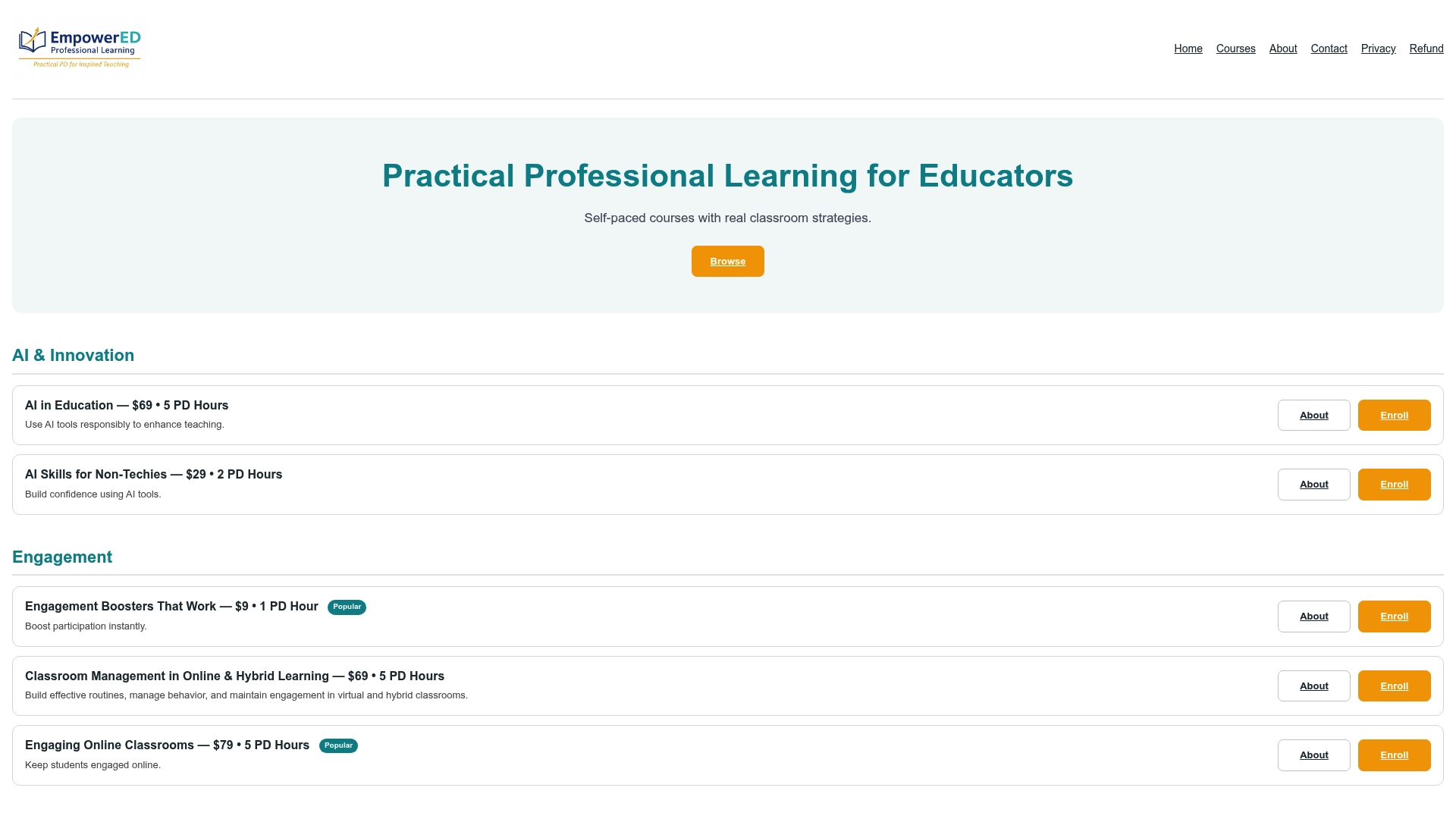
Empowered Professional Learning offers targeted courses built specifically for educators navigating flexible and hybrid teaching environments. The engagement strategies course gives you practical techniques for keeping all three participation modes active and connected. The UDL and accessibility course walks you through designing lessons that meet every learner where they are. Both courses deliver skills you can apply in your next class session, not just in theory. Empowered Professional Learning courses are designed for educators with real classrooms and real constraints, which means the strategies are tested, practical, and ready to use.
FAQ
What is the HyFlex model in simple terms?
The HyFlex model is a teaching approach where students choose each session whether to attend in person, join live online, or complete work asynchronously. All three options deliver equivalent learning experiences.
How does HyFlex differ from a traditional hybrid class?
A traditional hybrid class assigns students to either in-person or online attendance. HyFlex gives every student the freedom to switch between modes each session based on their needs.
What are the biggest challenges of implementing HyFlex?
Instructor workload and course redesign time are the top barriers. Institutions that provide instructional design support and professional development see significantly better results.
Does HyFlex work for K-12 schools?
Yes. The model applies to K-12 settings, though it requires clear communication with students and families about participation expectations and mode-switching procedures.
How do you keep remote HyFlex students engaged?
Using live polls, shared digital workspaces, and direct instructor acknowledgment of online participants reduces the psychological distance remote students feel and keeps participation active across all modes.