

Self-regulated learning (SRL) gives students the tools to actively manage their own cognitive, emotional, and behavioral processes rather than waiting for a teacher to direct every step. When students can set goals, monitor their progress, and adjust their approach, they become more capable and confident learners. The role of self-regulation strategies in learning goes well beyond keeping students on task. It shapes how deeply they engage, how they respond to setbacks, and how well they transfer skills across subjects and grade levels.
Self-regulation is not a single skill. It operates across four interconnected dimensions:
- Cognitive: Planning, organizing information, and applying study strategies
- Metacognitive: Monitoring understanding and evaluating whether a chosen strategy is working
- Emotional: Managing frustration, anxiety, and motivation during challenging tasks
- Motivational: Sustaining effort and connecting learning to personal goals
Critically, quiet behavior is not an adequate indicator of effective self-regulation. A student sitting silently may be disengaged, overwhelmed, or simply compliant. Real self-regulation requires explicit teaching, practice, and feedback within curriculum content.
Why self-regulation matters for student learning
The evidence for self-regulation’s impact on academic outcomes is strong and consistent. Metacognitive and self-regulation approaches yield notable additional student progress per academic year, making them among the highest-impact, lowest-cost interventions available to educators. That figure comes from the Education Endowment Foundation’s Teaching and Learning Toolkit, which synthesizes evidence across thousands of studies.

Self-regulation also supports outcomes beyond grades. Students who regulate their learning effectively tend to show greater emotional resilience, stronger executive functioning, and lower rates of academic burnout. Research on autonomous motivation shows that students who learn for internally driven reasons, rather than to avoid punishment or earn rewards, achieve more and report higher well-being. Self-regulation is the mechanism that makes autonomous motivation practical in a classroom setting.
| Outcome area | What self-regulation supports |
|---|---|
| Academic performance | Goal setting, strategic studying, and monitoring progress |
| Emotional well-being | Managing frustration and reducing test anxiety |
| Motivation | Shifting from compliance-driven to internally driven learning |
| Long-term persistence | Sustaining effort across complex, multi-step tasks |
| Skill transfer | Applying strategies learned in one subject to another |
Self-regulation also acts as a protective factor. Students who develop these skills earlier are better equipped to handle the increasing demands of secondary school and beyond, including managing workload, seeking help proactively, and recovering from poor performance without disengaging entirely.
Pro Tip: When you explain to students why they are learning a particular strategy, not just how to use it, you activate the motivational dimension of self-regulation. That “why” conversation is often the step educators skip.
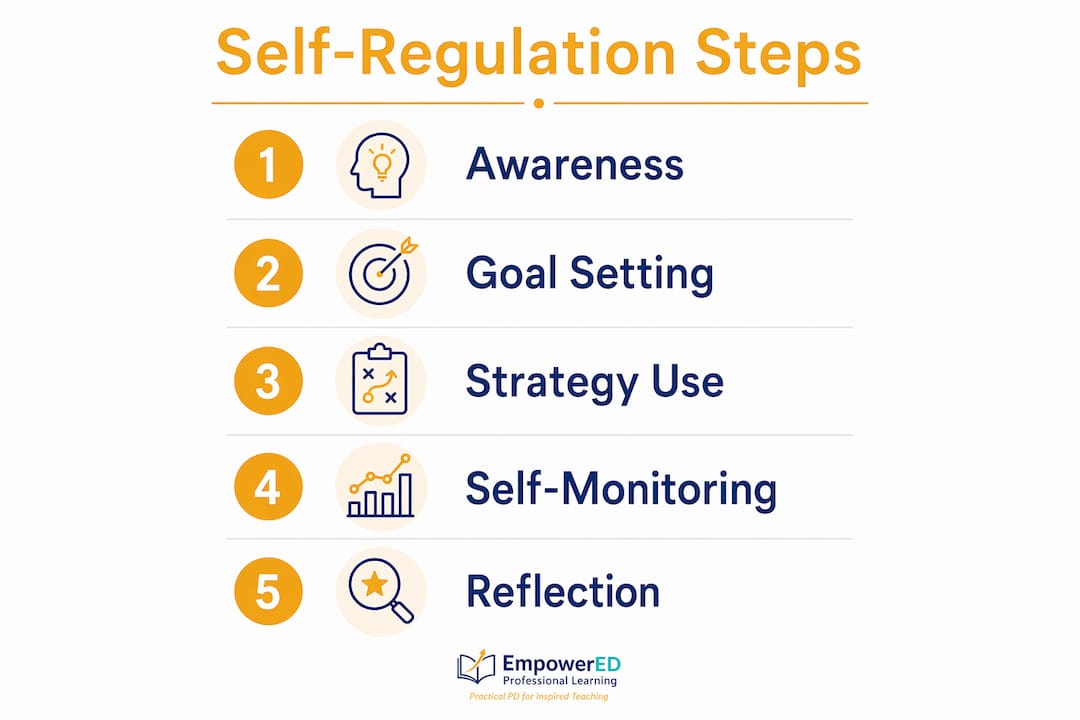
Effective strategies to teach self-regulation to students
Teaching self-regulation works best when it is embedded in content instruction rather than delivered as a standalone program. Effective interventions combine emotional and motivational support directly into everyday teaching, rather than isolating skills in separate lessons. Here are practical strategies educators can use across grade levels and subjects.
- Explicit goal setting: Teach students to write specific, time-bound goals before starting a task. In a writing class, this might look like: “I will draft my introduction paragraph in 15 minutes and check it against the rubric before moving on.” The specificity matters more than the ambition.
- Self-monitoring checklists: Provide structured checklists students complete during and after tasks. These prompt metacognitive reflection without requiring students to invent the process themselves. Checklists work especially well in math and science, where procedural steps are clear.
- Think-alouds and teacher modelling: Explicit teacher modelling of metacognitive strategies, including narrating your own thinking as you work through a problem, builds students’ awareness of what regulated thinking looks like. Co-constructing tools like anchor charts with students deepens that effect.
- Reflection prompts: End lessons with structured questions: “What strategy did you use today? Did it work? What would you try differently?” These prompts, used consistently, build the habit of self-evaluation. Connecting this practice to classroom questioning strategies strengthens metacognitive development across subjects.
- Autonomy-supportive choices: Offer students meaningful choices about how they demonstrate learning, such as written response, diagram, or verbal explanation. Autonomy-supportive teaching shifts students from controlled to autonomous regulation, improving both engagement and achievement.
- Scaffolded goal revision: Teach students to revisit and adjust goals mid-task rather than abandoning them. This models the cyclical nature of SRL and reduces the all-or-nothing thinking that leads to disengagement.
- Technology-supported SRL tools: Digital environments should include features that facilitate goal setting and self-monitoring, such as progress trackers, time management prompts, and self-assessment rubrics. These tools prevent students from feeling overwhelmed while building independent habits.
- Peer learning structures: Structured peer review and collaborative problem-solving give students low-stakes opportunities to observe and discuss each other’s strategies, reinforcing metacognitive awareness through social interaction.
- Formative assessment as feedback loops: Regular, low-stakes checks for understanding, connected to formative assessment techniques, give students real-time data about their own progress. When students receive this feedback consistently, they learn to seek it out independently.
- Emotional regulation check-ins: Brief, structured check-ins at the start of class, such as a one-word mood indicator or a quick rating scale, help students name their emotional state before learning begins. This supports the emotional dimension of self-regulation and gives educators useful information about readiness to learn.
- Embedding routines: Consistent classroom routines reduce cognitive load, freeing mental resources for self-regulation. When students know the structure of a lesson, they can focus on monitoring their learning rather than figuring out what comes next. Research on classroom routines and learning supports this directly.
What research tells us about self-regulation’s impact
The research base for self-regulation in education is both broad and specific. A school-based SRL training program produced an effect size of d=0.33 at a 3-month follow-up, meaning gains held and even grew after the intervention ended. That delayed effect is notable: it suggests students continued applying strategies independently once instruction stopped.

Studies in health sciences education found that self-regulated learning levels correlate with academic GPA at coefficients ranging from r=0.11 to r=0.55, depending on the specific SRL component measured. Motivational and metacognitive components tend to show the strongest associations with performance.
| Research finding | Implication for educators |
|---|---|
| Effect size d=0.33 at 3-month follow-up | SRL gains persist; early investment pays off over time |
| r=0.11 to 0.55 correlation with GPA | Motivational and metacognitive skills are worth prioritizing |
| ~8 months additional progress per year | SRL is among the highest-impact, lowest-cost strategies available |
| Autonomous regulation predicts achievement better than controlled regulation | Teaching for intrinsic motivation matters as much as teaching strategies |
One finding that often surprises educators is the “stagnation paradox.” SRL skills may regress in advanced academic years without continued support, largely because high cognitive load leaves fewer resources for active self-monitoring. Students who thrived with SRL strategies in middle school may struggle to apply them in demanding high school or college environments unless educators continue to scaffold and reinforce those skills.
Emotional support also plays a direct role. When students feel emotionally safe in a classroom, intrinsic motivation increases, which in turn strengthens self-regulation and academic achievement. This connection between emotional climate and SRL outcomes reinforces the value of social-emotional learning as a foundation for academic skill development. Holistic approaches that integrate cognitive, metacognitive, emotional, and motivational support into everyday teaching consistently outperform programs that target only one dimension.
Understanding how to assess students’ self-regulation skills is equally important. Educators can use structured observation tools, student self-report surveys, and portfolio-based evidence to track development over time. Pairing these with executive functioning supports gives a fuller picture of where students are and what they need next. For educators working with families, resources like guidance on evaluating academic learning needs can help bridge school-based SRL development with support at home.
Key Takeaways
Self-regulation strategies are among the most evidence-backed tools educators have for improving both academic performance and student well-being.
| Point | Details |
|---|---|
| SRL yields measurable gains | Metacognitive and self-regulation approaches produce approximately 8 months of additional progress per year. |
| Explicit teaching is required | Quiet, compliant behavior does not indicate self-regulation; it must be taught directly within content instruction. |
| Emotional climate matters | Emotional support builds intrinsic motivation, which strengthens self-regulation and academic outcomes. |
| Gains can regress without support | The stagnation paradox shows SRL skills may decline in advanced years if educators stop scaffolding them. |
| Autonomous motivation outperforms controlled motivation | Students who regulate for internal reasons achieve more and report higher well-being than those driven by external pressure. |
References and further reading
- Metacognition and Self-Regulation, Education Endowment Foundation — Evidence synthesis on the impact of metacognitive and self-regulation approaches on student progress.
- Supporting Self-Regulated Learning, Australian Education Research Organisation — Practice guide for teachers on modelling and explicitly teaching SRL strategies.
- Experimentally Evaluating Self-Regulated Learning Training Effects, Frontiers in Psychology — Three-level experimental study on short and long-term effects of school-based SRL training.
- Self-Regulation of Learning and Its Implications for Academic Performance in Health Sciences, MDPI — Examines correlations between SRL components and GPA, including the stagnation paradox.
- Effective Intervention Designs for Promoting Self-Regulation Skills, MDPI Education Sciences — Reviews holistic approaches integrating cognitive, emotional, and motivational support.
- A Guide for Teachers on Self-Regulated Learning in Technology-Enhanced Environments, ITD CNR — Practical guidance on embedding SRL tools in digital learning environments.
- Improving Programs Supporting Self-Regulation for Educators, ASPE HHS — Federal resource on program design for educator-focused self-regulation support.
- Impact of Motivation and Autonomy Support on Academic Achievement, Springer — Research on autonomous versus controlled regulation and its relationship to achievement and well-being.
- The Role of Tutors in Boosting Student Achievement, David TC Tutoring Services — Practical perspective on how external support structures complement SRL development.
Recommended
- Student Engagement Strategies for K-12 Educators: 2026 Guide
- Growth Mindset Teaching for K-12 Educators: 2026 Guide
- Classroom Energy Management for K-12 Educators: 2026 Guide – EmpowerED: Professional Development for Educators
- Educator Effectiveness Metrics Explained for K-12 Leaders – EmpowerED: Professional Development for Educators