The accommodations with the strongest track record fall into five categories: environment, instruction, assessment, organization, and behavior. Schools can formalize these supports through an IEP or a Section 504 plan, and behavioral tools like Daily Report Cards carry research support when used consistently. Pick one or two accommodations this week, track the results, and build from there.
TL;DR:
- Seating arrangements should place students near the teacher, away from high-traffic areas, and next to calm peers to minimize distractions and enhance focus.
- Instruction should be broken into short, multimodal segments with clear, one-step directions and student choices to improve engagement and information retention.
- Testing accommodations like extra time, quiet spaces, breaks, and alternative response formats help isolate content knowledge from processing and executive function barriers.
- Effective organizational supports include daily planners, color-coded folders, visible checklists, and routine cues to reduce memory load and improve task completion.
- Building collaborations with parents and healthcare providers ensures accommodations address co-occurring conditions, with regular communication supporting implementation fidelity.
Table of Contents
- Environmental and classroom-layout accommodations to reduce distraction
- Instructional strategies: chunking, multimodal presentation, and engagement techniques
- Assessment accommodations and fair grading practices
- Organizational supports, tools, and classroom routines
- Behavioral interventions and Daily Report Cards: evidence, realistic expectations, and low-burden versions
- Legal pathways: IEP vs. Section 504, when to seek evaluation and what schools must do
- One-week to six-week implementation checklist and monitoring plan
- Addressing comorbid conditions and their impact on accommodations
- Social-emotional supports for students with ADHD
- Transition strategies for different grade levels or classroom settings
- Collaboration with parents and healthcare providers to tailor accommodations
- Training and support for teachers on ADHD and accommodations
- Author perspective and EmpowerED evidence: bridging research and classroom practice
- How EmpowerED courses help implement accommodations
- Sources
- FAQ
Environmental and classroom-layout accommodations to reduce distraction
Where a student sits and what surrounds them changes how well they can focus. Seating near the teacher, away from doors and windows, and next to a calm, focused peer gives a student with ADHD fewer competing signals to filter out. The CDC’s classroom guidance points to minimizing distractions as a core piece of behavioral classroom management, alongside immediate positive feedback and consistent expectations.
Visual clutter competes with instruction for attention. Posted routines, a clean focal wall, and consistent daily visual cues give students a predictable anchor instead of a constant stream of new stimuli to process.
Movement matters too. Scheduled breaks, standing desks, or a wobble cushion let a student release physical energy without leaving the room or disrupting peers.
- Seating: front of room, away from high-traffic zones, near a positive peer model.
- Visual environment: reduce wall clutter, post routines at eye level, keep the same visual cues daily.
- Movement: build in short scheduled breaks or offer alternative seating.
- Sensory tools: fidgets and noise-reducing headphones help some students and distract others, so test individually and adjust.
Pro Tip: Trial one seating change for a full week before adding a second variable, so you know which change actually helped.
Instructional strategies: chunking, multimodal presentation, and engagement techniques
Long strings of directions overload working memory before a student with ADHD even starts the task. Give one step at a time, check understanding out loud, and pair spoken directions with a written version on the board or a handout. That combination catches students who process better by ear and those who need to reread.

Breaking a 40-minute lesson into three or four shorter segments, each using a different mode (a short video, a hands-on activity, a partner discussion), keeps attention from draining out halfway through. Multimodal delivery is not extra work: it is the same content, just resequenced.
Engagement rises when students have some say in how they show what they know. A choice between two response formats, or a classroom role that plays to a student’s strengths (timekeeper, materials manager, discussion starter), turns a distractible student into an anchor for the group.
- One-step directions: give a single instruction, confirm understanding, then move to the next.
- Written plus oral: post directions where students can glance back at them.
- Chunked, multimodal lessons: rotate visual, verbal, and hands-on segments every 10 to 15 minutes.
- Choice and roles: offer format options and strengths-based classroom jobs.
These same sequencing principles show up in more depth in EmpowerED’s guide to classroom management techniques, which walks through how to structure a lesson block by block.
Assessment accommodations and fair grading practices
Testing conditions can distort what a score actually measures. A student who knows the material but loses time to distraction or slow processing speed needs a setup that isolates content knowledge from those barriers.
- Extended time on tests and major assignments, set as a fixed ratio (time and a half is common) rather than an open-ended allowance.
- Separate or quiet testing space to remove visual and auditory competition during high-stakes assessments.
- Built-in breaks during longer tests, so fatigue does not masquerade as low ability.
- Alternate response formats, including oral answers, scribed responses, or typed work for students whose handwriting speed lags behind their thinking.
Not every adaptation needs a formal accommodation on paper. A teacher can offer a quiet corner or a reminder to skip and return to a hard question as a classroom-level adjustment. Formal accommodations become necessary when a student needs the same support consistently and across settings, which is where an IEP or 504 plan comes in.
Grading should separate mastery of content from mechanics affected by executive function. A rubric that scores the math reasoning independently from computation neatness, or that accepts a late assignment without penalty when lateness is a documented symptom rather than a choice, keeps the grade honest about what the student actually knows.
Organizational supports, tools, and classroom routines
Executive function, not intelligence, is usually the barrier between a student with ADHD and a finished assignment. External systems do the remembering the brain struggles to do internally.
- Daily planners with a fixed spot for every subject, checked briefly by the teacher each day.
- Color-coded folders so materials for each class are visually distinct and easy to locate.
- Visible checklists broken into small, checkable steps rather than one large task.
- Timers and reminder apps that cue transitions before they happen, not after the student is already off task.
The key is integration without friction. A planner that requires five extra minutes of setup each morning will get abandoned by week two. A 30-second check-in at the start and end of class, paired with a consistent homework folder routine, does more for follow-through than an elaborate system nobody maintains. EmpowerED’s piece on why classroom routines improve learning covers how predictability itself reduces the mental load these tools are meant to offset, and the time management routines guide offers short scripts for building transition cues into daily practice.
Behavioral interventions and Daily Report Cards: evidence, realistic expectations, and low-burden versions
A Daily Report Card (DRC) tracks a small number of specific behaviors during the school day and sends that information home, where it is paired with a reward or consequence. The loop is simple: teacher rates the target behaviors, the card goes home, parents reinforce it. That daily feedback cycle is the mechanism, not the paperwork itself.
The evidence is real but bounded. A randomized study of 63 elementary students found the Daily Report Card intervention produced a positive average effect size of about 0.35 in the behavior domain, though academic gains were limited.
Separate research on parent-initiated daily behavior report cards found the approach feasible but inconsistent without structured teacher support, and versions that built in performance feedback for teachers held up better over time.
- Simplify the target list to two or three specific, observable behaviors.
- Use one rating scale (a 0 to 2 score works) instead of a lengthy rubric.
- Track three numbers: teacher completion rate, parent return rate, and how often the student hits target.
A realistic fidelity benchmark: teacher completion around 73% and parent return around 64% are typical without added support, so treat those as your starting point rather than a failure signal.
Legal pathways: IEP vs. Section 504, when to seek evaluation and what schools must do
An IEP, governed by IDEA, provides specialized instruction and related services with formal, measurable goals. A Section 504 plan provides accommodations and removes barriers to access without necessarily changing what or how a student is taught. Both can cover a student with ADHD depending on the level and type of support needed.
Public schools have a Child Find obligation: they must evaluate a student whose ADHD may be affecting learning once a need is suspected. The Department of Education’s guidance on Section 504 makes clear that schools cannot require a student to go through general classroom interventions first as a way of delaying that evaluation.
- Request evaluation in writing, addressed to the school’s 504 coordinator or special education office.
- Document classroom interventions already tried, including dates and outcomes, before the meeting.
- Bring specific, measurable concerns rather than general descriptions of struggle.
One-week to six-week implementation checklist and monitoring plan
Starting small and measuring consistently beats launching five accommodations at once and losing track of what worked.
- Week 1: choose one or two accommodations, set a measurable target (assignment turn-in rate, or a specific behavior count), and build in a daily one to two minute check-in.
- Weeks 2 to 6: collect simple data such as DRC completion, turn-in percentage, or frequency counts, and adjust the plan every two weeks based on what the numbers show.
- Escalation point: if there is no improvement after six weeks, or the support is creating more burden than benefit for the student or the classroom, move to a formal referral for evaluation.
Pro Tip: Keep the data collection on one index card per student; anything more elaborate rarely survives past week two.
Addressing comorbid conditions and their impact on accommodations
ADHD rarely travels alone. Anxiety, learning disabilities, and oppositional behaviors frequently co-occur, and each one can change what an accommodation needs to accomplish. A student with ADHD and an anxiety disorder may need extended time not because processing is slow, but because time pressure itself triggers a stress response that blocks recall.
Accommodations written for ADHD alone can miss the mark when a co-occurring condition is driving the behavior a teacher observes. A student who seems inattentive might actually be struggling with undiagnosed dyslexia, where the real barrier is decoding text, not sustaining focus. Reduced-distraction seating helps the ADHD piece but does nothing for the reading gap underneath it.
The practical move is to treat the evaluation process as a chance to look at the whole picture rather than a single diagnosis. When a school team documents specific behaviors and academic patterns, rather than just labeling a student “ADHD,” it becomes easier to spot when something else is contributing. Accommodations should then be layered: one set for attention and executive function, another for the co-occurring condition, reviewed together rather than as separate plans that might work against each other.
Social-emotional supports for students with ADHD
Repeated redirection, missed social cues, and academic struggle take a toll that shows up as low self-esteem or social withdrawal well before it shows up as a grade. Students with ADHD often hear more correction than praise over the course of a school day, and that ratio shapes how they see themselves as learners.
Deliberately building in positive, specific feedback helps rebalance that ratio. Naming the exact behavior that worked, not just a general “good job,” gives a student something concrete to repeat. The CDC’s classroom behavior guidance points to strengths-focused roles and logical consequences, rather than punishment, as ways to build the sense of connectedness that supports both behavior and confidence.
Peer relationships need attention too. A quiet check on how a student is doing socially, not just academically, and structured opportunities to collaborate with peers on shared goals, can prevent the isolation that often follows a pattern of behavioral correction. Short mindfulness or reset routines, like the ones in EmpowerED’s classroom mindfulness activities, give students a self-regulation tool that does not require adult intervention every time.
Transition strategies for different grade levels or classroom settings
What works for a second grader moving between subjects does not automatically work for a ninth grader moving between seven different teachers a day. Younger students benefit from very concrete, visual transition cues: a timer, a specific song, or a physical signal that a change is coming in two minutes.

Middle and high school students face a harder problem: no single teacher owns their whole day, so accommodations have to travel with the student rather than live in one classroom. A written accommodation summary the student can hand to each new teacher, or a case manager who checks in across periods, keeps supports from disappearing at the classroom door.
Moves between settings, such as a new school year, a change from elementary to middle school, or a shift to a hybrid or online format, are high-risk points for accommodations to quietly lapse. Building a brief transition meeting into the calendar before the change happens, rather than after problems appear, keeps the plan intact. EmpowerED’s guide on classroom routine types includes scripts that adapt across these settings, which can shorten the relearning curve every time a student changes rooms or grade levels.
Collaboration with parents and healthcare providers to tailor accommodations
A classroom accommodation designed without input from home or a student’s healthcare provider is a guess dressed up as a plan. Parents see how a student manages homework, sleep, and medication timing, information a teacher never observes directly but that shapes how a student shows up in class.
Healthcare providers, including pediatricians or prescribing physicians, can offer context on medication timing that explains why focus dips at a predictable point in the afternoon, or why a student needs a lighter cognitive load right after lunch. The CDC’s treatment guidance frames school-based strategies as one part of a broader treatment plan that includes medical care, not a separate track running in parallel.
A short, regular communication loop, even a weekly two-line email or a shared log, keeps everyone working from the same information instead of three separate impressions of how the student is doing. When a DRC or behavior plan is in place, looping in parents on the data, not just the daily grade, turns home reinforcement into an informed partnership rather than a blind reward system.
Training and support for teachers on ADHD and accommodations
Most teachers receive little formal preparation on ADHD specifically, which leaves a gap between what research recommends and what happens day to day in a classroom. That gap is well documented in the broader literature on turning research into classroom practice, where the bottleneck is consistently implementation, not lack of evidence.
Closing that gap does not require a semester-long course. Short, focused professional development that hands teachers a ready-to-use template, whether for a DRC, a seating plan, or a chunked lesson format, gets used far more often than a general session on ADHD awareness. Templates remove the setup cost that causes good strategies to quietly disappear after the first busy week.
School-level support matters as much as individual training. A building where a coach or lead teacher can answer a quick question about adapting a specific accommodation keeps small implementation problems from turning into abandoned plans.
Author perspective and EmpowerED evidence: bridging research and classroom practice
The research on accommodations is solid. The gap is turning a strategy into a daily habit under real classroom conditions. Short, template-driven training, the kind that teaches noise management and executive function scaffolds in a sitting, closes that gap faster than another slide deck on ADHD awareness ever will.
— Brian Koster, Ed.D.
How EmpowerED courses help implement accommodations
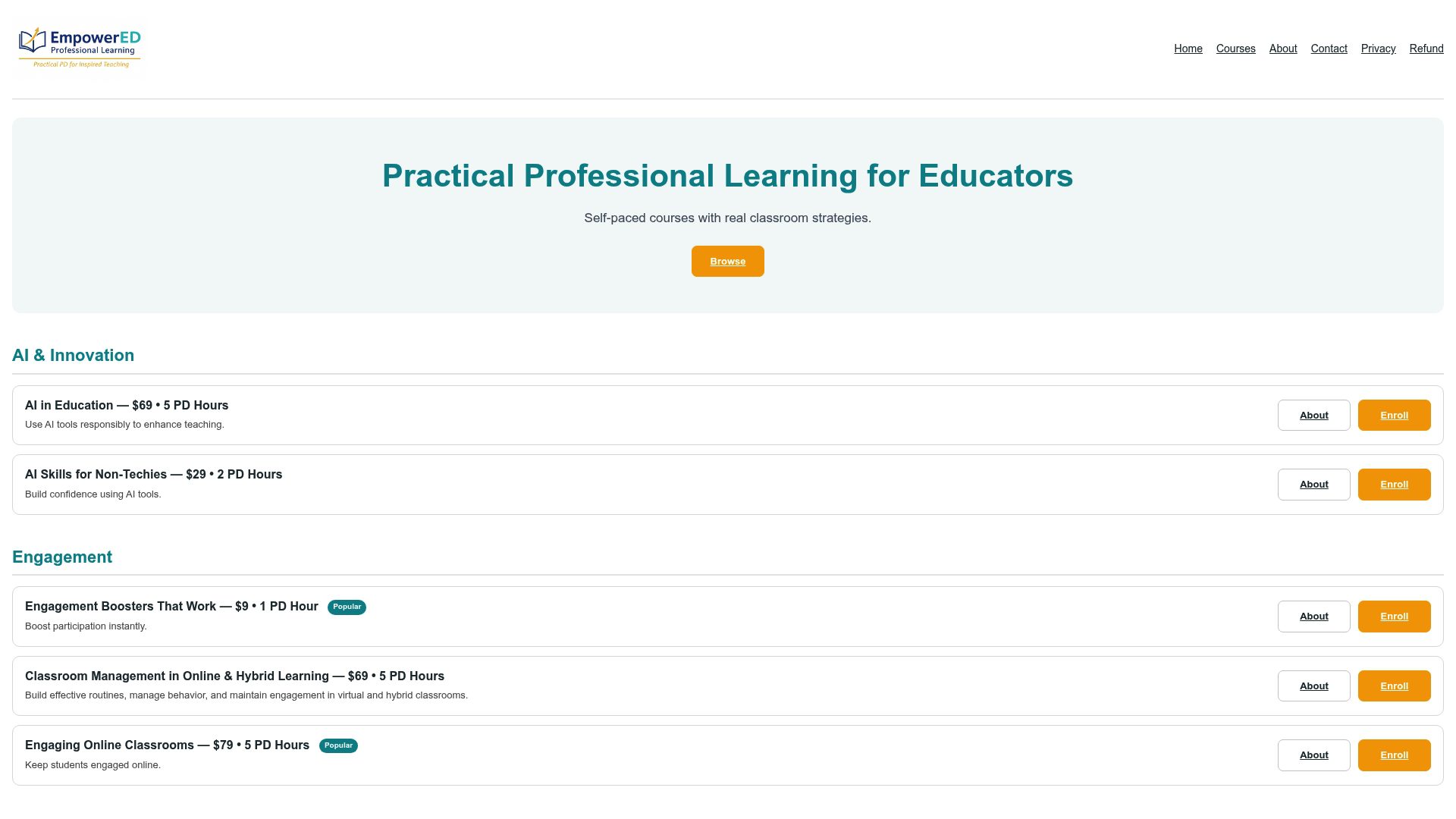
Reading about chunking and DRC templates is one step. Practicing them with feedback is another. EmpowerED’s Universal Design for Learning (UDL) & Accessibility course and the free Engagement Boosters That Work course both give ready-to-use classroom templates built around the strategies above. Enroll individually, or license courses for your whole team through the full professional learning catalog if your school wants a shared approach across classrooms.
Sources
Bring the CDC classroom guidance and the OCR Section 504 letter to any IEP or 504 meeting.
- CDC — ADHD in the Classroom
- U.S. Department of Education — Dear Colleague Letter: Know your rights under Section 504 (ADHD)
- IES/WWC — Enhancing the effectiveness of special education programming using a Daily Report Card
FAQ
What is the 10-3 rule for ADHD kids?
The 10-3 rule is a classroom pacing guideline suggesting 10 minutes of instruction followed by a short 3-minute movement or break period. It is not a formally established clinical standard, so treat it as one practical pacing option rather than a fixed rule, and adjust the ratio to what keeps a specific student engaged.
What can I do if my child with ADHD refuses to go to school?
Start by identifying whether school refusal stems from academic frustration, social anxiety, or an unmet accommodation need, since the response differs for each. A conversation with the school’s 504 coordinator or IEP team, alongside the student’s healthcare provider, helps determine whether current supports need to change before attendance becomes a bigger problem.
How can teachers help students with ADHD?
Teachers can combine environmental adjustments, chunked and multimodal instruction, organizational scaffolds, and consistent behavioral feedback such as a Daily Report Card. The CDC recommends treating these classroom strategies as part of the student’s overall treatment plan rather than optional extras.
How does ADHD affect academic performance?
ADHD affects academic performance primarily through difficulties with sustained attention, working memory, and task completion rather than through a lack of ability. These executive function challenges tend to show up most in assignments requiring multiple steps, sustained focus, or self-directed organization, which is why organizational and instructional accommodations carry so much weight in classroom support plans.