AI bias is real in schools, and it already produces unequal outcomes in areas such as e-proctoring, automated feedback, and placement algorithms. Students with disabilities and students from marginalized racial groups face documented risks from flawed tools used in high-stakes decisions. Educators, administrators, and researchers can detect and reduce these harms with practical auditing steps and informed procurement choices, starting this school year.
TL;DR:
- AI tools in schools exhibit representation, measurement, aggregation, and feedback-loop biases that can worsen disparities for students with disabilities or from marginalized racial groups.
- Federal and state reports reveal that AI application in e-proctoring, grading, and placement often disproportionately harms students with darker skin tones, disabilities, or lower income backgrounds.
- Bias primarily accumulates through training data, model objectives, deployment environments, and feedback loops, highlighting the need for thorough, repeated audits by educators without requiring technical expertise.
- School leaders must enforce transparency in AI procurement, require regular fairness audits, and document compliance with civil rights laws to mitigate legal and ethical risks.
- Simple, classroom-friendly bias detection methods involve pairing student profiles and prompts, recording outcomes, and sharing findings with administrators to prevent harm effectively.
Table of Contents
- What AI bias means for student equity
- Evidence: what recent research and federal reports found
- How bias gets built into classroom AI tools
- Civil rights risks school leaders cannot ignore
- How to audit AI tools before and after adoption
- Reducing bias in classrooms, curricula, and district decisions
- A procurement and policy checklist for school leaders
- What a first bias audit actually looks like in practice
- Building staff capacity with EmpowerED Professional Learning
- Sources
- FAQ
What AI bias means for student equity
AI bias occurs when a tool produces systematically different outcomes for different groups of students, not because of anything the students did, but because of how the system was built or deployed. Algorithmic discrimination is the legal and practical term for when that pattern crosses into unfair treatment based on race, disability, income, or another protected characteristic. Disparate impact describes a related idea: a policy or tool that looks neutral on its face but produces unequal results in practice, regardless of intent.
Schools also need to watch for what researchers call the hidden curriculum in AI, the unstated assumptions and cultural defaults baked into a tool’s training data and design choices that shape what students see as normal or correct.
A few patterns show up repeatedly in classroom AI tools:
- Representation bias, where training data underrepresents certain dialects, disabilities, or cultural contexts.
- Measurement bias, where a proxy (like typing speed or eye movement) stands in poorly for the thing actually being assessed, like understanding or honesty.
- Aggregation bias, where a model tuned for the “average” student performs worse for those who differ from that average.
- Feedback-loop bias, where a flawed early decision (like a placement score) shapes the data that trains future versions of the tool.
Civil rights and equity frameworks give schools the right lens because these are not abstract technical glitches. They determine who gets flagged for cheating, who gets tracked into remedial classes, and whose writing gets graded fairly. The U.S. Department of Education Office for Civil Rights has made clear that existing civil rights law applies fully to decisions made or informed by AI, which means a biased algorithm carries the same legal exposure as a biased human decision.
Evidence: what recent research and federal reports found
The evidence is no longer speculative. A 2024 U.S. Commission on Civil Rights report found that e-proctoring programs have repeatedly failed to authenticate students with darker skin tones and have disproportionately flagged neurodivergent students for behaviors like looking away from the screen or fidgeting, treating ordinary variation as suspicious.
A 2025 peer-reviewed analysis found significant bias across nine state-of-the-art large language models when generating educational content, with the largest gaps appearing along income and disability status. The ACL findings paper measured this bias across roughly 17,000 educational explanations and topics, meaning the pattern held across a wide range of subjects rather than a handful of edge cases.
These findings matter because the tools involved are already in classrooms, not in a lab:
- E-proctoring software flags students unevenly during high-stakes exams, based on skin tone and disability status.
- LLM-generated feedback and explanations vary in quality depending on a student’s inferred income level or disability status.
- Placement and grading algorithms trained on historical data can replicate the same tracking patterns that civil rights advocates have challenged for decades in human-run systems.
State and district-level incidents echo these federal findings. Districts piloting automated essay scoring have reported inconsistent grades for English language learners, and some AI-assisted attendance or behavior-tracking systems have drawn parent complaints for flagging students with IEPs at higher rates than their peers. These are not isolated software bugs. A longer USCCR synthesis of federal and state reports makes a consistent point: AI can help and harm at the same time, and the difference usually comes down to whether a school required transparency and oversight before adoption.
For educators building a case to their leadership, these findings are citable, specific, and recent enough to matter in a 2026 procurement conversation.
How bias gets built into classroom AI tools
Bias rarely enters a system through a single bad decision. It accumulates across four stages, and knowing where to look helps educators ask sharper questions of any vendor or tool.
- Training data reflects history, not fairness. A model trained on past grading patterns, disciplinary records, or admissions data will reproduce whatever inequities existed in that historical record.
- Objective and label choices quietly encode values. A model trained to predict “time to graduation” or “risk of dropping out” makes assumptions about what counts as success, and those assumptions are rarely neutral across student populations.
- Deployment context changes outcomes. A proctoring tool calibrated on a narrow set of faces or lighting conditions will behave differently in a classroom with diverse skin tones, older webcams, or shared home internet.
- Feedback loops compound small errors. Once a biased placement score sends a student into a lower track, the data generated from that placement reinforces the original error the next time the model is retrained.
Human and organizational factors sit underneath all four stages. Teams that build or select these tools often lack special education teachers, English language development specialists, or families from the communities most likely to be affected, and that absence shows up in what the tool never gets asked to handle well. Bringing those voices in earlier is one of the more reliable ways to catch a problem before it reaches a classroom.
Civil rights risks school leaders cannot ignore
Biased AI outputs do not stay contained to a single tool. They influence placements, grading, discipline referrals, and access to advanced coursework, often in ways that are hard to trace back to the algorithm once a decision has been made.
OCR guidance issued in November 2024 states plainly that AI tools used in schools must align with federal civil rights laws, and that existing nondiscrimination obligations apply directly to AI-driven decisions, not just to human ones. A district cannot treat an algorithm as a shield against Title VI or disability-rights obligations.
Leaders should watch for these risk patterns:
- A tool that disproportionately flags students with disabilities for academic integrity violations, as documented in e-proctoring cases.
- A placement or tracking algorithm that mirrors historical segregation patterns in advanced course enrollment.
- A vendor that cannot explain, in plain language, what data trained its model or how it was tested for disparate impact.
- A pilot that launches without a clear plan for handling parent complaints or appeals related to an automated decision.
The lesson from federal reporting is not that schools should avoid AI. It is that oversight, documentation, and a willingness to pause a tool when the data shows disparate impact are now baseline expectations, not optional extras.
How to audit AI tools before and after adoption
Detecting bias does not require a data science degree. It requires a structured process that a teacher, coach, or curriculum team can run in an afternoon and repeat every semester.
- Set a testing goal. Decide what you are checking: grading consistency, tone of feedback, or accuracy of generated content across student profiles.
- Build paired prompts. Submit near-identical assignments or profiles that differ only in one variable, such as a name associated with a different racial group or a stated disability.
- Record outputs side by side. Use a simple rubric that scores presence or absence of stereotypes, factual accuracy, and tone, so results are comparable rather than just impressions.
- Run a demographic stress test. Vary student writing samples across dialects, reading levels, and cultural references to see whether feedback quality holds steady.
- Document and escalate. Share specific examples, not general complaints, with the vendor and your district’s procurement office, and ask for a written response.
Structured end-user auditing has been shown to improve students’ ability to identify and document bias in AI outputs, and the same scaffold works well for adult educators running their own audits. Treating end-user auditing as pedagogy has a double benefit: it protects students now and teaches them a skill they will need for the rest of their working lives. Our guide on evaluating AI-generated classroom content walks through a version of this checklist teachers can use tomorrow.
Pro Tip: Run your first audit on a tool you already trust. Finding even one inconsistency there builds the habit of checking before it matters on a high-stakes tool.
A short pilot audit can run on a two-to-three-week timeline: one week to design paired prompts and a rubric, one week to collect outputs from a small group of students or staff, and a final few days to compile findings into a one-page summary for leadership.

Reducing bias in classrooms, curricula, and district decisions
Mitigation works best as a layered effort, with different actions at the classroom, curriculum, and district level.
At the classroom level, AI literacy and ethical thinking belong in the lesson plan, not a separate unit. Teaching students to question an AI tool’s output, the way they would question a biased textbook passage, builds measurable skill in recognizing AI harms over the course of a semester. Universal Design for Learning principles help here too: offering multiple ways for students to demonstrate understanding reduces the chance that a single biased scoring method determines a grade.
- Pair any AI-generated feedback with a human review step before it affects a grade.
- Adjust rubrics to flag when AI-assisted scoring diverges from a teacher’s independent judgment.
- Build short AI-literacy check-ins into existing lessons rather than adding a separate course load.
- Rotate which student work gets manually reviewed so bias patterns surface over time instead of hiding in aggregate data.
At the procurement level, districts should expect more from vendors than a demo and a sales pitch. Contracts should require transparency about data provenance, periodic fairness-audit reports, and a documented remediation timeline when a problem is found rather than a vague promise to “look into it.” State guidance from Oregon’s Department of Education-for-k-12-schools.aspx) models language districts can adapt directly into their own request-for-proposal documents.
Technical remediation, like diversifying training data or constraining a model’s outputs, helps, but researchers studying the hidden curriculum in generative AI are clear that technical fixes alone are not enough. Co-design with local educators, families, and students from the communities most likely to be affected catches problems that a data science team working in isolation will miss.
Pro Tip: Before adopting a new AI tool district-wide, ask the vendor for one specific example of how they tested it for disparate impact. A vague answer is itself useful information.
Our practical guide for K-12 teachers collects classroom-ready examples of these adjustments in action, and the broader guide for educators covers how to localize and audit AI systems as a team rather than alone.
A procurement and policy checklist for school leaders
A responsible AI pilot needs a paper trail, not just good intentions. The checklist below reflects the baseline that federal guidance and state toolkits now expect.
- Require a written data provenance statement from every vendor before a contract is signed.
- Confirm the tool aligns with FERPA and COPPA before any student data is entered.
- Build in a clear path for OCR reporting and nondiscrimination review if a complaint arises.
- Require periodic fairness-audit reports and a remediation timeline as a contract clause, not an informal promise.
- Name specific staff roles (a data privacy lead, a special education representative, a family liaison) responsible for the pilot’s oversight.
| Checklist item | Who owns it | When it happens |
|---|---|---|
| Data provenance statement | Procurement office | Before contract signing |
| FERPA/COPPA compliance review | Data privacy lead | Before pilot launch |
| Fairness-audit reporting clause | Legal/procurement | Written into contract |
| Complaint and OCR reporting path | Administrator | Before pilot launch |
| Pilot documentation and review | Instructional coach | End of pilot period |
A pilot guide for K-12 leaders can help structure this timeline in more detail, particularly for districts running their first formal AI pilot this year.
What a first bias audit actually looks like in practice
Running a first bias audit rarely looks like the case study you imagine. It looks like two colleagues sitting with a laptop after school, feeding a grading tool the same essay with two different names attached, and being surprised by how much the feedback tone shifted.
Time and staffing are the real constraints, not technical skill. Most schools do not have a data scientist on staff, and they do not need one. A single instructional coach with an afternoon and a simple rubric can surface patterns worth escalating. The realistic expectation for a first semester is not a perfect audit system. It is one documented finding, shared with leadership, that changes how the next tool gets adopted.
— Brian Koster, Ed.D.
Building staff capacity with EmpowerED Professional Learning
Understanding AI bias is the first step. Building the skill to catch it before it reaches students is what turns a policy document into daily practice, and that is where targeted professional development pays off faster than a district-wide mandate alone.
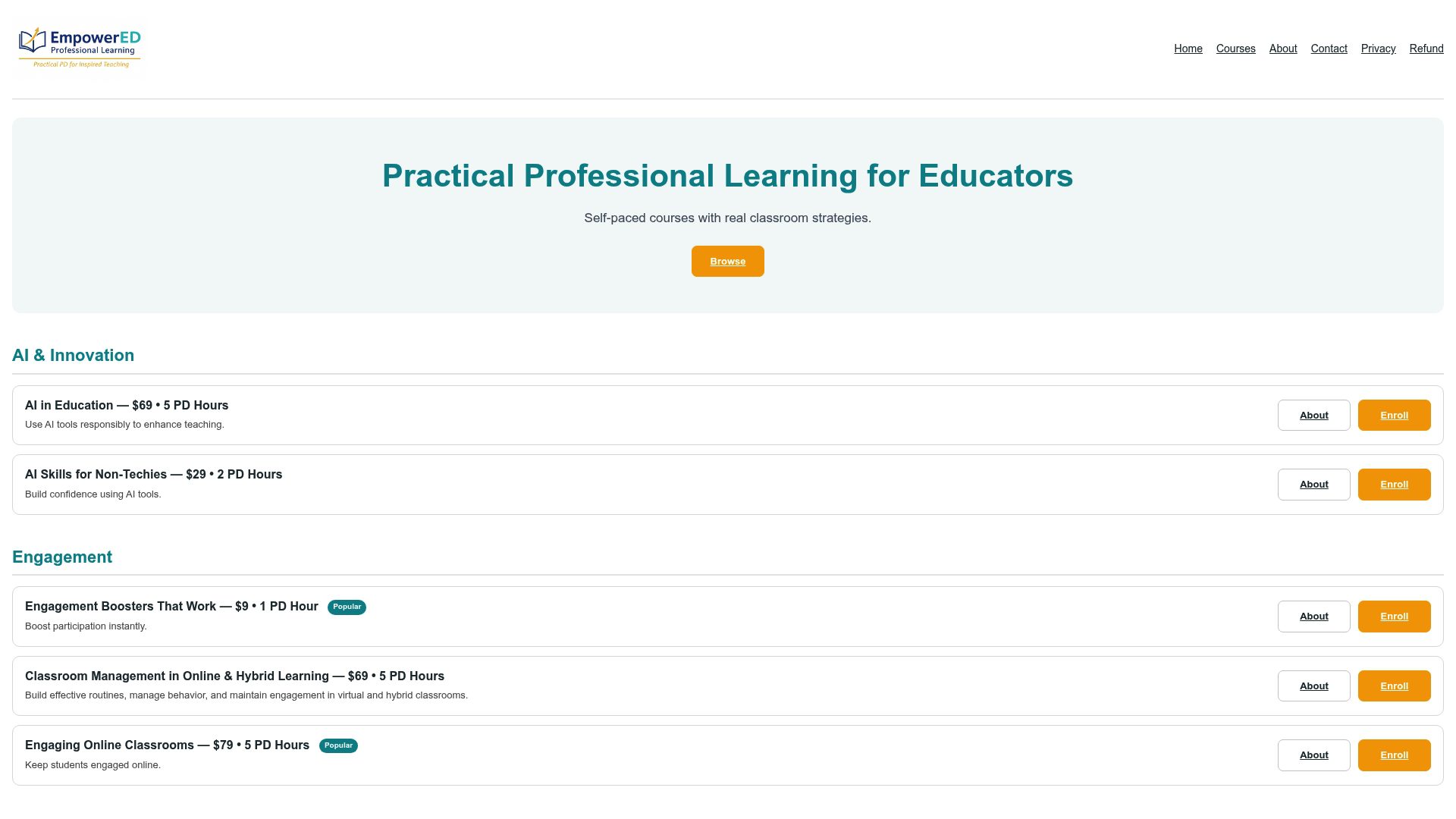
AI in Education: From Basics to Ethical Integration gives teachers a grounded starting point for the ethics and equity questions this article raises. Spot the AI: Evaluating AI-Generated Classroom Content builds the exact end-user auditing skill described above, and is available through our free courses page. For leaders building broader data confidence across a staff, Data Literacy for Teachers rounds out the skill set at $79 one-off.
- Courses are self-paced, allowing teachers to complete them around a full teaching schedule.
- Districts can license courses in bulk for entire teams rather than enrolling staff one at a time.
- Some courses may qualify for PD credit, offering staff credentials alongside classroom-ready skills.
Visit our full professional learning catalog to build a PD package that matches your school’s pilot timeline.
Sources
These are the primary reports and guidance documents behind the claims in this article, useful for citing in a staff meeting or a board presentation.
- The Rising Use of Artificial Intelligence in K-12 Education (USCCR, 2024)
- Avoiding the discriminatory use of artificial intelligence (U.S. Department of Education, OCR, 2024)
- User studies on student engagement and auditing LLMs (NSF / conference paper)
FAQ
What is an example of AI bias in a classroom setting?
A well-documented example is e-proctoring software that fails to authenticate students with darker skin tones or flags neurodivergent students for common behaviors like looking away from the screen. The USCCR has documented this pattern directly, and it is one of the clearest cases of AI bias affecting real students during high-stakes assessments.
Why is AI use controversial in schools right now?
AI use in schools raises concerns because biased outputs can affect grading, placement, and discipline decisions without clear accountability for how those decisions were made. Federal guidance now confirms that existing civil rights protections apply to these AI-driven decisions, which raises the stakes for districts adopting new tools without a review process.
Is it ethical for students to use tools like ChatGPT for schoolwork?
Ethical use depends on transparency, purpose, and oversight rather than a blanket yes or no answer. Because research shows large language models can produce biased educational content depending on a student’s inferred background, schools benefit from teaching students to critically evaluate AI output rather than simply banning or permitting the tool outright.
How can teachers start reducing AI bias without extra staff or budget?
A single teacher or instructional coach can run a basic paired-prompt audit using tools already in use, comparing outputs across different student names or profiles to spot inconsistencies. Pairing this with a human review step before any AI-assisted grade or recommendation becomes final catches most of the harm the USCCR and OCR guidance describe, without requiring new hires or software.
What should districts require from AI vendors before adopting a new tool?
Districts should require a written data provenance statement, periodic fairness-audit reporting, and a clear remediation timeline written into the contract itself. State guidance from Oregon offers language districts can adapt for their own procurement documents, giving leaders a starting point instead of drafting these clauses from scratch.