AI in education is the application of artificial intelligence technologies to personalize learning, strengthen teaching practice, and support administrative efficiency in K-12 classrooms. Tools like Grammarly, Colleague AI, and Llearn now give educators concrete ways to differentiate instruction, provide real-time feedback, and meet the needs of diverse learners without adding hours to an already full workday. A 2026 meta-analysis found that generative AI produces effect sizes of d = 0.74 for higher-order thinking and d = 0.59 for cognitive engagement, both statistically significant at p < .001. Those numbers signal a shift that every K-12 teacher and school administrator needs to understand. This guide delivers research-backed, practical insights on how to use AI responsibly to increase classroom engagement and support every learner.
How does AI in education improve teaching and learning outcomes?
Artificial intelligence in learning does more than automate grading or generate quiz questions. The 2026 meta-analysis cited above confirms that generative AI outperforms traditional digital learning approaches on higher-order thinking skills. That means students using AI-supported instruction are more likely to analyze, evaluate, and create rather than simply recall facts. For K-12 educators, this is the most important finding in recent education research.
One of the clearest benefits of AI in education is multimodal content transformation. AI-driven platforms that convert textbook content into dynamic visual and audio formats produce significantly better recall and self-efficacy compared to standard textbooks, based on an experimental study with 60 students. A student who struggles with dense text may fully grasp the same concept when it is presented as an annotated diagram with audio narration. That flexibility is what AI for personalized learning actually looks like in practice.

AI also changes how feedback reaches students. Instead of waiting until a paper is returned, students receive immediate, specific guidance on their writing or problem-solving process. This scaffolded feedback loop supports learner autonomy and reduces the gap between instruction and mastery.
Key benefits educators report from AI tools for education include:
- Personalized pacing: Students move through content at a rate matched to their demonstrated understanding.
- Differentiated support: AI identifies gaps and adjusts practice tasks without requiring the teacher to manually track every student.
- Reduced administrative load: Automated attendance, progress reports, and formative data summaries free up teacher time for direct instruction.
- Increased engagement: Interactive, multimodal content holds attention longer than static materials.
Pro Tip: Start with one AI tool that addresses your most pressing classroom challenge, such as formative feedback or reading differentiation, before adding more. Depth of use matters more than breadth.
What pedagogical frameworks best support AI integration?
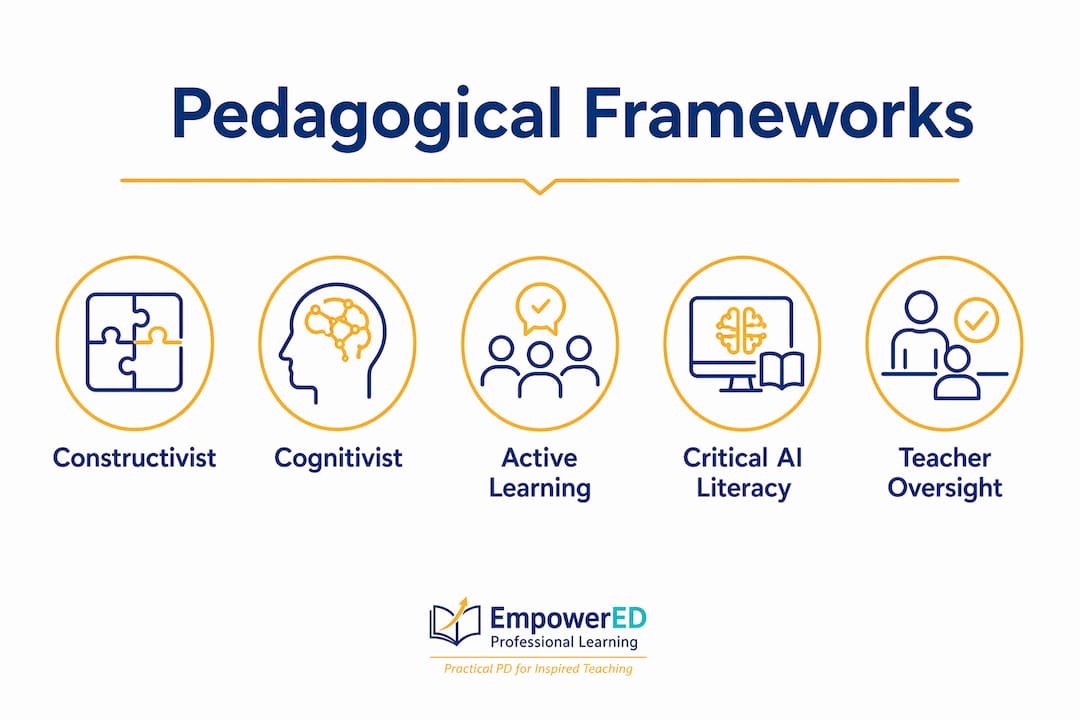
The role of AI in education is most effective when it aligns with how students actually learn. Three frameworks are especially relevant: constructivism, cognitivism, and connectivism. Constructivism holds that learners build knowledge through active experience. Cognitivism focuses on mental processes like memory, attention, and problem-solving. Connectivism describes learning as the formation of networks across people, tools, and information sources.
A synthesis of 50 reviews found that AI tools aligned with constructivist and cognitivist pedagogies facilitate active knowledge construction and improve problem-solving skills. AI functions as a scaffold in these frameworks, not a replacement for thinking. When a student uses an AI writing assistant to identify logical gaps in an argument, that is constructivism in action. When an AI tutor breaks a math problem into sequential steps, it supports the cognitive load management that cognitivism recommends.
Stanford education researcher Victor Lee argues that AI literacy belongs in curricula through open discussion about bias, privacy, and ethical implications rather than treating AI as an isolated problem. This perspective reinforces the idea that AI integration is a pedagogical decision, not just a technology decision.
The risk educators must watch for is the enhancement-dependence paradox. Over-reliance on AI can weaken student cognitive skills over time if the tool does too much of the thinking. Design-based approaches recommend gradually reducing AI support as student competence grows, which mirrors the gradual release model most K-12 teachers already use.
Pro Tip: Map your AI tool use to a specific learning objective before deploying it. Ask: “Does this tool require students to think, or does it think for them?” That single question will guide better instructional decisions.
The practical implication is clear. AI applications in classrooms work best when teachers remain the instructional decision-makers and use AI to extend their reach, not to hand off responsibility for learning.
How can schools ensure ethical and equitable AI adoption?
Responsible AI adoption in schools requires more than selecting a reputable platform. It requires institutional frameworks that protect student data, address bias, and maintain transparency. The LITE-Ed five-layer model, synthesized from 58 studies, recommends prioritizing transparency, explainability, and privacy-preserving mechanisms as foundational requirements for classroom AI.
Data privacy is non-negotiable. Schools in the United States must comply with FERPA and COPPA, while schools serving students in the European Union must also address GDPR requirements. Any AI platform used with minors must clearly document what data it collects, how it is stored, and who can access it. Platforms like Colleague AI and Llearn are designed with these constraints in mind, offering curriculum-aware AI that operates within school privacy controls.
Steps for building an ethical AI adoption policy:
- Audit current tools. Identify every AI-adjacent platform already in use, including reading apps, adaptive math programs, and communication tools.
- Evaluate data practices. Require vendors to provide a clear data processing agreement before deployment.
- Establish transparency norms. Students and families should know when AI is involved in instructional or assessment decisions.
- Address equity gaps. Confirm that AI recommendations do not systematically disadvantage students based on race, language, disability status, or socioeconomic background.
- Review regularly. Set a calendar date each semester to reassess tools against updated district policy and emerging research.
The following comparison illustrates how general-purpose and education-specific AI platforms differ on key ethical criteria:
| Criteria | General-purpose AI | Education-specific AI |
|---|---|---|
| Data privacy compliance | Varies by vendor | Designed for FERPA/COPPA |
| Curriculum alignment | None | Built-in |
| Audit trails | Rarely available | Standard feature |
| Bias mitigation | Inconsistent | Actively monitored |
| Offline capability | Rarely supported | Available (e.g., Llearn) |
Pro Tip: Before approving any AI tool for classroom use, run it through your district’s data privacy checklist. If no checklist exists, creating one is the first step.
What challenges do educators face when implementing AI tools?
Practical AI implementation in K-12 schools involves more than downloading an app. General-purpose chatbots lack the instructional context, rostering, and audit trails required for effective K-12 deployments. A tool built for general consumer use does not know your curriculum, your students’ IEP goals, or your district’s pacing guide. That gap creates real administrative and instructional risk.
Connectivity is another barrier. Many schools, particularly in rural and under-resourced districts, face unreliable network access. Offline AI capabilities are vital to mitigate connectivity barriers, and platforms like Llearn run curriculum-aware AI locally to address school network issues without sacrificing AI benefits. This matters because equitable access to AI tools cannot depend on a stable broadband connection.
Teacher AI literacy is the most frequently overlooked implementation challenge. Teacher-focused AI literacy development is required to avoid dependency and to use AI tools as part of a scaffolded learning progression. A teacher who does not understand how an AI recommendation is generated cannot evaluate whether it is appropriate for a specific student. Professional development must address this gap directly.
Practical considerations for successful AI deployment include:
- Choose education-specific platforms that integrate with your LMS, student information system, and curriculum maps.
- Pilot before scaling. Test one tool with one class before a school-wide rollout.
- Build in human oversight. Human-in-the-loop systems combining AI with traditional pedagogy address accuracy issues, cultural sensitivity, and learner autonomy in ways that fully automated systems cannot.
- Train teachers first. No AI tool performs well in the hands of an unprepared educator.
- Monitor outcomes continuously. Track whether the tool is producing the learning gains it promises, and be willing to discontinue it if it is not.
Pro Tip: Ask your AI vendor for a sample audit trail before signing a contract. If they cannot show you how student interactions are logged and reviewed, that is a significant red flag for K-12 use.
Key takeaways
AI in education produces measurable gains in higher-order thinking and engagement when it is embedded in sound pedagogy, governed by clear ethical frameworks, and supported by ongoing teacher professional development.
| Point | Details |
|---|---|
| AI improves learning outcomes | A 2026 meta-analysis shows effect sizes of d = 0.74 for higher-order thinking with generative AI. |
| Pedagogy must guide AI use | Constructivist and cognitivist frameworks keep AI in a scaffolding role rather than replacing student thinking. |
| Ethics and privacy are non-negotiable | Schools must verify FERPA and COPPA compliance and use platforms with transparent data practices. |
| Education-specific tools outperform general AI | Platforms with curriculum alignment, rostering, and audit trails reduce administrative and privacy risk. |
| Teacher AI literacy drives success | Professional development focused on AI literacy is the single most important implementation factor. |
What I’ve learned from watching schools get AI wrong and right
By Brian Koster, Ed.D.
After years of watching technology initiatives cycle through schools, I have one consistent observation: the tools that stick are the ones teachers understand well enough to push back on. AI is no different. The schools that are seeing real gains are not the ones that handed every student a chatbot. They are the ones where teachers asked hard questions about what the tool actually does, tested it against their own instructional goals, and made deliberate choices about when to use it and when not to.
The enhancement-dependence paradox is real, and I think it is underappreciated. When AI does the cognitive heavy lifting, students get the answer but miss the learning. The fix is not to avoid AI. It is to design tasks where AI is a thinking partner, not a shortcut. That requires teachers who understand the difference, which is why professional development on AI literacy is not optional.
I am genuinely optimistic about what AI unlocks for students who have historically been underserved by one-size-fits-all instruction. Multimodal content, personalized pacing, and real-time feedback can reach learners that traditional instruction misses. But that potential is only realized when educators lead the process with clear pedagogical intent and a willingness to monitor outcomes honestly.
The educators who will get the most from AI are the ones who treat it the way they treat any other instructional resource: with professional judgment, ongoing reflection, and a commitment to student outcomes above all else.
— Brian Koster, Ed.D.
Take the next step with Empoweredpl
Knowing the research is one thing. Applying it in your classroom is another. Empoweredpl offers targeted professional learning designed specifically for K-12 teachers and administrators who want to use AI responsibly and effectively.
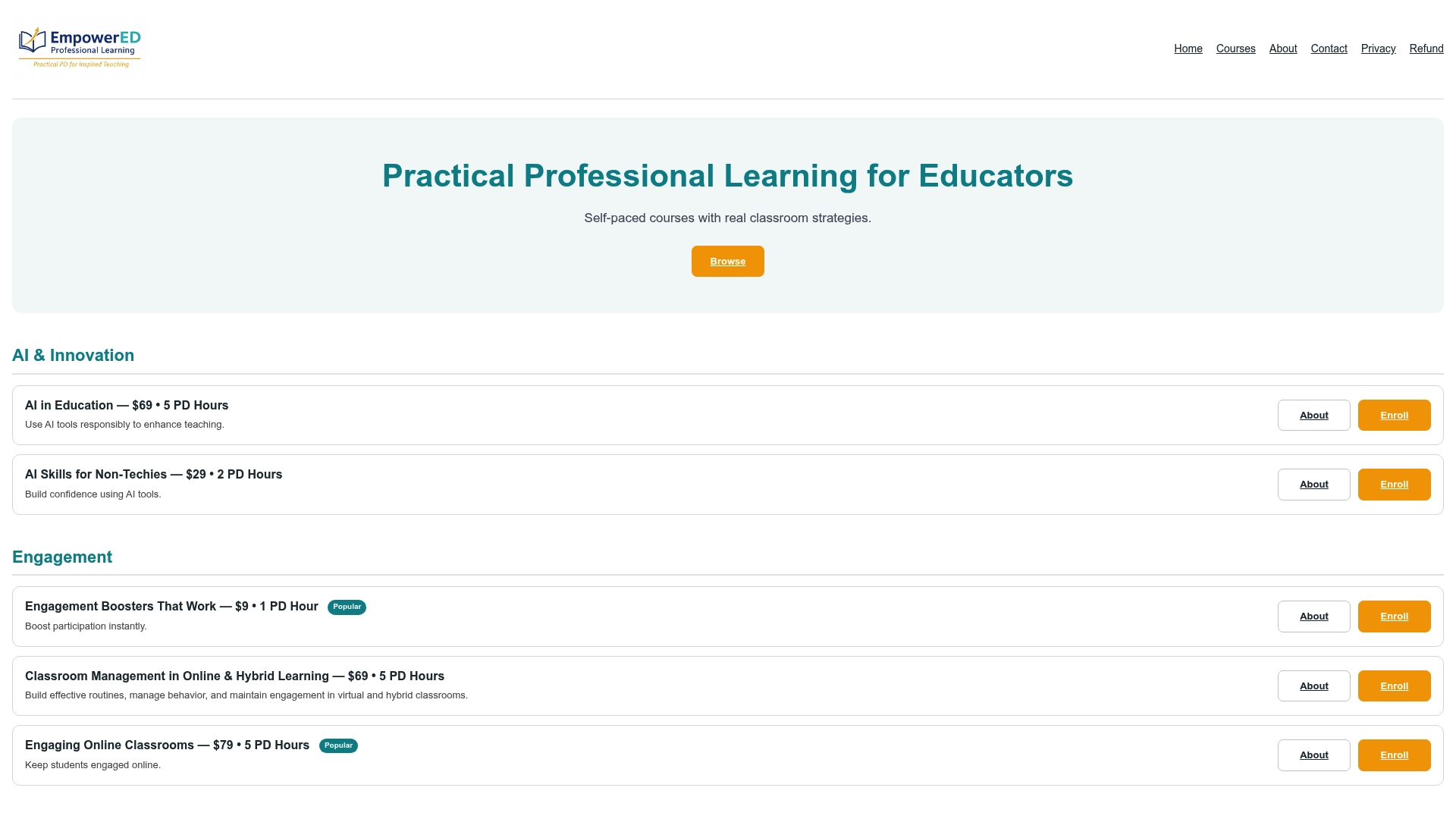
The Hybrid Learning Routines and Procedures course gives you a practical framework for embedding AI tools into existing classroom structures without disrupting what already works. Empoweredpl courses are built around real classroom challenges, not theoretical frameworks, so you leave each session with strategies you can use immediately. Explore the full suite of professional learning offerings and find the course that fits your most pressing instructional need right now.
FAQ
What is AI in education?
AI in education is the use of artificial intelligence technologies to personalize instruction, automate administrative tasks, and support diverse learner needs in K-12 and higher education settings. Tools range from adaptive learning platforms to AI-powered writing assistants and real-time feedback systems.
What are the biggest benefits of AI for K-12 teachers?
The most documented benefits include improved higher-order thinking, personalized pacing, multimodal content delivery, and reduced administrative workload. A 2026 meta-analysis reported an effect size of d = 0.74 for higher-order thinking skills when generative AI was used in instruction.
How do schools protect student privacy when using AI tools?
Schools must verify that any AI platform complies with FERPA and COPPA before deployment, and require vendors to provide a clear data processing agreement. Education-specific platforms like Colleague AI and Llearn are designed with these compliance requirements built in.
Can AI replace teachers in the classroom?
AI does not replace teachers. Research consistently shows that human-in-the-loop systems, where teachers maintain oversight and instructional decision-making, produce better outcomes than fully automated approaches. AI is most effective as a tool that extends teacher capacity, not one that substitutes for it.
How should schools start with AI adoption?
Start with a single education-specific tool that addresses a clear instructional need, pilot it with one class, and invest in teacher professional development before scaling. Aligning AI use with existing curriculum goals and privacy policies from the start prevents the most common implementation problems.