The most effective approach combines predictable routines and visual schedules, sensory-accessible environments, Universal Design for Learning, and a handful of targeted evidence-based practices, all implemented with coaching and measured against real IEP goals. Start with three moves this week: build a visual schedule, run a 10-minute sensory audit of your room, and write one observable, measurable IEP objective. The NCAEP review backs every piece of this mix.
TL;DR:
- Implementing consistent visual supports and predictable routines significantly reduces daily stress for autistic students and improves classroom management for all learners.
- Conducting a sensory audit and making small, low-cost accommodations can prevent overload and enhance participation without the need for major renovations.
- Using measurable, observable IEP goals paired with simple fidelity checks and regular family updates ensures progress is trackable and meaningful.
- Applying universal design principles and offering multiple means of engagement and assessment creates a more inclusive environment that benefits every student.
- Focusing on coaching and small pilot programs over time builds sustainable change, avoiding overwhelm and ensuring strategies are properly implemented and adjusted.
Table of Contents
- Building Predictable Routines and Visual Supports
- Designing a Sensory-Accessible Classroom
- How Can Teachers Support Communication and Peer Interaction?
- Behavior Supports Without Exclusionary Discipline
- Applying Universal Design for Learning in Daily Lessons
- Turning IEP Goals Into Measurable Classroom Practice
- Building School Capacity Through Coaching and Professional Development
- A Quick-Start Toolkit for This Week
- What I’ve Learned Watching Schools Roll This Out
- Where EmpowerED Professional Learning Fits Into Your Plan
- Sources
- FAQ
Building Predictable Routines and Visual Supports
Unpredictability is one of the biggest daily stressors for autistic students, and it is also one of the easiest things a classroom can fix. A meta-analysis of interventions in inclusive settings found that teacher-delivered strategies, including visual supports, produce some of the largest positive effects of any intervention type studied. That is not a minor finding. It means the tools you already control, your schedule board, your transition cues, your daily structure, carry more weight than almost anything else you could add to the room.
Visual schedules work across every grade band, but the format should shift with age. In elementary classrooms, use picture-and-word cards on a Velcro strip, moved from “to do” to “done” as each activity finishes. In middle and high school, a written or digital block schedule with checkboxes serves the same function without feeling babyish. Center rotations benefit from a rotation wheel or numbered stations chart so the student sees exactly where to go next without asking.
Transitions deserve their own plan, since they are where most classroom disruptions start. Give a warning at five minutes, then two minutes, then a concrete verbal or visual cue at the moment of the switch. A simple script helps: “In two minutes we are cleaning up math and moving to reading. Here is your reading spot.” Pair the words with a visual timer whenever possible.
Work systems, borrowed from structured teaching approaches, break independent work into a clear left-to-right or top-to-bottom sequence: what to do, how much, and what happens when finished. A labeled bin system (First, Then, Finished) gives a student a physical answer to “how long is this going to take,” which is often the real source of anxiety behind refusal behavior.
A few starting points for building your own system:
- Use consistent icons or photos across all schedules so symbols don’t have to be relearned each year.
- Post a “first, then” board near transition-heavy areas like the door or the carpet.
- Build in a visual cue for unexpected changes (assembly, substitute, fire drill) rather than springing them verbally.
- Review the schedule with the student at the start of the day, not just when a transition arrives.
Pro Tip: Laminate a blank schedule template and use dry-erase markers so you can adjust it daily without reprinting. It takes thirty seconds and saves you from ever running out of a critical visual support mid-lesson.
Classroom routines built this way don’t just serve autistic students. Every student benefits from knowing what comes next, which is part of why predictable routines improve learning across an entire class roster, not just for the students they were designed for.

Designing a Sensory-Accessible Classroom
Sensory overload is often mistaken for defiance, and that misread costs students instructional time and costs teachers trust. A short audit fixes more than most people expect. Walk your room for ten minutes and note: buzzing lights, hallway noise bleeding through the door, clutter in sightlines, and any area with no low-stimulation option. Rate each on a scale of low, medium, or high disruption, then tackle the high items first.
Practical accommodations do not require a renovation budget:
- Noise-reducing headphones or earplugs available at a supply station, not just for one student.
- A lighting adjustment, lamps instead of overhead fluorescents, or a seat away from direct glare.
- Flexible seating options: a wobble stool, a corner desk facing away from foot traffic, or a standing option.
- A designated calm corner with soft seating, dim lighting, and one or two regulation tools, not a toy bin.
- Reduced visual clutter on walls near instructional areas.
That last point matters more than most sensory checklists suggest. Practitioner guidance on classroom design points to spatial sequencing, organizing the room by function with clear pathways and less visual noise, as more effective at reducing cognitive load than scattered calming items. A room with a dozen fidget tools and no clear walking path can be more disruptive than a room with none.
Before you swap out anything, map what the student already does to cope. Some existing coping behaviors, including stimming, actually support learning and shouldn’t be replaced just because they look unusual. Ask the student, a paraprofessional, or the family what already helps before introducing a new tool that might compete with a strategy that already works.
When a sensory accommodation moves from “thing I tried” to “thing that works,” document it in the 504 plan or IEP so it travels with the student across substitutes, grade levels, and staff turnover. Trial changes for one to two weeks with a single measurable outcome, on-task minutes, number of self-initiated breaks, or completed transitions, before deciding whether to keep, adjust, or drop it. That short trial window keeps you from committing to a fix that only worked because it was novel.

How Can Teachers Support Communication and Peer Interaction?
Lower the language load first, then build participation opportunities on top of that foundation. A choice board with three to five images lets a nonverbal or minimally verbal student answer “what do you want to work on” without needing to generate spoken language on demand. Choice boards, first/then boards, and visual menus work well for any student who needs extra processing time, not only those with a communication diagnosis.
When language support needs to go further than pictures, augmentative and alternative communication (AAC) becomes the tool of choice. Here is how that usually rolls out in a classroom:
- Coordinate with the speech-language pathologist first. AAC systems, whether a low-tech communication board or a dedicated device, need consistent programming and vocabulary across every setting the student moves through.
- Model the device, don’t just hand it over. Adults and peers narrate their own actions using the AAC system so the student sees it used naturally, not only during “communication time.”
- Build AAC into every subject, not just speech sessions. A student who only uses AAC during pullout therapy rarely generalizes it to math class or lunch.
- Check in with the SLP regularly on vocabulary updates. Interests change, units change, and the device needs to keep up.
Social narratives and video modeling round out the communication toolkit and both carry strong evidence behind them. A short social story, written from the student’s point of view, walks through a specific situation (a fire drill, a birthday party invitation, a change in bus route) and what to expect and do. Video modeling, showing a short clip of a peer or the student successfully completing a task, works especially well for multi-step routines like using the cafeteria line or asking to join a game.
Peer support only works when it is structured rather than assumed. Pairing a student with a “buddy” and hoping for organic friendship rarely produces real interaction. Structured peer-mediated approaches, where peers are taught specific ways to invite participation, wait for a response, and expand on it, show moderate-to-large effects in the same inclusive-settings meta-analysis referenced above. Build activities with a built-in reason to interact: a two-person art project, a partner reading task with defined roles, or a game with a simple turn-taking structure. Engagement grows out of structure, not proximity, and a classroom engagement guide can help you plan activities that create those genuine interaction points on purpose.
Behavior Supports Without Exclusionary Discipline
Behavior is communication, and the fastest way to reduce a challenging behavior is usually to change what comes before it, not to punish what comes after. Antecedent-based strategies mean looking at the environment, the instructions, the transition, the noise level, right before a behavior occurs and adjusting that trigger. A brief functional read doesn’t require a formal assessment: ask what the student is trying to get (attention, an escape from a task, a sensory need, access to an item) and adjust the antecedent to meet that need proactively.
Reinforcement systems work best when they are specific and immediate rather than vague praise at the end of the day. Differential reinforcement, rewarding a replacement behavior instead of the problem behavior, tends to outperform simply ignoring or punishing the unwanted action. If a student blurts out during instruction, reinforce hand-raising heavily and specifically rather than only reacting to the blurting.
A few reinforcement and redirection tactics worth building into your routine:
- Reinforce the replacement behavior immediately and specifically (“You raised your hand, that’s exactly right”).
- Use neutral, low-affect redirection for minor off-task behavior instead of a verbal reprimand that draws attention to it.
- Pair a token or point system with a visual tracker so progress is visible, not just verbal.
- Fade reinforcement gradually as the replacement behavior becomes consistent, rather than removing it abruptly.
Pro Tip: Keep a small index card with three “go-to” replacement behaviors for your most common challenges (blurting, leaving the seat, refusing a task). Having the plan written down before the moment happens keeps your response consistent under pressure.
Older students benefit from taking over more of this monitoring themselves. Self-management tools, a simple checklist for tracking on-task minutes, a self-rating scale filled out every fifteen minutes, or a graph the student updates independently, build the same skills that get harder to teach explicitly once a student ages out of elementary supports. These self-monitoring approaches show up as one of the intervention types with favorable outcomes in inclusive settings, and they carry the added benefit of building independence rather than adult dependence.
When behavior escalates beyond what antecedent adjustments and reinforcement can manage, exclusionary discipline, suspension, repeated office referrals, isolated timeout rooms, tends to remove the student from exactly the instruction and peer contact they need most. Restorative approaches, a structured conversation after the moment has de-escalated, focused on repair and re-entry rather than punishment, keep the student connected to the classroom community while still holding the behavior accountable. A resource on common barriers to neurodiverse student success walks through several of these alternatives in more depth if your school is building out a behavior framework from scratch.
Applying Universal Design for Learning in Daily Lessons
Universal Design for Learning rests on three principles: multiple means of engagement, multiple means of representation, and multiple means of action and expression. In plain classroom terms, that means giving students more than one reason to care about a lesson, more than one way to receive the content, and more than one way to show what they learned.
A lesson on the water cycle, for example, can offer a video with captions, a hands-on diagram-building activity, and a short reading passage, covering representation in three formats at once. For action and expression, let a student demonstrate understanding through a labeled diagram, a short oral explanation, or a written paragraph, rather than requiring the same essay format from every student regardless of writing fluency.
Several classroom techniques map directly onto the practice categories in NCAEP’s review of 972 studies, which identified 28 distinct evidence-based practice categories for autistic students:
- Video modeling supports both UDL representation and skill acquisition for multi-step tasks.
- Direct instruction with clear, explicit steps benefits students who need reduced ambiguity in new content.
- Technology-aided instruction, including tablets, interactive whiteboards, and text-to-speech tools, offers flexible access points built into UDL by design.
- Visual supports, already covered in your schedules and choice boards, double as a UDL representation strategy.
Flexible assessment closes the loop. Offer a choice between a written test, an oral response, or a project-based demonstration for the same learning objective, and grade against the same rubric regardless of format. This is not lowering the bar. It is separating what you are actually measuring (does the student understand the content) from an unrelated skill (can the student produce five paragraphs of prose under time pressure).
Embedding these practices into your regular lesson plan template, rather than treating them as a special add-on for one student, is what makes UDL sustainable. A course like Universal Design for Learning: Designing Accessible and Inclusive Learning Experiences walks through this planning process step by step if your team wants a structured path to building it into every unit rather than retrofitting lessons one at a time.
Turning IEP Goals Into Measurable Classroom Practice
An IEP goal only helps a student if it is written in a way you can actually observe and count. “Improve social skills” tells a teacher nothing about what to watch for on a Tuesday afternoon. “Initiate a peer interaction during three of five recess periods, with adult support fading over six weeks” gives you something you can track on a clipboard.
The Goal Attainment Scale (GAS) turns a single goal into a five-point scale, from “much less than expected” to “much more than expected,” so progress reads as a number rather than a vague impression. Here’s how a team typically builds one:
- Write the target goal at the center (score 0). This is the expected outcome by the review date.
- Define one level below and one level above (scores -1 and +1). What does slightly less progress look like? What does exceeding the goal look like?
- Add the extreme low and high anchors (-2 and +2). These capture “no progress at all” and “far beyond expectation.”
- Score the student at each progress check using the same five-point scale, which makes progress monitoring consistent across observers and time points.
Selecting which evidence-based practice to pair with that goal depends on both the student’s need and what your classroom can realistically sustain, an approach sometimes called technical eclecticism. A goal around independent transitions might pair best with a visual schedule and a self-monitoring checklist. A goal around initiating peer conversation might pair better with structured peer-mediated instruction and social narratives. IDEA requires that the practices you choose are evidence-based and tied to measurable progress toward FAPE, so this pairing step is not optional paperwork, it is the legal and instructional core of the plan.
Fidelity monitoring does not need to be a research-grade data system. A simple checklist, did I use the visual schedule today, did I deliver reinforcement within ten seconds of the target behavior, filled out for even three days a week gives you enough signal to know if a strategy is being implemented as designed.
Pro Tip: Send families a one-paragraph update after each data review, in plain language, not IEP jargon. “Sam initiated a conversation with a peer during 4 of 5 recess periods this week, up from 2 last month” builds trust faster than a quarterly report ever will.
Building School Capacity Through Coaching and Professional Development
Isolated training rarely changes classroom practice on its own. A meta-analysis of inclusive-setting interventions found that teacher-delivered strategies produce the largest overall effects of any intervention category studied, which means the return on investing in teacher skill and confidence outweighs almost any curriculum purchase or standalone tool.
The National Professional Development Center model offers a structure worth borrowing even if your school never adopts it formally: assess current classroom quality against a known standard, set specific and measurable goals, select evidence-based practices matched to those goals, then coach implementation with regular feedback rather than a single training day. Multi-state evaluations of this exact model found it increased teacher use of evidence-based practices, improved fidelity scores, and improved student goal attainment across the districts studied.
The strongest implementations don’t apply strategies in isolation or all at once. They follow a data-driven cycle: assess where the classroom stands, set a measurable goal, choose practices matched to that goal, and coach the follow-through. Training without coaching rarely survives contact with a real classroom.
A pilot doesn’t need to cover every classroom in a building at once. A few starting points for administrators and teacher leaders:
- Pick one grade team or one department to pilot a single new practice for a full quarter before scaling building-wide.
- Pair any new PD with a coaching check-in, even fifteen minutes every two weeks, rather than a one-time workshop.
- Match the PD topic to the actual gap: UDL for lesson design gaps, engagement-focused training for participation gaps, and AI literacy for teachers looking to build accessible materials more quickly.
- Track one simple fidelity or outcome measure across the pilot so the team has something concrete to report back.
Since autism prevalence means autistic students are present in nearly every elementary school, and many teachers report feeling underprepared without structured PD, building this coaching cycle into your school calendar is not an extra. It is the difference between strategies that get tried once and strategies that stick.
A Quick-Start Toolkit for This Week
You don’t need a full committee meeting to start. Pick one item from each category below and trial it before Friday.
Visual schedule starter: Laminate a five-slot strip (Now, Next, Then, Later, Done) with Velcro-backed icons. Use this transition script: “In two minutes we finish [activity] and move to [activity]. Here is your card.”
Sensory audit checklist, walk the room and note:
- Lighting sources and glare spots
- Ambient noise from hallways or HVAC
- Visual clutter near instructional focal points
- Availability of a low-stimulation retreat space
Three low-cost accommodations to trial first: noise-reducing headphones at a shared supply station, a seat reassignment away from high-traffic zones, and a designated calm corner with one regulation tool rather than several.
Sample GAS-scaled goal:
| Score | Description |
|---|---|
| +2 | Initiates peer interaction independently in 5 of 5 recess periods |
| +1 | Initiates peer interaction in 4 of 5 recess periods |
| 0 (target) | Initiates peer interaction in 3 of 5 recess periods with minimal prompting |
| -1 | Initiates peer interaction in 1 to 2 of 5 recess periods with adult prompting |
| -2 | No independent peer initiation observed |
Run any new accommodation as a one-week micro-trial with a single measurable outcome, on-task minutes or independent transitions completed, and a fidelity threshold before deciding to keep it. Log the result in a shared document your team can see, and share quick wins at your next grade-level or IEP meeting rather than waiting for a formal review.
What I’ve Learned Watching Schools Roll This Out
The schools that see real change rarely start with a school-wide mandate. They pilot one strategy with one team, coach it for a few weeks, and only then scale what actually worked. I’ve watched well-intentioned staffs try to implement six new supports across every classroom in September, and by October nothing has stuck because nobody had the bandwidth to check whether any of it was being used with fidelity.
Two mistakes show up again and again. The first is treating a visual schedule or sensory tool as a one-time fix rather than something to review and adjust every few weeks as the student’s needs shift. The second is skipping the measurable goal entirely and relying on gut feeling to judge whether a strategy is working, which makes it nearly impossible to know when to adjust course.
If you take one thing from this article, make it this: pick a single strategy, write down what you’ll measure, and give it two weeks before you judge it. Small, tracked changes beat sweeping, untracked ones every time.
— Brian Koster, Ed.D.
Where EmpowerED Professional Learning Fits Into Your Plan
Empowered Professional Learning is built for the exact gap this article keeps circling back to: teachers know these strategies matter but rarely get PD that translates directly into Monday morning lesson plans. Every course is designed and taught by working educators, focused on strategies you can apply the same week you take it, with personalized instructor feedback and a PD certificate you can log toward your requirements.
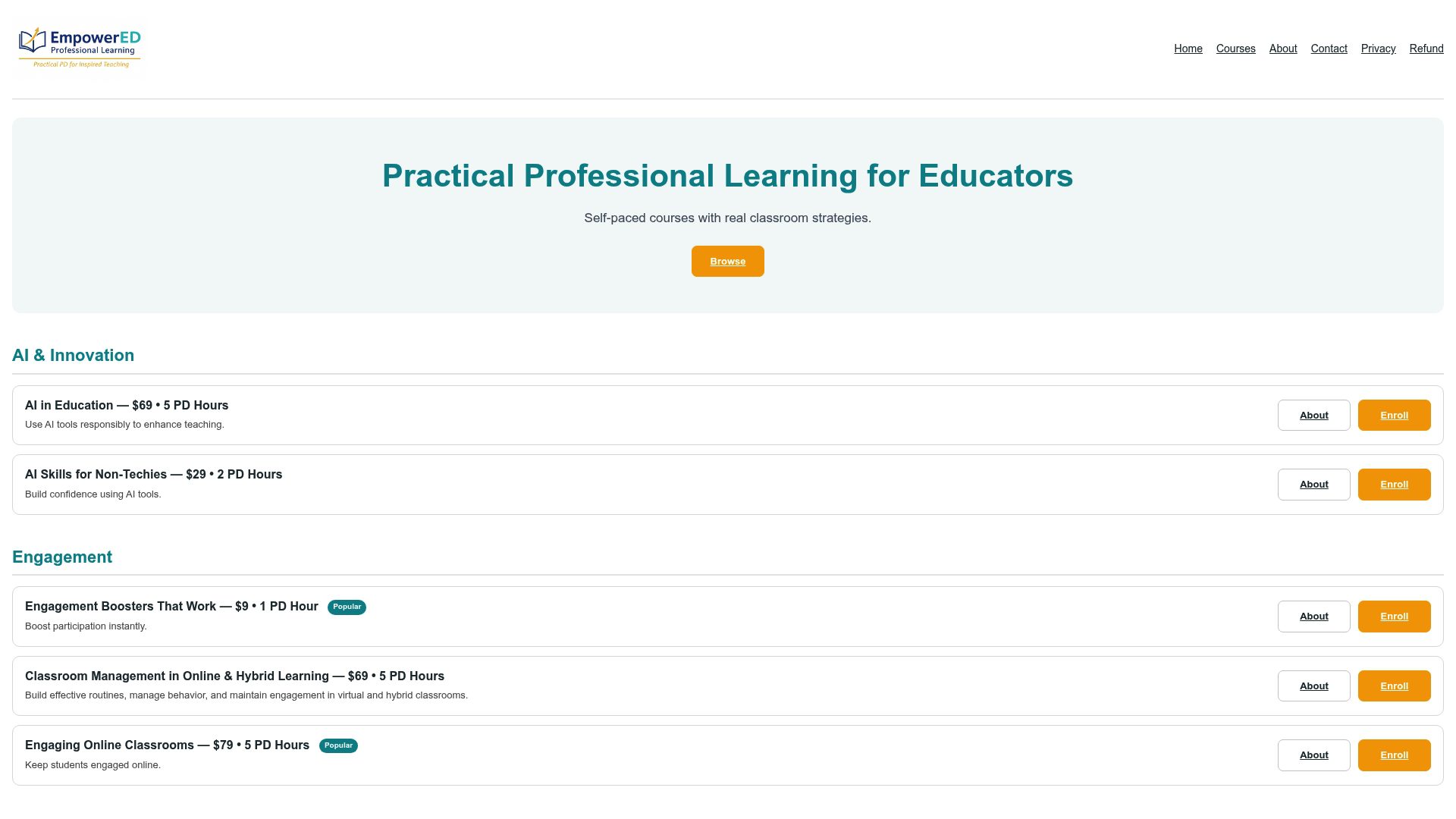
If UDL is your gap, Universal Design for Learning (UDL) & Accessibility walks through flexible representation, engagement, and assessment design for $79. If your priority is participation and reducing passive instruction, Engagement Boosters That Work targets exactly the kind of structured peer and classroom engagement strategies covered in this article. And for teams exploring how AI tools can help build accessible materials or draft differentiated content faster, AI in Education: From Basics to Ethical Integration covers that ground for $69.
Schools and districts building a pilot don’t have to buy course by course. The full professional learning catalog covers UDL, executive functioning, data literacy, and more, with licensing options for teams. Review the course syllabi on that page and request a demo to see how a pilot cohort could run at your school this semester.
Sources
These sources back the strategies covered above and are worth bookmarking for ongoing planning:
- Evidence-Based Practices for Autistic Students (NCAEP executive summary)
- Interventions for students with autism in inclusive settings: A best-evidence synthesis and meta-analysis
- Employing Evidence-Based Practices for Children with Autism in Elementary Schools
- Individuals with Disabilities Education Act (IDEA) guidance — US Department of Education
FAQ
What Is the 6-Second Rule for Autism?
The “pause rule” refers to waiting a short time after giving an instruction or asking a question before repeating it or intervening, giving an autistic student time to process the request. It’s a processing-time strategy, not a formal clinical term, and it pairs well with the visual supports and clear scripts covered earlier in this article.
How Do You Calm Down an Autistic Student Having a Meltdown?
Lower your voice, reduce sensory input (dim lights, quiet the room, clear the immediate space), and avoid physical touch or a barrage of questions. Offer a known regulation tool or the calm corner described in the sensory-accessible classroom section, and wait for the student to co-regulate before discussing what happened.
What Classroom Modifications Support Students With Autism?
Common modifications include visual schedules, sensory-friendly seating and lighting, choice boards, AAC access, extended processing time, flexible assessment formats under UDL, structured peer supports, and self-monitoring tools for older students. This article’s sections on routines, sensory design, communication, and UDL each cover a cluster of these in classroom-ready detail.
How Can I Teach an Autistic Child at Home?
The same core principles apply at home: predictable routines with visual supports, a sensory-friendly space, clear and consistent communication tools, and small, measurable goals reviewed regularly. Coordinating with the student’s school team and IEP goals, rather than running a separate plan, keeps home and classroom strategies aligned.
What Professional Development Helps Teachers Build These Skills?
Coaching-based PD that includes classroom assessment, goal-setting, and matched evidence-based practices produces the strongest results, according to multi-state program evaluations. Courses such as Universal Design for Learning (UDL) & Accessibility at $79 and Designing Lessons for Neurodiverse Learners at $29 give teachers a structured, applicable starting point.