Flipped classroom hybrid settings consistently deliver three measurable gains: higher student engagement during face-to-face sessions, stronger comprehension through self-paced content review, and deeper development of higher-order thinking skills. When educators shift direct instruction to pre-class video or reading, they reclaim in-person time for the collaborative, problem-centered work where real learning accelerates. Research supports this: a meta-analysis of 317 studies found flipped classrooms improve learning outcomes with effect sizes ranging from 0.20 to 0.53 compared to traditional lectures.
The core advantages of this model in hybrid environments include:
- Students access content anytime, accommodating diverse schedules and learning preferences
- In-class time shifts to active problem-solving, discussion, and peer collaboration
- Self-regulated learning and student autonomy develop through structured independence
- Instructors gain more time for targeted feedback and individual support
- Academic outcomes improve across disciplines and education levels, as confirmed by multiple meta-analyses
Table of Contents
- What is the flipped classroom model and how does it work?
- Which strategies and tools make hybrid flipped classrooms work?
- How do you solve the most common challenges in flipped hybrid classrooms?
- How to apply flipped classrooms effectively in hybrid environments
- Empowered Professional Learning supports flipped and hybrid teaching
- Empowered Professional Learning: your next step
- Key Takeaways
What is the flipped classroom model and how does it work?
The flipped classroom model reverses the traditional instructional sequence. Students engage with new content, typically through video lectures or readings, before class. Class time is then reserved for application, discussion, and collaborative problem-solving. This is not simply moving lectures to homework; it represents a full pedagogical shift toward learner-centered instruction.
The Flipped Learning Network defines this shift through the Four Pillars of F-L-I-P:
- Flexible Environment: Learning spaces and timelines adapt to student needs
- Learning Culture: The classroom becomes a space for active, student-driven inquiry
- Intentional Content: Educators identify which content students can explore independently and which requires guided interaction
- Professional Educator: Teachers observe, provide feedback, and facilitate rather than lecture
“Flipped Learning is a pedagogical approach in which direct instruction moves from the group learning space to the individual learning space, and the resulting group space is transformed into a dynamic, interactive learning environment where the educator guides students as they apply concepts and engage creatively in the subject matter.” — Flipped Learning Network
Metacognition sits at the heart of this model. Students who reflect on their own learning process, not just their test scores, develop the self-regulation skills that sustain academic performance over time. Visible learning, where both student and teacher can observe the learning process in real time, becomes possible when problem-solving moves into the classroom.
Which strategies and tools make hybrid flipped classrooms work?
Effective implementation depends on deliberate design choices, not just technology selection. The goal is to align every tool and activity with a clear pedagogical purpose.
- Concise pre-class videos: Keep instructional videos under 10 minutes. Shorter segments improve completion rates and reduce cognitive overload before class.
- Interactive online content: Embed quizzes, reflection prompts, and discussion boards within pre-class modules to confirm understanding before synchronous sessions.
- Synchronous engagement boosters: Use polls, breakout rooms, and collaborative documents during live sessions to maintain participation for both in-person and remote learners.
- Annotation and feedback tools: Platforms that allow students to comment on video content or shared documents support active processing of pre-class material.
- Multi-camera and audio setups: Annotation devices and multi-camera configurations improve visibility and engagement for remote students in hybrid flipped environments.
- Discussion boards for asynchronous depth: Structured online discussions extend the collaborative thinking that begins in class.
Pro Tip: Scaffold self-regulated learning explicitly. Before students can thrive in a flipped hybrid model, many need direct instruction on how to manage their time, monitor their comprehension, and seek help proactively. Build these skills into the first two weeks of any flipped course.
Aligning technology with pedagogy, rather than adopting tools for their own sake, is what separates effective hybrid flipped classrooms from ones that simply feel busy.

How do you solve the most common challenges in flipped hybrid classrooms?
Challenges in flipped classroom settings are real, and most fall into three categories: student readiness, access equity, and maintaining coherence between online and in-person spaces.
- Uneven self-regulation: Not all students arrive with the skills to learn independently. Provide structured viewing guides, comprehension checks, and clear expectations for pre-class work.
- Technology and access gaps: Some students lack reliable devices or internet at home. Offer downloadable content, low-bandwidth video options, and school-based access points where possible.
- Bridging the two spaces: The online and in-class components must feel like one coherent learning experience, not two separate courses. Problem-centered structures that unify both modalities address this directly.
- Keeping remote learners present: Without deliberate design, remote students disengage. Assign roles in collaborative tasks, use breakout rooms, and check in individually during synchronous sessions.
- Scalability: Large class sizes strain the instructor’s ability to provide personalized feedback. Peer review protocols and structured group work distribute that load.
Pro Tip: When engagement drops among remote learners, add a brief “entry ticket” at the start of each synchronous session. A one-question poll or a 60-second written reflection confirms who completed pre-class work and immediately activates participation.
Hybrid homeschool programs face similar self-regulation challenges, and the scaffolding strategies that work there translate directly to K–12 and higher education hybrid settings.
How to apply flipped classrooms effectively in hybrid environments
Successful application requires a design framework, not just a checklist. These practices work across subjects and education levels.

Design the learning cycle around a central problem. Each unit should begin with a question or challenge that the pre-class content, in-class activities, and after-class reflection all address. This gives students a reason to engage with every component.
Balance synchronous and asynchronous work deliberately. Synchronous sessions are best used for discussion, application, and feedback. Asynchronous modules handle content delivery, individual practice, and peer collaboration through discussion boards or shared documents.
Support self-regulation throughout. Explicit scaffolding for self-regulated learning is not optional in hybrid flipped models. Provide structured reflection prompts, progress checkpoints, and gradually reduce support as students build confidence.
A practical sequence for a single learning cycle:
- Release a concise pre-class video with an embedded comprehension check
- Open a discussion board prompt for students to post one question before class
- Use the synchronous session for collaborative problem-solving based on those questions
- Assign an after-class peer-review or application task
- Close the cycle with a brief self-assessment tied to the unit’s learning objectives
After-class collaborative modules are especially valuable in hybrid settings where face-to-face time is limited. Peer sharing and group reflection reinforce the gains made during synchronous sessions and extend the learning culture beyond the classroom walls.
Empowered Professional Learning supports flipped and hybrid teaching
Educators who want to implement these strategies confidently need professional development that is practical, current, and directly applicable. Empowered Professional Learning offers targeted courses built for exactly this purpose.
- Engagement Boosters That Work: Practical tools for increasing active participation in online and hybrid settings, directly applicable to flipped classroom design
- Hybrid Learning Routines and Procedures: Strategies for managing the logistics and instructional flow of hybrid classrooms
- HyFlex Classroom Model Guide: An in-depth look at hybrid-flexible models that complement flipped approaches
- Classroom Management in Online & Hybrid Learning: Focused support for maintaining discipline, presence, and equity across modalities
Each course is grounded in current research and designed for immediate classroom application. Empowered Professional Learning also integrates AI in education across its offerings, giving educators practical skills for using technology ethically and effectively.
“The practicality and immediate implementation potential of the strategies taught” is what educators consistently highlight about Empowered Professional Learning’s courses.
Empowered Professional Learning: your next step
Knowing the benefits of flipped classroom hybrid settings is one thing. Having the skills and confidence to implement them is another. Empowered Professional Learning gives educators a direct path from theory to practice, with courses that address the specific challenges of hybrid and flipped instruction: student engagement, classroom management, and technology integration.
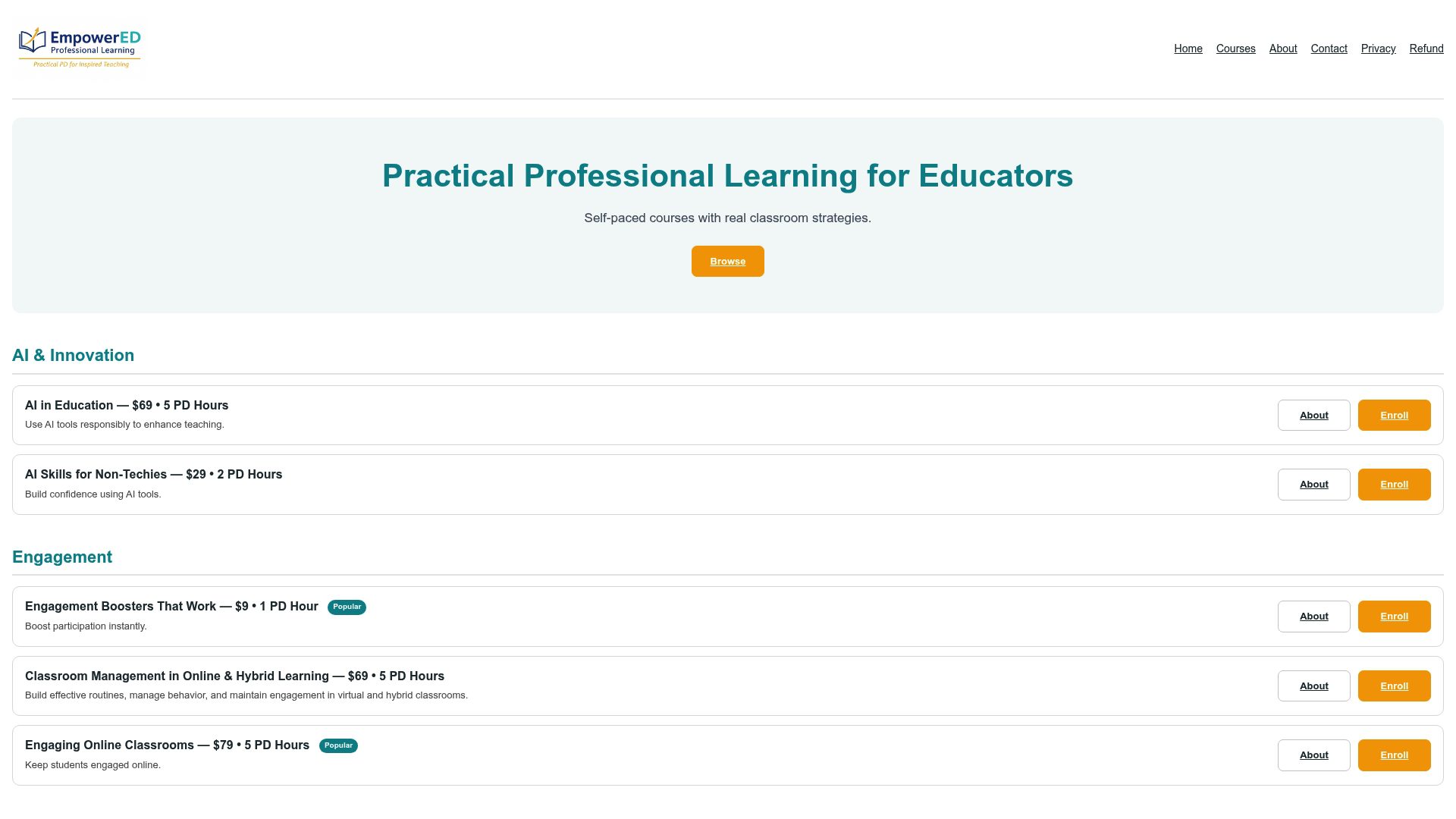
Every course is self-paced, research-backed, and built for working educators. Whether you are designing a flipped unit for the first time or refining an existing hybrid model, Empowered Professional Learning’s professional development courses give you the tools to do it well. Enroll today and apply what you learn in your next class session.
Key Takeaways
Flipped classroom hybrid settings improve student outcomes by shifting direct instruction to self-paced pre-class content and using synchronous time for active, collaborative learning.
| Point | Details |
|---|---|
| Research-backed outcomes | A meta-analysis of many studies confirms moderate positive gains over traditional lectures. |
| Four Pillars of F-L-I-P | Flexible Environment, Learning Culture, Intentional Content, and Professional Educator all must be present for the model to work. |
| Self-regulation scaffolding | Students need explicit support for independent learning before they can succeed in flipped hybrid models. |
| Coherent design matters | Problem-centered structures that unify online and in-person components prevent the two spaces from feeling disconnected. |
| Empowered Professional Learning | Targeted courses on engagement, hybrid routines, and classroom management give educators practical skills for immediate implementation. |