Choose professional development that is classroom-ready, job-embedded, and sustained over time. The Learning Policy Institute and U.S. GAO both identify these as the features most likely to change what happens in your classroom.
- What to prioritize: Content-focused design, active learning, coaching, and sustained follow-up rather than one-time workshops
- Delivery formats that work: Self-paced online modules combined with facilitated cohorts or in-school coaching cycles
- A ready-to-enroll option: Empowered Professional Learning offers self-paced, instructor-guided courses built around these exact characteristics
- Who benefits most: New teachers building foundational skills, mid-career educators refining practice, instructional coaches, and district PD coordinators planning staff development
Table of Contents
- What does effective professional development for teachers actually look like?
- Which PD delivery format fits your goals?
- How do you vet a PD provider before you commit?
- How do PD hours, certificates, and licensure renewal work in U.S. schools?
- Where can you find classroom-ready PD?
- Why active, sustained PD actually changes classroom practice
- Key Takeaways
- Why classroom-ready PD is the only kind worth your time
- Empowered Professional Learning: courses built for real classrooms
- Useful sources for further reading
What does effective professional development for teachers actually look like?
Research from the Learning Policy Institute and U.S. GAO points to seven consistent characteristics that separate PD that changes classroom practice from PD that doesn’t. Here’s what each one looks like in practice:
- Content-focused: Training is tied to the specific subject or grade level you teach. Indicator: The course uses your curriculum, not generic examples.
- Active learning: You practice the strategies yourself before using them with students. Indicator: The session includes modeling, role-play, or lesson design, not just slides.
- Collaboration and job-embedded work: Learning happens with colleagues, connected to your actual teaching schedule. Indicator: There are structured peer observation or shared planning components.
- Models of practice: You see the strategy demonstrated in a real or realistic classroom context. Indicator: Video examples, lesson demonstrations, or annotated student work are included.
- Coaching and expert support: A coach or facilitator provides feedback on your implementation. Indicator: Scheduled follow-up visits or feedback windows are built into the program.
- Feedback and reflection: You have structured opportunities to assess your own progress. Indicator: The program includes self-assessment tools, journals, or debrief protocols.
- Sustained duration: The PD spans multiple sessions over weeks or months, not a single day. Indicator: There is a clear multi-session schedule with classroom application between sessions.
The LPI review finds that content-focused PD, particularly math- or literacy-specific training, is more likely to affect both teaching practice and student learning than generic workshops. A RAND survey cited in the GAO report found that about 67% of teachers said collaborative PD improved their teaching to a moderate or large extent.
Pro Tip: Schedule a 15-minute “practice debrief” with a colleague the week after any PD session. Naming one strategy you tried and one that didn’t land yet is more effective than waiting for a formal follow-up.
| Characteristic | What it looks like in practice | Quick check |
|---|---|---|
| Content-focused | Discipline-specific examples and tasks | Does it name your subject or grade band? |
| Active learning | Teachers do the work, not just watch | Is there a practice or design task? |
| Collaboration | Peer observation, shared planning | Are colleagues involved? |
| Models of practice | Video demos, annotated artifacts | Can you see the strategy in action? |
| Coaching | Scheduled feedback from an expert | Is follow-up coaching included? |
| Feedback & reflection | Self-assessment, debrief protocols | Are reflection tools provided? |
| Sustained duration | Multi-session over weeks or months | Does it span more than one day? |
Which PD delivery format fits your goals?

Not every format supports all seven characteristics equally. Matching the format to your situation is what makes the difference between PD that sticks and PD that fades.
Online self-paced modules give you flexibility and low cost, but they require self-discipline and rarely include coaching by default. They work well for building foundational knowledge or exploring a new topic before a deeper cohort experience.

Facilitated virtual cohorts add collaboration and structured feedback to the online format. A cohort of 10–20 teachers working through the same content together, with a facilitator guiding discussion, supports several LPI characteristics at once. This format suits schools with distributed staff or teachers in different buildings.
In-person workshops are familiar but often fall into the one-and-done trap. A single full-day session rarely produces lasting change unless it is part of a longer series with classroom follow-through. Use them as a launch point, not a complete program.
Coaching and mentoring is the format most directly tied to classroom change. An instructional coach who observes your teaching and provides specific, timely feedback addresses the coaching and feedback characteristics directly. The LPI and GAO evidence shows coaching and collaborative models can support classroom change, though effect sizes vary.

Professional Learning Communities (PLCs) embed learning into the school week. Teachers meet regularly to examine student work, share strategies, and plan together. PLCs naturally support collaboration, reflection, and sustained duration.
Micro-credentials and certificates give teachers a documented, competency-based pathway. They work well for career advancement or when a teacher needs to demonstrate mastery of a specific skill for licensure or evaluation purposes.
| Format | Best for | LPI characteristics supported | Relative cost |
|---|---|---|---|
| Self-paced online | Individual skill building, flexible schedules | Content-focused, active learning | Low |
| Facilitated cohort | Collaborative learning, distributed teams | Collaboration, feedback, sustained | Medium |
| In-person workshop | Launch events, team alignment | Models of practice, active learning | Medium–High |
| Coaching/mentoring | Deep practice change, classroom fidelity | Coaching, feedback, sustained | High |
| PLC | Ongoing school-embedded learning | Collaboration, reflection, sustained | Low–Medium |
| Micro-credential | Documented skill mastery, career advancement | Content-focused, active learning | Low–Medium |
Pro Tip: Pair a self-paced online module with a monthly in-school coaching check-in. The module builds the knowledge base; the coaching session converts it into classroom practice. This combination addresses five of the seven LPI characteristics without requiring a large budget.
Techniques like active recall are a useful example of how learning-science principles apply directly to PD design: retrieval practice during training sessions strengthens retention far better than re-reading course notes.
How do you vet a PD provider before you commit?
The IRIS Center at Vanderbilt recommends asking four categories of questions when selecting a PD program: need, quality, implementation, and cost. Here is a practical checklist organized around those categories.
Evidence and quality
- What research base supports this program? Can you share a study or evaluation report?
- Are the trainers certified in adult learning or have documented classroom experience?
- Has the program been evaluated for effects on teacher practice or student outcomes?
- Does the design include the IGTP elements: insight, goal setting, technique development, and practice embedding? A systematic review found that PD programs intentionally incorporating these four mechanisms show larger average impacts on teacher practice and student outcomes.
Implementation
- What does the follow-up look like after the initial sessions?
- Is coaching or classroom observation included, or available as an add-on?
- How does the program align to our current curriculum and district goals?
- What materials or tools will teachers need to implement what they learn?
Cost and logistics
- What is the total cost, including any coaching, licensing, or materials fees?
- How many hours does the program require, and can it fit within our school schedule?
Red flags to avoid: one-and-done full-day workshops with no follow-up, providers who cannot name a research base, programs with no coaching component, vague outcome statements like “teachers will feel more confident,” and no alignment to your specific content area or grade level.
Data-informed PD planning helps administrators connect these vetting questions to real student and teacher data, making the selection process more precise.
How do PD hours, certificates, and licensure renewal work in U.S. schools?
PD credit in the United States comes in several forms, and the requirements for licensure renewal vary by state. Understanding the difference before you enroll saves time and prevents frustration.
- Clock hours: The most common unit. One clock hour equals one hour of verified PD participation. Most states require a set number of clock hours per renewal cycle, typically ranging from 60 to 180 hours depending on the state.
- Continuing Education Units (CEUs): One CEU equals 10 clock hours of instruction. Some providers issue CEUs; others issue clock hours. Both can count toward renewal depending on your state’s rules.
- State-approved credits: Some states require PD to come from an approved provider list or carry a specific state endorsement. A PD certificate from a provider is not automatically state-approved.
- University graduate credits: Courses offered through university extension programs often carry graduate credit that counts toward both licensure renewal and salary advancement on the district pay scale.
Steps to verify that a course counts toward your renewal:
- Check your state Department of Education website for the current renewal requirements and approved provider list.
- Contact your district HR or professional development office to confirm which credit types they accept.
- Ask the PD provider directly: “Do you issue a certificate of completion with clock hours or CEUs, and are you on any state-approved provider lists?”
- Keep a copy of every certificate, receipt, and completion record in a dedicated folder, digital or physical.
- If you need state approval for a specific course, request a course approval letter from the provider before you enroll.
Title II-A funds under the Every Student Succeeds Act are commonly used by districts to support sustained PD, and the GAO report describes how several states have used these funds to build mentoring and coaching structures that meet federal requirements for data-driven, sustained professional learning.
Pro Tip: Create a simple spreadsheet with columns for course name, provider, date, hours/CEUs, and certificate file name. Update it after every PD session. When renewal time comes, you will have everything in one place.
Where can you find classroom-ready PD?
Several reliable channels exist for finding quality PD, and the right one depends on your budget, timeline, and whether you are buying for yourself or for a team.
- State PD clearinghouses: Most state Departments of Education maintain lists of approved providers and upcoming workshops. Illinois, North Carolina, and Colorado, for example, each publish online course listings for educators through their state portals.
- District PD offices: Your district’s curriculum or professional development team often has pre-vetted programs and may cover costs through Title II-A or local funds.
- University extension programs: Many universities offer graduate-credit courses in content-specific pedagogy. These tend to be rigorous and carry salary-advancement credit.
- Professional associations: Subject-specific organizations such as NCTM (math) or ILA (literacy) offer conferences, webinars, and online courses aligned to current research.
- Online providers: Self-paced and facilitated online courses give teachers flexible access to targeted skill development without requiring substitute coverage.
Empowered Professional Learning offers self-paced, instructor-guided online courses built specifically for K–12 educators. Three courses worth knowing:
- Engagement Boosters That Work: Practical strategies for increasing student participation, designed for teachers in any grade band who want classroom-ready techniques they can use the next day.
- Social-Emotional Learning & Teacher Wellness: Covers SEL frameworks and teacher well-being supports, useful for schools prioritizing whole-child approaches or staff retention.
- Mathematical Thinking for Teachers: A content-focused course on mathematical pedagogy and problem-solving strategies, directly aligned with the LPI finding that discipline-specific PD produces stronger outcomes.
Individual teachers can enroll directly through the course pages. District and school buyers can request bulk licensing for team access. For a full view of available pathways, the course catalog lists all current offerings by topic area.
Pro Tip: If substitute coverage is a barrier, ask your principal about using early-release days, common planning periods, or asynchronous online modules that teachers complete on their own schedule. Many online providers, including Empowered Professional Learning, are designed specifically for this kind of flexible access.
Why active, sustained PD actually changes classroom practice
The evidence connecting PD design to classroom outcomes is consistent across multiple research traditions. The U.S. GAO review synthesizes meta-analyses and rigorous studies and finds that PD programs including multiple LPI characteristics, particularly coaching and collaboration, show positive associations with changes in teacher practice. Teacher-reported usefulness strongly favors collaborative, job-embedded formats over lecture-based workshops.
A systematic review and meta-analysis found that PD programs intentionally designed around insight, goal setting, technique development, and practice embedding show larger average impacts on both teacher practice and student outcomes than programs missing these elements. The practical implication: a program that teaches a strategy, sets a practice goal, gives you a technique to try, and then checks in on your implementation is measurably more effective than one that stops at the teaching stage.
The “knowing-doing gap” is real. Teachers often leave a workshop with solid knowledge but no clear path to application. Education Week practitioners recommend designing PD as a cycle of inquiry: introduce a strategy, try it in class, bring back evidence of what happened, and refine. That cycle, repeated over a semester, produces the kind of durable change that shows up in student outcomes.
High-quality implementation also requires district-level supports: protected planning time, substitute coverage funding, materials aligned to new practices, and clear metrics tied to both teacher practice and student results.
- Coaching and collaborative PD show positive associations with student test-score gains, though effect sizes vary across studies.
- Sustained, multi-session PD consistently outperforms single-session workshops in changing classroom behavior.
- Content-specific PD (math, literacy, science) produces stronger outcomes than generic skill-building.
- PLCs and peer observation are among the formats teachers themselves rate most useful for improving practice.
Key Takeaways
Effective professional development for teachers must be classroom-ready, sustained over time, and built around the seven research-backed characteristics identified by the Learning Policy Institute and U.S. GAO.
| Point | Details |
|---|---|
| Seven characteristics matter most | Content focus, active learning, collaboration, models, coaching, reflection, and sustained duration predict PD impact. |
| Coaching drives practice change | Collaborative and coaching-based formats show positive associations with classroom improvement and student outcomes. |
| Vet providers before you enroll | Ask about trainer qualifications, coaching follow-up, research base, and alignment to your curriculum. |
| Document every credit | Keep certificates, clock hours, and CEU records in one place to simplify licensure renewal. |
| Empowered Professional Learning | Offers self-paced, instructor-guided courses including Engagement Boosters That Work, SEL & Teacher Wellness, and Mathematical Thinking for Teachers. |
Why classroom-ready PD is the only kind worth your time
The gap between a well-designed PD session and actual classroom change is wider than most providers acknowledge. Attending a workshop, even a good one, rarely produces lasting shifts in practice unless the design forces you to try something, get feedback, and try again. The research is clear on this: sustained, coaching-embedded, content-specific PD is what moves the needle. Generic skill-building days, however well-intentioned, tend to produce short-term enthusiasm and long-term drift.
What often gets overlooked is the role of specificity. A math teacher who attends a general “engagement strategies” workshop walks away with ideas. A math teacher who works through a course built around mathematical thinking and problem-solving pedagogy, then applies a specific technique the following Monday and reflects on what happened, walks away with a changed practice. The difference is not motivation. It is design.
The classroom-ready module approach that Empowered Professional Learning uses is built on exactly this principle: every course is designed so that the strategy you learn on Tuesday is something you can test on Wednesday. That is not a marketing claim. It is the defining feature of PD that actually works.
Empowered Professional Learning: courses built for real classrooms
Empowered Professional Learning gives K–12 teachers and district teams a direct path to PD that meets the research standard without requiring a conference trip or a multi-year contract.
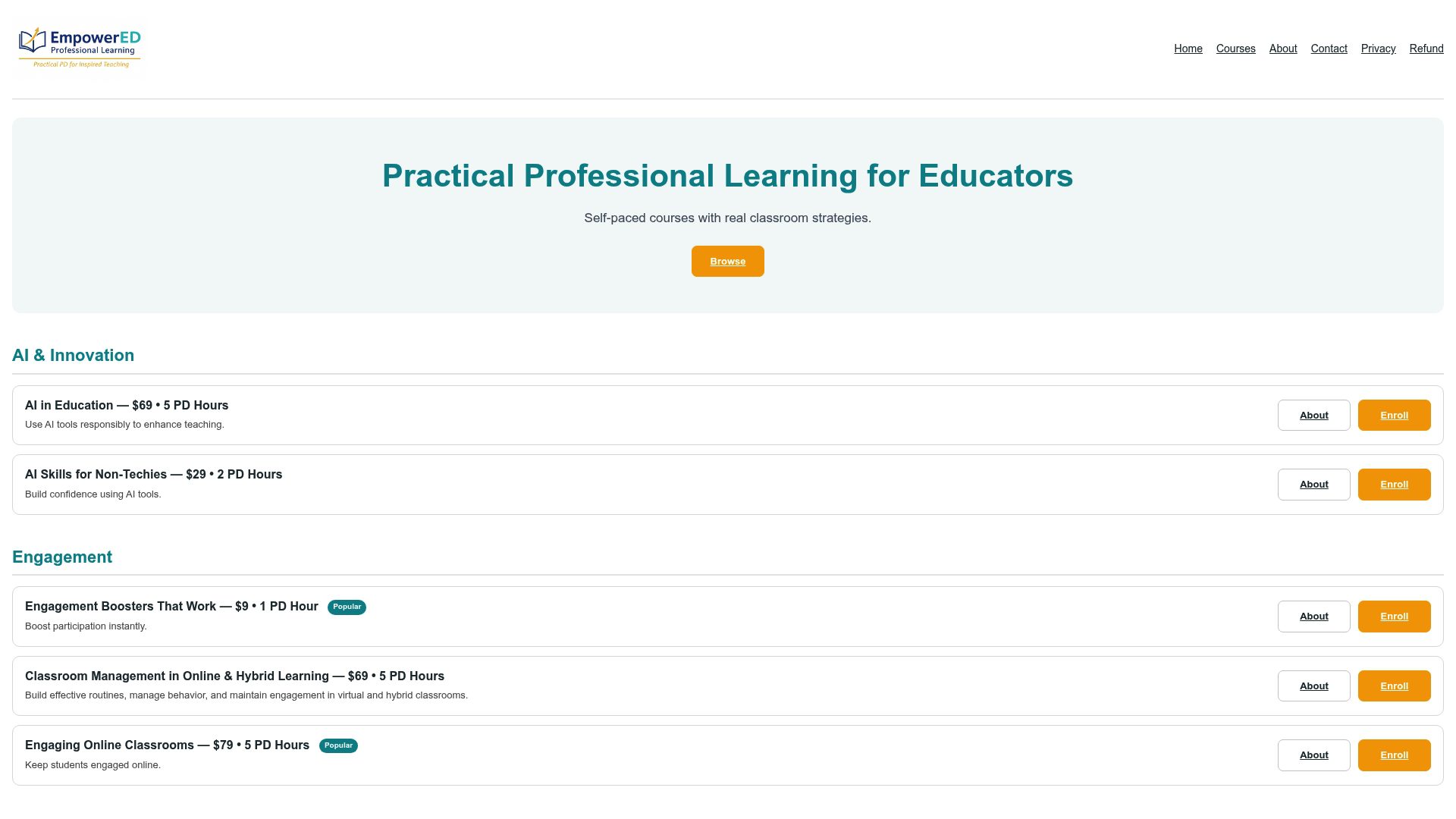
Three courses address the most common classroom priorities. Engagement Boosters That Work delivers practical, immediately usable strategies for increasing student participation, designed for any grade level. The SEL and Teacher Wellness course supports whole-child teaching and staff well-being, a priority for schools managing both student needs and teacher retention. Mathematical Thinking for Teachers is a content-focused course aligned with the LPI finding that discipline-specific PD produces stronger outcomes than generic training.
Individual teachers purchase courses directly. Schools and districts can request bulk licensing for team access at a reduced per-seat cost. Every course includes a PD certificate with documented clock hours for licensure renewal. Browse the full catalog or request a demo at empoweredpl.com.
Useful sources for further reading
- Learning Policy Institute: Effective Teacher Professional Development — The primary research synthesis behind the seven characteristics; essential reading for anyone designing or selecting PD.
- U.S. GAO Report GAO-26-107874 — Federal review of PD effectiveness research, including teacher survey data and policy implications.
- IRIS Center / Vanderbilt: Questions to Consider When Choosing PD — A practical vetting tool for district leaders and instructional coaches evaluating providers.
- ERIC Systematic Review: Characteristics of Effective Teacher PD — Meta-analysis covering the IGTP model and what design features produce the largest impacts on practice and outcomes.
- Education Week: Plan PD You Would Want to Attend — Practitioner-focused guidance on inquiry cycles and embedded coaching.
- Illinois State PD Course Listings for Educators — Example of a state-level clearinghouse for approved PD options.
- Empowered Professional Learning — Self-paced, instructor-guided online courses for K–12 educators, with district licensing and PD certificates included.