Teacher-assigned, forward-facing seating (rows or single desks) reliably cuts disruptive behavior during independent work, while clusters and semicircles boost collaboration but raise the odds of off-task chatter. The research on seating arrangements behavior is consistent enough to act on: match the layout to the task, not to habit. Treat your seating chart as a flexible, measurable management tool you adjust weekly, not a fixed feature of the room.
TL;DR:
- Teacher-assigned seating during individual work reduces disruptive behavior to less than a third of student-selected seatings, based on multiple studies.
- Rows or single desks are most effective for independent, logic-based tasks, while clusters enhance collaboration but increase off-task chatter.
- Implementing seating changes requires short-term planning, immediate observation, and data-driven adjustments within days to ensure effectiveness.
- Random seating can help break up friend groups and may lower disruptions when used as a reset tool, especially in classrooms with behavior challenges.
- Flexible seating options can support movement needs, but their success depends on instructional changes rather than furniture alone.
Table of Contents
- What the Research Says About Seating Arrangements and Behavior
- How Rows, Clusters, Semicircles, and Flexible Seats Change Classroom Behavior
- Who Should Choose the Seats: Teacher, Student, or Random Draw
- Matching Seating to the Task and the Student
- A Six-Step Protocol for Changing Your Seating Plan
- Measuring Whether a Seating Change Actually Worked
- When Flexible and Movement-Friendly Seating Actually Helps
- An Educator’s Take on Seating as a Management Tool
- Get Coached Support for Implementing Seating and Behavior Strategies
- Sources
- FAQ
What the Research Says About Seating Arrangements and Behavior
The clearest evidence on seating arrangements behavior comes from a 2012 study in the Journal of Applied Behavior Analysis that should reshape how you think about who picks the seats. Bicard and colleagues tracked fifth graders under two conditions: teacher-assigned seats and student-selected seats. During group seating, disruptive behavior was more than twice as high when students chose their own seats compared with teacher-assigned seating. During individual seatwork, disruptions were more than three times as high under student choice versus teacher assignment, according to the JABA study on seating arrangements and disruptive behavior.

That is not a small effect. It means the single fastest, cheapest classroom management adjustment you can make this week is deciding who sits where, rather than leaving it to friend groups.
A separate line of research backs up part of the mechanism. A 2020 field study of 77 primary school students found that children seated at single desks scored higher on logical reasoning tasks than children seated in clusters, though the effect wasn’t uniform. Individual traits, including loneliness and peer popularity, moderated how much a layout helped or hurt, according to research on classroom seating and children’s cognitive processes. Rows tend to favor convergent, independent thinking; clusters tend to favor divergent, social thinking. That distinction should drive your layout choice more than tradition does.
Observational syntheses of classroom seating research point the same direction: rows generally minimize off-task behavior during independent activities, while clusters increase off-task rates but improve participation and peer interaction, according to a research synthesis on classroom seating arrangements. None of this means clusters are bad. It means clusters carry a behavioral cost you should only pay when the lesson goal justifies it.
Here’s what the data consistently shows across these studies:
- Student-selected seating roughly doubles group disruptions and more than triples individual-seatwork disruptions compared with teacher-assigned seating.
- Single desks correlate with stronger performance on convergent, logic-based tasks.
- Clusters raise collaboration and participation but also raise off-task behavior.
- Individual differences (attention, loneliness, popularity) shift how much any single layout helps or hurts a given student.
Key Finding: Teacher-assigned seating cut disruptive behavior during individual seatwork to less than a third of the rate seen under student-selected seating, based on the JABA seating study.
None of these findings license a one-size-fits-all seating chart. Sample sizes in the underlying studies are modest, most work focuses on elementary grades, and effects vary by classroom culture, subject, and the specific mix of students in the room. Use the numbers as a strong directional signal, not a universal rule, and always check them against what you observe in your own room.
How Rows, Clusters, Semicircles, and Flexible Seats Change Classroom Behavior
Four mechanisms explain almost everything the research on seating arrangements behavior finds: proximity, visibility, reinforcement density, and distraction exposure. Proximity determines how easily a student can talk to, copy from, or be provoked by a neighbor. Visibility determines how easily you can see and respond to a behavior before it escalates. Reinforcement density describes how many social rewards (laughs, attention, side conversations) are available in a given seat. Distraction exposure is simply how much visual and auditory noise a student has to filter out to stay on task.
Rows minimize all four risk factors at once. Students face forward, proximity to peers drops, and you get a clean visual line to every face in the room. That’s why rows consistently show lower off-task rates for independent work.
Clusters flip the equation. Proximity goes up, reinforcement density goes up (there’s always someone to talk to), and visibility for you goes down because students face each other instead of the front. That trade-off is worth making when the lesson genuinely requires peer talk.
Semicircles and horseshoes split the difference. Students face the center or the teacher, which preserves visibility and reduces some distraction exposure, while still allowing eye contact across the group for discussion. They tend to work well for Socratic seminars and whole-class debate, where you want every student both seen and heard.
Flexible seating (wobble stools, standing desks, floor seating) changes a fifth variable that rows and clusters don’t touch: movement tolerance. For students who need to shift or fidget to sustain attention, flexible options can lower off-task behavior that would otherwise show up as chair-rocking or wandering.
Quick scenario mapping:
- Independent quiz or test: Rows or single desks, maximum spacing, minimal peer visibility.
- Group project or lab: Clusters of three to four, with roles assigned to keep reinforcement density productive rather than social.
- Whole-class discussion: Semicircle or horseshoe, so every student can see the speaker and you can scan every face.
- Independent reading with fidgety learners: Flexible seats near the front, away from high-traffic paths.
Pro Tip: Before you commit to a layout for a whole unit, run it for a single lesson and watch the first ten minutes. Most seating problems surface almost immediately, and a quick swap costs far less than living with two disruptive weeks.
Who Should Choose the Seats: Teacher, Student, or Random Draw
Teacher-assigned seating is the default that the evidence supports most strongly, but it doesn’t have to mean rigid, permanent, no-input seating charts. The JABA findings on seating arrangements behavior show student-selected seating produced roughly double the disruptions in groups and more than triple the disruptions during individual work, compared with teacher assignment. That gap is large enough that “just let them sit where they want” should never be your default for a class with existing behavior challenges.
You can still give students a voice without surrendering the outcome. Three structures work well:
- Timed choice windows. Let students choose seats for a single activity or day, then reset. This gives some agency while capping how long a bad choice can compound.
- Limited choice sets. Offer two or three teacher-approved seat options instead of the whole room. Students feel ownership; you retain control over who sits near whom.
- Conditional seating privileges. Tie open seating to demonstrated on-task behavior over a set period, and revoke it (calmly, without drama) if disruptions climb back up.
Random seating, drawn by cards or a name generator, sits between the two extremes. Action-research reports suggest random draws can reduce clique formation and, in some classrooms, lower disruptions compared with unrestricted student choice, according to action research on seating choice and classroom disruptions. It’s a reasonable middle path when you want to break up friend groups without hand-picking every seat yourself, though results vary enough across classrooms that you should track outcomes rather than assume it will work.
The practical rule: default to teacher-assigned seating for any class with a history of behavior issues, reserve structured choice for classes that have earned it, and treat random seating as a useful reset tool rather than a permanent policy.
Matching Seating to the Task and the Student
A seating chart that works for a math test will fail for a Socratic seminar, and a chart that works for most of your students may actively hurt one or two with executive function challenges. Build your seating plan in four steps: identify the lesson’s objective, list student needs, pick the layout that fits both, then set placement rules before you finalize names.
Start with the objective. Independent, convergent work (tests, silent reading, worksheets) points toward rows or single desks. Collaborative, divergent work (projects, brainstorming, peer editing) points toward clusters. Whole-class discussion points toward a semicircle. This alone resolves most seating decisions before you even think about individual students.
Then layer in accessibility needs using a Universal Design for Learning lens. A few checks matter every time:
- Visual access: Can every student see the board, screen, or speaker without turning or straining?
- Hearing: Are students with hearing differences seated away from HVAC noise and close to the primary speaker?
- Mobility: Is there a clear, wide path to any seat used by a student with a mobility device?
- Executive function: Are students who struggle with sustained attention seated near you, away from doors and windows, with a clear sightline to instructions?
For students with externalizing behaviors, a randomized controlled trial found that pairing them with a well-liked, prosocial “buddy” seatmate improved peer acceptance and reduced externalizing behavior, without increasing aggression in the neighboring student, according to research on seat rearrangement for children with externalizing problems. That single move, deliberate buddy pairing rather than isolation, often does more than moving a struggling student to the back.
| Student profile | Best seating approach | What to avoid |
|---|---|---|
| Attention or focus challenges | Front row, near teacher, away from doors/windows | Back corners, high-traffic aisles |
| Externalizing behavior | Paired with a prosocial, well-liked peer | Isolation seating as a first response |
| Hearing difference | Close to primary speaker, away from HVAC noise | Back of a large cluster |
| Mobility needs | Wide, clear path; consistent location | Seats requiring furniture rearrangement to access |
| High social distractibility | Rows for independent work; monitored cluster for group work | Clusters for every activity regardless of task |
A Six-Step Protocol for Changing Your Seating Plan
Changing a seating chart mid-year can spike anxiety for some students and excitement for others. A structured rollout keeps both in check and protects the behavioral gains the research promises.
- Define the objective. Decide whether you’re solving a behavior problem, supporting a new unit, or responding to a specific student’s needs.
- Choose the layout. Match rows, clusters, semicircle, or flexible seating to that objective using the framework above.
- Assign placements. Use the UDL checklist and buddy-pairing principle before finalizing names, not after.
- Teach the norms. Spend five minutes explicitly stating expectations for the new arrangement. Silence is not assumed; it’s taught.
- Monitor the first week. Watch for the specific behaviors the change was meant to fix, and note any new problems the layout introduces.
- Adjust based on data. Move seats that aren’t working within days, not months. A seating chart is a draft, not a contract.
A few sample rules make step four concrete. For a two-seat approach with students who have self-regulation challenges, assign one seat for independent work (front, low-distraction) and a separate assigned seat for collaborative tasks (near a calm, prosocial peer), and rehearse the transition between the two until it’s automatic.
Communicating the change matters as much as the change itself. A short script for students: “Starting Monday, we’re trying new seats for group projects. Everyone gets a fair shot to show how this works, and we’ll check in after a week.” For parents, a brief note explaining the reasoning, paired with a template like the behavior email templates for teachers, keeps the message consistent and prevents rumors from filling the gap.
If budget allows any flexible options, start small: a few wobble stools or a standing-desk corner rather than a full room overhaul. You can find broader behavior-management tactics, including how seating pairs with routines and transitions, in 15 classroom management techniques for K to 12 teachers.
Pro Tip: Announce seating changes as an experiment, not a punishment. Framing it as “we’re testing this for two weeks” lowers resistance and gives you an easy, face-saving path to reverse course if it doesn’t work.
Measuring Whether a Seating Change Actually Worked
Guessing whether a new layout helped is a common mistake, and it’s an easy one to fix with a five-minute measurement routine. Momentary time sampling works well here: observe the class every 30 seconds for five to ten minutes, mark each student as on-task or off-task at that instant, then tally the percentage on-task. Run this once before the seating change and again a week after, at the same time of day and during the same type of activity, so the comparison is fair.
Pair that observational snapshot with two other signals:
- Work product measures. Track completion rates and accuracy on the same type of assignment before and after the change.
- Student perception checks. A quick, anonymous one-question survey (“Do you feel like you can focus in your seat?”) surfaces problems observation alone might miss.
Set a decision threshold before you start, so you’re not tempted to rationalize a weak result. A useful rule of thumb: if on-task sampling improves by a clearly visible margin and work completion holds steady or rises, keep the layout. If either measure drops, or if two or more students report new focus problems, revisit the chart within a week rather than waiting out the grading period.
A quick before-and-after comparison, five minutes of sampling twice, gives you more decision-quality data than a full semester of gut instinct.
A simple case pattern illustrates the logic: a fifth-grade teacher moves from open student-selected seating to teacher-assigned rows for independent math work, runs a five-minute on-task sample before and after, and sees a clear jump in on-task percentage alongside steadier assignment completion. That pattern mirrors what the JABA research on seating and disruptive behavior would predict, and it’s the kind of quick, local confirmation that makes the research usable in your specific room.
When Flexible and Movement-Friendly Seating Actually Helps
Stability balls, standing desks, and wobble cushions generate real enthusiasm in teacher circles, and the underlying research supports cautious optimism rather than blanket adoption. A systematic review of classroom-based dynamic seating interventions found that flexible seating improves on-task behavior mainly when teachers change their teaching approach to take advantage of the movement and choice, not when furniture alone is swapped in, according to a systematic review of dynamic seating interventions. Buy a wobble stool and change nothing else about how you run the lesson, and you’ll likely see a weaker effect than the marketing promises.
Students who benefit most tend to be those who fidget to stay regulated rather than to seek attention. For them, movement-friendly seating channels restlessness into something that doesn’t disrupt neighbors. Students who use movement to escape a task, on the other hand, may need a different intervention entirely.
Before rolling out flexible seating classroom-wide, weigh four practical constraints:
- Cost. Wobble stools and stability balls run from modest to significant per-unit costs across a full classroom set.
- Storage. Balls and stools take floor space that traditional desks don’t, especially in smaller rooms.
- Supervision. New seating options need explicit norms taught up front, or they become a distraction rather than a support.
- Equity. If you can only afford a few flexible seats, decide transparently who gets them and rotate access rather than letting the same students claim them every day.
Start with a handful of flexible options tied to a specific instructional change, measure the effect using the same on-task sampling described above, and expand only what the data supports.
An Educator’s Take on Seating as a Management Tool
Most teachers treat seating charts as a housekeeping task, something to finish before the first day and revisit only when a specific student becomes a problem. The research on seating arrangements behavior argues for something more active: seating is one of the few classroom variables you can change in five minutes that produces a measurable behavioral shift within days.
The bigger mistake I see isn’t picking the wrong layout. It’s picking a layout once and defending it out of consistency rather than evidence. A cluster arrangement that worked beautifully for a project unit becomes the default for silent testing weeks later, simply because nobody wants to redo the chart. The data on rows versus clusters is clear enough that this kind of drift has a real behavioral cost, and it’s an entirely avoidable one.
There’s also a tendency to treat flexible seating as a fix rather than a tool. Wobble stools don’t manage behavior. Teachers manage behavior, and flexible seating just gives some students a better environment to succeed in when the pedagogy around it actually uses the flexibility. Buying furniture without changing instruction is a expensive way to accomplish very little.
If you take one thing from the research, take this: seating is not a decoration decision. It’s a lever, one of the cheapest and fastest levers available to you. Use the research-based tips on optimal seating arrangements as a starting framework, but let your own five-minute observation data have the final word.
— Brian Koster, Ed.D.
Get Coached Support for Implementing Seating and Behavior Strategies
Reading the research is one step. Applying it under real classroom pressure, with 28 students and a pacing guide breathing down your neck, is another. Empowered Professional Learning builds its courses specifically for that gap: practical, classroom-ready strategies taught by educators, with personalized feedback instead of a static slideshow.
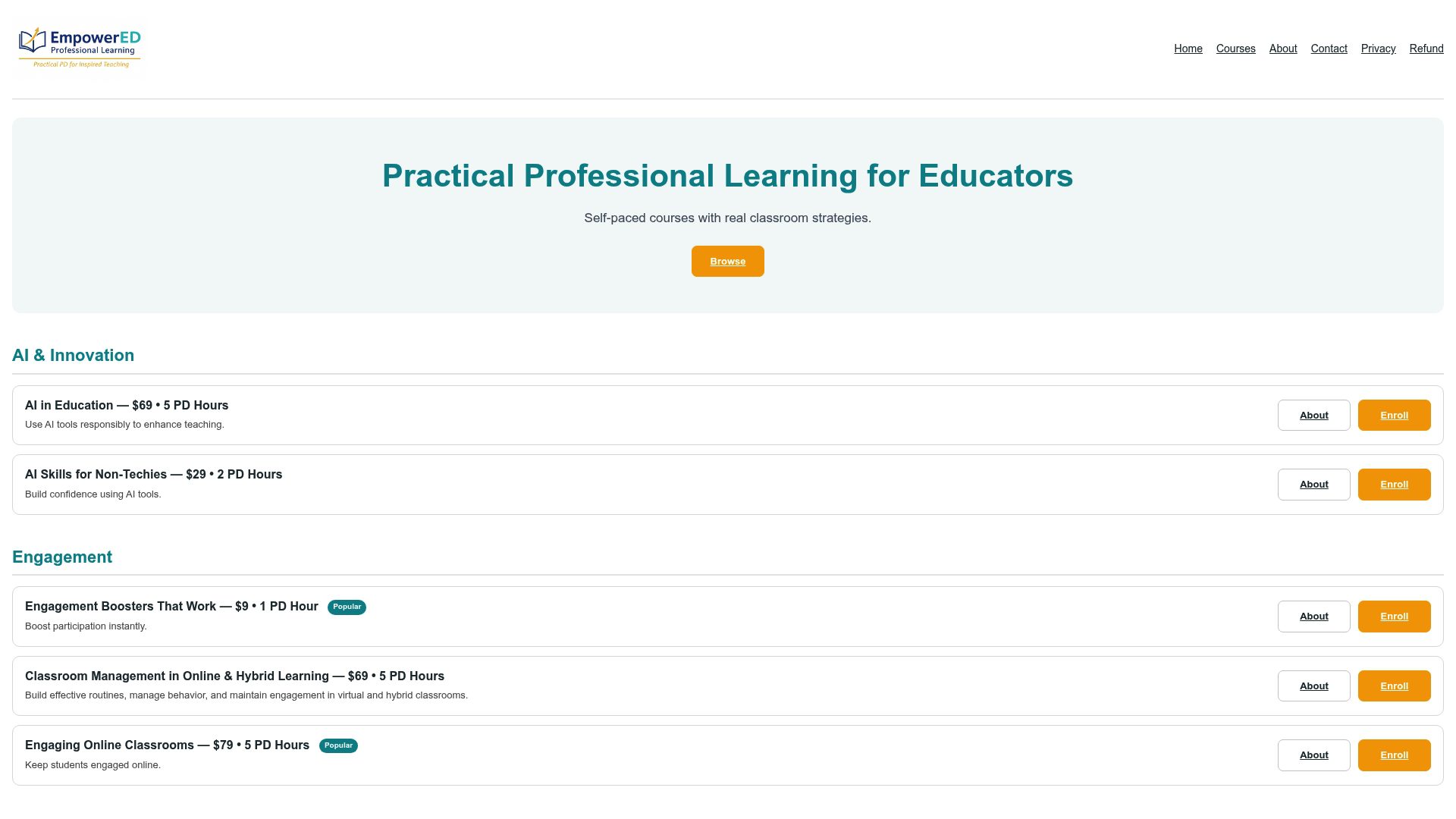
If seating and behavior management are your immediate priority, Classroom Management in Online & Hybrid Learning covers layout, routines, and behavior systems for $69. For teachers building accessible seating plans for neurodiverse learners, Universal Design for Learning (UDL) & Accessibility runs $79 and walks through the exact checklist categories covered above. If engagement, not just compliance, is the goal once seating is sorted, Engagement Boosters That Work is available as a free course. Every course includes a PD certificate, and district-level licensing is available for teams adopting these strategies school-wide. Browse the full professional learning catalog to find the course that matches what your classroom needs this semester.
Sources
- Differential effects of seating arrangements on disruptive behavior of fifth grade students during independent seatwork (JABA, 2012)
- Research-Based Tips for Optimal Seating Arrangements (Edutopia, 2025)
- The effects of classroom-based dynamic seating interventions on academic outcomes in youth: a systematic review (2018)
FAQ
What are the three types of seating arrangements?
The three most common classroom layouts are rows (single desks facing forward), clusters (small groups of three to four), and semicircles or horseshoes (students facing the center or teacher). Each supports different behavior: rows minimize off-task distraction for independent work, clusters raise collaboration and off-task rates together, and semicircles balance visibility with discussion.
How do seating arrangements affect learning?
Layout affects learning mainly through attention and task fit. Research shows single desks correlate with higher logical reasoning scores on convergent tasks, while clusters support divergent, collaborative thinking at the cost of some off-task behavior.
How do you solve a difficult seating arrangement problem?
Start by identifying the specific behavior you’re trying to fix and match the layout to the task, not the other way around. Use short, five-minute on-task observation samples before and after any change so the decision is based on data rather than guesswork, and adjust within days if it isn’t working.
What are the best seating plans for managing behavior?
Teacher-assigned seating in rows or single desks generally produces the lowest disruption rates for independent work, based on the JABA study on seating and disruptive behavior. For students with externalizing behavior, pairing them with a prosocial, well-liked seatmate tends to outperform isolating them.
Does Empowered Professional Learning offer courses on classroom seating and management?
Empowered Professional Learning’s Classroom Management in Online & Hybrid Learning course covers seating, routines, and behavior systems for $69. The Universal Design for Learning (UDL) & Accessibility course, priced at $79, addresses accessible seating and layout planning for neurodiverse learners.