Standards-based grading reports what students know and can do against clear learning targets, not their behavior, effort, or timeliness. The core benefit is clarity: teachers, students, and families see exactly which skills are mastered and which need more work. A simple first step is to pilot one learning target with a 1 to 4 rubric and one built-in retake window before expanding further.
TL;DR:
- Standards-based grading evaluates students on specific, measurable skills rather than combining behavior, effort, or participation into the final score.
- It relies on short, clear proficiency scales and provides multiple opportunities for students to demonstrate mastery through retakes or revisions.
- The approach separates academic mastery from non-academic factors, ensuring progress reflects current skill levels without penalty for late work or past mistakes.
- Pilot programs should start with one unit, clearly define retake policies, and communicate progress effectively to families, focusing on tangible learning targets.
- Common pitfalls include mixing behavior with academic scores and inconsistent rubric language, which can obscure true student mastery and cause confusion.
Table of Contents
- Core principles behind standards-based grading
- How standards-based grading differs from traditional grading
- Rubric language and sample scales you can use tomorrow
- Getting started: a rollout checklist for teachers and leaders
- Explaining standards-based grading to families without confusion
- What the research says about outcomes
- Author expertise behind this classroom-ready overview
- How EmpowerED can support your standards-based grading pilot
- Practical perspective: what commonly goes wrong
- Sources
- FAQ
Core principles behind standards-based grading
Standards-based grading rests on a few ideas that shape every decision that follows. Learning targets are specific, measurable skills pulled from a broader standard, so a target might isolate one skill within a larger reading or math standard rather than trying to grade the whole thing at once. Academic performance and behavior are reported separately, since a student who turns in work late but demonstrates mastery should not receive a lower proficiency score for that reason. Proficiency scales, most often 1 to 4 or 1 to 3, replace percentage points with descriptors tied to what the student has actually shown.
- Learning targets break a standard into a specific, gradable skill.
- Academic grades and behaviors like effort or timeliness get reported in separate categories.
- Proficiency scales use short descriptors instead of point totals.
- Multiple opportunities, including retakes, let the grade reflect current mastery rather than a single test day.
Research reviews and primers recommend three principles for building these systems: grades should carry meaning tied to standards, rely on multiple pieces of evidence with room for revision, and keep academic indicators separate from non-academic behaviors.
How standards-based grading differs from traditional grading
Traditional grading often averages everything into one number: quizzes, homework, participation, extra credit, and late penalties all blend together. That average can hide whether a student actually mastered the material, since a strong test score and a missed homework packet cancel each other out. Standards-based grading keeps academic mastery in its own lane and reports work habits, such as homework completion or participation, in a separate section of the report card.
- Stop averaging every assignment into one grade regardless of when it was completed.
- Start scoring only the assessments that measure the actual standard.
- Continue collecting homework and practice work, but log it as formative evidence rather than a grade.
- Stop penalizing retakes; instead, replace the old score once new evidence shows growth.
This shift does not mean lowering expectations. It means the grade finally answers one question clearly: what can this student do right now?
Rubric language and sample scales you can use tomorrow

A useful proficiency scale needs to describe observable skill levels, not vague impressions. A 1 to 4 scale might read: 4, applies the skill independently in new situations; 3, meets the standard with expected support; 2, shows partial understanding with gaps; 1, needs foundational instruction to begin the skill. A simpler 1 to 3 version works for younger grades: 3, meets the standard; 2, approaching the standard; 1, not yet demonstrating the standard.
Single-point rubrics work well because they describe only the proficient level, leaving space for notes above and below it instead of forcing every possible outcome into a grid. For an opinion writing task aligned to a claim-and-evidence standard, the proficient row might read: “States a clear opinion, supports it with at least two relevant reasons, and includes a concluding statement that restates the opinion.” Teachers write growth notes in the “needs work” column and stretch notes in the “exceeds” column as they read.
- Use the same descriptor language across a grade level so scores mean the same thing in every classroom.
- Keep single-point rubrics to one page so students can reference them while writing.
- Adjust the descriptor’s complexity, not the standard itself, for students with IEPs.
- Apply Universal Design for Learning principles by offering the rubric in visual, verbal, and written formats.
Districts piloting this approach often keep the scale small on purpose. A four-point scale with plain language beats a ten-point rubric nobody remembers by the third assignment.
Getting started: a rollout checklist for teachers and leaders
A pilot works best when it is small enough to manage and specific enough to learn from. Rather than converting an entire course at once, most successful rollouts start with one unit and expand once the routines feel natural.
- Choose one unit and identify three to five learning targets within it.
- Align one summative assessment and two to three formative checks to those targets.
- Write and publish a retake policy that states the timeline and any prerequisite, such as a corrective task before retesting.
- Remove formative work from the final grade calculation, so it functions as practice rather than a point source.
- Set up a simple tracking method, whether a spreadsheet or a digital gradebook feature, and schedule a short team review after the first assessment cycle.
- Draft two communication pieces: a student-facing explanation of the scale and a one-page family handout describing what a 3 means.
Formative checks work best when they are varied and frequent rather than heavy and rare; a range of quick formative assessment techniques can supply the multiple evidence points a fair proficiency score requires.
Pro Tip: Run the pilot in one course period before rolling it out schoolwide. A single class gives you real data without disrupting an entire grade level.

Explaining standards-based grading to families without confusion
Most parents grew up with percentage grades, so a 3 out of 4 can sound like a 75%. However, it usually means “meets the standard.” A short explanation works better than a long one: “Our grading reports show what your child has learned to do, using a scale from 1 to 4, where 3 means your child meets the grade-level expectation.” When a letter grade is required for a transcript, districts typically map the top two scores to A and B ranges rather than treating the proficiency number as a percentage.
- Use color-coded snapshots showing growth over time instead of a single static score.
- Mark skills not yet taught as “not yet assessed” rather than leaving them blank or scoring them as zero.
- Share a simple retake timeline so families know when a score can still change.
Districts that communicate well tend to repeat the message often. Ongoing, multichannel communication using visuals and repeated sessions helps families move past the 100-point mental model, since one Back-to-School Night is rarely enough.
What the research says about outcomes
Research on standards-based grading points to a consistent set of principles rather than a single dramatic result. The ERIC research primer recommends grades that are meaningful and standards-linked, built from multiple pieces of evidence with room for revision, and separated from non-academic behaviors like participation. Related implementation research on embedding standards-based grading shows that aligned rubrics and policies allowing new evidence to update grade records can make reports clearer for both families and teachers than traditional letter grades.
- Meaningful, standards-linked grades give students and families an accurate picture of current skill.
- Multiple evidence points and revision opportunities improve the reliability of a final score.
- Separating academic and behavior reporting reduces the confusion that fuels grade disputes.
None of this works without aligned instruction. A rubric only reports what students learn; it cannot substitute for well-designed teaching or consistent classroom communication.
Author expertise behind this classroom-ready overview
This overview draws on Brian Koster, Ed.D.’s background in K-12 instructional leadership to translate standards-based grading research into steps a school can act on this term. EmpowerED Professional Learning’s course catalog reflects the same practical focus: courses on AI in Education support the data-review habits SBG pilots need, Universal Design for Learning and Accessibility work helps schools write rubrics that report fairly for every learner, and Engagement Boosters That Work targets the retake and revision cycles that keep students working toward mastery instead of disengaging after a low score.
How EmpowerED can support your standards-based grading pilot
A standards-based grading pilot moves faster when the whole staff shares a common vocabulary before the first report card goes home. EmpowerED Professional Learning’s course library maps directly onto that need, with self-paced sessions educators can complete around a teaching schedule rather than during it.
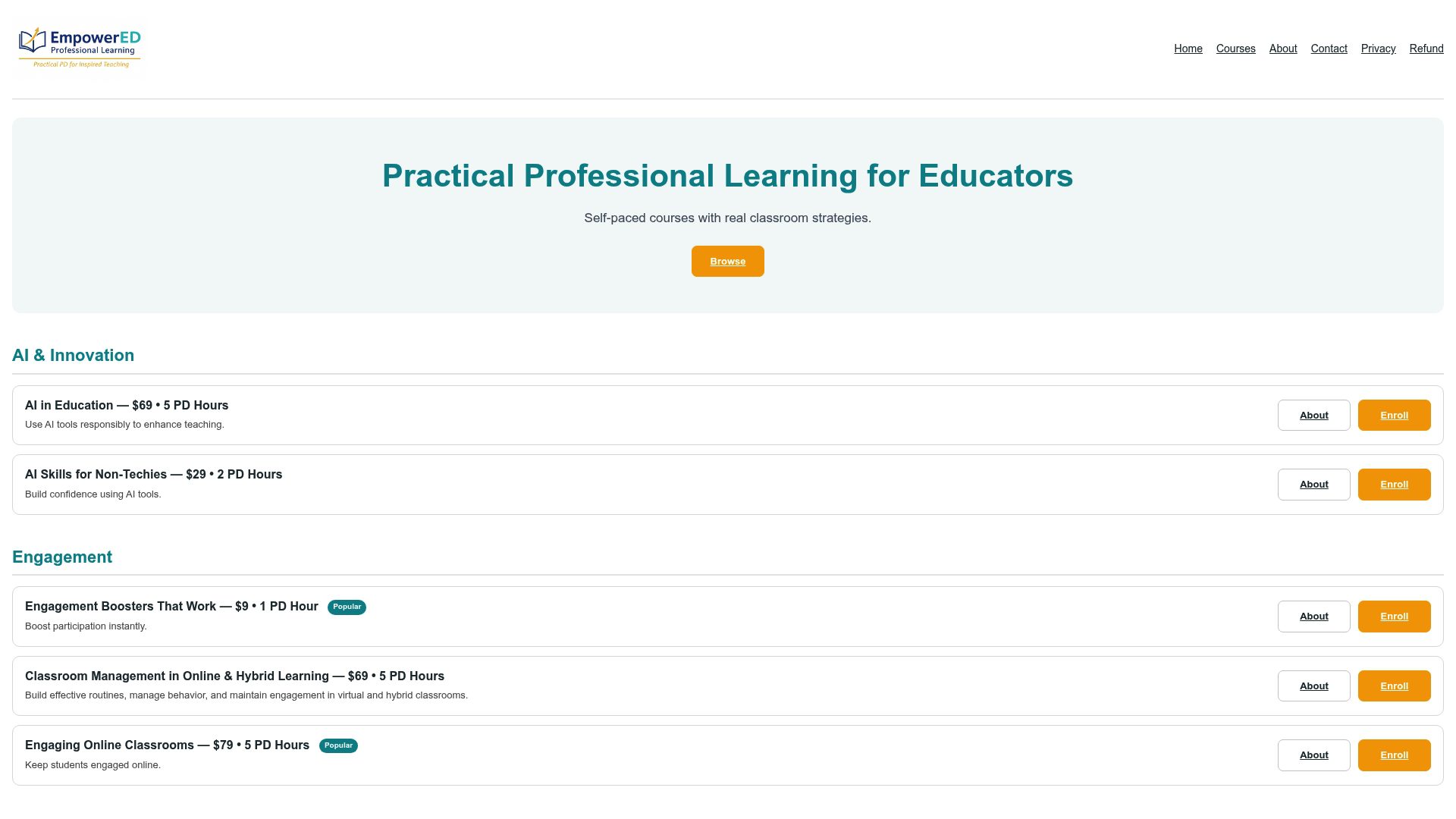
- AI in Education: From Basics to Ethical Integration helps staff use AI responsibly when reviewing student work and identifying patterns across proficiency data, for $69.
- Universal Design for Learning (UDL) & Accessibility supports rubric design that reports fairly for students with IEPs and diverse learning needs, for $79.
- Engagement Boosters That Work offers strategies for keeping students motivated through formative cycles and retakes.
A practical rollout plan might include a staff session on one of these topics combined with a follow-up coaching conversation. Browse the full professional learning catalog to build a session plan that matches where your team is starting.
Practical perspective: what commonly goes wrong
The most frequent pilot mistake is mixing behavior into an academic score, which muddies both signals. A close second is letting every teacher on a team write different rubric language for the same standard, so a 3 means something different in each classroom.
- Fix mixed reporting by moving behavior into its own report card section immediately.
- Fix inconsistent rubrics by drafting shared descriptor language as a team before the pilot starts.
- Fix weak communication by sending the family one-pager before the first report card, not after.
- Fix vague retake rules by publishing a timeline and prerequisite in writing on day one.
Keep iterating with your teacher team, and keep talking to families throughout the term, not just at the start.
— Brian Koster, Ed.D.
Sources
For readers who want the full detail behind this overview, the ERIC research primer lays out implementation principles in depth, Education Week’s explainer on standards-based grading documents real district reporting choices, and the Kappan piece on family communication covers strategies for reducing parent confusion.
- What does the research say about standards-based grading: A research primer (ERIC)
- Communicating with parents about standards-based grading (Kappan Online, 2024)
FAQ
What is an example of standards-based grading?
A teacher might grade a persuasive essay against a single writing standard, scoring it 1 to 4 based on whether the student states a clear claim and supports it with evidence, rather than averaging that essay with homework and quiz scores. The ERIC research primer describes this kind of standards-linked, evidence-based scoring as a core principle of the approach.
What does a 3 mean in standards-based grading?
A 3 on a typical 1 to 4 scale means the student meets the grade-level standard independently, without needing significant additional support. It reflects current mastery of that specific skill, separate from behavior, effort, or homework completion.
What are some examples of standards-based grading rubrics?
Common formats include a 1 to 4 scale with descriptors for each level and single-point rubrics that describe only the proficient row, leaving room for notes above and below it. Inclusion-focused guidance on standards-based report cards offers adapted descriptor examples for students with disabilities.
How do I explain standards-based grading to parents?
Tell families the scale reports what their child has learned to do, not a percentage, and that a 3 typically means the student meets the grade-level expectation. Districts that communicate well use visuals and repeated, multichannel sessions rather than a single explanation at the start of the year.