Formative assessment techniques are specific strategies educators use during instruction to collect evidence on student learning and adjust teaching decisions in real time. The most effective types of formative assessment techniques share one defining quality: they close the gap between where students are and where they need to be through a deliberate feedback loop. Research shows a 25.3% increase in achievement and a 31.7% increase in engagement when teachers combine immediate feedback with culturally responsive formative strategies. That result is not accidental. It comes from choosing the right technique for the right moment, then acting on what the evidence reveals.
1. Types of formative assessment techniques that work every day
The most practical starting point for K-12 educators is a fixed daily palette of techniques. The Formative 5, detailed in a SAGE Publications resource for K-8 math teachers, identifies five core methods: Observations, Interviews, Show Me, Hinge Questions, and Exit Tasks. Using a consistent set reduces planning fatigue and generates varied forms of evidence across a single lesson. Each technique targets a different type of evidence and a different moment in the learning cycle.
Observations
Observations are the most continuous of all assessment methods. You watch students work, listen to their reasoning, and note specific behaviors tied to your learning target. The key is knowing your “look-fors” before the lesson starts. Without a clear target, observations become impressionistic rather than diagnostic.

Interviews
One-on-one or small-group questioning reveals the thinking behind an answer in ways written work cannot. A student who writes the correct answer may not understand why it is correct. A two-minute conversation during independent work time surfaces that gap immediately. This technique works especially well in literacy and math reasoning tasks.
Show Me
Show Me uses mini whiteboards, response cards, or digital tools to get simultaneous visual responses from every student. When you ask all students to hold up their boards at the same time, you see the full distribution of understanding at once. Mid-lesson checks like these provide rapid, sortable data for adjusting instruction before the lesson ends.
Hinge questions
A hinge question is a strategically designed multiple-choice question placed at a critical decision point in a lesson. Each wrong answer corresponds to a specific misconception, so the pattern of responses tells you exactly where to go next. This is not a quiz. It is a diagnostic pivot point built into your lesson plan.
Exit tasks
Exit tasks, commonly called exit tickets, are short written prompts completed in the final minutes of class. One or two targeted questions create sortable data that directly informs your next lesson. The key word is “targeted.” A vague prompt produces vague data.
Pro Tip: Limit exit tickets to one or two questions tied directly to the lesson’s learning target. Sort responses into three piles: got it, almost there, and not yet. Plan your next lesson opening around the “not yet” pile.
2. Classroom Assessment Techniques (CATs) and peer-based methods
Classroom Assessment Techniques, or CATs, are frequent, low-stakes assessments that provide immediate feedback on learning during instruction. Developed and cataloged by researchers at institutions including North Carolina State University, CATs extend well beyond math and work across every subject area and grade band.
The most widely used CATs include:
- Minute Paper: Students respond in writing to two questions at the end of class: “What was the most important thing you learned today?” and “What question do you still have?” This takes two minutes and produces specific, usable data.
- Muddiest Point: Students write down the single concept that remains unclear. This technique surfaces confusion that students often will not raise by hand in front of peers.
- Concept Maps: Students diagram relationships between ideas, revealing how they organize knowledge. Gaps in the map show gaps in understanding, not just gaps in recall.
- One-Sentence Summary: Students summarize a concept in one sentence using a structured format. This checks both comprehension and the ability to synthesize.
Peer and self-assessment methods add a second layer of evidence by activating students as learning resources for each other. Translating learning targets into student-friendly language is the prerequisite for this to work. Students cannot evaluate their own work or give useful feedback to a peer if they do not understand what quality looks like.
Effective peer feedback structures include:
- Provide students with a clear success criteria checklist before the task begins.
- Ask peers to identify one specific strength and one specific area to improve.
- Require the receiving student to respond in writing to the feedback they received.
- Close the loop by asking students to revise one element based on peer input.
Effective self-assessment requires that students reference clearly communicated learning goals during the task, not after it. Handing students a rubric at the end of a lesson is compliance. Sharing it at the start and asking them to self-monitor throughout is formative practice.
3. How to choose the right technique for your instructional goal
Choosing a formative assessment strategy based on the tool rather than the purpose is the most common planning mistake in K-12 classrooms. The formative action loop provides a better framework: orientate, generate, evaluate, act, and verify. Each phase requires a different type of evidence, and each type of evidence calls for a different technique.
Here is how to map your learning intention to the right method:
- Orientate: What do students already know? Use a Concept Map or a pre-lesson hinge question to activate and reveal prior knowledge.
- Generate: What are students producing during learning? Use Show Me or Observations to capture evidence in real time.
- Evaluate: How does their current understanding compare to the target? Use Interviews or peer feedback structured around success criteria.
- Act: What do you do next? Sort exit ticket responses and adjust tomorrow’s opening accordingly.
- Verify: Did the adjustment work? Use a follow-up hinge question or a second exit task to confirm.
Evidence gathered without instructional action is descriptive assessment, not formative assessment. The technique is only as useful as the decision it produces. This distinction matters because many educators collect data through exit tickets or quick checks and then move on without changing anything. That cycle does not improve learning.
Pro Tip: Before designing any formative check, write down the specific instructional decision you will make based on the results. If you cannot name the decision in advance, the technique is not yet formative.
Dylan Wiliam’s framework, organized around five core teacher actions, reinforces this point. The five actions are: clarifying learning intentions, eliciting evidence, providing feedback, activating students as resources, and fostering student ownership. Selecting a technique based on which action you are trying to support produces far richer evidence than selecting a technique because it is easy to run.
4. Comparing techniques by context, time, and feedback speed
Not every technique fits every classroom context. The table below compares the most common formative assessment methods across four practical dimensions to help you match the right approach to your situation.
| Technique | Feedback speed | Prep time | Best context | Student engagement |
|---|---|---|---|---|
| Exit ticket | End of lesson | Low | All subjects, all grades | Individual, written |
| Hinge question | Mid-lesson | Medium | Math, science, literacy | Whole class, simultaneous |
| Show Me (whiteboard) | Immediate | Low | Math, vocabulary, short answers | Whole class, visual |
| Minute Paper (CAT) | End of lesson | None | Secondary, discussion-based | Individual, reflective |
| Observation | Continuous | Low | All subjects, especially labs and group work | Individual or group |
| Peer feedback | During or after task | Medium | Writing, project-based learning | Paired or small group |
| Interview | During independent work | Low | Reading, math reasoning | Individual |
| Concept Map | End of unit segment | Low | Science, social studies, ELA | Individual or paired |
Large classes favor whole-class simultaneous techniques like Show Me and hinge questions because they surface the full distribution of understanding without requiring you to read 30 individual responses in the moment. Small classes and intervention groups benefit most from Interviews and structured peer feedback, where depth of evidence matters more than speed. Mixed-method routines, for example a mid-lesson hinge question followed by a two-question exit ticket, provide both breadth and depth within a single class period.
Key takeaways
Formative assessment techniques only improve learning when the evidence they generate leads directly to an instructional decision.
| Point | Details |
|---|---|
| Choose technique by purpose | Match each method to a specific phase of the formative action loop, not to convenience. |
| Fixed palettes reduce fatigue | Using a consistent set like the Formative 5 builds routine and generates comparable data over time. |
| Student language matters | Translating learning targets into student-friendly language is required before peer or self-assessment can work. |
| Act on the data | Evidence without an instructional response is not formative practice. Plan your next move before you collect. |
| Low-stakes frequency wins | Brief, frequent checks outperform infrequent high-stakes assessments for closing learning gaps. |
What I have learned from watching formative assessment go wrong
Most teachers I have worked with understand the mechanics of exit tickets and hinge questions. The breakdown almost never happens at the tool level. It happens at the action level. Teachers collect the data, sort it mentally, and then teach the next lesson exactly as planned. The loop never closes.
The uncomfortable truth about formative assessment is that the technique is the easy part. Designing a hinge question takes ten minutes. Deciding what you will actually do differently based on three different response patterns takes real instructional thinking. That is where most professional development falls short. It trains teachers on tools and stops before the decision-making.
Formative assessment implementation is also genuinely constrained by time and class size. A teacher with 32 students and 50 minutes cannot run individual interviews every day. That is not a failure of will. It is a structural reality that requires intentional planning. The fix is not to do more. It is to do less, more deliberately. One well-designed hinge question at the right moment in a lesson produces more usable evidence than five low-quality checks scattered across the period.
The other pattern I see consistently is the use of student-friendly language as an afterthought. Teachers share the learning target at the start of the lesson and move on. But effective self-assessment requires students to reference that target throughout the task, not just at the start. Posting the target on the board is not enough. Building moments into the lesson where students check their own progress against it is what creates ownership.
Start with one technique. Design it around a specific decision point. Act on what you find. Then add a second technique once the first is a habit.
— Brian
Take your formative assessment practice further with Empoweredpl
Knowing the techniques is the starting point. Applying them consistently, adjusting instruction in real time, and building student ownership into daily routines requires deeper practice than any single article can provide.
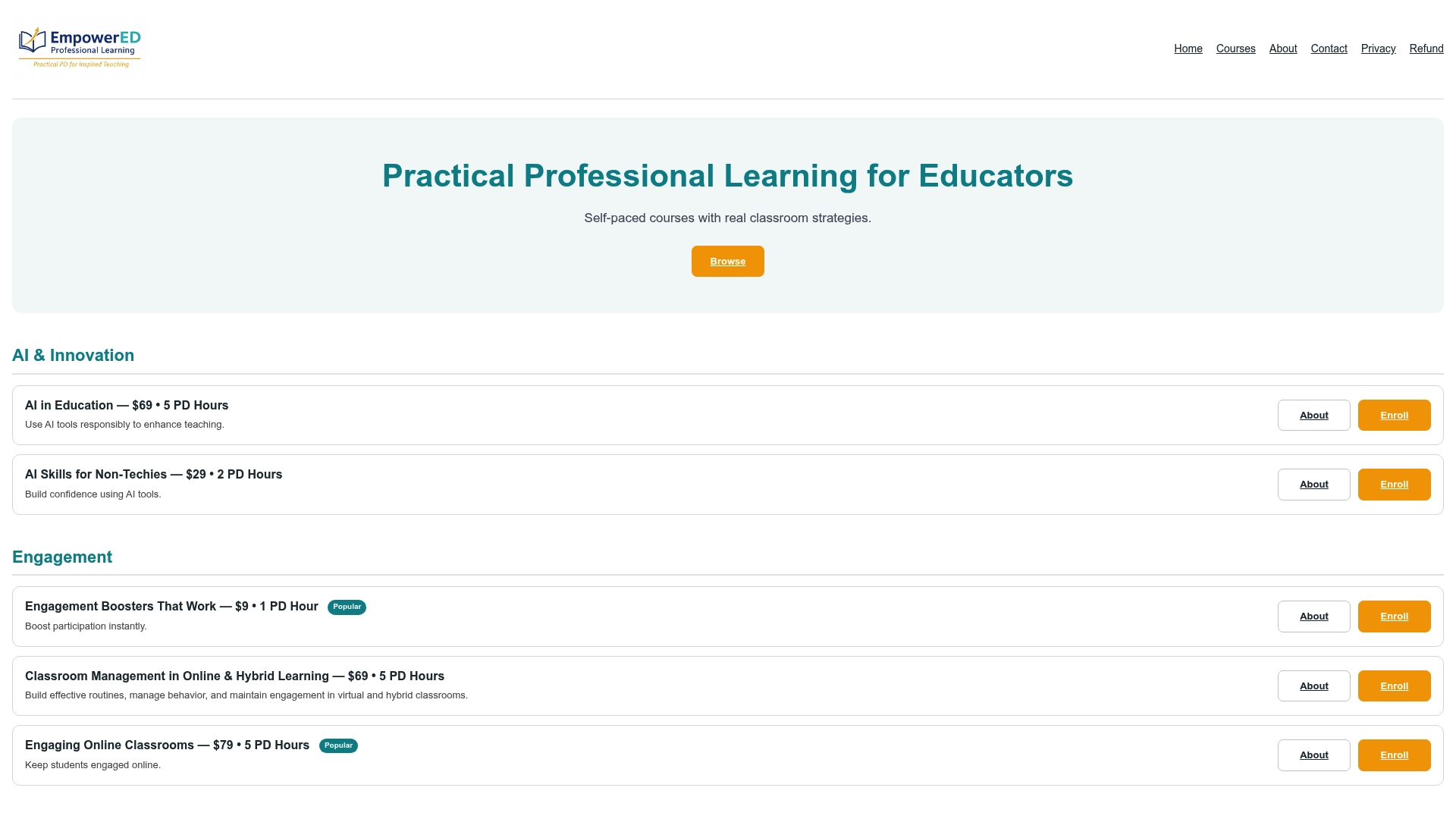
Empoweredpl offers targeted professional learning courses built specifically for K-12 educators who want to move from understanding formative assessment to using it with confidence every day. Courses address practical challenges like managing evidence collection in large classes, designing hinge questions that reveal real misconceptions, and building student self-assessment habits that stick. Educators who complete Empoweredpl courses report immediate implementation in their classrooms. Explore the full range of professional development for educators and find the course that fits your current teaching context.
FAQ
What are the main types of formative assessment techniques?
The main types include exit tickets, hinge questions, Show Me responses using mini whiteboards, classroom observations, one-on-one interviews, and Classroom Assessment Techniques like Minute Paper and Muddiest Point. Each method targets a different phase of the learning cycle and produces a different type of evidence.
How is formative assessment different from summative assessment?
Formative assessment happens during instruction and is used to adjust teaching in real time, while summative assessment measures learning after instruction is complete. The defining feature of formative practice is that the evidence collected leads to an immediate instructional change.
How often should teachers use formative assessment?
Formative checks work best when used frequently and at low stakes, ideally multiple times per lesson or unit segment. Brief, targeted checks like a one-question hinge question or a two-question exit ticket are more effective than infrequent, lengthy assessments.
What makes a formative assessment technique effective?
A technique is effective when it is designed around a specific learning target, generates evidence tied to a pre-planned instructional decision, and leads to a teaching adjustment. Evidence without instructional action does not qualify as formative practice regardless of the tool used.
Can students use formative assessment techniques themselves?
Yes. Peer feedback and self-assessment are both recognized formative strategies. They require that learning targets are communicated in student-friendly language before the task begins, so students can evaluate their own progress against a clear standard rather than a vague expectation.
Recommended
]]