Classroom routines are structured, predictable sequences of activities that reduce cognitive load and directly increase students’ capacity to learn. Research from Virginia Commonwealth University’s TTAC and Edutopia confirms that why classroom routines improve learning comes down to one core mechanism: when students know exactly what to do next, their working memory is free to focus on content rather than procedures. Routines also support executive function skills like attention, planning, and self-regulation. Beyond cognitive benefits, a 2026 Springer Nature study found that purposeful morning routines increase children’s sense of belonging, which is an upstream driver of deeper academic engagement.
How do classroom routines reduce cognitive load and support learning?
Predictable classroom routines reduce cognitive load by clarifying how students begin work and stay engaged, freeing mental energy for actual learning. This is not a soft benefit. Working memory is limited, and every decision a student must make about procedure draws from the same cognitive budget as content processing. When routines handle the procedural layer automatically, students can think harder about the material in front of them.
Edutopia’s Jim Heal explains that routines preserve working memory so students and teachers can focus on lesson content rather than procedural noise. A classroom where students know to retrieve materials, review the agenda, and begin a warm-up activity without prompting is a classroom where the teacher can open instruction at a higher cognitive level. That is not incidental. That is the design.
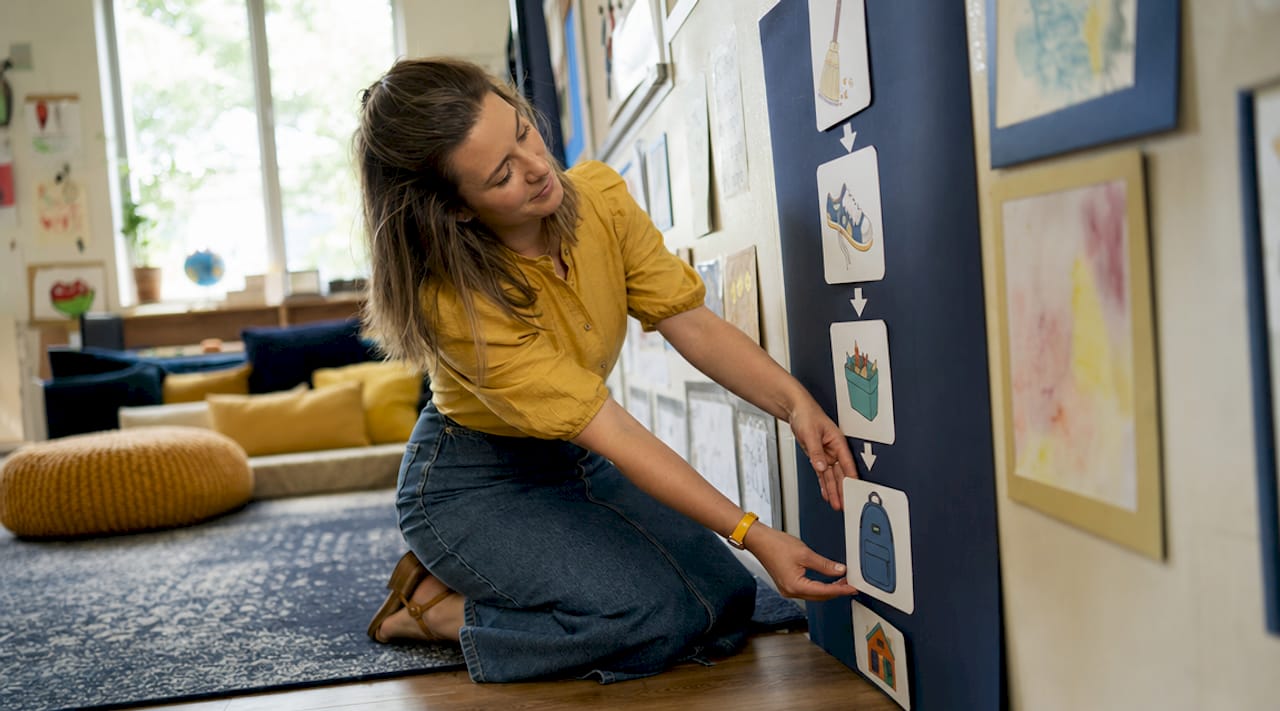
The Virginia DOE’s TTAC frames routines as both cognitive and metacognitive supports, aligned with the Gradual Release of Responsibility model. This model, often called “I do, we do, you do,” teaches routines in stages so students internalize the sequence rather than just comply with it. A teacher might model the transition from independent reading to group discussion, then practice it with the class, then release students to manage it independently. Classroom-based executive-function training using structured sequences like this showed significant improvements in working memory, planning, and cognitive flexibility across 18 sessions.
Practical examples of cognitive load reduction through routines include:
- Structured entry routines: Students see a posted agenda and a do-now task the moment they walk in, eliminating the “what are we doing?” decision.
- Clear transition signals: A consistent audio cue (a chime or clap pattern) tells students exactly when and how to shift activities.
- Procedure anchors: Labeled supply stations and posted step-by-step instructions for common tasks remove the need to ask for directions repeatedly.
- Exit ticket sequences: A predictable end-of-class reflection routine signals closure and reinforces metacognitive habits.
Pro Tip: Post routine steps visually at eye level for students. Visual anchors reduce the number of verbal reminders you give, which also lowers your own cognitive load during instruction.
What social-emotional benefits do classroom routines provide?
Routines fulfill students’ social and emotional needs in ways that directly affect their willingness to participate and take academic risks. A 2026 Springer Nature study found that morning routines increase belonging scores among children, with teacher observations reporting improved peer interactions and greater comfort in the classroom environment. Belonging is not a feel-good metric. Students who feel they belong in a classroom are more likely to ask questions, persist through difficulty, and engage with peers during collaborative tasks.
The key distinction is between routines that are merely procedural and routines that are purposefully relational. A morning meeting that includes a greeting, a sharing activity, and a group question is not just a warm-up. It is a structured opportunity for students to practice social skills, feel seen by their teacher, and connect with classmates before academic demands begin. Treating this as dead time is a missed opportunity.
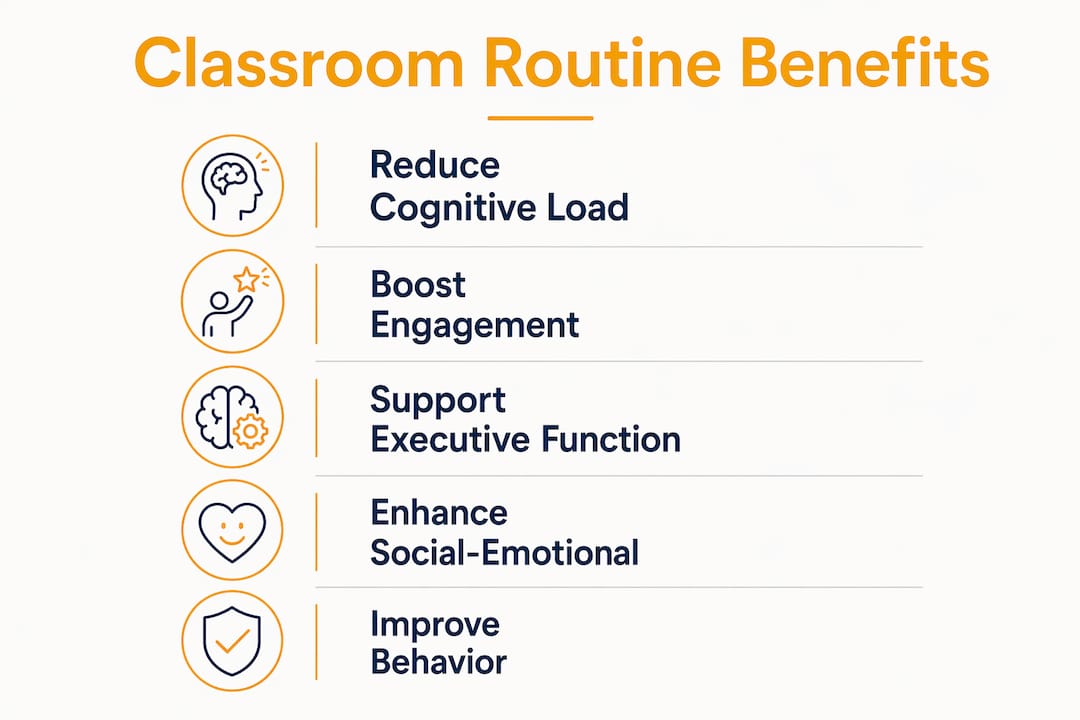
The table below summarizes the social-emotional benefits documented in recent research:
| Routine type | Social-emotional outcome | Academic connection |
|---|---|---|
| Morning meeting or greeting routine | Increased sense of belonging | Higher willingness to participate |
| Peer collaboration protocols | Improved social interaction skills | Stronger group work outcomes |
| Mindfulness or breathing routine | Reduced anxiety and emotional dysregulation | Better focus during instruction |
| Consistent teacher check-ins | Stronger student-teacher relationship | Increased trust and academic risk-taking |
| Structured transitions | Reduced social conflict between activities | Smoother instructional flow |
Purposeful social-emotional routine design improves belonging and peer interaction rather than treating routines as mere classroom warm-ups. Educators who recognize this distinction build classrooms where students are emotionally ready to learn before the first academic task begins.
What are the effects of routines on student behavior and classroom environment?
Routines are one of the most direct tools educators have for reducing disruptive behavior without relying on reactive discipline. A study published in Contemporary School Psychology found that a combined Second Chance Breakfast and mindfulness routine produced statistically significant improvements in academic engagement and a moderate reduction in disruptive behaviors in elementary classrooms. This matters because the intervention did not require additional staff, new curriculum, or disciplinary systems. It required a structured sequence of activities at the start of the school day.
Two behavioral concepts explain why routines work at this level. The first is behavioral momentum, which refers to the principle that students who complete a series of easy, familiar steps are more likely to comply with subsequent demands. A smooth entry routine builds momentum that carries into the first instructional block. The second is neutralizing routines, which are specific sequences designed to de-escalate students who arrive dysregulated. A brief mindfulness or breathing activity at the start of class gives students a structured way to reset before academic expectations begin.
Routines are especially effective in diverse and underserved student populations, where external stressors can make self-regulation more difficult. Consistent classroom structure provides a reliable environment that compensates for unpredictability outside of school.
Key behavioral benefits of well-designed classroom routines include:
- Fewer transitions that result in off-task behavior or conflict
- Reduced need for teacher redirection during instructional time
- Greater student independence in managing materials and movement
- More consistent academic engagement across the full class period
Pro Tip: If a routine is breaking down repeatedly at the same point, that is diagnostic information. It usually means the procedure is ambiguous at that step. Reteach it explicitly rather than increasing consequences.
How do home routines and parenting interact with school-based routines?
The benefits of classroom routines do not exist in isolation. A 2026 Penn State study found that stronger home routines lower behavior problems and reduce ADHD symptoms in children, but harsh or aggressive parenting significantly reduces these benefits even when home routines are strong. This finding has direct implications for how educators interpret student behavior and design support systems.
Students who experience consistent routines both at home and at school show the strongest behavioral and academic outcomes. Students who have strong school routines but chaotic or high-stress home environments still benefit from classroom structure, but the effect is moderated. Educators cannot control what happens at home, but they can recognize that some students need more explicit routine coaching at school to compensate for less predictability elsewhere.
Practical steps educators and administrators can take based on this research:
- Share routine-building strategies with families through newsletters, family nights, or brief video guides
- Avoid assuming that a student who struggles with routines is non-compliant. They may simply have less practice with structured sequences outside of school
- Coordinate with school counselors and social workers when a student’s home environment is identified as a significant stressor
- Design morning routines that include a brief emotional check-in, giving students a structured way to signal when they are not ready to learn
The school-home connection is not optional for maximizing the impact of routines on education. It is a variable that shapes how much students can benefit from the structure you build in your classroom.
What are best practices for designing effective classroom routines?
Effective routine design starts with the Gradual Release of Responsibility framework. Introduce each routine by modeling it completely (“I do”), then practice it with the class as a group (“we do”), then have students practice in pairs or small groups (“you do together”), and finally release them to execute it independently (“you do alone”). Skipping steps in this sequence is the most common reason routines fail to stick.
Eliminating ambiguity in transitions is the single most important design principle. If students have to decide what to do next at any point in a routine, cognitive load increases and learning focus suffers. Every transition should have a clear signal, a clear destination, and a clear first action upon arrival.
Named routine frameworks that educators have implemented successfully include:
- SLANT (Sit up, Lean forward, Ask questions, Nod, Track the speaker): A listening routine that makes attentive behavior explicit and teachable.
- SCORE (Sit up, Contribute, Offer help, Respect others, Encourage): A collaborative discussion routine that structures peer interaction.
- TREE (Topic sentence, Reasons, Explanations, Ending): A writing routine that externalizes the structure of a paragraph so students can focus on content rather than format.
Routines externalize self-regulation demands, allowing students to internalize learning skills beyond behavior compliance. The goal is not a compliant classroom. The goal is a classroom where students have internalized the habits of effective learners.
Pro Tip: Revisit and reteach routines after every extended break. Students need reactivation, not punishment, when they return from winter or spring break and the routine has degraded.
Key takeaways
Classroom routines improve learning by reducing cognitive load, supporting executive function, and creating the social-emotional conditions that make academic engagement possible.
| Point | Details |
|---|---|
| Cognitive load reduction | Predictable routines free working memory so students focus on content, not procedures. |
| Executive function support | Structured sequences like SLANT and TREE externalize self-regulation and build independent learning habits. |
| Social-emotional benefits | Morning routines increase belonging scores, which directly raises student participation and academic risk-taking. |
| Behavioral impact | Combined routines like Second Chance Breakfast with mindfulness reduce disruptive behavior without new disciplinary systems. |
| Home-school alignment | Strong home routines amplify school-based benefits; educators can share routine strategies with families to extend impact. |
What I’ve learned from watching routines transform classrooms
I have seen teachers spend the first three weeks of school doing nothing but teaching routines, and I have seen those same classrooms outperform comparable groups by February. The investment is not intuitive. It feels like lost instructional time. It is not.
What strikes me most is how often educators underestimate the social-emotional layer. A well-designed morning meeting is not a soft activity. It is the mechanism that makes a student feel safe enough to raise their hand when they do not understand something. That willingness is worth more than any single lesson.
The hardest part of routine-building is resisting the urge to treat it as a one-time setup. Routines are living structures. They need reteaching after breaks, adjustment when a class’s needs shift, and honest reflection when they stop working. The educators I have seen get the most out of routines are the ones who treat them as instructional tools, not administrative scaffolding.
If you are an administrator, the most useful thing you can do is protect the time teachers need to build and reteach routines at the start of the year. That time pays compound interest across the entire school year.
— Brian
Take your classroom management strategies further with Empoweredpl
Empoweredpl offers targeted professional learning courses built specifically for K-12 educators who want to move beyond theory and apply research-backed strategies in their classrooms immediately.
Courses from Empoweredpl cover executive function supports, behavior management, and routine design using practical frameworks you can implement the next school day. Whether you are refining your classroom organization approach or building new systems for student engagement, Empoweredpl’s programs are designed to meet you where you are and give you tools that work. Explore the full course catalog and find the professional development that fits your immediate classroom needs.
FAQ
Why do classroom routines improve learning outcomes?
Classroom routines reduce cognitive load by automating procedural decisions, freeing students’ working memory for content processing. Research from VCU TTAC confirms that predictable routines also support executive function skills like attention and planning, which are prerequisites for deep learning.
How long does it take for classroom routines to become effective?
Most routines require consistent modeling and practice over two to three weeks before students execute them independently. Using the Gradual Release of Responsibility framework (“I do, we do, you do”) accelerates internalization and reduces the need for repeated teacher prompting.
What is the connection between routines and student behavior?
A study in Contemporary School Psychology found that structured morning routines combining Second Chance Breakfast and mindfulness produced statistically significant reductions in disruptive behavior and increased academic engagement in elementary students.
Do home routines affect how well school routines work?
Yes. Penn State research shows that strong home routines lower behavior problems and ADHD symptoms, but harsh parenting moderates these benefits. Educators can extend routine benefits by sharing family-friendly routine strategies with caregivers.
What are examples of effective classroom routines for K-12 students?
Named frameworks like SLANT (a listening routine), SCORE (a collaborative discussion protocol), and TREE (a paragraph writing structure) give students explicit, repeatable sequences that externalize self-regulation and reduce decision-making demands during learning tasks.