
Culturally responsive teaching is defined as a pedagogical approach that uses students’ cultural knowledge and experiences to make learning more relevant, effective, and equitable for ethnically diverse students. Scholars Geneva Gay and Gloria Ladson-Billings established this framework, with Gay emphasizing culture as a central instructional asset and Ladson-Billings coining the term culturally relevant pedagogy to describe teaching that supports academic success while affirming cultural identity. For K-12 educators working in increasingly diverse classrooms, this approach is not optional enrichment. It is a foundational shift in how instruction is designed, delivered, and assessed. Understanding what culturally responsive teaching actually requires, and what it does not, is the starting point for every educator committed to genuine equity.
What is culturally responsive teaching and why does it matter?
Culturally responsive teaching (CRT) is a systemic instructional model that modifies techniques, materials, relationships, classroom climate, and teacher self-awareness to reflect and affirm the cultural identities of all students. It is not a single lesson or a bulletin board display. It is a coordinated set of instructional decisions that treat culture as a resource for learning rather than a barrier to overcome.
Geneva Gay’s framework, widely cited by New America and Heinemann, positions culture as the lens through which students process new information. When teachers ignore that lens, they create unnecessary distance between what students already know and what they are being asked to learn. That distance shows up as disengagement, underperformance, and widening achievement gaps, particularly for Black, Latino, Indigenous, and other historically marginalized students.
Gloria Ladson-Billings extended this thinking by arguing that effective teaching must simultaneously produce academic achievement, develop positive cultural identity, and build critical consciousness. Her three-goal framework remains the most widely cited structure in culturally responsive pedagogy research. The practical implication is direct: a teacher cannot claim to be culturally responsive while ignoring whether students see themselves reflected in the curriculum or whether they are developing the capacity to think critically about the world around them.
CRT also blends cognition and culture, recognizing that the brain integrates new information through existing cultural contexts. This is not a soft, feel-good principle. It is grounded in how learning actually works.

What are the core tenets and goals of culturally responsive teaching?
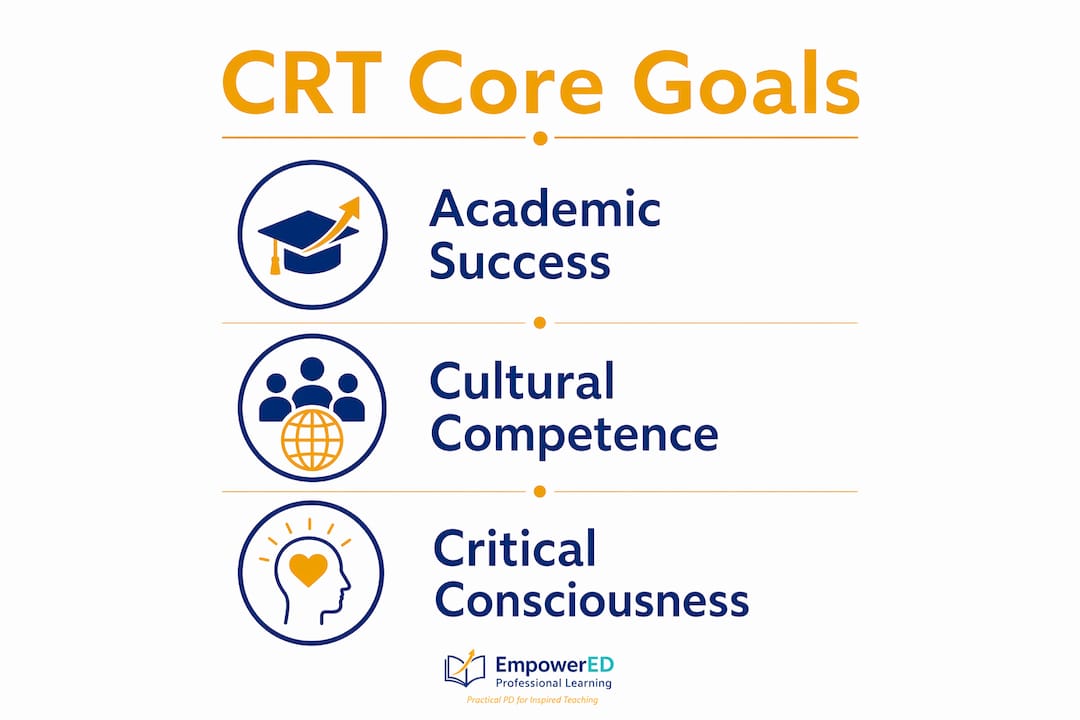
Gloria Ladson-Billings identified three goals that define culturally relevant pedagogy, and Education Week confirms these remain the organizing framework for CRT practice today:
- Academic success: Students must meet rigorous academic standards. CRT does not lower expectations. It changes the instructional pathway to make high achievement accessible to more students by connecting content to what they already know and value.
- Cultural competence: Students develop a strong, positive sense of their own cultural identity while also learning to function effectively in other cultural contexts. This is not about celebrating heritage months. It is about building identity as an intellectual asset.
- Critical consciousness: Students learn to recognize and challenge social inequities. This goal is often misunderstood as political indoctrination, but its actual purpose is to develop students’ capacity for analytical thinking about the world they live in.
One of the most persistent misconceptions about CRT is that emphasizing cultural identity requires softening academic rigor. The three-tenet framework directly refutes this. Standards are not lowered. The instructional approach is refined so that more students can meet them. A student who sees their community’s history in a primary source document is more likely to engage analytically with that document, not less.
Pro Tip: When planning a unit, map each lesson to at least one of Ladson-Billings’ three goals. If a lesson only addresses academic content and ignores cultural identity or critical thinking, revise it before you teach it.
How does culturally responsive teaching differ from related approaches?
Educators frequently encounter three overlapping terms: culturally responsive teaching, culturally relevant pedagogy, and culturally sustaining pedagogy. They share an asset-based perspective on students’ cultural backgrounds, but they differ in emphasis, scope, and application.
| Framework | Primary Focus | Key Emphasis | Practical Application |
|---|---|---|---|
| Culturally responsive teaching (Geneva Gay) | Instructional practice | Using culture to improve academic outcomes | Modifying techniques, materials, and climate |
| Culturally relevant pedagogy (Gloria Ladson-Billings) | Student outcomes and identity | Academic success, cultural competence, critical consciousness | Curriculum design and teacher-student relationships |
| Culturally sustaining pedagogy (Django Paris) | Long-term cultural preservation | Sustaining students’ cultural and linguistic practices | Centering community languages and traditions in schooling |
Culturally responsive teaching, as Gay defines it, is the most instructionally focused of the three. It asks teachers to make specific, observable changes to how they teach. Ladson-Billings’ culturally relevant pedagogy adds a stronger emphasis on student identity development and social critique. Django Paris’ culturally sustaining pedagogy, introduced in 2012, pushes further by arguing that schools should actively preserve students’ cultural and linguistic practices, not merely acknowledge them.
For most K-12 educators, Gay’s framework is the most practical entry point because it translates directly into classroom decisions. Understanding the distinctions between these frameworks prevents the common error of treating them as interchangeable, which dilutes the precision of each approach.
What are effective culturally responsive teaching practices for K-12 classrooms?
New America identifies eight teacher competencies that operationalize CRT in real classrooms. The most effective practices cluster around four areas:
-
Cultural scaffolding: Identify what students already know from their home and community experiences, then use that knowledge as the foundation for introducing new academic concepts. A math teacher in a predominantly Latino community might connect ratio problems to cooking recipes students recognize from home. This is not simplification. It is strategic connection-building.
-
Curriculum evaluation and supplementation: Evaluate existing materials for representation gaps and stereotypes. Supplement with diverse curriculum resources such as news clippings, song lyrics, documentary clips, and community-produced texts that provide both mirrors (students see themselves) and windows (students see others). A standard U.S. history textbook rarely reflects the full range of student experiences in a diverse classroom.
-
Student input in assessment design: Incorporate student voice into how learning is demonstrated. When students have input on assignment formats, they engage more deeply with the content. Formative assessment techniques can be adapted to allow students to demonstrate understanding through formats that reflect their strengths and backgrounds.
-
Teacher self-awareness and cultural humility: Reflect consistently on your own cultural assumptions and how they shape your instructional decisions. This is not a one-time exercise. It is an ongoing professional practice. Teachers who examine their own biases are better positioned to recognize when their default instructional choices exclude or disadvantage certain students.
The iterative bridging approach operationalizes these competencies in three steps: identify students’ cultural frames of reference, scaffold new concepts onto those frames, and refine tasks and assessments using student input. This cycle repeats throughout a unit, not just at the start.
Pro Tip: Before each unit, survey students about their prior experiences with the topic. A simple three-question written response takes five minutes and gives you the cultural scaffolding data you need to plan more effectively.
Building consistent classroom routines also supports CRT by creating predictable structures within which culturally affirming interactions can occur. Students who feel physically and emotionally safe in a classroom are more likely to take the intellectual risks that rigorous learning requires. Cultural responsiveness and classroom management are not separate concerns. They reinforce each other directly.
What are common misconceptions and pitfalls to avoid?
Educators who approach CRT without a clear, research-grounded definition frequently make implementation errors that reduce its effectiveness. The most common pitfalls include:
- Confusing rapport with responsiveness. A common misconception is that being warm, friendly, and caring toward students constitutes culturally responsive teaching. Positive relationships are necessary but not sufficient. CRT requires systemic changes to instruction, not just interpersonal warmth.
- Surface-level cultural content. Displaying flags, celebrating heritage months, or adding one diverse author to a reading list does not constitute CRT. These acts can be meaningful, but they are not a substitute for the deeper instructional work of connecting academic content to students’ lived experiences.
- Lowering academic expectations. Some educators mistakenly believe that affirming students’ cultural identities means reducing academic demands. This is the opposite of what CRT requires. The goal is to use cultural knowledge as a lever for higher achievement, not as a reason to expect less.
- Treating CRT as a program rather than a practice. CRT is not a curriculum package you purchase and implement. It is a professional orientation that requires ongoing educator growth and a growth mindset. Educators who treat it as a checklist miss its transformative potential entirely.
- Tokenistic representation. Inserting one culturally specific example into an otherwise unchanged lesson does not make instruction culturally responsive. Students recognize tokenism quickly, and it can undermine trust rather than build it.
Avoiding these pitfalls requires coherent, research-informed definitions and a commitment to the full scope of CRT practice. Partial implementation produces partial results.
Key takeaways
Culturally responsive teaching requires systemic changes to instruction, materials, relationships, and teacher self-awareness, grounded in Ladson-Billings’ three goals of academic success, cultural competence, and critical consciousness.
| Point | Details |
|---|---|
| Foundational definition | CRT uses students’ cultural knowledge and experiences as instructional assets, not add-ons. |
| Three core goals | Academic success, cultural competence, and critical consciousness guide every CRT decision. |
| Practical entry point | Cultural scaffolding and student input in assessment are the most direct implementation strategies. |
| Common pitfall | Confusing friendliness or surface representation with systemic culturally responsive practice. |
| Professional growth | CRT requires continuous self-reflection and cultural humility, not a one-time training. |
Why CRT is the most important shift in teaching practice I’ve seen
I have worked with educators across grade levels and subject areas for over two decades, and the shift toward culturally responsive pedagogy is the most consequential change I have seen in classroom practice. Not because it is trendy, but because it addresses the actual mechanism by which students disengage: the persistent message, embedded in curriculum and instruction, that their backgrounds and experiences are not academically relevant.
What I find most striking is how often educators underestimate their own cultural assumptions. Most teachers entered the profession with genuine care for students. But care alone does not produce equity. I have watched skilled, well-intentioned teachers consistently call on students whose communication styles mirror their own, design assessments that favor linear written responses, and select texts that reflect a narrow cultural range, all without realizing they were doing it. CRT gives educators the framework to see those patterns and change them.
The growth mindset required for CRT is not about self-criticism. It is about professional precision. When you understand that cognition is shaped by cultural context, you stop treating culturally responsive practices as extra work. You recognize them as the core of effective teaching. The educators I have seen make the most progress are those who treat CRT as an identity practice, not a compliance requirement. They ask not just “What am I teaching?” but “Who am I teaching, and what do they bring to this learning?”
If you are early in this work, start with self-reflection and cultural scaffolding. If you are further along, examine your assessment practices and curriculum materials with fresh eyes. The work is ongoing, and that is exactly as it should be.
— Brian Koster, Ed.D.
Deepen your culturally responsive teaching practice with Empoweredpl
Empoweredpl offers targeted professional development courses built specifically for K-12 educators who want to move beyond theory and apply culturally responsive strategies in real classrooms.
Empoweredpl’s educator professional development courses address the specific instructional challenges that make CRT difficult to implement consistently, including classroom climate, student engagement, and formative assessment design. Courses on hybrid learning strategies help you connect with diverse learners across instructional formats. Each course is designed for immediate application, so you leave with strategies you can use in your next lesson, not just ideas to consider later.
FAQ
What is culturally responsive teaching in simple terms?
Culturally responsive teaching is an instructional approach that uses students’ cultural backgrounds, prior experiences, and identities to make academic content more relevant and accessible. It was developed by scholars Geneva Gay and Gloria Ladson-Billings and applies across all subject areas and grade levels.
How does CRT differ from culturally sustaining pedagogy?
Culturally responsive teaching focuses on modifying instructional practices to improve academic outcomes, while culturally sustaining pedagogy, developed by Django Paris, goes further by actively working to preserve students’ cultural and linguistic practices within schooling.
Does culturally responsive teaching lower academic standards?
No. The three-tenet framework outlined by Gloria Ladson-Billings explicitly requires high academic achievement alongside cultural competence and critical consciousness. CRT changes the instructional pathway to rigorous standards, not the standards themselves.
What are the most practical CRT strategies for classroom teachers?
Cultural scaffolding, curriculum supplementation with representative materials, and incorporating student input into assessments are the three most directly applicable strategies. New America’s eight teacher competencies provide a full framework for implementation.
Can CRT be used in all subject areas?
Yes. CRT applies to every subject. A science teacher can connect ecological concepts to students’ local environments. A math teacher can use culturally familiar contexts for problem-solving. The cultural context of language and music also offers strong entry points for ELA and arts educators.