

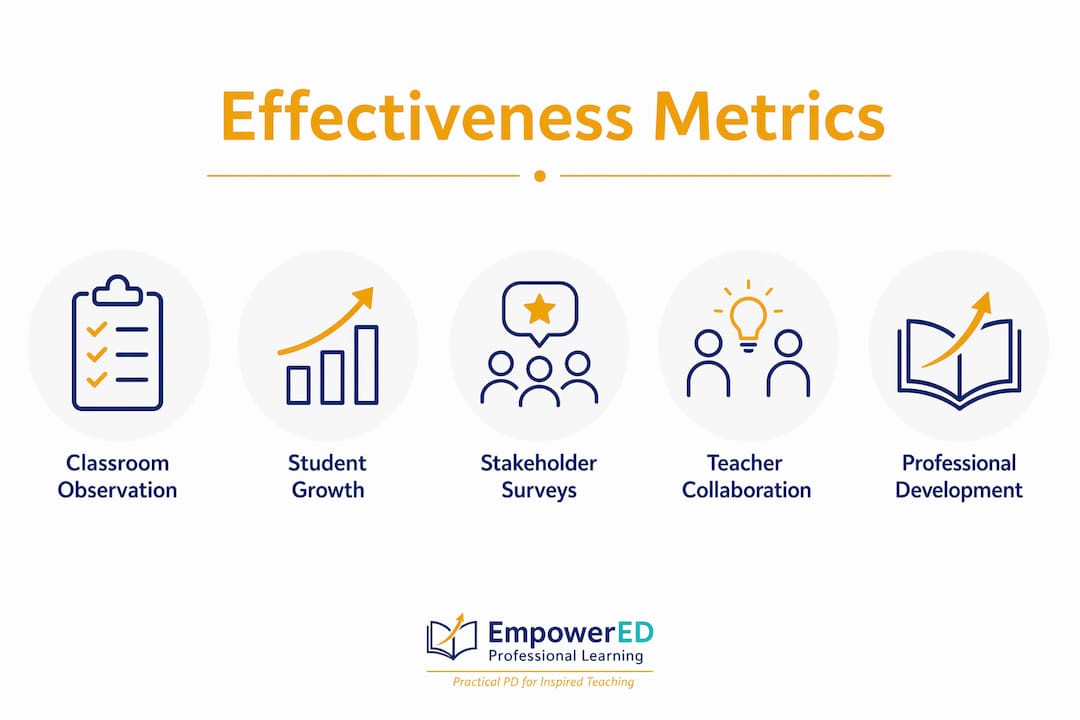
Educator effectiveness metrics are defined as multi-measure systems that assess teaching performance across classroom observations, student growth data, stakeholder feedback, and content knowledge to improve instructional quality and student outcomes. These systems go far beyond a single observation score. Research shows that a school-based performance management model incorporating cognitive, affective, and pedagogical dimensions improved student outcomes by 17.8% and teacher digital pedagogy competency by 22.4%. That result signals what well-designed educator effectiveness metrics explained through a multi-dimensional lens can actually accomplish. Frameworks like the Teacher Effectiveness Measure (TEM) and Education Value-Added Models are the industry’s recognized standards for putting these ideas into practice.
What components are included in educator effectiveness metrics?
The Teacher Effectiveness Measure (TEM) is one of the most cited multi-measure frameworks in K-12 evaluation. It distributes weight across five data sources, each serving a distinct purpose in evaluating educator effectiveness.
The TEM weighting structure breaks down as follows:
| Component | Weight |
|---|---|
| Classroom observation | 40% |
| Student growth (value-added) | 35% |
| Student achievement | 15% |
| Stakeholder perceptions | 5% |
| Content knowledge assessment | 5% |
Classroom observation carries the largest share because it captures instructional practice directly. Trained observers use structured rubrics to assess questioning techniques, pacing, student engagement, and feedback quality during live or recorded lessons.

Student growth data, often calculated through Education Value-Added Models, tracks how much a teacher’s students improve relative to similar peers. The Measures of Effective Teaching project recommends weighting student growth between 33% and 50% to balance accuracy with statistical stability. That range reflects the reality that a single year of growth data is noisy and benefits from being paired with other measures.
Stakeholder perceptions, including student surveys, round out the picture. Student survey instruments like the Tripod survey ask about classroom climate, teacher clarity, and whether students feel challenged. These data points add a perspective that observation alone cannot capture.
Pro Tip: When reviewing your district’s weighting model, check whether student growth data sits within the 33%–50% range. Models that weight it higher without strong statistical controls increase the risk of unfair evaluations.
What are the limitations of teacher performance metrics?
Knowing what these metrics measure is only half the job. Understanding where they fall short is what separates informed leaders from those who misapply data.
Value-added models are the most commonly misunderstood component. Value-added scores typically explain only 1%–14% of variance in student test scores, with 86%–99% of variance attributed to factors outside teacher control. That means a teacher’s value-added score reflects far more about student demographics, school resources, and home environment than it does about instructional quality alone.
Common pitfalls in interpreting teacher performance metrics include:
- Treating a single year’s value-added score as definitive. Scores fluctuate significantly from year to year, making one-year snapshots unreliable for high-stakes decisions.
- Ignoring contextual factors. A teacher working with high proportions of students experiencing poverty or trauma will often show lower growth scores, not because of poor teaching, but because of external pressures.
- Skipping the validity-first step. A validity-first approach requires districts to articulate the intended use and interpretation of evaluation data before selecting any metric. Without that step, systems often measure what is easy to quantify rather than what matters most.
- Using evaluation data punitively without transparency. When teachers cannot see how scores are calculated or appeal results, trust collapses and the system loses its ability to drive improvement.
Pro Tip: Involve teachers directly in reviewing their own evaluation data. Structured dialogue between teachers and evaluators, rather than one-way score delivery, produces more accurate interpretations and stronger professional growth.
How do schools balance accountability and professional growth?
The tension between accountability and professional growth is not new. It has shaped teacher evaluation policy for decades. The shift happening now is that evaluation systems are moving away from a policing model toward one that centers teacher feedback and professional dialogue.
Balancing these two purposes requires deliberate design choices. Here is a practical sequence for school and district leaders:
- Define the primary purpose first. Decide whether the system’s main goal is summative accountability, formative growth, or both. Mixed-purpose systems need explicit protocols to keep the two functions from undermining each other.
- Embed teacher voice throughout. Evaluation models developed with teacher input through iterative frameworks like ADDIE produce stronger engagement. Collaborative model development is directly linked to the 22.4% increase in digital pedagogy competency cited earlier.
- Use evaluation data to drive targeted professional learning. A teacher rated “developing” in questioning techniques should receive coaching specifically on that skill, not a generic workshop. Connecting evaluation findings to data-informed professional development is what makes the system worth the effort.
- Protect teacher voice through formal dialogue structures. Post-observation conferences, mid-year check-ins, and end-of-year reflection meetings give teachers the chance to contextualize their data rather than simply receive a verdict.
“Embedding teacher voice and dialogue within evaluation promotes professional growth and reduces negative culture around accountability. The shift from policing to improvement requires structural changes, not just attitude adjustments.”
That shift is measurable. Schools that redesign evaluation systems with teacher input report higher buy-in, lower grievance rates, and more consistent use of evaluation data for instructional planning.
What are best practices for implementing effective teaching assessment?
Effective teaching assessment works when the system is designed with the end use in mind and when teachers understand how every data point connects to their growth.
Best practices for implementation include:
- Align metrics to specific policy goals. A district focused on closing achievement gaps needs different metric weights than one focused on retaining early-career teachers. Misaligned systems produce data that nobody uses.
- Use non-compensatory or hybrid models. Non-compensatory evaluation models set minimum cut points in core competency areas. This design prevents a teacher from scoring high on peripheral activities while masking a serious weakness in, say, classroom management or content delivery.
- Set cut points carefully. Cut points define the threshold between performance levels. Setting them too low masks real weaknesses. Setting them too high creates a system that labels effective teachers as struggling.
- Build in transparency and appeal mechanisms. Teachers who can see their data, understand the methodology, and formally contest errors are more likely to trust and use the system constructively.
- Connect evaluation results to student engagement strategies. Evaluation data should feed directly into the professional learning teachers receive, not sit in a file until the next annual review.
Measuring teaching success is not a one-time event. The most effective districts treat evaluation as a continuous cycle: collect data, analyze patterns, deliver targeted support, and reassess. That cycle, repeated consistently, is what produces lasting instructional improvement.
Key Takeaways
Educator effectiveness metrics work best when they combine multiple data sources, prioritize validity, and connect directly to teacher growth rather than serving only as accountability checkboxes.
| Point | Details |
|---|---|
| Multi-measure design matters | Combine observation, student growth, and stakeholder data for a complete picture of teaching performance. |
| Value-added models have limits | VAM scores explain only 1%–14% of student score variance; never use them as the sole basis for high-stakes decisions. |
| Validity must come first | Define the intended use of evaluation data before selecting any metric to avoid misapplication. |
| Teacher voice drives improvement | Collaborative, iterative model development increases teacher engagement and measurably improves instructional competency. |
| Non-compensatory models protect accuracy | Minimum cut points prevent strong scores in minor areas from hiding critical teaching weaknesses. |
Why validity and teacher voice are the real foundation
I have spent years working with K-12 schools on professional learning systems, and the pattern I see most often is this: districts invest heavily in building evaluation frameworks, then treat validity as a technical detail to sort out later. That sequence is backward. Validity is not a compliance checkbox. It is the question you answer before you build anything else. What is this data actually for? Who will use it, and how? Without clear answers, even a well-weighted rubric becomes a tool that generates numbers nobody trusts.
The second thing I have observed is that teacher voice is not just a cultural nicety. It is a design variable with measurable outcomes. Schools that involve teachers in building and refining their own evaluation models see real gains in instructional competency, not because the metrics changed, but because teachers understand and own the process. The growth mindset principles that we ask teachers to model for students apply equally to how we ask them to engage with their own evaluation data.
The future of educator effectiveness systems is not more data. It is better questions, clearer purposes, and stronger relationships between evaluators and teachers. Districts that get that right will build systems that actually improve teaching rather than just document it.
— Brian Koster, Ed.D.
Practical resources from Empowered Professional Learning
Empowered Professional Learning offers targeted courses built specifically for K-12 educators who want to act on what their evaluation data tells them. The courses address real classroom challenges, from hybrid engagement to data literacy, with strategies that educators report using immediately after completing them.

For educators looking to strengthen the skills that evaluation systems measure, the Engagement Boosters That Work resource page offers practical, evidence-based tools tied directly to the instructional competencies most commonly assessed in formal evaluations. Empowered Professional Learning courses are designed to connect evaluation findings to concrete next steps, so professional learning feels relevant rather than routine. Visit Empowered Professional Learning to find courses matched to your current goals.
FAQ
What are educator effectiveness metrics?
Educator effectiveness metrics are multi-measure evaluation systems that assess teaching performance using classroom observations, student growth data, stakeholder surveys, and content knowledge assessments. They are designed to improve both instructional quality and student outcomes.
How much weight should student growth data carry in teacher evaluations?
The Measures of Effective Teaching project recommends weighting student growth data between 33% and 50% of a teacher’s overall evaluation score to balance accuracy with statistical stability.
Why are value-added models considered limited?
Value-added models explain only 1%–14% of variance in student test scores, meaning the vast majority of score differences reflect factors outside a teacher’s control, such as student demographics and home environment.
What is a non-compensatory evaluation model?
A non-compensatory model sets minimum performance thresholds in core teaching competencies, so a teacher cannot offset a critical weakness by scoring high in less important areas.
How can districts use evaluation data to support professional growth?
Districts connect evaluation findings to targeted professional learning by identifying specific skill gaps from observation data and pairing teachers with coaching or courses that address those exact areas.