

What is hybrid teacher workload, and why has it grown so much?
Hybrid teacher workload is the total effort required to instruct in-person and remote students at the same time, within a single lesson, using a single set of resources. It is not simply “more work.” It is a fundamentally different kind of work, one that doubles or triples the demands teachers face compared to a traditional single-modality classroom.
The increase comes from several compounding factors:
- Dual lesson preparation: Content must work for students sitting in the room and for students joining remotely, often requiring separate materials or formats.
- Real-time multitasking: Teachers monitor chat feeds, manage in-room behavior, troubleshoot technology, and deliver instruction simultaneously.
- Orchestration load: Research identifies three cognitive layers teachers carry: evaluating what is happening across both groups, forming goals in real time, and taking immediate action to keep learning on track.
- Technology integration: Managing platforms, cameras, microphones, and shared documents adds a layer of technical responsibility that did not exist in traditional classrooms.
- Emotional labor: Teachers report persistent anxiety about whether remote students are receiving equitable attention and support.
Understanding these components is the first step toward managing them.
What challenges make hybrid teaching so demanding?
The lack of clearly defined hybrid models is one of the most underappreciated drivers of workload. When schools deploy parallel, alternating, or blended hybrid formats without clearly communicating expectations, teachers improvise. That trial-and-error process is exhausting and unsustainable.

Technical demands compound the problem. Managing multiple platforms in real time, troubleshooting connectivity issues mid-lesson, and monitoring both physical and digital spaces simultaneously pushes cognitive load well beyond what a single teacher can comfortably sustain. NASA-TLX scores measuring teacher workload in hybrid settings show medium-to-high mental demand and temporal demand scores reaching up to 70 and 60 points respectively.
The emotional dimension is just as significant. Research shows that the feeling of not reaching all students equitably contributes more to teacher anxiety than the sheer number of hours worked. When a remote student goes quiet and a teacher cannot tell whether they are confused, disengaged, or simply having technical trouble, that uncertainty accumulates across every class period.
“Teachers feel the emotional burden from perceived gaps in engagement between remote and in-person learners. The absence of immediate feedback from online students contributes more to anxiety than sheer hours worked.” — Research on workload and emotional factors in hybrid and online teaching
Key workload drivers at a glance:
- Insufficient training before hybrid formats launch
- No dedicated planning time for dual-modality lessons
- Simultaneous management of physical and digital classroom spaces
- Institutional expectations that do not account for the added complexity
- Limited access to integrated tools that reduce redundant tasks
How can you balance and manage your hybrid workload effectively?
Time management is the foundation. Blocking dedicated planning time for hybrid lessons, separate from general prep, prevents the last-minute scramble that drains energy before the school day even begins. Scheduling asynchronous tasks like feedback and grading during lower-energy windows preserves focus for live instruction.

Universal Design for Learning (UDL) is the most practical framework for reducing redundant lesson creation. When you design content with multiple means of representation and engagement from the start, the same lesson serves both your in-room and remote students without requiring a separate version. UDL-aligned planning significantly reduces orchestration load because the lesson structure itself accommodates both modalities rather than forcing you to adapt on the fly.
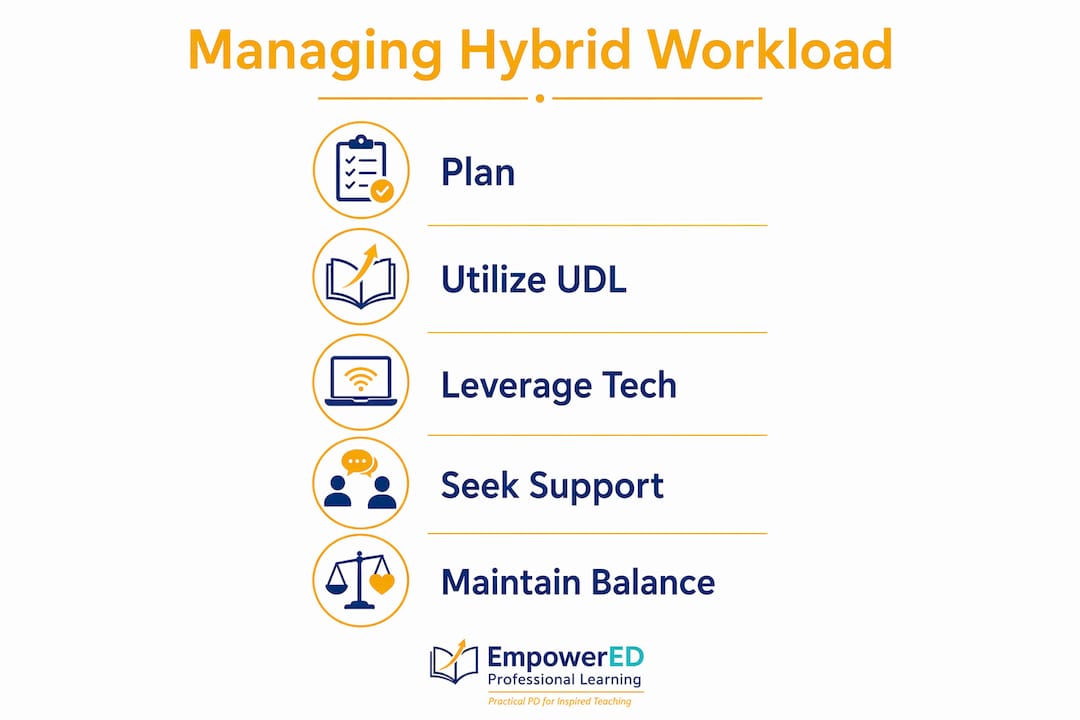
Technology choices matter too. Integrated platforms that centralize resources, enable synchronous group monitoring, and support real-time collaboration allow teachers to manage both student groups from a single interface. Teachers using these tools report lower workload than those toggling between disconnected apps.
Pro Tip: Shift your mental model from multitasking to multi-modal tasking. Instead of trying to do the same thing for two groups at once, design each modality’s experience intentionally. Treating in-person and remote participation as distinct but parallel tracks reduces cognitive strain and produces better outcomes for both groups.
Practical strategies to apply now:
- Use UDL principles when planning for the new school year so lessons are flexible by design.
- Build hybrid learning routines that students in both settings can follow independently.
- Collaborate with colleagues to share lesson templates, reducing individual prep time.
- Designate one platform as the single source of truth for materials, assignments, and communication.
- Set clear boundaries around response times for online student messages to protect planning time.
Professional learning resources that support hybrid teaching
Targeted professional development reduces anxiety and builds real confidence in hybrid settings. Empowered Professional Learning offers courses built specifically for K-12 educators navigating these demands, with practical strategies you can apply in your classroom the next day.
Relevant courses include:
- Hybrid Learning Routines and Procedures for K-12 Teachers: Covers practical classroom management structures for both in-person and remote learners, with a focus on building consistent routines that reduce daily decision fatigue.
- Effective Assessment and Feedback in Online and Hybrid Learning: Addresses one of the most time-consuming aspects of hybrid teaching by providing assessment strategies that work across both modalities without doubling your grading workload.
- Classroom Management in Online and Hybrid Learning: Focuses on engagement and behavior management techniques tailored to the unique dynamics of split-audience instruction.
- Student Engagement Strategies for K-12 Educators: Provides approaches to keep both in-room and remote students actively participating, which directly reduces the emotional burden of feeling like you are losing half your class.
Each course integrates UDL principles and is designed for educators preparing for the new school year.
How does hybrid workload affect teacher well-being?
The cumulative weight of hybrid teaching demands takes a measurable toll. Surveys of instructors in hybrid and online models show that over 50% report significantly increased time spent rethinking methodologies, correcting student work, and providing online tutoring. That is time pulled from rest, planning, and personal recovery.
Digital workload fatigue is a recognized pattern in hybrid teaching arrangements, where the always-on nature of online communication blurs the boundary between school hours and personal time. Teachers who cannot establish clear limits around digital availability report lower professional commitment over time. Burnout in hybrid settings tends to build gradually, driven less by any single overwhelming day and more by the steady accumulation of unresolved cognitive and emotional demands across weeks and months.
What tasks most commonly drive hybrid workload up?
The tasks that consume the most additional time in hybrid teaching are often invisible in workload calculations:
- Redesigning assessments to work fairly for both in-person and remote students
- Recording or captioning lessons for asynchronous access
- Monitoring online participation during live sessions while managing the physical room
- Responding to remote student questions outside of class time
- Troubleshooting technology failures mid-lesson without losing the in-room group
- Creating and managing digital collaboration spaces alongside physical ones
- Providing individual feedback through multiple channels simultaneously
Each of these tasks is reasonable on its own. Together, they represent a fundamentally different workload profile than traditional teaching, one that requires deliberate systems to manage.
What institutional support actually helps hybrid teachers?
Schools that successfully manage hybrid workload share a few concrete practices. They provide dedicated planning time for hybrid formats, not just general prep periods. They invest in integrated technology platforms rather than expecting teachers to stitch together disconnected tools. They communicate clearly which hybrid model is in use, whether parallel, alternating, or blended, so teachers know what is expected rather than guessing.
Access to adequate resources matters beyond technology. Research on the 2020–2021 National Teacher and Principal Survey found that teachers in schools with more adequate resources were less likely to report dissatisfaction and intent to leave teaching, even when managing hybrid instruction. Administrative support, peer collaboration structures, and access to professional development all reduce the isolation that amplifies hybrid workload stress.
Key Takeaways
Hybrid teacher workload requires deliberate systems, UDL-based planning, and institutional support to remain sustainable across a full school year.
| Point | Details |
|---|---|
| Workload doubles or triples | Hybrid teaching demands significantly more time and cognitive effort than single-modality instruction. |
| Orchestration load is the core challenge | Teachers carry three simultaneous cognitive layers: evaluating, goal-forming, and acting in real time. |
| UDL reduces redundant planning | Designing lessons with UDL principles from the start serves both modalities without separate lesson versions. |
| Emotional strain exceeds hours worked | The feeling of not reaching all students equitably drives anxiety more than total time on task. |
| Institutional support changes outcomes | Teachers with adequate resources and clear model expectations report lower dissatisfaction and burnout. |