Breathing exercises, mindful listening, brief body scans, and movement-based resets are the four classroom mindfulness approaches that give teachers the fastest return: calmer transitions, fewer disruptions, and modest but real gains in focus and social-emotional skills. None require special training to start. Model one approach yourself for a week, then run a 1 to 3 minute version daily, and the routine sticks faster than any elaborate program would.
TL;DR:
- Short, repeatable mindfulness routines, such as breathing exercises or body scans, deliver faster benefits when practiced consistently before key transitions or tasks.
- Activities like five-finger breathing or bell listening can be embedded into daily routines in under five minutes without special materials or training.
- Implementing one or two core practices first, modeled by teachers themselves, increases fidelity and sustainability over elaborate or multiple routines.
- Small effects on wellbeing and attention are supported by research, with improved results linked to high-quality, consistent delivery and integration into broader SEL strategies.
- Tailoring activities to students’ age, cultural context, and resistance levels increases engagement and effectiveness, especially when framing mindfulness as a focus or performance skill.
Table of Contents
- Why Mindfulness Activities in the Classroom Work Better Than You Think
- Six Ready-to-Use Classroom Mindfulness Activities
- A Grade-by-Grade Catalog of Classroom Mindfulness Exercises
- Short Routines You Can Run in Under Five Minutes
- How to Introduce Classroom Mindfulness Without Losing the Room
- What the Research Actually Shows About Classroom Mindfulness
- Reaching Students Who Resist Mindfulness Practices
- Weaving Mindfulness Into Math, Reading, and Science
- How to Tell If Mindfulness Activities Are Working
- Making Mindfulness Exercises Culturally Responsive
- What I’ve Learned Watching These Routines Succeed or Fail
- Build Teacher Skills That Support Classroom Wellbeing
- Sources
- FAQ
Why Mindfulness Activities in the Classroom Work Better Than You Think
You don’t need a meditation cushion or a 20-minute block carved out of your day. Classroom mindfulness activities work because they’re short, repeatable, and tied to a specific moment: right before a test, after recess, during a transition between subjects. Mindfulness exercises for kids succeed or fail based on frequency, not length. A 90-second breathing reset done daily beats a 15-minute session done once a month.
That’s the standard term worth knowing: mindfulness based interventions, or MBIs, is what researchers call these structured practices when they study them in schools. You’ll see that phrase in the research section below. For now, the practical takeaway is this: consistency matters more than duration, and teacher modeling matters more than a script.
Six Ready-to-Use Classroom Mindfulness Activities
Each of these takes under five minutes and needs no materials beyond your voice and a timer.
- Five-Finger Breathing — Trace one hand’s fingers while inhaling up each finger and exhaling down. Takes 60 to 90 seconds. Works for grades K through 5. Use it before a test or after an argument on the playground. Cue: “Trace your fingers with me, breathe in going up, breathe out coming down.”
- Bell Listen — Ring a chime or bell and have students raise a hand when they can no longer hear it. Takes 30 to 60 seconds. Works for all grades. Use it to reset attention after group work. Cue: “Raise your hand the moment the sound disappears.”
- Body Scan Lite — Guide students through noticing tension from feet to head. Takes 2 to 3 minutes. Best for grades 3 and up. Use it before writing assignments or after PE. Cue: “Notice your feet on the floor. Now your shoulders. Let them drop.”
- Silent 60 — One full minute of silence with eyes open or closed, no talking. Takes 60 seconds. Works for all grades. Use it as a hard reset after recess. Cue: “Sixty seconds, no talking, just breathing.”
- Mindful Walk — Students walk slowly across the room noticing each footstep. Takes 2 to 4 minutes. Best for grades K through 8. Use it for a movement break during long blocks. Cue: “Feel your heel touch, then your toes.”
- Gratitude Round — Each student names one thing, out loud or on paper. Takes 2 to 5 minutes. Works for grades 2 and up. Use it at the end of the day or week. Cue: “One thing that went right today. Just one.”
A Grade-by-Grade Catalog of Classroom Mindfulness Exercises
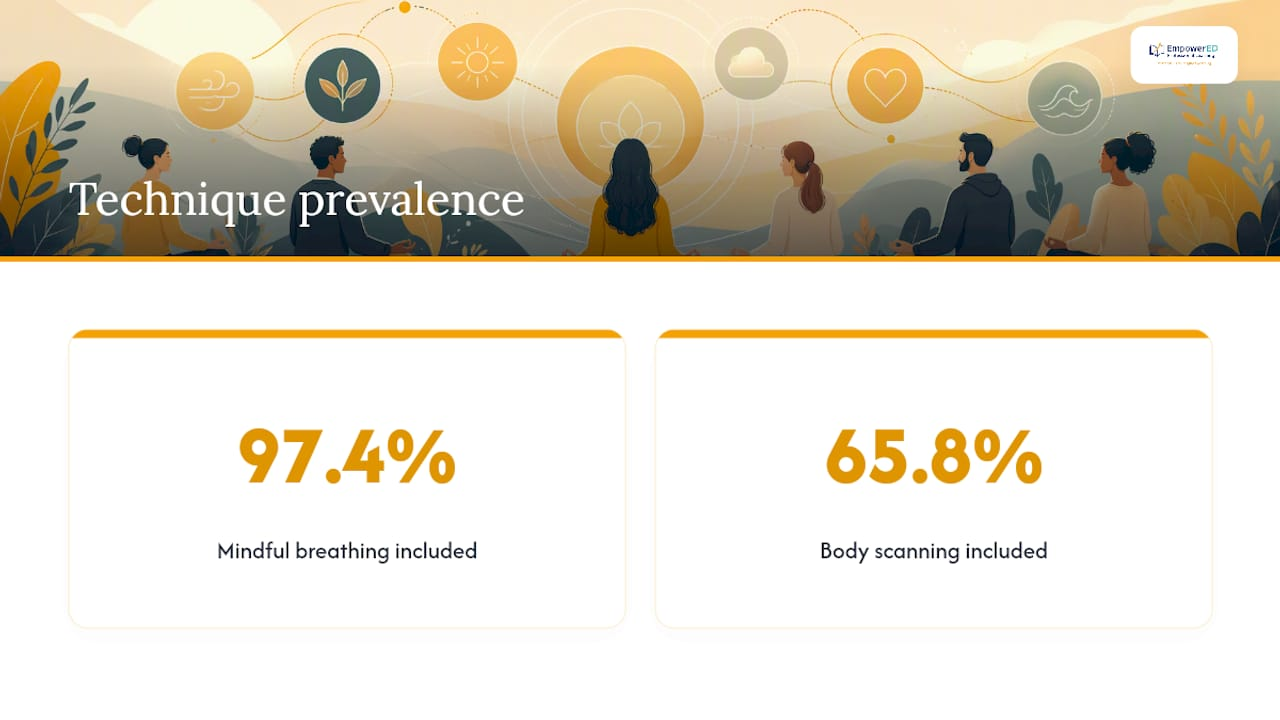
Breath-based practices show up in nearly every school mindfulness trial. One systematic review of intervention content found mindful breathing included in 97.4% of programs and body scanning in 65.8%, which tells you where to invest your prep time if you’re only adding one or two techniques this semester.
Grades K through 2 need play framed as practice, not stillness framed as discipline. A sensory scavenger hunt where students find five sounds, three textures, and one smell in the room works better than asking a six-year-old to sit quietly for two minutes. The University of Iowa’s Scanlan Center recommends exactly this kind of play-based adaptation for younger students, including short movement breaks disguised as games like “freeze and breathe.” Goal: build the vocabulary of noticing. Timing: 1 to 2 minutes. Materials: none. Differentiation: pair verbal cues with a visual (a stop sign, a hand shape) for students who need a non-auditory anchor.
Grades 3 through 5 can handle structured breath work and short body scans with a clear script. Try box breathing: inhale four counts, hold four, exhale four, hold four, repeated four times. Goal: teach a self-regulation tool students can use without you. Timing: 2 to 3 minutes. Materials: a printed breathing card taped to desks helps non-readers and English language learners follow along. Classroom cue: “Box breathing, four rounds, follow the card.” Watch for students who report dizziness. That’s a sign to shorten the hold count, not push through it.
Grades 6 through 12 respond better to practices framed around performance: test anxiety, focus before a presentation, decompression after a stressful hallway moment. A three-minute mindful listening exercise using an ambient sound clip works without feeling babyish. Goal: normalize regulation as a skill, not a punishment. Timing: 3 to 5 minutes. Materials: a phone or speaker for ambient audio. Differentiation: offer an alternative for students who find eyes-closed practices uncomfortable. Journaling with a single prompt achieves a similar effect without the vulnerability.
Gratitude and journaling cross every grade band and pair naturally with SEL curricula already in place. A one-line prompt at the end of the day takes under two minutes and gives you a written record of student mood over time, which doubles as an informal check-in tool.
An activity needs adaptation or replacement when more than a third of the class disengages, when a student reports genuine distress rather than boredom, or when the same script stops landing after repeated use. Rotate scripts every few weeks before that happens.
Short Routines You Can Run in Under Five Minutes
These scripts are built for the moments teachers actually need them: right before a transition, right after a disruption, right before a test.
- The 3-Breath Reset. Say “three breaths, then we begin” before starting a new subject. Takes 20 to 30 seconds. Use it at every transition point in the day.
- Silent 60. Full minute of quiet after recess or lunch. Use it as the first thing students do walking back in the door.
- Bell Listen Minute. Ring a chime, students track the fade of the sound. Use it before test instructions to lower baseline anxiety.
- Five-Finger Breathing. Trace-and-breathe on one hand. Use it during a fire drill debrief or after a conflict on the playground.
- Desk Drop. Students place both palms flat on the desk and take three slow breaths. Use it mid-lesson when energy spikes and you need a fast reset without leaving your spot at the board.
The routine that survives a full semester is the one with the fewest moving parts.
Pro Tip: Pick one consistent verbal or visual signal, like dimming the lights or ringing the same chime every time, and never switch it. Students respond to the cue faster than the activity itself once the pattern is set.

How to Introduce Classroom Mindfulness Without Losing the Room
Start with yourself, not your students. Teachers who practice breathing or body scan techniques for a week or two before introducing them to a class model authenticity that students notice immediately, and this teacher-first sequencing is echoed in whole-school implementation guidance that stresses aligning practice with language staff already use.
- Send a short note home before rolling out a new routine, describing it in secular, skill-based language: “a brief focus exercise,” not a spiritual or religious practice.
- Offer an opt-out without penalty. A student who prefers to read quietly during a body scan should have that option without explanation required.
- Embed practices into existing SEL blocks or morning meetings rather than adding a new unsupported time slot.
- Track fidelity with a simple checklist: Did I run the routine today? Did most students participate? Any signs of distress? Five minutes of reflection a week is enough.
Programs that train teachers and provide ongoing support show better sustainability than one-off lessons dropped into a curriculum, according to implementation research on school-based mindfulness. That single point explains why so many well-intentioned rollouts fizzle by spring: the practice is added, but the teacher training never keeps pace with it.
Pro Tip: Keep a laminated card of your two or three go-to scripts on your desk. When you’re stressed and short on time, you’ll default to whatever is easiest to find, not whatever works best.
What the Research Actually Shows About Classroom Mindfulness
The honest evidence summary: effects are real but small. An umbrella review of meta-analyses covering 110 studies and 28,910 participants found statistically significant but very small improvements in wellbeing (g = 0.13), mindfulness (g = 0.11), and anxiety (g = 0.11), with no meaningful effect on depression.
That doesn’t mean skip it. A 2024 randomized trial of 292 fifth graders found that eight weeks of mindfulness training produced significant gains in cognitive flexibility and improved year-end SEL grades compared to a control group. The gap between those two findings comes down to fidelity: quality and consistency of delivery predict results more than the practice itself, and some cluster-randomized trials show mixed academic effects when programs are poorly integrated.
Mindfulness for students works best as one part of a broader SEL strategy, never as a stand-alone fix for behavior or academic struggles. It’s not therapy. A student showing signs of real distress needs a school counselor, not a longer breathing exercise.
Reaching Students Who Resist Mindfulness Practices
Some students will roll their eyes, and that’s a predictable response, not a failure on your part. Reframe the pitch away from “calm down” language, which teenagers especially read as dismissive, toward performance language: “This is a tool athletes and performers use to focus before something hard.” That framing lands better with skeptical middle and high schoolers than anything wellness-branded.
Give students a menu instead of one script. A student who hates eyes-closed silence might do fine with a mindful walk or a journaling prompt. Forcing one format on 30 different personalities guarantees resistance from a chunk of the room.
Keep participation low-stakes and never graded. The moment mindfulness feels evaluated, it stops being restorative and starts being one more assignment to resent. Let students opt for a quieter alternative, like doodling or reading, without a conversation about why.
Peer modeling helps more than teacher modeling once you’re past elementary school. If you can get even two or three students visibly leaning into a practice, holdouts often follow within a few sessions purely from social proof.
Finally, don’t overexplain the neuroscience. A thirty-second rationale is plenty. Students who resist mindfulness are usually resisting the framing, not the actual physical act of breathing slowly for sixty seconds.
Weaving Mindfulness Into Math, Reading, and Science
Mindfulness activities in the classroom work better when they’re not treated as a separate subject competing for time. Attach a 60-second breathing reset to the moment right before a math test, and you’re using the practice to serve an academic goal instead of adding to an already packed schedule.
In reading blocks, a mindful listening exercise using an audio clip primes attention before a challenging text. Ask students to notice three sounds in the recording, then transition directly into silent reading. The shift in attention state carries over for a few minutes, which is often enough to get reluctant readers past the first page.
Science classrooms lend themselves naturally to body scan language, since noticing physical sensation ties directly into lessons on the nervous system or the five senses. A body scan framed as “data collection about your own body” reframes a soft skill as scientific observation, which tends to land better with older students who are wary of anything that feels emotional.
Writing classes benefit from a two-minute gratitude or noticing prompt before a creative writing block. It primes specific, sensory language, the same skill good writing requires. Math teachers report the clearest transition benefit: a three-breath reset before a timed assessment lowers the baseline anxiety that causes careless errors in the first few minutes.
The strategy that works across subjects is pairing, not replacing. Attach the mindfulness moment to an existing transition point rather than carving out new time, and the academic subject absorbs the benefit without a scheduling fight.
How to Tell If Mindfulness Activities Are Working
You don’t need a formal assessment to know if a practice is landing. Watch for behavioral signals first: fewer disruptions during the five minutes after the routine, faster settling time after transitions, and fewer students asking to leave the room during stressful periods like testing.
A simple weekly checklist works better than a complicated rubric. Note whether you ran the routine, roughly what percentage of students participated, and whether you noticed any change in the following ten minutes of class. Three weeks of that data tells you more than a single formal survey.
For older students, a short anonymous exit ticket asking “Did that help you focus, yes or no” gives you direct feedback without putting anyone on the spot. Track it over a month, not a single day, since the first week or two of any new routine is noisy no matter how well designed.
Academic proxies matter too. If a mindful transition precedes a math test, compare error patterns on early problems before and after adding the routine. The randomized trial with fifth graders tracked SEL grades and cognitive flexibility as outcome measures, which is a reasonable model for a classroom-level version: pick one or two indicators you already collect, and watch them over several weeks rather than inventing a new metric from scratch.
Making Mindfulness Exercises Culturally Responsive
The fastest way to lose buy-in from families is language that sounds religious or spiritual when the practice itself is secular and skill-based. Say “focus exercise” or “calming strategy,” not “meditation” or anything tied to a specific tradition, even though many of these techniques have roots in Buddhist practice. Aligning mindfulness with language schools already use is one of the clearest predictors of family and staff acceptance.
Be aware that stillness and eye contact carry different cultural meanings across households. A student who avoids closing their eyes around adults, or who comes from a family where quiet compliance reads differently than intended, isn’t being defiant. Offer eyes-open alternatives by default rather than treating closed eyes as the standard.
Avoid activities that borrow surface aesthetics, chimes, specific hand positions, or terminology, without acknowledging where they come from. A body scan or breathing exercise stripped of ornamental trappings is both more inclusive and more defensible to families who raise concerns.
Build in flexibility for students observing religious practices that include their own meditative or reflective traditions. The goal is a shared, neutral skill set that layers onto whatever a student already brings, not a replacement for it.
What I’ve Learned Watching These Routines Succeed or Fail
The classrooms where mindfulness sticks are never the ones with the fanciest curriculum. They’re the ones where the teacher picked one script and ran it daily for a month before judging whether it worked. Most rollouts fail in week two, right when it stops feeling novel and starts feeling routine, which is exactly the point where the benefit actually shows up.
The biggest misconception I see is treating mindfulness as a behavior fix for a single disruptive student rather than a whole-class regulation habit. It works far better as a shared practice than a targeted intervention, and singling out one student to “calm down” almost always backfires. Teachers who invest in their own practice first, even briefly, teach it with a credibility that a borrowed script never carries.
— Brian Koster, Ed.D.
Build Teacher Skills That Support Classroom Wellbeing
Professional learning providers can offer a faster path to sustainable classroom mindfulness than trial-and-error alone. Instead of assembling scripts from scattered blog posts, the Social-Emotional Learning & Teacher Wellness course walks through SEL-aligned strategies and teacher wellness practices designed by educators, with personalized feedback on how to embed them into your actual routines.
If engagement, not calm, is your bigger challenge, Engagement Boosters That Work pairs well with short mindfulness resets to rebuild focus after a rough transition. Teachers juggling math instruction alongside SEL goals can look at Mathematical Thinking for Teachers for classroom-ready strategies that fit the pairing approach described above. These courses are typically self-paced and come with certificates that may count toward PD credit. Browse the full catalog of professional learning courses and enroll in whichever one matches the gap you’re trying to close this semester.
Sources
For evidence strength, the umbrella review of school-based MBIs is the most rigorous synthesis available. For a practical rollout blueprint, the Mindfulness Initiative’s implementation guide covers teacher training and fidelity in depth.
This article is general information, not a substitute for advice from a qualified doctor. Consult a qualified healthcare professional about your own circumstances before acting on anything here.
- An Umbrella Review of Meta-analyses of School-Based Mindfulness Based Interventions (MBIs)
- 2024 randomized trial of mindfulness training with fifth graders
- Whole-school mindfulness implementation guidance
FAQ
What are some fun mindfulness activities for students?
Bell Listen, where students raise a hand the moment a chime’s sound fades, and Mindful Walk, where students notice each footstep across the room, both work well because they feel more like a game than a lesson. Five-Finger Breathing is another favorite since it gives younger students something physical to trace while they breathe.
What are the 5 R’s of mindfulness?
Definitions of the “5 R’s” vary across programs and aren’t a single standardized framework in the school-based mindfulness research. Rather than force a specific list, focus on the well-supported core elements instead: breath awareness, body scanning, mindful listening, movement, and gratitude practice.
How do you practice mindfulness in the classroom?
Start small: pick one script, like a 3-breath reset or a 60-second silent pause, and run it at the same transition point every day. Model the practice yourself first, keep the language secular and skill-based, and align it with existing SEL routines rather than adding a separate class period.
What are some five-minute mindfulness activities I can do with students?
A Body Scan Lite guiding attention from feet to head takes 2 to 3 minutes and works well before a writing assignment. A Gratitude Round where each student names one good thing from the day takes under 5 minutes and doubles as an informal SEL check-in.
Does classroom mindfulness training require special certification?
No special certification is required to run basic classroom mindfulness activities, though structured training improves consistency and results. Courses like Social-Emotional Learning & Teacher Wellness from Empowered Professional Learning give teachers a structured, classroom-ready foundation with feedback and a PD certificate.