Email is the right first move for most behavior concerns: one-off incidents, minor pattern notices, or positive updates. The moment a situation touches safety, repeats after two documented attempts, or carries strong emotion, pick up the phone instead. Your first behavior email to parents should do exactly one thing: state the observable fact, name what you already tried, and invite the parent into the next step.
TL;DR:
- Teachers should call parents immediately for safety concerns or after three similar incidents to address patterns that cannot be managed through email.
- Behavior emails must be concise, neutral in tone, include specific examples, and clearly state next steps to prevent defensive responses from parents.
- Personalize templates by including the child’s name and context, and keep subject lines focused to encourage open, non-alarming communication.
- Document all interactions in a simple log with dates, methods, and decisions, and involve counselors or administrators after multiple unresponsive attempts or in serious cases.
- When writing emails, avoid labeling children, maintain privacy, and use factual language, especially when discussing possible disabilities or behavioral issues.
Table of Contents
- When Should You Email vs. Call About Student Behavior?
- Five Rules for Writing Behavior Emails That Don’t Backfire
- How to Personalize Templates Without Sounding Robotic
- Five Ready-to-Send Behavior Email Templates
- How Should You Document Behavior Communications?
- Legal and Privacy Considerations When Emailing Parents
- Cultural Sensitivity and Diversity Awareness in Communication
- When and How Often Should You Email Parents About Behavior?
- How Can You Involve Parents in a Behavior Plan?
- What Actually Moves the Needle in Parent Behavior Communication
- Build These Skills Further With Short, Practical Courses
- Sources
- FAQ
When Should You Email vs. Call About Student Behavior?
Not every behavior concern deserves the same channel. Edutopia’s guidance on emailing parents frames the choice as a traffic light, and it holds up well in a real classroom.
Green covers routine, low-stakes updates: a positive note, a homework reminder, a minor one-time slip that doesn’t need a response. Yellow is a concern that might need follow-up but isn’t urgent. Email works, but flag it clearly and offer a call if the parent wants one. Red means safety, repeated defiance, or anything likely to provoke a strong emotional reaction. Call first, every time.
That’s where the rule of three comes in. One incident is a data point. Two might be a coincidence. Three similar incidents in a short window is a pattern, and patterns belong in a phone call or meeting, not another email in a growing thread.
Before you hit send on any behavior email, run through this:
- Is the tone neutral, not annoyed?
- Is it under 150 words?
- Does it include one specific example?
- Does it ask for something concrete (a reply, a call, a meeting)?
Pro Tip: If you’ve reread an email twice and still feel your frustration in the wording, wait an hour before sending it. A calmer version almost always reads better to the parent on the other end.
Five Rules for Writing Behavior Emails That Don’t Backfire
Most defensive replies from parents trace back to the same five drafting mistakes. Fix these and most of that friction disappears.
- Describe behavior, don’t label the child. “Left his seat four times during math” lands differently than “disruptive.” Stick to what, when, and where.
- Lead with something true and positive. Even one sentence of genuine context (effort in group work, improvement from last week) changes how the rest of the email reads.
- Name what you’ve already tried. Parents respond better when they see you’ve acted first, not just reported a problem.
- Ask an open question. “Have you noticed anything similar at home?” invites partnership instead of putting the parent on defense.
- End with next steps and a timeline. Vague emails generate vague replies. Specific asks get specific answers.
Communication research on framing backs this up directly: teachers who send regular positive messages build a kind of goodwill that makes the hard emails land softer when they eventually have to send one. Templates under roughly 150 words that state objective facts and next steps have also been shown to reduce parental defensiveness and boost engagement compared to longer, more emotionally loaded messages.
How to Personalize Templates Without Sounding Robotic
Templates save you from writing every behavior email from scratch under pressure, but a template pasted in without editing reads as cold, especially on sensitive topics. Personalize the specific example, the child’s name, and any context you know about the family. Copy the structure as is for routine, low-stakes updates.
Subject lines matter more than teachers usually think, since a vague or scary-sounding subject gets opened with dread instead of curiosity:
- Positive note: “A great moment from [Child]’s day”
- Pattern notice: “Checking in about [Child]’s week”
- Urgent issue: “Please call when you can, re: [Child]”
Store your go-to templates somewhere you’ll actually reuse them. Gmail’s built-in templates feature, your school’s LMS message library, or a simple notes app folder all work. The goal is having five solid drafts ready before you need them at 4:45 PM on a Friday, not building one from scratch every time.
Five Ready-to-Send Behavior Email Templates
Copy these, swap in specifics, and adjust tone to fit your relationship with the family.
-
Positive note (send these often). “Hi [Parent name], I wanted to share something great: today [Child] helped a classmate who was struggling with the assignment without being asked. Small moments like this tell me a lot about who they are. Have a great weekend.”
-
Short, objective heads-up. “Hi [Parent name], I wanted to flag something from today. During independent reading, [Child] was talking with a neighbor several times after I asked the group to work quietly. I moved his seat and he settled in. No action needed on your end, just keeping you in the loop.”
-
Pattern notification. “Hi [Parent name], I’ve noticed [Child] has had trouble staying in his seat during math on Monday, Wednesday, and again today. I’ve tried a proximity check and a quiet reminder each time, with limited success. I’d like to try [specific strategy] next week. Have you seen anything similar at home?”
-
Meeting or call request. “Hi [Parent name], I’d like to set up a short call or meeting to talk through some patterns I’m seeing with [Child] in class. Would Tuesday at 3:30 or Wednesday at 8:00 AM work? I want to make sure we’re aligned on next steps.”
-
24-hour follow-up summary. “Hi [Parent name], thank you for talking with me today. To recap: we agreed [Child] will use a break card when feeling frustrated, and I’ll check in with you again next Friday. Let me know if I missed anything.”
That last one matters more than teachers often realize. Edutopia recommends sending a short written summary within 24 hours of any phone call about behavior, so both sides have the same record of what was decided.
How Should You Document Behavior Communications?
Keep a simple log, not a novel. For every meaningful contact, jot down the date, the method (email, call, meeting), who was involved, what was decided, and what happens next. A spreadsheet or a notes app works fine; the format matters less than the consistency.
Loop in a counselor or administrator once you’ve made two or three documented attempts without progress, or immediately if safety is a concern. That’s not a failure on your part. It’s the system working as designed.
- Date and method of contact
- Who participated (parent, student, admin)
- What was agreed
- Next check-in date
Pro Tip: Write your follow-up summary within 24 hours of any call, while the details are still fresh. A summary written three days later tends to miss the specifics that actually matter if a dispute comes up later.
Legal and Privacy Considerations When Emailing Parents
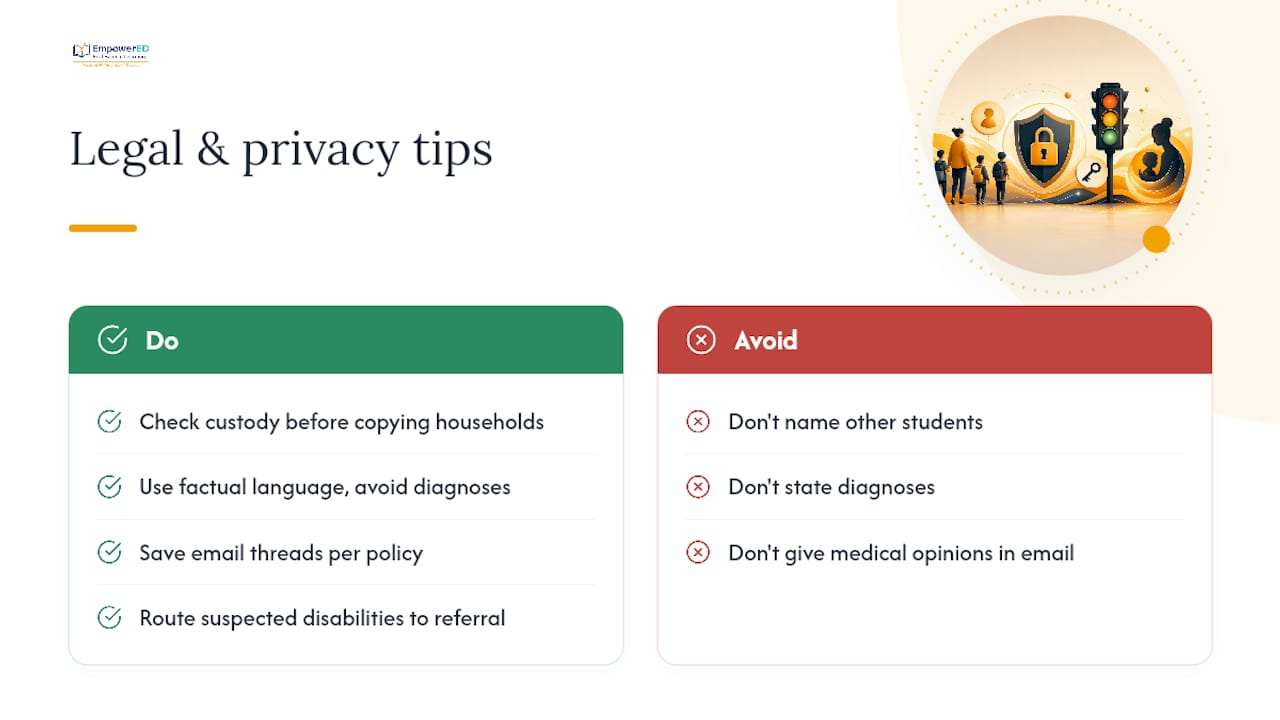
Behavior emails aren’t just classroom notes. They’re part of a student’s educational record under the Family Educational Rights and Privacy Act (FERPA), which means the same care you’d apply to a written report card applies here. Never mention another student by name in an email about someone else’s behavior, even in passing. “He was arguing with another student” is fine; “he was arguing with Marcus” is not, regardless of how well you know both families.
Check who has legal custody and communication rights before you loop in a second household. Many schools maintain a flag in the student information system for custody restrictions, and it’s worth a quick check before you copy both parents on a sensitive email, especially in a shared-custody situation you’re not fully familiar with.
Keep language factual rather than diagnostic. Writing “appears distracted and has difficulty focusing” is an observation; writing “shows signs of ADHD” edges into a medical opinion you’re not qualified to offer in writing, and it can create real complications for the family and the school. Route any suspicion of a disability or learning difference through your school’s formal referral process, not an off-the-cuff email.
Save your emails. Most districts have retention policies for parent communication, and a saved thread protects you as much as it protects the family if a disagreement about what was said ever comes up months later.
Cultural Sensitivity and Diversity Awareness in Communication
The same words land differently depending on who’s reading them, and behavior emails are no exception. A direct, blunt tone that reads as efficient to one family can feel harsh or disrespectful to another, particularly in cultures where a teacher’s written word carries significant authority or where public correction of a child (even in writing) carries more weight than it does in other households.
Avoid assuming a shared first language. If you know a family primarily communicates in a language other than English, a short, simple email translates more reliably through school translation services than a long, nuanced one. Idioms and sarcasm rarely translate cleanly, so keep the wording literal.
Be mindful of family structure assumptions, too. Not every student goes home to two parents, or any parent at all. Use “parent or guardian” rather than defaulting to “mom and dad,” and check the emergency contact list before assuming who should receive a sensitive message.
Some families come from educational systems where teacher contact almost never happens unless something is seriously wrong. For those families, even a mild, well-intentioned behavior email can trigger real alarm. A little extra warmth and context in the opening line goes a long way in those cases, and it costs you nothing to include it.

When and How Often Should You Email Parents About Behavior?
Timing shapes how a behavior email gets received almost as much as the wording does. Send routine, non-urgent notes during school hours, ideally mid-morning to mid-afternoon, so parents aren’t reading about their child’s classroom struggles right before bed or during a hectic dinner rush. Avoid sending anything sensitive on a Friday afternoon if you can help it. A concern sent at 3:15 PM Friday sits unresolved all weekend, which tends to make small issues feel bigger than they are by Monday.
Frequency matters just as much as timing. If the only emails a parent ever gets from you are about problems, you’ve trained them to dread your name in their inbox. Aim for a rough ratio where positive or neutral notes outnumber concern emails, even if that means deliberately sending a quick “great day” note once a week or two. That habit is what builds the goodwill that makes the harder conversations easier when they’re genuinely necessary.
Avoid emailing about the exact same incident more than once. If you’ve already sent a heads-up and nothing new has happened, resist the urge to send a reminder. Repetition without new information reads as nagging, not diligence, and it erodes trust faster than silence would.
How Can You Involve Parents in a Behavior Plan?
A behavior email works best as an opening, not a verdict. Once a pattern is clear enough to need a real plan, treat the parent as a partner in building it rather than an audience for your decisions.
Start by asking what they see at home before you propose a fix. A student who struggles with transitions at school may show the exact same pattern during homework time, and a parent who’s already found something that works there has just handed you a head start. Frame the invitation directly: “What have you tried that’s worked at home?”
Once you agree on a plan, put it in writing together rather than presenting a finished document. A simple shared plan might include a specific trigger, one classroom strategy, one home strategy, and a check-in date. Two weeks is a reasonable first checkpoint for most behavior plans. Long enough to see a real pattern, short enough that nobody feels forgotten.
Give parents a small, concrete role rather than a vague one. “Ask him about his day” is hard to act on. “Ask him whether he used his break card today” gives a parent something specific to check in on, and it reinforces the same language you’re using in the classroom. Consistency between home and school is often the single biggest factor in whether a behavior plan actually works.
What Actually Moves the Needle in Parent Behavior Communication
The conventional advice on this topic spends too much time on tone and not enough on structure. Teachers get told to “stay positive” and “assume good intent,” which is true but incomplete. What actually changes outcomes is specificity: an observable fact, a stated action, and a real question. Vague warmth without those three elements reads as filler, and parents can tell.
The traffic-light framework and the rule of three get underused because they sound almost too simple for a problem that feels emotionally loaded in the moment. But that simplicity is the point. A teacher exhausted at 4:30 PM doesn’t need a nuanced framework. They need a fast rule that tells them whether to type or dial.
If there’s one place teachers should invest their limited planning time, it’s in a small stash of five personalized templates built before the pressure hits, not during it. That’s the gap between the advice everyone gives and what actually gets used on a Tuesday afternoon with twelve other things due.
— Brian Koster, Ed.D.
Build These Skills Further With Short, Practical Courses
A strong behavior email is one piece of a bigger classroom management skill set, and that skill set is exactly where Empowered Professional Learning focuses its short courses. Unlike a full-semester certification, these are one-off, self-paced courses built by educators for the specific problems you’re facing right now.
If parent communication tends to come from behavior you’re managing in real time, Classroom Management in Online & Hybrid Learning covers the in-classroom strategies worth mentioning in your “what I already tried” line. Social-Emotional Learning & Teacher Wellness builds the language and framing that keeps a tense email collaborative instead of defensive. And if disengagement is driving the behavior you’re reporting home, Engagement Boosters That Work gives you classroom-ready tactics to try before the next email even needs to be sent.
Most courses are self-paced with personalized instructor feedback, so you can finish one between grading stacks and walk away with something usable Monday morning. Browse the full professional learning catalog to find the course that matches the gap you’re feeling right now.
Sources
For more template examples and background on the guidance in this article, a few outside sources are worth bookmarking. Edutopia’s guide to emailing parents covers the traffic-light system in more depth. Understood offers a parent-side view of what makes a message land well. ParentsSquare’s response templates are useful for de-escalating tricky replies once a parent writes back.
- A Practical Guide to Emailing Parents
- Sample Email to Parents About Student Behavior (5 Templates You Can Copy)
- When to Email, Call, or Meet With Parents
FAQ
How Do You Write a Behavior Email to a Parent?
State the observable behavior with a date and specific example, mention what you’ve already tried in class, and close with an open question or a clear next step. Keep it under 150 words and avoid labeling the child; describe what happened instead.
How Do You Politely Tell a Parent Their Child Is Misbehaving?
Lead with something genuine and positive if you can, then describe the specific behavior factually rather than using a label like “disruptive” or “disrespectful.” Frame the email as a partnership by asking what the parent sees at home, which invites collaboration instead of putting them on the defense.
What Are the 5 Rs of Behavior Management?
Definitions of the “5 Rs” vary depending on the source, and there’s no single standard version educators universally teach. Rather than force a specific list, focus on the drafting principles that consistently work: observable facts, positive framing, prior action taken, an open question, and clear next steps.
What Can I Do to Help My Child With Behavior Problems at School?
Ask the teacher directly what they’ve observed and what they’ve already tried, then share what you see at home so the two of you can build one consistent plan. A short, specific behavior plan with a two-week check-in date tends to work better than a vague agreement to “work on it.”
When Should I Call Instead of Sending a Behavior Email to Parents?
Call when a concern involves safety, when the same issue has happened three times (the rule of three), or when the topic is emotionally sensitive enough that tone could easily be misread in writing. Edutopia’s traffic-light framework treats these as “red” situations that need a real-time conversation, followed by a brief written summary within 24 hours.