The fastest way to improve your teaching is to collect short, regular formative feedback and act on it. That means a mix of quick exit tickets, a midterm survey of 5 to 10 questions, and rapid comprehension checks, woven into your normal week. What separates useful feedback from a stack of ignored comment cards is what happens next: closing the loop with students and treating the results as a starting point for real change, not a verdict on your worth as a teacher.
TL;DR:
- Regular midterm feedback around weeks 4 to 6 provides the clearest opportunity for meaningful teaching adjustments before the course ends.
- Short tools like exit tickets, quick comprehension checks, and digital polls yield useful insights without taking up excessive class time.
- Effective questions are concise, balance rating scales with open comments, and focus on actionable areas such as pacing, clarity, and workload.
- Responding to feedback with specific changes and informing students about those adjustments significantly increases response rates and trust.
- Combining student feedback with support in interpretation and discussion enhances its impact on teaching quality and student learning outcomes.
Table of Contents
- When Should You Collect Feedback on Teaching?
- What Are the Best Feedback Collection Methods for Teachers?
- How Do You Design Good Feedback Questions?
- How Do You Turn Feedback Into Real Classroom Changes?
- Should You Use Paper or Digital Tools to Collect Feedback?
- What Does the Research Say About Student Feedback and Teaching Quality?
- Templates You Can Use This Week
- Why Feedback Should Feel Like Inquiry, Not a Performance Review
- Get Guided Help Turning Feedback Into Classroom Change
- Sources
- FAQ
When Should You Collect Feedback on Teaching?
Timing shapes what kind of feedback you get and what you can do with it. A survey in week one tells you almost nothing about your teaching. A survey in week fifteen tells you everything, too late to help the students who gave it.
Start-of-course feedback works best as a baseline check, not a teaching review. Ask students about their prior experience with the subject, their learning preferences, and what worries them about the class. This sets expectations early and gives you a reference point for later comparisons.
Midterm feedback, typically around weeks 4 through 6, is where the real payoff happens. Enough class time has passed for students to form honest opinions, and enough of the term remains for you to act on what you learn. Stanford’s Teaching Commons points to this window as the sweet spot for formative changes, and administering the survey during class time meaningfully raises how many students respond.
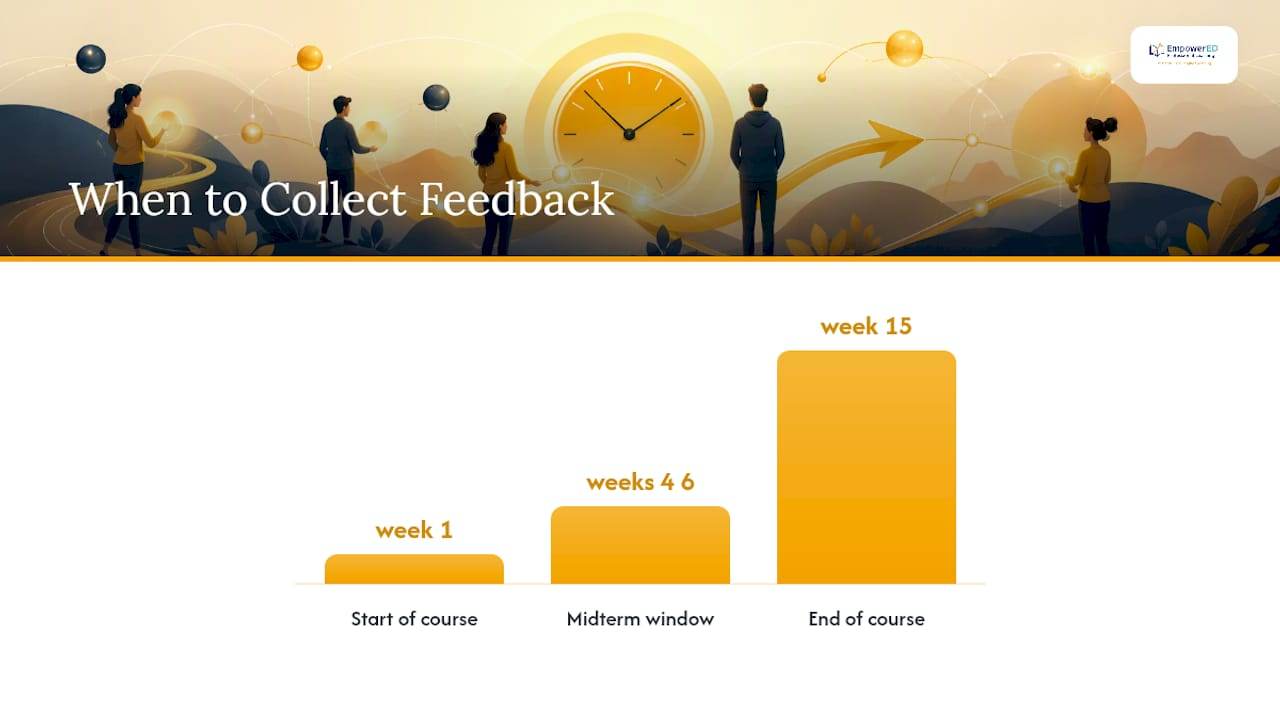
Continuous feedback fills the gaps between those two checkpoints. Exit tickets and quick comprehension checks give you a pulse on daily understanding without waiting for a formal survey cycle.
Class size and modality change your approach:
- Large classes (30-plus students) benefit from short, structured surveys since open discussion doesn’t scale well.
- Small classes and seminars can support more informal, spoken feedback moments.
- Hybrid and remote classes need digital tools built for asynchronous responses, since not every student is in the room at once.
- Self-paced or block classes may need feedback checkpoints tied to units rather than calendar weeks.
What Are the Best Feedback Collection Methods for Teachers?
You don’t need elaborate software to get feedback on teaching that’s genuinely useful. Some of the most effective methods take five minutes and a stack of index cards.
- Exit tickets. Hand out a slip with one or two questions as students leave. Ask something concrete: “What was the muddiest point today?” or “Rate your confidence with today’s topic, 1 to 5.” Collect them at the door so nobody skips it.
- Lecture Comprehension Checks (LCCs). These are rapid, low-tech prompts, often just one to three questions on paper, gathered at the end of class. Research on rapid feedback methods shows LCCs drive strong participation because they take almost no student effort and feel low stakes.
- Small-Group Instructional Diagnosis (SGID). A colleague or instructional coach visits your class, breaks students into small groups, and asks them to reach consensus on what’s working and what isn’t. Ohio State’s teaching center notes that having an outside facilitator run this process produces more candid answers than a teacher-led discussion ever could.
- In-class digital surveys and live polls. For hybrid or remote sections, a quick poll embedded in your video call or LMS can substitute for a paper slip. Keep it to two or three questions so it doesn’t eat into instructional time.
- Rotating sampling for large classes. If you teach 150 students across five sections, survey one section each week instead of surveying everyone at once. This keeps the workload manageable while still giving you a representative signal.
Anonymity matters more than most teachers assume. Students soften or withhold criticism when they think it can be traced back to them, so strip names from paper slips and use anonymous form settings on digital tools.
Pro Tip: Read exit tickets before you leave the building, and mention one adjustment at the start of the next class. Even a small visible change tells students their feedback did something, which raises response rates the next time you ask.
How Do You Design Good Feedback Questions?
Length is the first thing to get right. Keep instruments to 5 to 10 questions. Past that point, response quality drops and completion rates fall, according to guidance from Carnegie Mellon’s teaching center on early course feedback surveys.
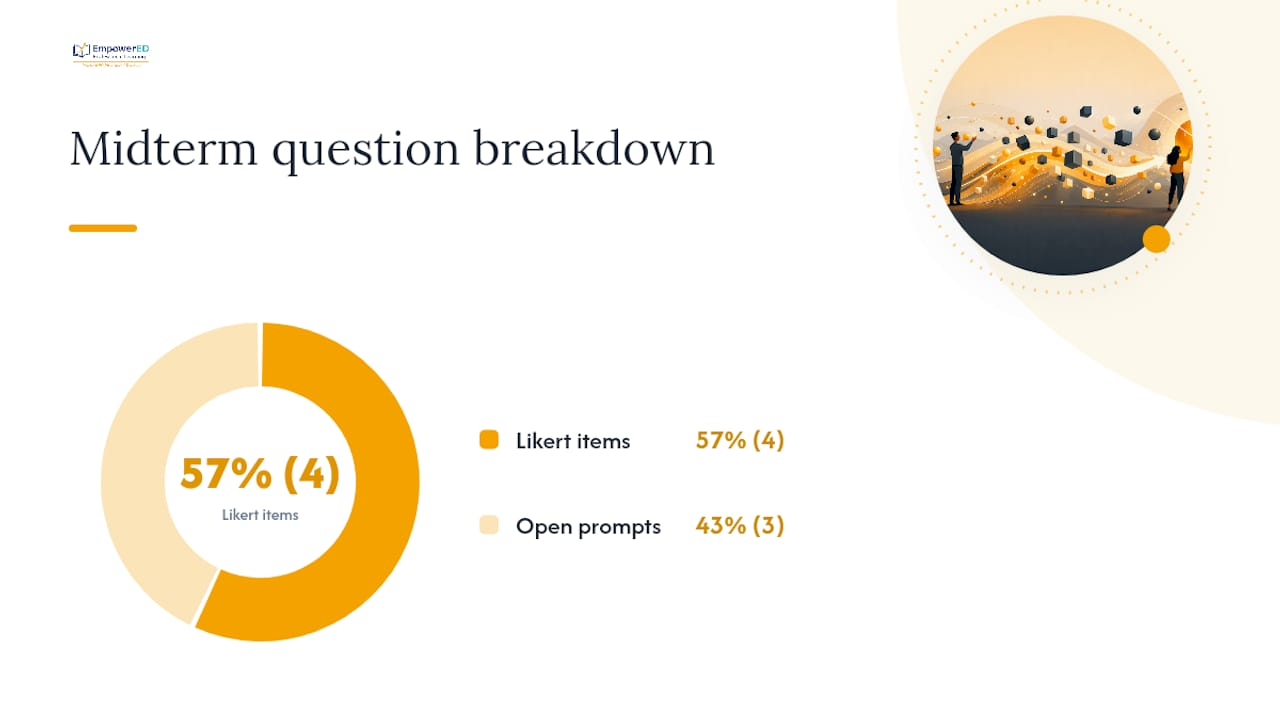
Mix your question types deliberately. Likert scale items (rate 1 to 5, agree to disagree) let you track trends over time and compare across class sections. Two or three open-ended prompts capture the specific detail a number can’t, like which explanation confused a student or which activity they’d want repeated. Neither format alone tells the full story.
Match your language to the grade band:
- K to 2: Use faces or simple thumbs up/down scales instead of text-based Likert items. Ask one thing at a time: “Did today’s story make sense to you?”
- 3 to 5: Short sentences with a 3-point scale work well. Add one open prompt like “What was your favorite part of the lesson?”
- 6 to 8: A standard 5-point Likert scale plus two open questions (“What helped you learn today?” and “What would help you learn better?”) fits this age group’s growing self-reflection skills.
- 9 to 12: Students can handle more nuanced prompts, including comparative questions like “How does this class compare to your expectations?”
The Keep/Start/Stop framework is one of the simplest tools available for turning open feedback into direction. Ask students to name one thing you should keep doing, one thing you should start doing, and one thing you should stop. It’s blunt, fast to answer, and produces results that sort themselves into action categories almost automatically.
A basic midterm template might include four Likert items covering pacing, clarity, engagement, and workload, paired with three open questions: one Keep, one Start, one Stop. That’s seven items total, well within the recommended range, and it takes most students under ten minutes.
How Do You Turn Feedback Into Real Classroom Changes?
Collecting responses is the easy part. Interpreting them and acting is where most feedback efforts quietly die.
- Group the open-ended responses into themes. You’ll usually find three or four recurring topics, pacing complaints, unclear instructions, requests for more practice problems, rather than fifty unique issues.
- Check the Likert data for trend shifts. Compare this survey’s averages to your start-of-course baseline or last term’s numbers. A drop in the “clarity” score matters more than a single low individual rating.
- Pick your top two actionable items. Trying to fix everything at once usually means fixing nothing well. Choose the changes with the clearest payoff and the lowest implementation cost first.
- Sort changes by timeline. Some fixes are immediate (slow down on a confusing topic tomorrow), some are term level (adjust the pacing of the next unit), and some need a full redesign for next year (rebuild an assessment structure).
Closing the loop is the step that makes the whole process worth repeating. Tell students plainly what will change, what won’t, and why. A script as simple as, “Based on your midterm feedback, I’m adding a review day before the next test, but I’m keeping the current homework schedule because most of you said it’s working,” takes thirty seconds and builds real trust.
If the feedback points to something bigger than a scheduling tweak, such as a pattern across multiple sections or a persistent engagement gap, that’s a signal to loop in an instructional coach or department colleague rather than troubleshoot alone. Ohio State’s guidance on student feedback specifically recommends pairing formal collection methods with a colleague debrief when the findings are complex.
Pro Tip: Keep a running document of feedback themes across terms. Patterns that repeat across multiple classes are worth prioritizing over one-off complaints tied to a single rough week.
Should You Use Paper or Digital Tools to Collect Feedback?
The right tool depends less on what’s trendy and more on what your students will actually complete. Paper slips still outperform QR codes and take-home digital surveys in most classroom settings, largely because the in-class, in-hand format removes friction and signals that the request is part of today’s lesson, not optional homework.
- Paper slips and index cards work best for exit tickets and LCCs where speed and near-universal completion matter more than data analysis.
- LMS-based forms make sense for midterm surveys since they auto-tabulate Likert results and export cleanly for year-over-year comparison.
- Live polling tools fit hybrid and remote classes where students aren’t physically present to hand in paper.
- Hybrid workflow: run paper LCCs for in-person days and a short digital form for remote days, then combine both into the same theme-grouping process described above.
Privacy is simple but easy to skip under time pressure. Skip name fields, use anonymous form settings, and avoid asking questions specific enough that a student’s identity becomes obvious from their answer, like naming a single event only one student attended. A guide to survey design from Baby Love Growth offers additional structure for building instruments that balance clarity with respondent comfort, useful background if you’re building a template from scratch.
What Does the Research Say About Student Feedback and Teaching Quality?
A 2025 hierarchical meta-analysis covering 23 studies and 314 effect sizes found that student feedback interventions in K to 12 settings produced a weighted mean effect size of d = 0.27 on teaching quality. That’s a modest but real effect, roughly comparable in size to other well-established classroom interventions, and it isn’t uniform across every teacher who tries it.
The same analysis found effects were noticeably larger when teachers received support interpreting the feedback and when they discussed results directly with students. In other words, the data alone doesn’t move the needle much. What moves it is a teacher who reads the results, gets help making sense of unclear or conflicting signals, and then talks with the class about what changes.
That has a direct practical implication: pair every feedback collection effort with some form of interpretation support, whether that’s a coaching conversation, a peer debrief, or structured professional development. Student feedback also has real limits. It reflects perception, not always instructional accuracy, and it works best alongside other signals like educator effectiveness metrics, peer observation, and your own self-assessment rather than as a stand-alone verdict.
Templates You Can Use This Week
You don’t need to build anything from scratch. Here are ready-to-use instruments, plus a short cycle for running your first midterm check.
- Midterm survey (7 items): Rate 1 to 5: pacing, clarity of instructions, engagement of activities, workload. Then answer: one thing to Keep, one thing to Start, one thing to Stop.
- Exit ticket (2 prompts): “What’s one thing that made sense today?” and “What’s one thing that’s still unclear?”
- LCC (1 to 3 prompts): “Rate your confidence with today’s material, 1 to 5” plus an optional “What would help most right now?”
- Introduction script: “I want to make this class work better for you, so I’m asking a few quick questions. Your name isn’t on this, and I’ll share back what I hear next class.”
- Report-back script: “Here’s what came up in your feedback, here’s what I’m changing starting now, and here’s what’s staying the same and why.”
| Week | Action |
|---|---|
| Week 1 | Distribute midterm survey (7 items) or run first LCC |
| Week 1 (same day) | Group open responses into 3 to 4 themes |
| Week 2 | Announce 1 to 2 changes to the class using the report-back script |
| Week 2 | Continue LCCs or exit tickets to monitor whether the change is landing |
If you want more structured practice on turning classroom activities into engagement wins, Engagement Boosters That Work walks through tactics that pair directly with a feedback-informed teaching cycle.
Why Feedback Should Feel Like Inquiry, Not a Performance Review
Most teachers treat feedback like a report card, something to survive rather than something to use. That framing backfires. Research on reflective practice suggests that teachers who treat feedback as instructional inquiry, an open question about what’s working rather than a judgment on their competence, respond with more curiosity and less defensiveness.
After each cycle, ask yourself three things: What surprised me in these responses? What’s one change I can make by next week? What pattern have I seen across more than one class? Feedback collected this way stops feeling like scrutiny and starts feeling like a normal part of teaching well. That shift alone tends to make teachers more willing to ask for it again, which is the whole point.
— Brian Koster, Ed.D.
Get Guided Help Turning Feedback Into Classroom Change
Professional development providers can offer coached interpretation and clear implementation plans, built by educators experienced with these cycles. If closing the loop with students feels like the hardest part of this process, that’s exactly where structured PD earns its cost.
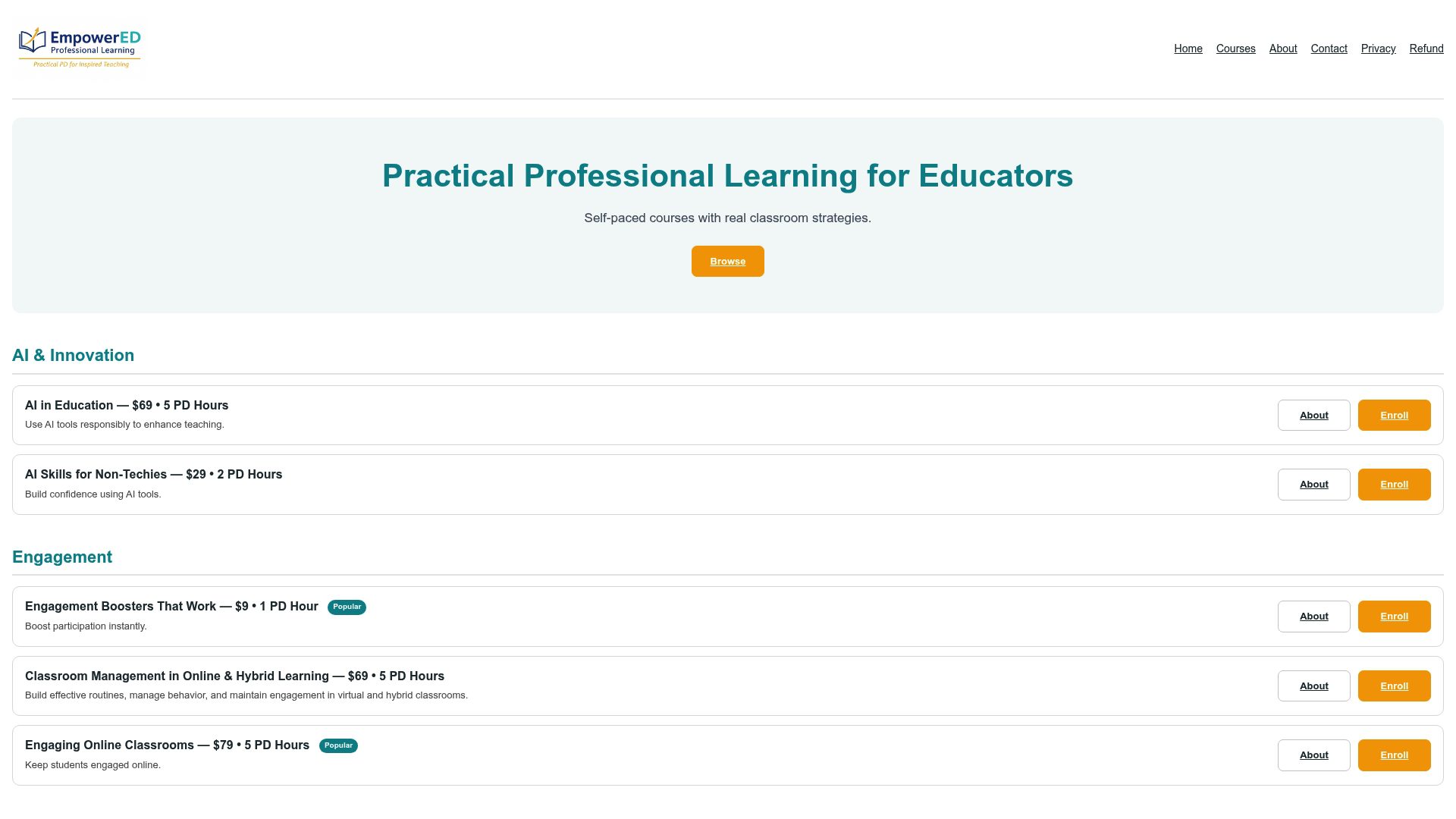
Two courses map directly onto what this article covers. Engagement Boosters That Work is a free course that pairs well with your first feedback cycle, giving you concrete tactics to try once you know what students want changed. For a deeper dive, Effective Assessment & Feedback in Online & Hybrid Learning runs $79 and covers instrument design, interpretation, and response strategies for both in-person and remote classrooms. If you’re building feedback into a broader improvement plan, the full professional learning catalog includes options in data literacy and classroom management that extend the same principles. Start with the free course this week, then decide if the deeper one fits your goals for the term.
Sources
- Can feedback from students to teachers improve different dimensions of teaching quality in primary and secondary education? A hierarchical meta-analysis
- Instructor-led early course feedback (CMU teaching resources)
- Collecting Student Feedback on Your Teaching (Ohio State University teaching resources)
FAQ
What Are Examples of Good Feedback for Teachers?
Good feedback is specific and tied to something a teacher can act on, like “the pacing in the second half of class felt rushed” rather than a vague rating alone. Combining a Likert scale rating with a short open comment, as recommended by Carnegie Mellon’s teaching center, gives teachers both a trend to track and a concrete detail to work from.
What Are the Five R’s of Feedback?
Definitions of the “five R’s” vary across education sources, and no single standardized version applies universally to K to 12 classroom feedback. Rather than relying on an unverified acronym, focus on the practices with actual evidence behind them: regular timing, relevant questions, review of responses, response to students, and revisiting the change later in the term.
What Are the Three C’s of Good Feedback?
Like the five R’s, the “three C’s” framing isn’t a single agreed-upon standard in the research on student feedback. What the evidence does support is feedback that’s clear, concise, and closed-loop, meaning students actually hear back about what changed as a result of what they shared.
What Are the Keys to Effective Feedback?
Effective feedback is short enough to complete in class (5 to 10 questions), mixes rating scales with open-ended questions, and gets collected at a useful moment like the midterm point rather than only at the end of a course. The step that most separates effective feedback from ignored feedback is closing the loop, telling students plainly what’s changing because of what they said, a practice Ohio State’s teaching resources identify as central to building trust in the process.
Does Getting Feedback on Teaching Actually Improve Outcomes?
Yes, a 2025 meta-analysis of 23 studies found a weighted mean effect size of d = 0.27 on teaching quality from student feedback interventions. The effect grows when teachers get support interpreting results and discuss them with students, which is the model courses like Effective Assessment & Feedback in Online & Hybrid Learning are built around.