Restorative practices are relationship centered strategies that replace exclusionary discipline with community building, dialogue, and repair. The single most important step for a classroom teacher is to start Tier 1 routines this week—mainly short community circles and affective statements—while securing administrative support for professional development. The Learning Policy Institute and the Institute of Education Sciences both back this approach, and courses like EmpowerED Professional Learning’s SEL and classroom management offerings give teachers a fast path to the training that makes it stick.
TL;DR:
- Schools see the greatest reduction in suspensions after at least two years of consistent restorative practice implementation, not within one semester.
- Starting Tier 1 routines such as community circles twice weekly and affective statements can be done immediately without waiting for district-wide adoption.
- Full restorative conferences are reserved for serious conflicts, while quick impromptu talks handle minor issues and help maintain trust.
- Success depends on whole-school buy-in, ongoing staff training, and designated coordinators, rather than isolated classroom scripts or single-training efforts.
- Implementing restorative practices within a multiyear plan that includes data collection, fidelity checks, and staff onboarding is essential for sustainable change.
Table of Contents
- What Does Restorative Practice Look Like in a Classroom?
- Does Restorative Discipline Actually Reduce Suspensions?
- Which Classroom Routines Should You Start This Week?
- How Do You Handle a Conflict Between Students?
- What Does a Multiyear Rollout Actually Require?
- What Goes Wrong Most Often?
- Who Wrote This Guide and What Backs It?
- Ready-to-Use Support for Restorative Classrooms
- Sources
- FAQ
What Does Restorative Practice Look Like in a Classroom?
Restorative practices in schools split into two categories: proactive work that builds trust before anything goes wrong, and responsive work that repairs harm after it does. Proactive practices sit at Tier 1 and belong in every classroom, every day, regardless of behavior history. Responsive practices activate at Tier 2 and Tier 3, when conflict, harm, or repeated disruption calls for structured intervention.
The core toolkit is smaller than most professional development slides suggest:
- Circles, with a talking piece that controls who speaks and slows the pace of conversation
- Affective statements, where a teacher names the impact of behavior on themselves or the group instead of issuing a directive
- Restorative questions, a fixed set of prompts (“What happened?” “Who was affected?”) used instead of “Why did you do that?”
- Impromptu conferences, brief one-on-one restorative conversations that happen in the hallway or at a desk, not a formal office referral
- Reintegration or welcome circles, used at Tier 3 when a student returns from suspension or an extended absence
Tier 1 uses circles and affective statements constantly. Tier 2 relies on impromptu conferences and small mediation circles. Tier 3 reserves full restorative conferences and welcome circles for the most serious harm.
Does Restorative Discipline Actually Reduce Suspensions?
Yes, when it is implemented well and given enough time. The Learning Policy Institute reports that well implemented restorative practices are linked to fewer suspensions, better school climate ratings, and narrower disciplinary gaps between student groups, with the strongest gains showing up for Black and Latino students. A randomized controlled trial of a whole-school restorative model found improvements in teacher-rated climate and fewer days lost to suspension, particularly in elementary settings, according to a WestEd review of restorative justice research.
The two-year threshold: Schools that stuck with restorative practices for schools implementing restorative practices for a longer period saw larger drops in suspension rates than those with shorter implementation, based on findings cited by Hollands and colleagues. One semester of circles will not move your data. Two years of consistent practice tends to.
None of this works as a standalone program bolted onto an existing discipline code. The gains researchers document come from restorative practice as a schoolwide culture shift, not a Tuesday afternoon circle that never touches how referrals get written.
Which Classroom Routines Should You Start This Week?
Tier 1 routines are the foundation, and they take less time than most teachers expect. Here is a sequence you can adopt without waiting for a district rollout.
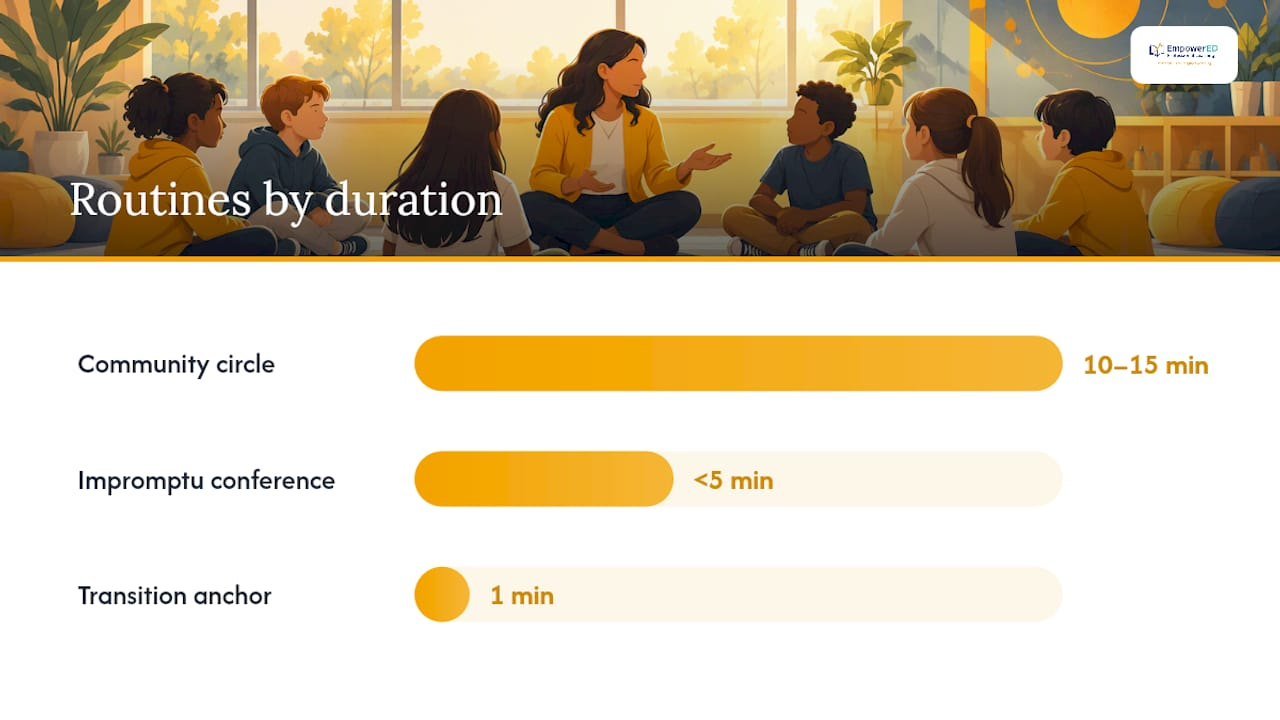
- Run a community circle twice a week, 10 to 15 minutes, same time slot, same opening question. Rotate the talking piece and use prompts like: “What’s one thing that made you feel proud this week?” or “Share a time someone helped you without being asked.” Keep a closing prompt in reserve: “What do you need from this group to have a good day tomorrow?”
- Use affective statements instead of commands. Swap “Stop talking” for “When side conversations happen during instructions, I feel like the plan for the day gets lost, and that worries me.” The shift from directive to impact statement is what makes the practice restorative rather than just polite.
- Ask restorative questions before consequences. When something goes wrong, lead with: “What happened?” then “What were you thinking at the time?” then “Who else was affected by this?” Save any consequence discussion for after the student has answered all three.
- Run impromptu conferences in under five minutes. Pull the student aside, ask the same restorative questions in a lower-stakes tone, and end with, “What do you think would help make this right?”
- Anchor transitions with one minute of quiet breathing or reflection. A single minute before a test or after recess resets the room and makes the next circle or conversation land better.
Pro Tip: Keep a laminated card with your six restorative question prompts taped inside a desk drawer. When a conflict flares up, you will not have to think on the spot, you just read the next question.
The Schoolwide Restorative Circles guide walks through a full pilot plan if you want scripts beyond this starter list, and pairing these routines with classroom management techniques built for K to 12 settings tends to shorten the learning curve.
How Do You Handle a Conflict Between Students?
The decision is mostly about scale. An impromptu conference works for a hallway shove or a snapped comment between two students who are otherwise fine. A full restorative conference is for repeated harm, bullying, or incidents that affected multiple people or damaged trust in a way a five-minute chat cannot fix.
A full conference follows a fairly consistent structure:
- Separate initial conversations with each student to understand their account
- A joint session using restorative questions: “What happened?” “Who was affected, and how?” “What do you think needs to happen to repair this?”
- An agreement both students can state in their own words, not one dictated by the adult in the room
- A follow-up check-in within a week to confirm the agreement held
Reintegration after a suspension deserves its own step. A brief welcome circle, run by the classroom teacher or a designated coordinator, signals that the student is returning to a community rather than sliding back into an empty seat. Looping in families before that circle, with a short call describing what the circle involves, cuts down on surprises and builds trust with caregivers who may already be skeptical of school discipline processes.
What Does a Multiyear Rollout Actually Require?
Restorative practice fails fastest when a school treats it as a single training day. The U.S. Department of Education’s guiding principles on school discipline name staff buy-in, whole-school adoption, and ongoing professional training as the non-negotiables, and the ERIC administrator’s guide lays out a four-part framework schools can follow instead of building one from scratch.
A realistic timeline runs three years, not one semester:
- Pilot year: A handful of classrooms or one grade level runs Tier 1 routines daily, with weekly coaching check-ins and baseline data collection on referrals and climate surveys.
- Expansion year: The practice moves schoolwide, a designated restorative coordinator or transition facilitator takes on Tier 2 and Tier 3 cases, and staff PD shifts from introductory training to coaching real incidents.
- Sustain year: Data collection becomes routine, fidelity checks run each semester, and new staff get onboarded through a shortened version of the original training.
A dedicated coordinator role matters more than most budgets account for. IES-funded design work points to full-time or designated staff as a key piece of infrastructure for keeping reintegration and Tier 2 mediation consistent rather than ad hoc.
Blending restorative work with an existing SWPBIS or MTSS framework rather than running it as a separate initiative also matters. The IES PRIDE project found that combining SWPBIS with restorative discipline increased teachers’ actual use of restorative strategies and showed early promise for narrowing disparities. On funding, a REL Northwest practice brief suggests grants or reallocated PD funds, including ESSA Title IV dollars, as realistic sources for sustained coaching. The trauma-informed teaching guide covers how this integration plays out at the classroom level.
What Goes Wrong Most Often?
The most common failure is skipping Tier 1 and jumping straight to Tier 2 conferences, expecting a mediation script to work without the daily trust building that makes students willing to be honest in a circle. A close second is treating restorative practice as an add-on training rather than a shift in how the whole staff talks about accountability, which is exactly the gap the Department of Education’s guidance warns against.
Watch these fidelity signals each semester:
- Percentage of staff who completed initial and refresher training
- Average frequency of community circles per classroom per week
- Referral and circle participation data broken out by student subgroup, not just schoolwide averages
Uneven exposure is the equity red flag hiding in plain sight. If circle frequency or restorative conference access differs sharply between subgroups, the Learning Policy Institute’s equity gains will not materialize, no matter how strong the pilot data looks on paper. Correct it by auditing which classrooms actually run Tier 1 routines weekly, not just which staff attended training.
— Brian Koster, Ed.D.
Who Wrote This Guide and What Backs It?
This guide was written by Brian Koster, Ed.D., whose doctoral work in educational leadership informs the emphasis on schoolwide systems, not just classroom scripts, since sustainable discipline reform lives or dies at the leadership level.
Teachers ready to build Tier 1 skills fast should start with SEL and classroom management courses. Instructional coaches and administrators managing a multiyear rollout benefit more from courses on trauma-informed practice and inclusive design, since those roles need to think about staffing, fidelity, and equity across an entire building. Each course includes a completion certificate that may qualify for PD credit, which helps when a rollout needs documented training hours for a grant or accreditation file.
Ready-to-Use Support for Restorative Classrooms
Empowered Professional Learning is built for exactly this problem: turning research on restorative practices into short courses teachers can finish between grading stacks, not semester-long certification programs that outlast the school year. These self-paced courses let one teacher or an entire team start today, with personalized instructor feedback built into most of them.
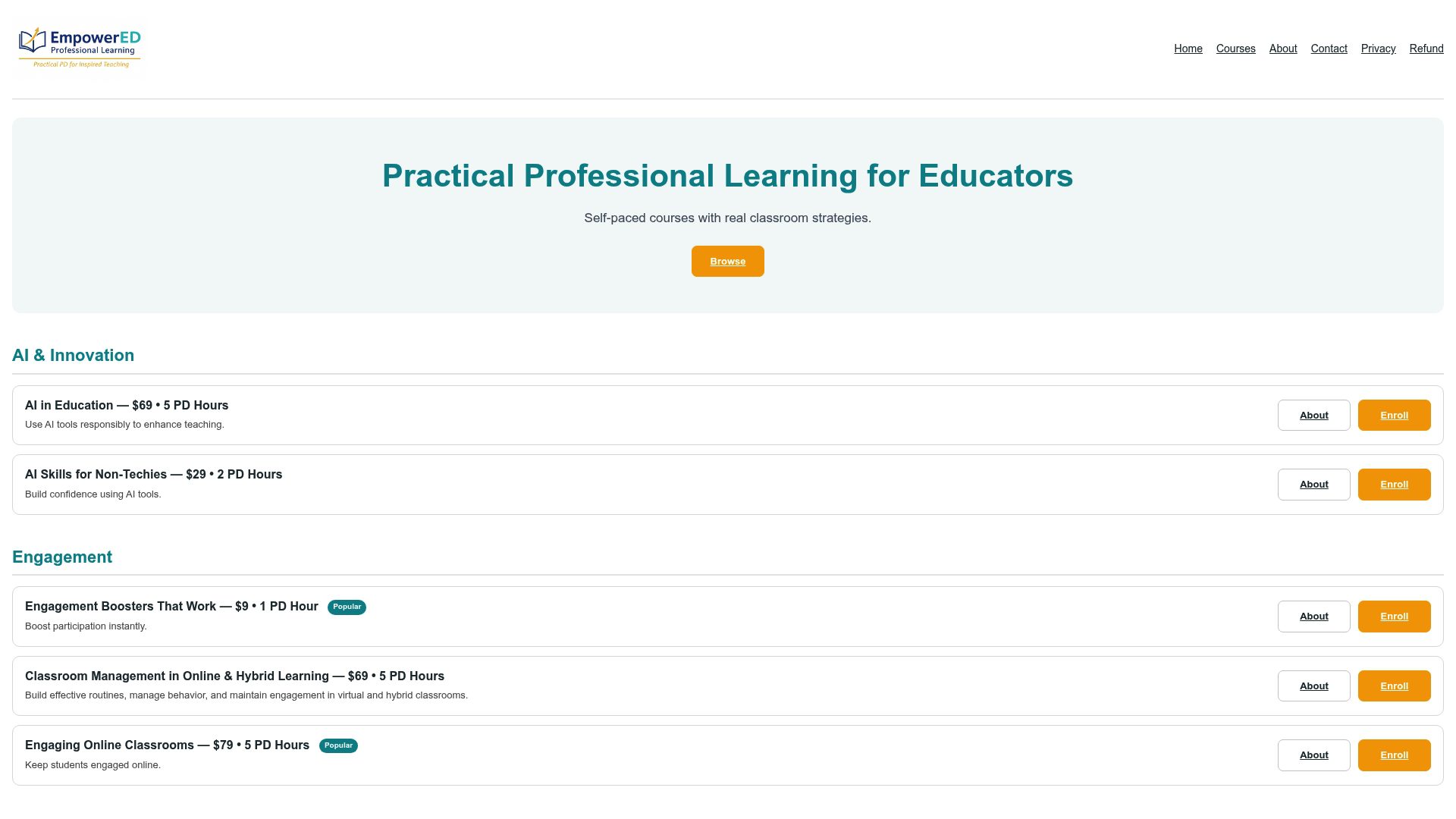
If you teach in the classroom, start with Social-Emotional Learning & Teacher Wellness to build the relationship skills restorative circles depend on, then add Engagement Boosters That Work to keep Tier 1 routines from going stale by winter break. If you lead a building or a grade-level team, Universal Design for Learning (UDL) & Accessibility ensures your restorative routines actually reach neurodiverse learners and students who process circles differently. Browse the full professional learning catalog to build a team-wide plan, or license courses in bulk for your district’s multiyear rollout.
Sources
- PubMed: Hollands et al. (study cited on implementation duration)
- U.S. Department of Education: Guiding principles on school discipline
- ERIC ED627822: Getting Started with Restorative Practices in Schools: A Guide for Administrators and Teacher Leaders
- IES: Positive and Restorative Investment in Discipline (PRIDE) project
FAQ
What Are the 5 R’s of Restorative Practices?
Definitions vary across programs, but common versions include relationship, respect, responsibility, repair, and reintegration. These represent the arc a restorative process moves through, starting with the relationship that made trust possible and ending with the student’s return to full community standing.
What Are the 5 C’s of Classroom Management?
The framework is not consistently defined across sources, and no single canonical version appears in restorative practice research. Rather than force a fit, focus on the elements this guide covers directly: consistent routines, clear expectations stated through affective language, and community building through regular circles.
What Are Some Examples of Restorative Practice Activities?
Community circles, affective statements, restorative questions, impromptu conferences, and welcome circles for students returning from suspension are the core activities. A simple starting point is a twice-weekly circle using rotating prompts, paired with affective statements swapped in for directive commands during regular instruction.
How Long Does It Take to See Results From Restorative Practices?
Meaningful drops in suspension rates tend to show up more strongly after two years of consistent implementation rather than one. Expect the first year to focus on building Tier 1 habits and collecting baseline data, with larger schoolwide gains emerging in year two and beyond.
Does Empowered Professional Learning Offer Restorative Practice Training?
Empowered Professional Learning offers related courses including Social-Emotional Learning & Teacher Wellness, Engagement Boosters That Work, and Universal Design for Learning (UDL) & Accessibility, each supporting different pieces of restorative implementation. Current pricing and course details are listed on the professional learning catalog.