The most effective way to reduce cognitive load in a lesson is to combine six research-backed moves: worked examples, deliberate signaling, chunking content into smaller segments, scaffolding that fades over time, retrieval practice, and cutting extraneous distractions from your materials. Each strategy below comes with a classroom action you can try tomorrow, grounded in cognitive load theory and reviewed against the IES practice guide. Brian Koster, Ed.D., breaks down what the research supports and what gets oversimplified in staff-meeting slide decks.
TL;DR:
- Using multiple worked examples before independent tasks helps students recognize patterns and improves retention, especially when support is gradually faded.
- Signaling key terms and narrating visuals in the lesson minimizes visual search and splits cognitive load between channels, enhancing understanding.
- Breaking lessons into smaller chunks with pauses allows students to consolidate information and reduces the intrinsic load of complex content.
- Teaching scaffolds should be released as soon as students can perform tasks independently to avoid helping that adds to cognitive overload.
- Eliminating unnecessary visual clutter and distractions can significantly decrease extraneous load, freeing working memory for core learning tasks.
Table of Contents
- Six Ways to Start Reducing Cognitive Load Tomorrow
- A Simple Lesson Plan That Puts These Strategies to Work
- Why Brian Koster, Ed.D. Trusts This Framework
- What Germane Cognitive Load Actually Does for Learning
- Intrinsic Cognitive Load: What You Can and Can’t Simplify
- How Attention Management Reduces Cognitive Load
- Multimedia Design Principles Beyond Signaling and Contiguity
- Where Cognitive Load Theory Comes From
- Why Working Memory Limitations Shape Every Lesson You Teach
- The Real Gap Between Cognitive Load Research and Classroom Practice
- Turn These Strategies Into Classroom Practice
- Key Research and Practice Guides to Consult Next
- Sources
- FAQ
Six Ways to Start Reducing Cognitive Load Tomorrow
Working memory can only hold a handful of new items at once, and every lesson competes for that limited space. The strategies below target the parts of instruction that eat working memory without adding to learning, so students spend their mental effort on the material itself instead of decoding how to access it.
Worked examples come first for a reason. Novice learners retain more when they study a fully solved problem before attempting one themselves, rather than jumping straight into independent problem-solving. The MIT Teaching + Learning Lab notes that multiple worked examples typically produce more initial benefit than a single one, because repetition helps students notice the underlying pattern rather than memorizing one specific case. Fade the support gradually: full worked example, then a partially completed problem, then an independent one. Alternating worked examples with practice problems, rather than blocking all examples together, also improves transfer according to EEF’s guidance on worked examples.
Signaling tells students where to look. Bold the key term. Put the label next to the diagram, not below it. Cognitive load theory calls this spatial contiguity, and the effect is not subtle: when text and visuals sit far apart, students burn working memory just hunting for the connection between them. The modality effect adds a second lever. Explaining a diagram out loud while students look at it works better than making them read dense on-screen text and study the same diagram simultaneously, because it splits the load across two channels instead of stacking it on one.
Chunking breaks a lesson into digestible pieces. A 50-minute block delivered as one long explanation asks students to hold too much in working memory before any of it gets used. Segmenting the same content into four or five smaller chunks, each followed by a brief pause, a question, or a two-minute reflection, gives working memory a chance to consolidate before the next chunk arrives.
Scaffolding follows an “I do, we do, you do” arc. You model the skill completely, then share the work, then release it. The mistake many teachers make is releasing too slowly. Once students can do a piece independently, remove that scaffold. Leaving support in place after it is no longer needed causes what researchers call expertise reversal, where help that once reduced cognitive load starts adding to it instead.
Retrieval practice cements what chunking and scaffolding built. Low-stakes quizzes, flashcards, and quick recall prompts strengthen memory more than passive review, and the IES practice guide specifically recommends spacing this retrieval over days and weeks rather than cramming it into one review session. Retrieval works even when students get an answer wrong, as long as feedback follows quickly.
Cutting extraneous distractions is the cheapest fix on this list. A slide with six fonts, three colors, and a decorative clip art image forces students to filter out noise before they can process content. EEF’s research on extraneous load found that simplifying layouts and pre-teaching unfamiliar vocabulary are among the highest-impact, lowest-cost changes a teacher can make.
UDL rounds out the list by building flexibility in from the start. Offering multiple ways to access the same content, text, audio, visual diagram, hands-on model, means fewer students spend working memory translating information into a format they can actually use. Universal Design for Learning treats this as a design principle rather than an accommodation added after the fact.
- Worked examples: model multiple before independent practice, then fade support.
- Signaling: place labels next to visuals; narrate diagrams instead of captioning them.
- Chunking: break lessons into four or five segments with a pause after each.
- Scaffolding: release support the moment a student can do the step alone.
- Retrieval practice: quiz in short, low-stakes bursts, spaced across the week.
- Distraction control: strip slides down to what students actually need to see.
Pro Tip: Before adding anything new to a lesson, ask whether it earns its place in working memory. If a visual, phrase, or transition doesn’t directly support the learning goal, cut it rather than explain it away.
A Simple Lesson Plan That Puts These Strategies to Work
Turning six strategies into a coherent lesson is easier with a fixed sequence to follow. Use this checklist when planning, then adapt the timing to your subject and grade level.
- Pre-teach and prime. Spend two or three minutes activating prior knowledge and naming today’s one learning goal.
- Present worked examples. Walk through two or three fully solved examples, thinking aloud as you go.
- Guided practice. Work the next problem together, releasing more of the work to students each time.
- Independent practice. Students try a similar problem alone while you circulate and check for confusion.
- Retrieval activity. Close with a two-minute low-stakes recall task tied to today’s content or last week’s.
- Spaced re-exposure. Revisit the same skill briefly in a warm-up three to five days later.
A 45-minute micro-sequence:
| Time | Phase | What happens |
|---|---|---|
| 2–3 minutes | Pre-teach | Activate prior knowledge, state the goal |
| — | Worked examples | Two to three modeled problems with think-aloud |
| — | Guided practice | Shared work, scaffolds start fading |
| — | Independent practice | Students apply the skill solo |
| — | Retrieval + exit ticket | Quick recall question, no grading pressure |
Cue phrases worth reusing: “Watch where I’m looking, not just what I’m writing” for signaling, and “What’s the first thing you notice here?” before releasing a worked example to students.
Pro Tip: Keep your exit ticket to one question. A five-question quiz at the end of class measures more than it teaches, and it adds load right when attention is lowest.
Why Brian Koster, Ed.D. Trusts This Framework
Brian Koster, Ed.D. brings a background in instructional design and educator training to this breakdown, focusing on strategies that hold up in real classrooms, not just in lab studies. [brand_signal] EmpowerED’s course library is built around the same premise: teachers need classroom-ready tools they can apply the same week they learn them, not theory that stays on a slide deck. [author_bio]
Several EmpowerED courses map directly to the strategies above. Universal Design for Learning (UDL) & Accessibility helps teachers build the multiple-representation habits that reduce extraneous load for diverse learners. Engagement Boosters That Work tackles distraction control and signaling design directly. Neither course invents new theory. Both translate it into moves you can use Monday morning.
What Germane Cognitive Load Actually Does for Learning
Germane load is the only kind of cognitive load you want more of. It represents the mental effort students spend building and connecting schemas, the organized mental structures that let an expert glance at a problem and immediately recognize its type. Intrinsic load is the difficulty baked into the material itself. Extraneous load is the wasted effort caused by poor design. Germane load is productive struggle, and increasing it (while keeping the other two in check) is the actual goal of cognitive load management.

You enhance germane load by asking students to compare examples, explain their reasoning, or connect a new concept to one they already know. Self-explanation prompts work particularly well here: pausing after a worked example to ask “why did that step come next?” pushes students to build the schema themselves rather than just watching you build it. Research on worked examples suggests this kind of guided reflection, not just exposure to more examples, is what drives deeper transfer.
The mistake many teachers make is treating “reduce cognitive load” as “reduce all effort.” That’s backwards. The goal is freeing up capacity by cutting extraneous and manageable intrinsic load, so students have room left over for the germane load that actually builds understanding. A lesson with zero productive struggle isn’t efficient. It’s just easy, and easy rarely transfers.
Intrinsic Cognitive Load: What You Can and Can’t Simplify
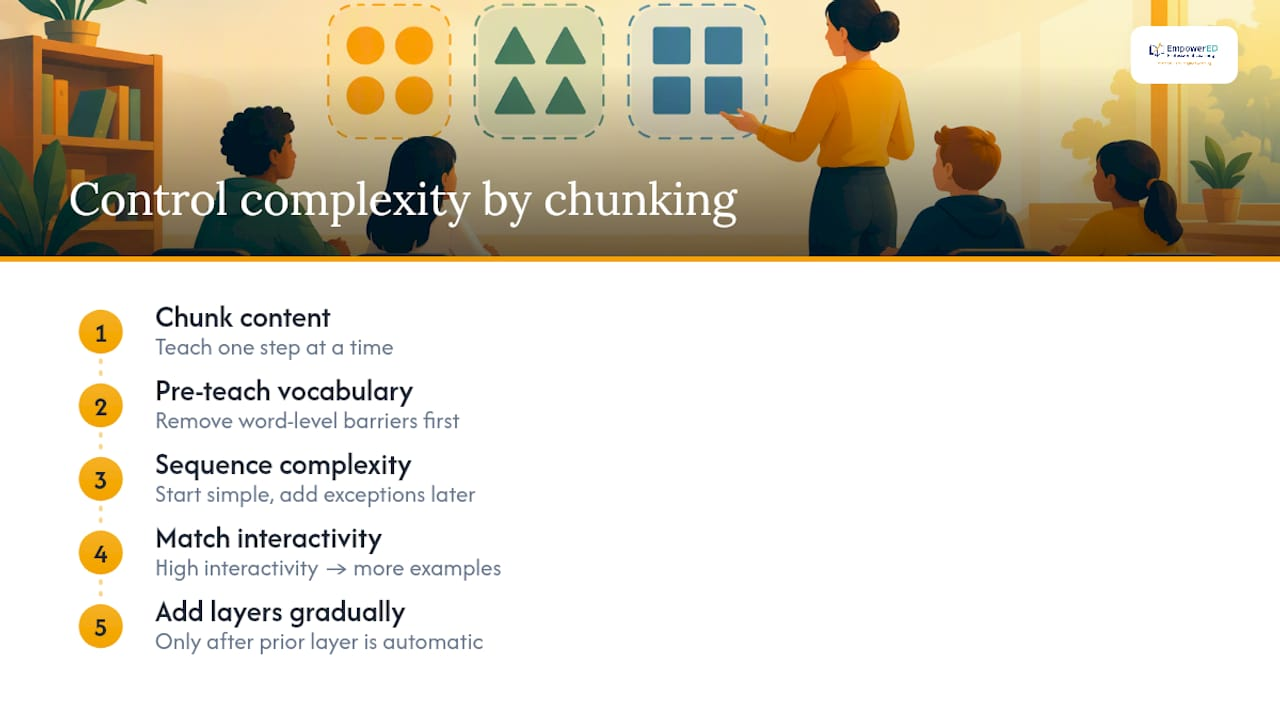
Intrinsic load comes from the inherent complexity of the material itself, and unlike extraneous load, you cannot design it away entirely. Long division has more moving parts than single-digit addition no matter how clean your slides look. What you can control is how much of that complexity students face at once.
Chunking is the primary lever here. Breaking a multi-step process into smaller, sequential pieces lowers the intrinsic load of each individual step without lowering the difficulty of the skill overall. Pre-teaching vocabulary before a dense reading does something similar: it strips one layer of difficulty (unfamiliar words) so students can focus their intrinsic-load budget on the harder layer (the ideas the words describe).
Sequencing matters as much as chunking. Teaching the simplest version of a concept before its exceptions and edge cases keeps intrinsic load manageable early, then lets it rise naturally as students gain capacity. This is why most math curricula introduce whole numbers before fractions and fractions before negative numbers. Each new layer of intrinsic complexity gets added only once the previous layer is automatic.
Element interactivity is the technical term worth knowing here: some content has high element interactivity because its parts can’t be understood in isolation (grammar rules, chemical equilibrium), while other content has low interactivity because pieces can be learned independently (vocabulary lists, historical dates). High interactivity content needs more chunking and more worked examples. Low interactivity content tolerates faster pacing.
How Attention Management Reduces Cognitive Load
Attention is the gatekeeper for working memory. Nothing gets processed, stored, or connected to prior knowledge unless a student’s attention lands on it first, and every distraction competing for that attention pulls capacity away from the actual lesson. This is why classroom noise, cluttered walls, and even a poorly timed hallway announcement carry a real cognitive cost, not just a behavioral one.
Signaling, discussed earlier, is really an attention-management tool wearing a different name. Bolding a term or narrating a diagram works because it directs attention to the right input at the right moment, rather than leaving students to guess what matters. The same logic applies to classroom layout. A well-organized room with clear sightlines reduces the visual scanning students do before they can even begin processing a lesson, which matters more for students who are already working hard to filter sensory input.
Timing attention shifts deliberately also helps. Asking students to switch from listening to writing to discussing in rapid succession fragments attention across tasks faster than working memory can reset. Building in short transition pauses, even five seconds of silence before switching activities, gives attention time to fully disengage from one task before engaging the next. It’s a small design choice with a disproportionate payoff for students who struggle to shift attention quickly, including many students with ADHD or sensory processing differences, where structured sensory strategies can make classroom transitions substantially smoother.
Multimedia Design Principles Beyond Signaling and Contiguity
Signaling and spatial contiguity get most of the attention in multimedia design discussions, but Richard Mayer’s broader research on multimedia learning identifies several other principles worth building into daily materials. The coherence principle says to strip out interesting-but-irrelevant content, that fun tangent story or decorative animation, because it competes with the actual learning content for attention rather than supporting it.
The redundancy principle cautions against narrating a slide word-for-word while the same text also appears on-screen. Students end up splitting attention between reading and listening to identical information, which adds load instead of reducing it. Better to let narration explain what text alone cannot, like reasoning behind a step, while the on-screen visual carries the structure.
The pre-training principle suggests introducing key vocabulary and concepts before the main lesson rather than during it. Students who already know what “photosynthesis” and “chlorophyll” mean can spend their attention on the process itself instead of decoding terminology mid-explanation.
Finally, the personalization principle notes that conversational language (“Let’s figure out why this happens”) tends to engage students more actively than formal, distant phrasing, which keeps working memory oriented toward meaning rather than toward parsing tone. None of these principles require new technology. They require reviewing existing slides, handouts, and videos with a more critical eye.
Where Cognitive Load Theory Comes From
Cognitive load theory originated with psychologist John Sweller in the 1980s, building on earlier research into working memory limitations. Sweller’s core insight was that instructional design fails or succeeds based on how well it respects the brain’s limited processing capacity, not just on how accurate or thorough the content is. RIT’s overview of cognitive load breaks the theory into the three load types referenced throughout this article: intrinsic, extraneous, and germane.
The theory sits on top of a well-established model of working memory, one that treats it as a narrow bottleneck compared to the much larger capacity of long-term memory. Once information moves into long-term memory and forms a schema, it stops requiring conscious working-memory effort to retrieve, which is why experts can solve familiar problems almost automatically while novices labor through the same problem step by step.
Over the decades since Sweller’s original work, researchers have refined the model to account for element interactivity, the testing effect, and the role of germane load in schema construction. What hasn’t changed is the central claim: instruction that ignores working memory’s limits, no matter how well-intentioned, teaches less than instruction designed around them.
Why Working Memory Limitations Shape Every Lesson You Teach
Working memory can hold roughly a handful of new items at once, and it can lose them within seconds if nothing reinforces them. That constraint, not motivation or ability, is often the real reason a lesson that felt clear to you leaves half the class confused. Every additional decision a student has to make mid-lesson, where to look, what to write down, which instruction to follow first, draws down that same limited resource.
This is why overload shows up as specific, recognizable behavior rather than vague disengagement. A student who suddenly stops taking notes, asks a question you already answered, or stares blankly at a multi-step instruction is often not distracted. Their working memory has hit capacity, and something had to drop.
The instructional fix is not to lower expectations. It’s to reduce the number of simultaneous demands so more of a student’s limited working memory goes toward the actual learning goal. Chunking, signaling, and worked examples all work by trimming the number of things a student has to juggle at once, which frees enough capacity for the harder, more valuable work of building understanding.
The Real Gap Between Cognitive Load Research and Classroom Practice
Most professional development treats cognitive load like a checklist: add signaling, add chunking, done. That’s not wrong, but it misses the harder judgment call underneath all six strategies, which is knowing when a student is struggling productively versus struggling because the lesson itself is poorly designed. The research supports removing unnecessary friction. It does not support removing all friction, and too many well-meaning simplification efforts end up flattening germane load along with extraneous load.
The strategy I’d prioritize first, ahead of the others, is worked examples with deliberate fading. It’s the one technique that forces you to plan for the release of support before the lesson even starts, which prevents the common failure mode of scaffolding that never gets removed. Everything else on this list works better once fading is built into your default lesson structure. Teachers who treat cognitive load reduction as a design habit rather than a one-time fix see the difference show up in how quickly students transfer skills to new problems, not just how well they perform on the original task.
— Brian Koster, Ed.D.
Turn These Strategies Into Classroom Practice
Reading about cognitive load reduction and actually redesigning a unit around it are two different skills, and most teachers don’t have a spare planning period to bridge that gap alone. Courses are available that show you exactly how to apply strategies like these in your own lesson plans, not just why they work.
Universal Design for Learning (UDL) & Accessibility walks through building multiple representations into your materials, the exact fix for reducing extraneous load for students with different processing needs. Engagement Boosters That Work focuses on cutting the distractions and off-task triggers that quietly drain working memory during a lesson. And AI in Education: From Basics to Ethical Integration covers tools for building modality-friendly materials, narrated explanations, visual supports, and multimodal content, without requiring a technology background.
Many courses offer personalized instructor feedback and a certificate that may count toward PD credit. Browse the full professional learning catalog to find the course that matches what your classroom needs this semester.
Key Research and Practice Guides to Consult Next
The MIT Teaching + Learning Lab’s worked examples guide explains how many examples to use and when to fade them. The IES practice guide offers the most comprehensive set of classroom-tested recommendations across spacing, quizzing, and dual representation. Virginia Tech’s retrieval practice resource gives ready-to-use low-stakes quiz formats. Brock University’s overview of extraneous load reduction covers signaling and the modality effect in more depth. RIT’s cognitive load overview provides the clearest short summary of the theory’s three load types.
Sources
- Worked examples – Teaching + Learning Lab (MIT)
- Practice Guide: Improving Students’ Learning With Effective Teaching Practices (Institute of Education Sciences)
FAQ
What Are the Signs a Student Is Cognitively Overloaded?
Common signs include a student who stops taking notes mid-lesson, repeats a question you already answered, freezes on multi-step instructions, or seems to disengage suddenly rather than gradually. These usually signal working memory has hit capacity, not a lack of motivation.
How Can Teachers Help Students Build Working Memory Capacity?
You can’t directly expand working memory’s size, but you can reduce how much of it a task demands through chunking, worked examples, and scaffolding, which frees capacity for harder thinking. Retrieval practice also helps by moving information into long-term memory, where it no longer occupies working memory space once learned.
What Happens When Cognitive Load Gets Too High in a Lesson?
Learning drops off sharply once cognitive load exceeds working memory’s capacity, because new information gets lost before it can be processed or stored. Students often shut down, guess randomly, or fixate on one detail while missing the rest of the instruction.
What Are Common Classroom Examples of Cognitive Load?
Examples include a cluttered slide with too much text and imagery, an instruction with five steps given all at once, unfamiliar vocabulary embedded in a new concept, and background noise competing with a teacher’s explanation. Each adds a demand on working memory that has nothing to do with the actual learning goal.