Start with six classroom-ready active learning strategies this week and you will see measurable gains in engagement and critical thinking almost immediately. The six best starters are: Think-Pair-Share, Exit Tickets/Muddiest Point, a short Problem-Based Learning task, Gallery Walk, Jigsaw, and brief academic movement bursts. A large meta-analysis of 398 studies found strong positive effects for active learning, with an effect size of g = 1.005 for academic achievement and g = 1.204 for learning retention in K–12 settings. That is a substantial, research-backed payoff for a shift that can begin with a single 10-minute activity.
Your six starter strategies:
- Think-Pair-Share, Exit Tickets/Muddiest Point, and short PBL tasks (5–15 minutes each)
- Gallery Walk, Jigsaw, and academic movement bursts (5–15 minutes each)
- All six require minimal materials and no major lesson redesign
Quick-action step: Pick one strategy from the list above and run a 10-minute version in your next class tomorrow.
Pro Tip: Start with Think-Pair-Share. Pose one strong question, give students 60 seconds to think silently, 90 seconds to discuss with a partner, then cold-call two or three pairs. Total time: under 5 minutes.
Table of Contents
- What active learning really means for K–12 classrooms
- Why active learning produces better outcomes in K–12
- What the research actually says
- 10 classroom-ready strategies with examples and grade variations
- How to roll out active learning in four weeks
- Formative assessment during active learning
- Solving common problems and keeping equity at the center
- Key Takeaways
- A practitioner’s perspective on what actually moves the needle
- Empowered Professional Learning supports your active learning rollout
- Useful sources and further reading
What active learning really means for K–12 classrooms
Active learning is instruction where students do the cognitive work: they think, explain, apply, question, and construct understanding rather than passively receive information. The teacher’s role shifts from primary information provider to facilitator who structures tasks, monitors progress, and adjusts support in real time.
Six principles guide effective design:
- Student accountability: every student produces something (a written response, a spoken explanation, a movement) so no one can coast.
- Purposeful structure: tasks have clear goals, time limits, and success criteria.
- Scaffolding: guidance is calibrated to student readiness. Research on cognitive prerequisites shows an inverted-U relationship between guidance and prior knowledge: too little support harms lower-knowledge students, while too much limits growth for advanced ones.
- Wait time: pausing 5–10 seconds after a question increases response quality and broadens participation.
- Low-stakes practice: students rehearse thinking without fear of a grade penalty.
- Alignment to learning goals: every activity connects to a standard or learning target.
Active learning overlaps directly with student-centered learning, Universal Design for Learning (UDL), and equitable participation. UDL principles ask teachers to offer multiple means of engagement and expression, which active tasks naturally support. Empowered Professional Learning’s UDL and Accessibility course gives teachers a structured framework for applying these principles across grade levels.
Why active learning produces better outcomes in K–12
The benefits of student-centered learning are observable, not just theoretical. Here is what each benefit looks like in a real classroom:
- Improved academic achievement: students who explain concepts to peers consolidate understanding faster than those who re-read notes.
- Better retention: active retrieval during class (exit tickets, quick writes) reduces forgetting between lessons.
- Higher on-task behavior: short active lessons of 5–15 minutes combining movement with academic content improve time on task in elementary students, with a measurable dose-response effect.
- Increased critical thinking: questioning strategies, Socratic discussion, and short written exercises are among the most effective methods for promoting critical thinking in K–12 students.
- SEL gains: collaborative tasks build communication, perspective-taking, and self-regulation skills that districts increasingly track.
One practical note on standards alignment: a 10-minute Think-Pair-Share or exit ticket fits inside any lesson without sacrificing coverage. Short active-learning doses accumulate benefits over time and do not require cutting content.
What the research actually says
The strongest evidence comes from a meta-analysis of 398 studies on active learning in K–12 settings. The headline findings indicate large positive effects on academic achievement (g = 1.005) and learning retention (g = 1.204) across many studies.
Effect sizes vary by moderator. The same meta-analysis found that subject domain, grade level, who implements the lesson, and group size all influence outcomes. That variability is not a reason to hesitate. It is a reason to collect your own quick formative data in the first month so you can see what works for your students.
For administrators: these numbers translate directly into the language of school improvement plans. A teacher who can show exit-ticket data alongside a research summary has a credible case for continued implementation time.
10 classroom-ready strategies with examples and grade variations
1. Think-Pair-Share
How it works: Pose a question, students think independently, discuss with a partner, then share with the class.
Example: After reading a paragraph, ask: “What is the author’s main claim and what evidence supports it?” Think: 60 seconds. Pair: 90 seconds. Share: 2–3 pairs.
Time: 5–8 minutes. Group size: Pairs.
- Elementary: Use sentence starters (“I think… because…”) to scaffold the share step.
- High school: Require partners to identify one point of agreement and one point of disagreement before sharing.
Pro Tip: Cold-call after pair time, not before. Students are far more willing to share publicly once they have rehearsed with a partner.

2. Exit tickets and Muddiest Point
How it works: Students write one thing they learned and one thing still unclear on a slip of paper or digital form before leaving class.
Example: “Write the one concept from today’s lesson you feel confident about and the one question you still have.” Collect and sort responses into three piles: got it, almost, needs reteaching.
Time: 3–5 minutes. Group size: Individual.
- Elementary: Use a simple two-box template (one smiley face box, one question-mark box).
- Middle/High: Ask students to write a follow-up question they would ask the author or scientist.
3. Gallery Walk
How it works: Post questions or prompts around the room. Small groups rotate, respond in writing, and build on previous responses.
Example: Post five chart papers with different historical primary sources. Groups spend 3 minutes at each, adding observations and questions. Debrief as a class.
Time: 15–25 minutes. Group size: 3–4 students.
- Elementary: Use images instead of text-heavy prompts; provide sentence frames.
- High school: Require groups to evaluate and respectfully challenge prior responses.
Active learning strategies like Gallery Walk correlate with improved analytical and reflective skills in K–12 contexts.
4. Jigsaw
How it works: Each student becomes an “expert” on one section of content, then teaches it to peers in a mixed group.
Example: Divide a chapter into four sections. Expert groups read and discuss their section (10 minutes), then regroup to teach each other (12 minutes).
Time: 25–35 minutes. Group size: 4–6 students.
- Elementary: Use picture books or short leveled texts; provide a graphic organizer for the teach-back.
- High school: Assign primary sources or competing arguments; require experts to anticipate peer questions.
5. Socratic seminar (scaled)
How it works: Students discuss an open-ended question using text evidence, building on each other’s ideas without teacher direction.
Example: Pose one essential question tied to a shared text. Students sit in a circle, discuss for 15 minutes, with the teacher only tracking participation and posing a follow-up question if discussion stalls.
Time: 15–20 minutes. Group size: 8–15 students (inner circle/outer circle for larger classes).
- Elementary: Use a “fishbowl” with 6–8 students; outer circle observes and gives feedback.
- High school: Require students to cite specific text evidence before making a claim.
Pro Tip: Wait at least 5–10 seconds after posing a probing question before accepting responses. That silence feels uncomfortable but consistently produces more thoughtful, equitable participation.
For deeper questioning techniques, the classroom questioning strategies guide from Empowered Professional Learning offers grade-specific examples teachers can use immediately.
6. Problem-Based Learning (short PBL task)
How it works: Students tackle a real-world problem that requires applying content knowledge to propose a solution.
Example: “The school cafeteria wastes 30 pounds of food daily. Design a two-week plan to cut waste by half.” Groups research, plan, and present a one-page proposal.
Time: 1–3 class periods for a short version. Group size: 3–4 students.
- Elementary: Use a local, concrete problem (e.g., designing a school garden layout).
- High school: Require students to cite data sources and address counterarguments in their proposal.
7. Flipped classroom (micro-flip)
How it works: Students watch a short video or read a brief text before class; class time is used for application, discussion, and practice.
Example: Assign a 5-minute video on a math concept the night before. Class opens with a quick check question, then moves directly into collaborative problem-solving.
Time: 5-minute check-in plus full class period for application. Group size: Individual to small groups.
- Elementary: Use read-alouds or short picture-book videos; keep pre-work under 5 minutes.
- High school: Pair the video with two guiding questions students answer in writing before class.
8. Stations and rotations
How it works: Students rotate through 3–5 activity stations, each targeting a different skill or modality.
Example: Four stations: independent reading, collaborative discussion, hands-on manipulatives, and a digital practice tool. Each station runs 10–12 minutes.
Time: 40–50 minutes. Group size: 4–6 students per station.
- Elementary: Use picture cues at each station so students know exactly what to do without re-reading directions.
- Middle school: Assign station roles (recorder, timekeeper, reporter) to build accountability.
9. Academic movement bursts
How it works: Brief physical activity is paired with academic content to boost focus and on-task behavior.
Example: “Stand up if you think the answer is A, stay seated for B.” Or have students walk to a corner of the room labeled with their position on a debate topic.
Time: 5–10 minutes. Group size: Whole class.
- Elementary: Use “four corners” with vocabulary words or math facts.
- High school: Use movement to sort competing claims or rank historical events chronologically.
Research from the Texas I-CAN trial found that even brief active lessons improve student focus and time on task, with effects measurable within a single class period.

10. Cooperative group tasks with accountable roles
How it works: Students work in structured groups where each member holds a specific, rotating role that ensures participation.
Example: Assign roles: Facilitator (keeps discussion on track), Recorder (writes group responses), Reporter (shares with class), and Skeptic (challenges assumptions). Groups solve a problem or analyze a text together.
Time: 15–20 minutes. Group size: 4 students.
- Elementary: Use role cards with pictures and sentence starters for each role.
- High school: Add a “Devil’s Advocate” role to push deeper critical thinking.
For student engagement strategies that map directly to these cooperative structures, Empowered Professional Learning offers a practical guide with templates and planning tools.
How to roll out active learning in four weeks
A low-risk start is better than a perfect plan that never launches. Here is a concrete four-week timeline:
Week 1: Run two 5–10 minute starters (Think-Pair-Share and an exit ticket). Focus on logistics: signal for transitions, partner assignments, and collecting written responses.
Week 2: Add one medium-length strategy (Gallery Walk or cooperative group task with roles). Introduce role cards and a simple participation rubric students can see.
Week 3: Run a short PBL task or Jigsaw. Brief students on norms before starting: one voice at a time, build on each other’s ideas, cite evidence.
Week 4: Collect formative data. Count the percentage of students who provide evidence-backed responses on exit tickets. Compare to week 1. Adjust groupings or scaffolding based on what you see.
Practical norms to establish before the first active lesson: a clear transition signal (a chime, a countdown, a visual timer), assigned partner or group roles, and a posted sentence frame for academic discussion. These small structures cut transition time significantly. Classroom routines that are consistent and predictable make active tasks feel safe for students who are not used to them.
Pro Tip: Keep a sticky note on your desk during week 1 with one question: “Who is doing the thinking right now?” If the answer is mostly you, add a brief pair-share or written response before moving on.
Pro Tip: Set a visible timer for every active task. Students work more efficiently when they can see time remaining, and you preserve instructional time without having to narrate transitions.
Formative assessment during active learning
Checking for understanding during active tasks does not require stopping the lesson. A four-step loop keeps assessment embedded and efficient:
- Observe: circulate and listen to group conversations; note who is on-task and who is struggling.
- Probe: ask one targeted question to a group (“What evidence supports that claim?”) rather than addressing the whole class.
- Give targeted feedback: respond to the group’s reasoning, not just their answer (“Your reasoning is strong; can you connect it to the text?”).
- Adjust: if multiple groups share the same misconception, pause the class for a 2-minute whole-group clarification before continuing.
For exit tickets, a simple rubric works well. Evaluate student responses on four criteria: reasoning (is there a logical argument?), evidence (is a specific example cited?), participation (did the student engage with the task?), and clarity (is the response understandable?). Score each criterion on a 1–3 scale. This takes under 30 seconds per ticket and gives you sortable data.
A short note on grading: active tasks are most effective as formative practice, not summative grades. Grading every group discussion creates anxiety that suppresses participation. Reserve grades for products (a written proposal, a final presentation) and use quick rubrics for in-process feedback. For a deeper look at formative assessment techniques, Empowered Professional Learning offers a practical guide aligned to K–12 standards.
Pro Tip: Use wait time during your observation loop too. When you approach a group, pause 5 seconds before speaking. Students often self-correct or extend their thinking when they realize you are listening.
Solving common problems and keeping equity at the center
Active learning surfaces participation gaps that traditional instruction hides. Here are the most common problems and targeted fixes:
- Dominant voices: assign structured roles (Skeptic, Recorder) so no single student can monopolize discussion.
- Quiet students: use Think-Pair-Share before whole-class discussion so every student rehearses before going public.
- Time overruns: set a visible timer and practice the transition signal in week 1 until it is automatic.
- Misaligned tasks: check that every activity connects to a specific standard or learning target before running it.
- Testing-schedule pressure: use 5–10 minute active doses aligned to tested content. Teachers who succeed in standardized-testing environments tend to integrate active learning in brief, aligned doses and collect quick formative evidence to demonstrate impact.
Equity checklist:
- Apply UDL principles: offer multiple ways to respond (written, verbal, visual, movement-based).
- Scaffold for multilingual learners: provide sentence frames, bilingual glossaries, and extended think time.
- Support neurodiverse learners: use predictable structures, clear role cards, and low-stakes entry points.
- Monitor wait time equity: track whose responses you call on and adjust deliberately.
Scaffolding is not a one-size-fits-all fix. Research on active learning prerequisites shows that guidance should be calibrated to student readiness: higher-knowledge students benefit from more autonomy, while lower-knowledge students need more structured support. Adjust the level of scaffolding within the same task by providing optional sentence frames or graphic organizers rather than changing the task entirely.
Pro Tip: Normalize productive struggle explicitly. Tell students: “Feeling unsure right now is part of learning. Your job is to think, not to already know the answer.” Students who expect certainty disengage when tasks are ambiguous; students who expect productive difficulty stay in the work.
The structural constraints teachers face, including tight pacing guides and high-stakes testing, are real. Understanding educator-specific structural challenges can help school leaders make space for the kind of instructional experimentation that active learning requires.
Key Takeaways
Active learning strategies for K–12 classrooms produce large, research-backed gains in achievement and retention when implemented consistently, even in short daily doses aligned to standards.
| Point | Details |
|---|---|
| Start small and specific | Pick one 5–10 minute strategy (Think-Pair-Share or exit ticket) and run it tomorrow before redesigning full lessons. |
| Research supports the shift | A meta-analysis of 398 studies found large positive effects for achievement (g = 1.005) and retention (g = 1.204) in K–12 settings |
| Scaffold for every learner | Calibrate guidance to student readiness; UDL adaptations (sentence frames, role cards, movement options) keep all students in the work. |
| Assess during, not just after | Use the four-step loop (observe, probe, feedback, adjust) to check for understanding without stopping the lesson. |
| Empowered Professional Learning | Offers classroom-ready PD courses on engagement and UDL so teachers can implement and sustain active learning with confidence. |
A practitioner’s perspective on what actually moves the needle
Most teachers who struggle with active learning are not doing it wrong. They are doing it in isolation. They try Think-Pair-Share once, it feels awkward, and they conclude the strategy does not work for their students. What actually happened is that the students were not yet trained to use it.
The research is clear that active learning works. The meta-analysis numbers are large and consistent. But the moderator data is equally clear: implementation quality matters enormously. Grade level, group size, and who runs the lesson all affect outcomes. That means the first month is not a test of whether active learning works. It is a training period for both teacher and students.
The most durable shift is not a new strategy. It is a new classroom norm: students expect to think, explain, and produce something every day. Once that norm is established, any strategy from this list becomes easier to run and more effective. The teachers who sustain active learning long-term are the ones who stay student-focused and experimental, iterating based on what they see in exit tickets and group work, not on whether a lesson felt smooth.
One underappreciated move: run a brief debrief after the first active task. Ask students, “What helped you think during that activity? What made it harder?” Their answers will tell you exactly what to adjust in week 2. That feedback loop, more than any single strategy, is what separates classrooms where active learning takes hold from classrooms where it fades after a few weeks.
Empowered Professional Learning supports your active learning rollout
Teachers who want classroom-ready materials, structured PD, and a clear path from strategy to implementation will find both in Empowered Professional Learning’s course catalog.
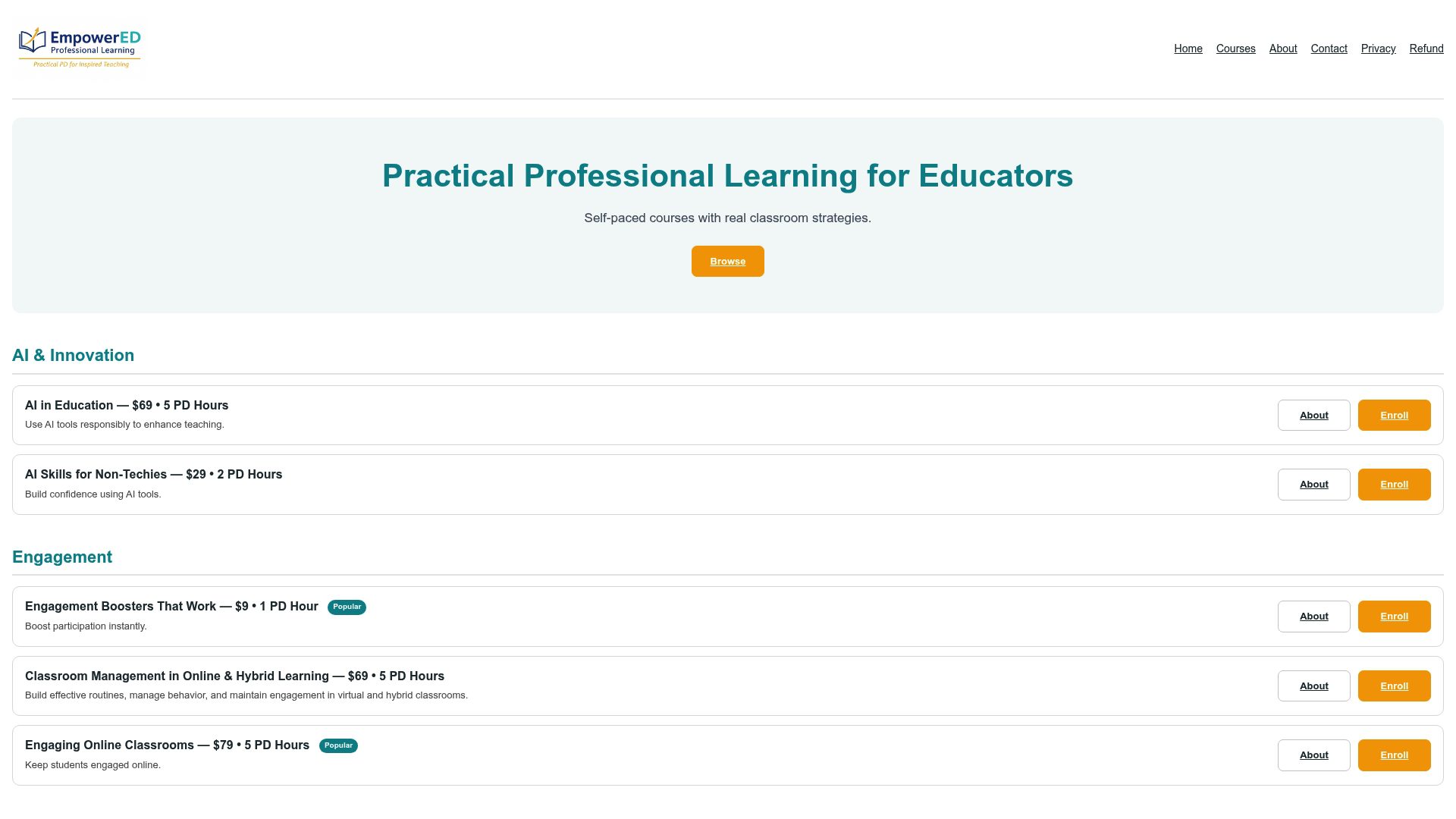
The Engagement Boosters That Work course gives you templates, role cards, and quick-start routines you can use in the first week, along with a PD certificate for your records. For teachers working with diverse learners, the UDL and Accessibility course walks through practical adaptations for multilingual learners, neurodiverse students, and students with IEPs, grounded in the same principles covered in this article. Both courses are self-paced, instructor-guided, and built for busy educators who need practical results, not theory. Browse the full catalog at empoweredpl.com and enroll in the course that fits your most immediate classroom need.
Useful sources and further reading
“Active learning puts students at the center of the learning process by encouraging them to engage, reflect, and apply what they’re learning in meaningful ways.” — University of Colorado Boulder, Center for Teaching & Learning
- For the research case: Active Learning Improves Academic Achievement and Learning Retention in K-12 Settings: A Meta-Analysis — start here if you need effect sizes to share with administrators.
- For movement-based strategies: Active learning improves on-task behaviors in 4th grade children (PMC) — practical evidence for brief academic movement bursts.
- For critical thinking strategies: Active Learning Strategies to Promote Critical Thinking (PMC) — covers questioning, wait time, and discussion techniques.
- For scaffolding and prerequisites: How Can We Make Active Learning Work in K–12 Education? (Sage Journals) — essential reading for teachers working with mixed-readiness classrooms.
- For overcoming barriers: Active Learning in the Middle Grades Classroom (ERIC) — qualitative study of teachers who succeeded in standardized-testing environments.
- For classroom examples and strategy lists: University of Colorado Boulder CTL Active Learning Strategies — a practical, accessible reference for any grade level.
- For PD and classroom-ready materials: Empowered Professional Learning — self-paced courses with templates, rubrics, and PD certificates for K–12 educators.