AI literacy for teachers means understanding how AI systems work, critically evaluating their outputs, and using them safely to improve learning. It is not the same as knowing how to operate a chatbot. The single best next step for any school right now is a short staff PD paired with one low-risk classroom pilot, reflected on and adjusted before scaling further.
TL;DR:
- Teachers need to critically evaluate AI outputs and understand how AI systems generate content, not just learn software operation.
- Progression in AI literacy involves moving from understanding basic concepts to designing and mentoring AI-integrated lessons across three levels.
- Classroom activities should focus on evaluating AI’s accuracy and bias, beginning with simple verification and source comparison tasks.
- Effective PD includes ongoing practice, collaboration, and scenario-based assessments rather than one-time workshops.
- District policies should prioritize governance, privacy, equity, and partner with local experts or vendors to build foundational AI literacy.
Table of Contents
- What Does AI Literacy for Teachers Actually Mean?
- Core Competencies and Progression for Teacher Skills
- Practical Classroom Applications and Short Lesson Ideas
- Designing Professional Development That Builds Competency
- District Implementation, Policy, and an Equity Checklist
- Where to Find Practical Resources and Courses
- Challenges and Barriers Teachers Face in Building AI Literacy
- Ethical Considerations of AI Use in Education
- Assessment Strategies for Measuring AI Literacy Among Teachers
- Collaboration Opportunities With AI Experts and Technologists
- Future Trends in AI Impacting Education and Teacher Skills
- A Starter Sequence That Actually Works
- Build Teacher Confidence With Courses Made for the Classroom
- Sources
What Does AI Literacy for Teachers Actually Mean?
The phrase “AI literacy” gets thrown around loosely, often as a stand in for “knows how to use ChatGPT.” That is not what the frameworks that actually define this term mean.
Digital Promise defines AI literacy for educators as the knowledge and skills to critically understand, evaluate, and use AI systems. Three verbs carry the whole definition:
- Understand how AI systems generate output, including basic concepts like training data and pattern prediction.
- Evaluate whether an AI response is accurate, biased, or appropriate for a given instructional purpose.
- Use AI tools deliberately, with clear pedagogical intent, rather than as a novelty.
The UNESCO AI Competency Framework for teachers builds on this with five competency dimensions: human-centered mindset, ethics of AI, AI foundations and applications, AI pedagogy, and AI for professional learning. UNESCO also lays out three progression levels: Acquire, Deepen, and Create, giving districts language to describe growth rather than treating literacy as a pass/fail checkbox.
Here is the distinction that trips up most PD plans: tool proficiency is knowing which buttons to click in a specific platform. AI literacy is knowing whether the output that platform generates deserves to be trusted, and why. A teacher can be highly proficient with one AI tool and still lack literacy if they never question what the tool produces. Districts that conflate the two end up training staff on software features while skipping the judgment skills that actually protect students.
Core Competencies and Progression for Teacher Skills
A useful competency map gives teachers and coaches a shared vocabulary instead of vague goals like “get comfortable with AI.” UNESCO’s five dimensions translate into classroom terms this way:
- Human-centered mindset: keeping student agency and teacher judgment central, not the tool.
- Ethics: understanding bias, privacy, and consent issues tied to AI-generated content.
- AI foundations: grasping basic mechanics, like how generative models predict text rather than “know” facts.
- AI pedagogy: designing lessons that use AI to deepen thinking instead of shortcutting it.
- Professional learning: using AI to support the teacher’s own planning, feedback, and growth.
The Acquire, Deepen, Create progression gives each dimension a growth arc. At the Acquire stage, a teacher can define key terms and identify an AI-generated text. At Deepen, that teacher redesigns a unit to include AI evaluation tasks. At Create, they mentor colleagues and build original AI-integrated curriculum.
Sample goals by grade band make this concrete. Elementary teachers might aim to help students spot when a chatbot gives a confidently wrong answer. Middle school teachers might build a unit where students compare AI-generated summaries against primary sources. High school teachers might guide students through evaluating AI’s role in a research process, citations included.
Pro Tip: Assign yourself a progression level in just one dimension this month. Trying to advance all five at once is how PD plans stall before they start.
Practical Classroom Applications and Short Lesson Ideas
Classroom-ready activities work best when they start small and build in a built-in accuracy check. Try these three starting points, organized by grade band:
- Elementary: Have students ask a simple factual question to an AI tool, then verify the answer using a picture book or classroom reference. Discuss what the AI got right, wrong, or vague about.
- Middle school: Give students an AI-generated paragraph on a topic they are studying and have them mark it up like an editor, flagging unsupported claims, missing citations, or biased framing.
- High school: Assign a short research task where students must document every AI-assisted step, then defend which parts of their final work reflect their own reasoning versus AI suggestion.
Each of these tasks is designed around a simple principle: students should evaluate accuracy, bias, and sourcing before they trust an output, not after. That evaluative habit is the actual skill being taught, and it transfers whether the tool in question is a chatbot, a search engine, or a biased textbook passage.
Not every entry point requires new software or district approval. Columbia’s Digital Futures Institute makes the case that AI literacy can be taught conceptually, without students touching an AI tool at all. A class discussion analyzing a printed AI-generated sample, paired with an editorial checklist the class builds together, teaches the same critical evaluation skills with zero procurement hassle and zero student data exposure. That makes it a genuinely low-risk starting point for any teacher nervous about jumping straight into live tools.
Designing Professional Development That Builds Competency
PD built around a single lecture rarely changes classroom practice. Digital Promise’s research on K-12 AI literacy strategies points to structured, ongoing practice as the actual lever that moves teacher confidence, not one-time exposure.
A model that works has four components:
- Differentiated pathways so a teacher new to AI and a teacher already experimenting with it are not stuck in the same session.
- Hands-on practice where teachers use AI tools on their own lesson materials, not hypothetical examples.
- Coaching with a colleague or instructional coach who can troubleshoot in real time.
- Communities of practice where teachers share what worked and what backfired across a semester.
Assessment matters as much as delivery. Scenario-based tasks, where a teacher reviews a sample AI output and has to identify its flaws using a rubric, measure actual judgment rather than attendance. A WeAreTeachers guide on K-12 AI literacy notes that many teachers already feel unequipped and are asking for exactly this kind of hands-on, subject-specific training rather than generic overviews.
Sequencing matters too. Start with staff who already show curiosity and let them become peer coaches. Group PD by subject area where possible, since evaluating an AI-generated math solution requires different judgment than evaluating an AI-generated essay. Readiness, not seniority, should decide who moves through the sequence first.
District Implementation, Policy, and an Equity Checklist
Moving from a single classroom pilot to districtwide practice requires governance decisions made deliberately, not by accident. The ERIC report on AI literacy in PK-12 education recommends forming an AI task force, investing directly in educator PD, and embedding AI literacy across subjects rather than leaving it to individual enthusiasts.
Federal attention to this issue is growing too. Ai signal that governance expectations around AI in schools will keep tightening, which is one more reason to build a policy structure now rather than reactively later.
A practical tool-evaluation checklist should cover:
- Privacy: Does the tool collect student data, and where is it stored?
- Data security: What safeguards exist against breach or misuse?
- Age appropriateness: Is the content filtering suited to the grade band using it?
- Bias mitigation: Has the vendor documented steps to reduce biased outputs?
Equity has to be a line item, not an afterthought. Schools with fewer devices per student or slower broadband risk falling further behind if AI PD assumes universal access. Budget for shared classroom devices before assuming every student can run a tool independently, and flag any tool that requires a paid tier as a potential equity gap rather than a convenience.
Pro Tip: Put your tool-evaluation checklist in writing before any teacher requests a new AI platform. Reviewing tools case by case under pressure is how privacy gaps slip through.
Where to Find Practical Resources and Courses
Matching PD investment to competency gaps works better than a generic rollout. Empowered Professional Learning’s course catalog maps directly onto the frameworks above:
- Mathematical Thinking for Teachers builds the discipline-specific judgment needed to evaluate AI-generated math reasoning and solutions, a skill general AI training rarely covers.
- Universal Design for Learning (UDL) & Accessibility strengthens the equity dimension of AI integration, ensuring tools support neurodiverse learners rather than sidelining them.
| Competency dimension | Maps to course |
|---|---|
| AI foundations and pedagogy | AI in Education: From Basics to Ethical Integration |
| Discipline-specific evaluation | Mathematical Thinking for Teachers |
| Equity and inclusive design | UDL & Accessibility |
For further study beyond a single course, Digital Promise, UNESCO’s framework summary, and ERIC’s full report remain the strongest free anchors for district policy writers building their own PD sequence.
Challenges and Barriers Teachers Face in Building AI Literacy
Time is the barrier that surfaces first in nearly every staff survey. Teachers already stretched across grading, IEP meetings, and lesson planning are being asked to learn an entirely new evaluative skill on top of everything else, and one-off PD days rarely give that skill room to develop.
Confidence gaps compound the time problem. A teacher who has never examined how a generative model works may feel embarrassed asking basic questions in front of colleagues who seem more fluent. Digital Promise’s research brief on K-12 strategies points directly to this dynamic, noting that teachers need low-pressure spaces to experiment without being watched or judged.
Access is uneven, too. Some districts hand out AI tool licenses freely; others restrict access over privacy concerns, leaving teachers in the second group without hands-on practice even if they want it. That inconsistency means two teachers in neighboring districts can end up with wildly different starting points.
Subject-specific relevance is often missing from generic training. A session built around writing prompts does little for a chemistry teacher trying to evaluate an AI-generated lab explanation. Without scenario-based practice tailored to their subject, many teachers walk away from PD unsure how any of it applies to their actual classroom, which is exactly the gap the WeAreTeachers guide flags as a recurring complaint.
Ethical Considerations of AI Use in Education
Bias sits at the center of most ethical concerns around classroom AI use. Generative models trained on uneven data can reproduce stereotypes or skew toward dominant cultural perspectives, and students need explicit instruction to catch this rather than absorb it unquestioned.
Data privacy carries real weight, particularly with minors. Any AI tool that stores prompts, responses, or student writing needs scrutiny over where that data lives and who can access it. A Third Space Learning practical guide frames this correctly: AI literacy is not just technical skill, it includes data privacy and media literacy as core, teachable components, not footnotes.
Academic honesty questions deserve direct, ongoing classroom conversation rather than a single policy memo at the start of the year. Students benefit from understanding the difference between using AI as a thinking partner and submitting AI output as their own unexamined work, and that distinction shifts by assignment and grade level.
Equity is an ethical issue as much as a logistical one. If wealthier schools give students structured practice evaluating AI while under resourced schools ban it outright out of caution, the literacy gap between those students will widen, not narrow. Ethical AI integration means asking who benefits and who gets left out of every policy decision, not just whether a tool works well in a demo.
Assessment Strategies for Measuring AI Literacy Among Teachers
Attendance at a PD session measures nothing about whether a teacher can actually evaluate an AI output. Scenario-based assessment does. Research summarized by Praxis/ETS on AI literacy for teachers points to rubric-scored tasks, where teachers review a sample AI response and identify accuracy issues, bias, and instructional fit, as a far stronger signal of readiness.
A workable rubric might score three dimensions: can the teacher identify a factual error in AI output, can they name a specific bias or limitation, and can they explain how they would adapt or reject the response for classroom use. Scoring against these three questions gives coaches a concrete measure instead of a vague “comfort level” survey.
Self-assessment tools tied to the UNESCO Acquire, Deepen, Create framework also work well, letting teachers place themselves honestly on a progression rather than forcing a binary pass or fail. Pair that self-placement with a coach’s observation of one AI-integrated lesson each semester, and districts get both a self-reported and an observed data point.
Portfolio-based assessment, where teachers submit one AI-integrated lesson plan plus a written reflection on what they’d change, tends to reveal more growth over a year than any single quiz ever could.
Collaboration Opportunities With AI Experts and Technologists
Most districts do not have an in-house AI expert, and that is fine. Effective collaboration does not require hiring a data scientist onto every campus.
University partnerships offer one practical route. Local education schools and computer science departments increasingly welcome K-12 collaboration, sometimes offering guest sessions or co-designed curriculum pilots for a fraction of the cost of hiring outside consultants.
Instructional technologists already on staff or shared across a district can serve as an internal bridge if given time to specialize. Rather than treating tech support staff purely as help desk resources, districts that formally assign one technologist to AI literacy coordination see faster, more consistent rollout.
Cross-district networks matter more than most PD plans acknowledge. A district piloting an AI unit in ninth-grade English can learn faster from a neighboring district’s failed first attempt than from any vendor pitch. Regional education service agencies are often well positioned to host these shared learning sessions.
Vendors themselves can be a resource, cautiously. A tool developer willing to walk staff through how their model was trained and where its limitations lie offers more genuine literacy building than a sales demo focused only on features. Ask vendors for transparency documentation before asking them for a training session.
Future Trends in AI Impacting Education and Teacher Skills
Generative AI tools are moving from novelty to infrastructure faster than most PD calendars can keep pace with. Tools that write lesson plans, generate practice problems, or draft parent communications are becoming standard features inside learning management systems rather than separate add-ons teachers have to seek out.
That shift changes what literacy needs to cover. Teachers will need less training on how to access a tool and more on how to audit tools that are already embedded in the platforms they use daily. Evaluating a built-in AI feature buried inside a grading system is a different skill than evaluating a standalone chatbot.
Multimodal AI, tools that generate video, audio, and images alongside text, is expanding the kinds of content students and teachers need to evaluate critically. A tested review of AI video tools for education shows how quickly this category is moving, and teachers who only learned to evaluate text output will need parallel skills for visual and audio content.
Personalized, AI-assisted course design is also gaining traction as a professional learning format itself. AnyLearns’ work on AI-generated courses points to a broader shift toward adaptive, learner-paced professional learning, a model districts may increasingly apply to their own teacher PD, not just student instruction.
A Starter Sequence That Actually Works
Most AI literacy plans fail because they start too big. A self-assessment first, placing each teacher somewhere on the Acquire, Deepen, Create scale, tells you far more than a districtwide mandate ever will. Follow that with micro-PD, a single 45-minute session tied to one real lesson, then a pilot in one classroom, then a reflection cycle before anyone talks about scaling.

Three mistakes show up constantly: skipping the self-assessment and assuming every teacher starts at zero, treating one PD day as sufficient, and rolling out district-wide before a single pilot has been reflected on. Each mistake wastes the goodwill teachers bring into this work.
Empowered Professional Learning built its AI in Education course around exactly this sequence, because starting small and iterating beats a big-bang rollout almost every time.
— Brian Koster, Ed.D.
Build Teacher Confidence With Courses Made for the Classroom
Empowered Professional Learning is built for exactly the starter sequence outlined above: short, practical, self-paced courses instead of a one-day workshop that fades by Friday. Every course pairs classroom-ready strategies with personalized feedback, so teachers leave with something they can use in a lesson next week, not just a certificate.
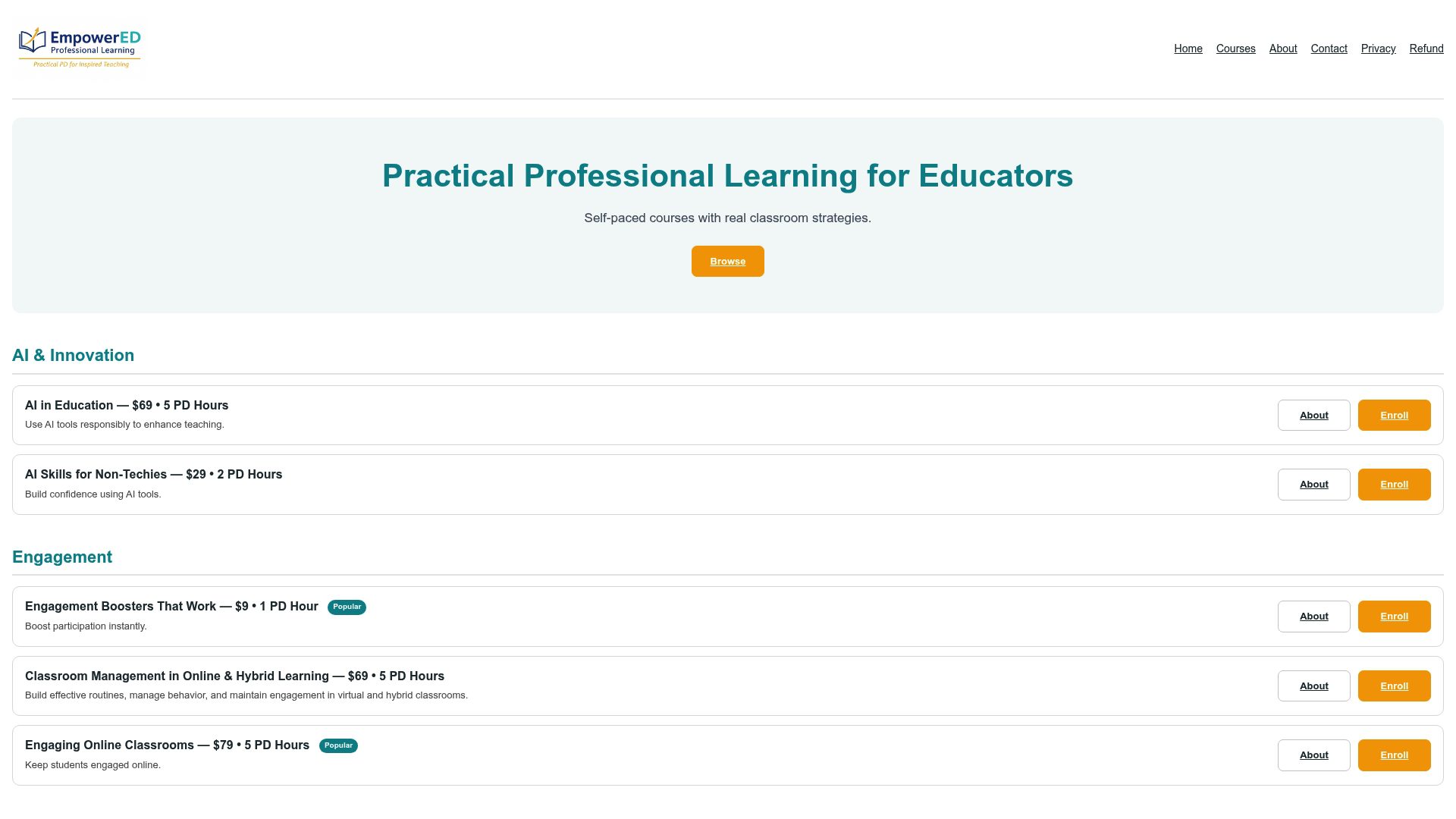
The AI in Education course walks teachers through the full understand, evaluate, use progression with real classroom scenarios. Teachers focused on discipline-specific judgment can pair it with Mathematical Thinking for Teachers, while schools prioritizing inclusive rollout should add Universal Design for Learning (UDL) & Accessibility to the sequence. Courses are available for individual purchase or as bulk licensing for a school or district team, with PD certificates included.
Start with one course, one classroom, and one semester. Visit the AI in Education course page to see the syllabus and enroll.
Sources
- Digital Promise — AI literacy in education
- UNESCO AI competency framework for teachers (summary)
- AI Literacy in PK-12 Education — ERIC full text
- Teaching AI Literacy with or without AI Tools — Columbia DFI