Trauma-informed teaching means treating disruptive or withdrawn behavior as a signal of stress, not defiance, and designing classroom life around predictability, choice, and relationships. If you take one thing from this guide, take this: start by treating behavior as communication and by making your classroom more predictable through routines and clear signals. Everything else, from de-escalation scripts to schoolwide policy, builds on that shift.
TL;DR:
- Most trauma-responsive approaches focus on creating predictable routines, sensory supports, and compassionate language to help students manage stress and remain regulated.
- Building trust and consistent relationships with students, involving families, and ensuring cultural responsiveness are crucial for sustaining trauma-informed practice.
- System-wide implementation requires staff training, collaboration, revised discipline policies, pilot programs, and ongoing coaching, not just one-day training sessions.
- Monitoring progress involves observing behavior patterns, low-stakes indicators, and regular, private check-ins rather than relying solely on academic assessments.
- Small, gradual changes combined with staff wellness support make trauma-informed practice sustainable rather than expecting quick fixes or rapid results.
Table of Contents
- What Is Trauma-Informed Teaching and Why Does It Matter?
- Core Principles That Guide Every Trauma-Informed Decision
- What Do Trauma-Related Behaviors Look Like in the Classroom?
- How Do You Build a Trauma-Sensitive Classroom Day to Day?
- How Do You Build Relationships That Feel Safe to Trauma-Affected Students?
- How Do Schools Scale Trauma-Informed Practice Beyond One Classroom?
- How EmpowerED Professional Learning Supports Implementation
- How Do You Track Student Progress and Well-Being Along the Way?
- How Should Teachers Work With Families and Community Resources?
- How Does Trauma-Informed Practice Change Across Age Groups?
- What Sustaining This Work Actually Requires
- Ready to Build Trauma-Informed Skills? Start With One Course
- Toolkits Worth Downloading Before Your Next Staff Meeting
- Sources
What Is Trauma-Informed Teaching and Why Does It Matter?
Trauma-informed teaching is a lens, not a diagnosis. You are not identifying which students have experienced trauma. You are structuring instruction so that any student carrying stress, whether from a single event or ongoing hardship, has a better chance of staying regulated enough to learn.
The neuroscience behind this is straightforward. When a student’s brain perceives threat, real or imagined, the amygdala triggers a fight, flight, or freeze response before the prefrontal cortex gets a say. That prefrontal cortex is where working memory, planning, and impulse control live. So a student in a stress response isn’t choosing to ignore your instructions. Their brain has temporarily deprioritized the exact functions a classroom demands.
This matters because chronic stress rewires how a student scans for danger, and a raised voice, a sudden schedule change, or even bright fluorescent lights can register as threat.
In practical terms, that stress response shows up as:
- Difficulty sustaining attention on multi-step tasks
- Trouble starting or finishing work after a transition
- Overreaction to minor corrections or perceived criticism
- Shutting down or going silent when called on unexpectedly
- Physical restlessness or the opposite, unusual stillness
None of these are character flaws. They’re predictable outputs of a nervous system on alert, and they respond to structure and relationship far more reliably than to consequences alone.
Core Principles That Guide Every Trauma-Informed Decision
Most frameworks for trauma-responsive schools boil down to five overlapping principles. When you’re deciding how to handle a moment in class, these are the filters worth running the decision through:
- Safety: Is the physical and emotional environment predictable and free of humiliation?
- Trustworthiness: Do your actions match your stated expectations, consistently?
- Choice: Does the student have some control over how they respond or participate?
- Collaboration: Are you working with the student rather than imposing on them?
- Empowerment: Does the response build the student’s sense of competence rather than shame?
A synthesis of trauma-informed education programs found that effective approaches address both “bottom-up” needs, like safety, sensory regulation, and relational trust, and “top-down” needs, like SEL skills, academic access, and cultural affirmation. The same research found many programs lean heavily on the bottom-up side and under-integrate instructional design, which is exactly where classroom teachers can add the most value.
Some frameworks use a “Four R’s” structure: realize the impact of trauma, recognize its signs, respond with informed practice, and resist re-traumatization through policy and culture. Whichever language your school uses, equity has to sit underneath all of it. Cultural context shapes how a student expresses distress, and a strategy that reads as calming to one student can read as invasive to another.
What Do Trauma-Related Behaviors Look Like in the Classroom?
Behavior is communication, and it changes shape by developmental stage. Here’s how to read it and respond without escalating:
- Elementary students often show trauma stress through tantrums, clinginess, regression in skills they’d already mastered, or complaints of stomachaches and headaches with no clear cause.
- Middle schoolers tend toward irritability, sudden friend group conflict, task avoidance, or a sharp drop in a previously reliable subject.
- High schoolers more often show withdrawal, chronic tardiness or absence, defensiveness toward authority, or, less visibly, over-compliance and perfectionism.
- Document patterns, not incidents. A single outburst rarely tells you much. A pattern across two or three weeks, tied to specific triggers like transitions or unstructured time, is worth flagging to a counselor or student support team.
- In the moment, do this: lower your voice, name what you observe without judgment (“I notice you pushed your chair back”), and offer a choice. Avoid this: public correction, sarcasm, or demanding an immediate explanation for the behavior.
Referral isn’t a failure. If a behavior pattern is intensifying or a student discloses something concerning, looping in a counselor is the trauma-informed move, not a workaround.
How Do You Build a Trauma-Sensitive Classroom Day to Day?
This is where trauma-informed teaching stops being theory and becomes a Tuesday afternoon. Four categories of practice do most of the work: predictable routines, sensory and regulation supports, de-escalation language, and instructional choice.
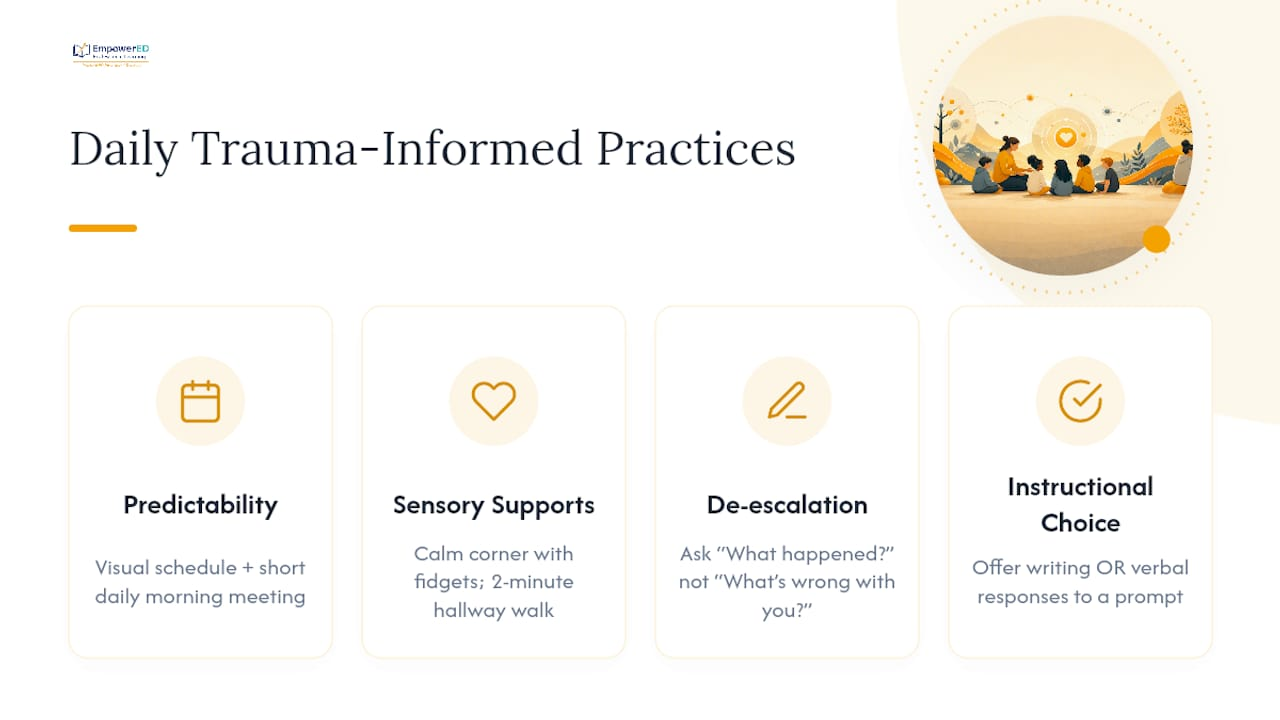
Predictability is the foundation. A visual schedule posted where every student can see it does more to reduce anxiety than almost any other single change, because it removes the guesswork that a stressed brain treats as danger. Classroom routines that stay consistent across the week, paired with a short daily morning meeting, give students a reliable rhythm to orient around before academic demands ramp up. If your school runs any hybrid or flexible scheduling, those routines need to travel across modalities too, since inconsistency between in-person and remote days is its own trigger.
Sensory supports give students an off-ramp before dysregulation peaks. A calm corner stocked with fidget tools, a designated hallway pass for a two-minute walk, or a scheduled movement break every 20 to 30 minutes all work by giving the nervous system a physical outlet instead of forcing a student to sit through rising distress. These aren’t rewards for good behavior. They’re standing options available to everyone.
Language during a tense moment can de-escalate or accelerate. Compassionate curiosity, asking “what happened?” instead of “what’s wrong with you?”, shifts the interaction from accusation to problem-solving. A university teaching toolkit built specifically for this purpose recommends scripting a few go-to phrases in advance, because in the heat of a moment, most teachers default to whatever they say least intentionally.
Instructional choice keeps trauma-informed practice from becoming purely behavioral. Letting a student choose between writing a response or recording it verbally, or between two prompts covering the same standard, applies Universal Design for Learning principles directly to trauma sensitivity: multiple ways in, multiple ways to show understanding. This is also where SEL instruction earns its place in the daily schedule rather than living only in a crisis response plan.
Pro Tip: Script three compassionate curiosity questions in advance and keep them taped inside your desk drawer. When a student shuts down or lashes out, you won’t have to invent calm language on the spot. You’ll already have it.
How Do You Build Relationships That Feel Safe to Trauma-Affected Students?
Relationship is the delivery mechanism for every other strategy on this list. A regulation tool offered by a teacher a student doesn’t trust will get ignored. The same tool offered by someone who checks in consistently gets used.
- Greet each student by name at the door, even on days you’re rushed.
- Give feedback that names a specific strength before addressing a gap.
- Keep your availability predictable: same time for questions, same tone whether it’s Monday or Friday.
- Avoid deficit language in records and conversations (“struggles with” instead of “is a problem in”).
- Involve families as partners, not as an escalation point, when discussing a student’s needs.
Culturally responsive practice sits inside this work, not beside it; integrating intersectionality in counseling is essential to effectively supporting diverse students affected by trauma. A culturally responsive approach means recognizing that a student’s cultural background shapes how they express distress, seek help, or respond to authority, and adjusting your read of behavior accordingly rather than applying one universal script. The NEA’s guidance on trauma-informed practices points to consistent, relationship-centered responses across every adult in the building as one of the strongest predictors of a safe school culture. Student voice matters here too: giving students input on classroom norms or project topics builds the sense of agency that trauma often strips away.
How Do Schools Scale Trauma-Informed Practice Beyond One Classroom?
A single teacher running a great trauma-informed classroom inside a punitive school culture will burn out fast. System change requires more than a one-day training.
- Assess readiness first. Before rolling out anything schoolwide, survey staff comfort level and audit current discipline data for patterns, like which behaviors get referred out most and by whom.
- Build a multidisciplinary workgroup. Include a counselor, an administrator, a special education representative, and at least two classroom teachers so decisions reflect real classroom conditions, not just policy language.
- Align with MTSS. Trauma-informed strategies fit naturally into a multi-tiered system of support: universal practices for every classroom, targeted supports for identified students, and intensive intervention for the smallest group needing it.
- Revise discipline policy explicitly. Suspension and exclusion tend to intensify the exact dysregulation they’re meant to correct. Replacing default suspension with restorative conversations for lower-level incidents is one of the most concrete policy shifts a school can make.
- Pilot before scaling. Run new practices in two or three classrooms for a semester, gather feedback, then expand. The TIPPS framework outlines ten pillars for this kind of whole-school transformation, and its case examples are useful for showing skeptical staff what pilot success actually looks like.
- Monitor and coach, don’t just train. A detailed action guide from NCSSLE makes the point plainly: one-off professional development sessions rarely change practice on their own. Ongoing coaching, checklists, and leadership follow-through are what make a pilot stick.
How EmpowerED Professional Learning Supports Implementation
Reading about trauma-informed strategies is one step. Practicing them with feedback is another. Empowered Professional Learning’s course catalog maps directly onto the gaps most schools hit during rollout:
- Social-Emotional Learning & Teacher Wellness builds the self-regulation and relationship skills this guide covers, for both students and the educators supporting them.
- Universal Design for Learning & Accessibility turns the instructional choice principle into concrete lesson redesign.
- AI in Education covers practical tools for tracking engagement patterns and flagging when a student may need additional support.
Courses are self-paced, instructor-guided, and led by practitioners including Brian Koster, Ed.D. Schools can license seats individually or in bulk for teams working toward the same schoolwide plan.
How Do You Track Student Progress and Well-Being Along the Way?
Monitoring in a trauma-informed classroom looks different from a standard progress chart, because the goal isn’t just academic growth. It’s whether a student’s capacity to access learning is improving over time.
Start with observable, low-stakes indicators rather than formal assessments alone: attendance consistency, participation in low-risk activities, frequency of dysregulated episodes, and how quickly a student recovers after a difficult moment. A student who used to need 20 minutes to reset and now needs five is showing real progress, even if their test scores haven’t moved yet.
Brief, private check-ins work better than public behavior charts, which can shame a student in front of peers and undercut the safety principle you’re trying to build. A simple weekly rating scale, where a student marks how the week felt on a one to five scale, gives you longitudinal data without requiring a clinical tool.
Transparent assessment practices also matter here: giving students low-risk ways to demonstrate learning, like a practice quiz that doesn’t count toward the grade, reduces the anxiety that skews performance data in the first place. Share this information with counselors and support staff on a regular cycle rather than only during a crisis, so patterns get caught early instead of after a breaking point.
Keep your own notes brief and behavior-specific. “Took three attempts to start independent work, calmer after a movement break” tells a future teacher or counselor far more than “had a rough day.”
How Should Teachers Work With Families and Community Resources?
Families are the people who know a student’s history best, even when they don’t share every detail. Trauma-informed collaboration with them starts by shifting the tone of every conversation you initiate. Calling home to report only problems trains families to dread your calls. Calling occasionally just to share something positive changes that dynamic before you ever need to discuss a difficult behavior.
When a harder conversation is necessary, frame it around support rather than blame. Instead of “your child was disruptive again,” try “I’ve noticed some changes in how your child is handling transitions, and I want to figure out together what might help.” That framing invites information rather than defensiveness, and families dealing with their own stress are far more likely to engage with it.
Community resources extend what a single classroom or school can offer. School counselors, social workers, and community mental health partners each fill a different gap, and knowing your school’s referral pathway before you need it saves critical time during a crisis. Some districts also partner with local organizations for after-school support, family counseling access, or basic-needs assistance like food and clothing, which often address the stressors sitting underneath a behavior pattern.
Confidentiality matters throughout. Share only what’s necessary with the people who need it to help, and always loop families in on major decisions affecting their child rather than presenting a plan as already finalized.

How Does Trauma-Informed Practice Change Across Age Groups?
A calm corner that works beautifully in a second-grade classroom will feel babyish and counterproductive in tenth grade. Developmental stage shapes almost every tactic in this guide.
Early elementary students respond well to concrete, visual supports: picture schedules, a designated stuffed animal or object for comfort, and short, frequent check-ins. Their regulation skills are still forming, so adults need to co-regulate actively rather than expect independent coping.
Upper elementary and middle school students benefit from more autonomy inside the same predictable structure. This is a good age for teaching explicit regulation vocabulary, like naming the difference between frustrated and overwhelmed, and for introducing choice-based calm-down strategies instead of a single designated spot.
High school students often resist anything that feels like it singles them out. Discretion matters more here: a quiet hallway pass system that doesn’t draw peer attention works better than a visible calm corner. Older students also respond well to being given real information about why a practice exists, since a sense of respect and transparency itself functions as a trust-building move at this age.
Across every stage, the underlying principles, safety, choice, consistency, stay the same. Only the delivery changes.
What Sustaining This Work Actually Requires
The biggest implementation pitfall isn’t a lack of knowledge. It’s expecting fast results and giving up when a strategy doesn’t calm a struggling student in a week. Trauma-informed practice is slow, cumulative work, and treating it as a quick fix sets teachers up to feel like they’ve failed when they haven’t.
Start smaller than you think you need to: one predictable routine, one compassionate curiosity script. Celebrate the small wins, a shorter meltdown, a faster recovery, because those are the real markers of progress. And build this alongside staff wellness, not after it. A regulated teacher is the single best trauma-informed tool in any classroom.
— Brian Koster, Ed.D.
Ready to Build Trauma-Informed Skills? Start With One Course
You don’t need a semester-long overhaul to start seeing results. Empowered Professional Learning is built for exactly this: focused, self-paced courses that get you practicing a specific skill set within weeks instead of waiting for the next districtwide training day.
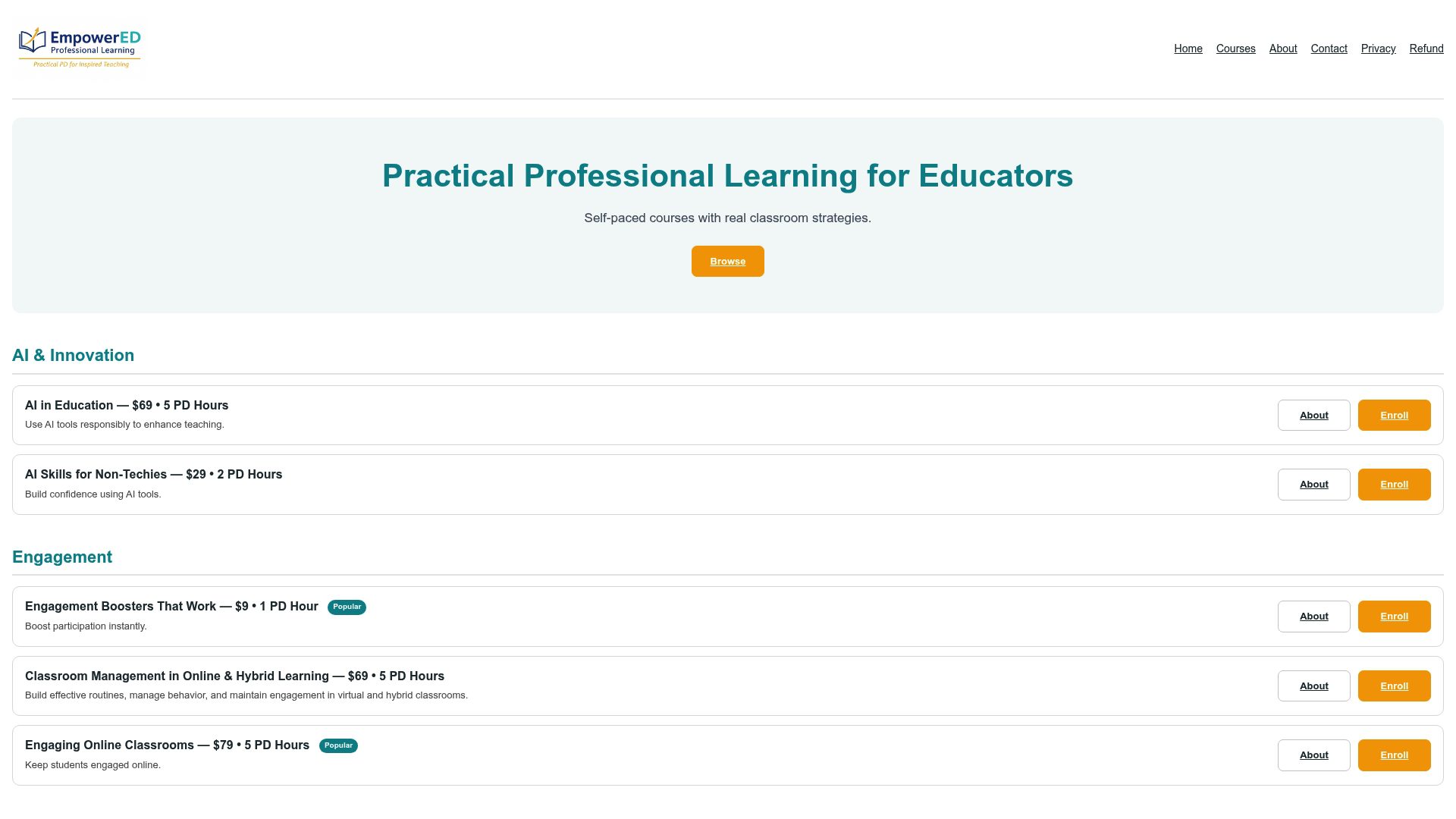
If regulation and relationship-building are your priority, Social-Emotional Learning & Teacher Wellness walks through the exact strategies covered in this guide, with personalized feedback along the way. If instructional access is the gap, Universal Design for Learning & Accessibility shows you how to build choice directly into lesson design. And if your school wants to pair trauma-informed practice with modern tools for tracking engagement, AI in Education covers practical, ethical ways to use AI in daily instruction.
Individual teachers can enroll directly in a single course. Instructional coaches and administrators looking to train a full team can request bulk licensing for their school or district. Every course includes a professional development certificate you can apply toward your requirements. Visit Empowered Professional Learning to browse the full catalog and find the course that fits where your classroom or school is right now.
Toolkits Worth Downloading Before Your Next Staff Meeting
A few resources are worth bookmarking and sharing with colleagues directly:
- The TIPPS guide for a full ten-pillar schoolwide framework and case examples.
- The NCSSLE Trauma-Sensitive Schools action guide for phased implementation planning.
- The UGA classroom toolkit for ready-to-use scripts and daily practices.
Pick one, bring it to your next team meeting, and pilot a single strategy in one classroom before deciding how far to scale it.
Sources
- How is Trauma-Informed Education Implemented within Classrooms? A Synthesis of Trauma-Informed Education Programs
- TIPPS: Ten Trauma-Informed Programs and Practices pillars and guide
- Trauma-Sensitive Schools Training Package: Action guide (NCSSLE / AIR)
- Trauma-Informed Teaching Toolkit (UGA Center for Teaching and Learning)
- Trauma-Informed Practices | NEA