The most effective classroom approach for students with dyscalculia is explicit, multisensory instruction paired with routine accommodations and regular progress monitoring. Start with number lines, ten-frames, and formula cards, model every step out loud, and build a two-week routine around them. Collect a simple baseline probe before you begin, then track accuracy and independence, not just speed.
TL;DR:
- Consistent use of visual aids like number lines, ten-frames, and manipulative models is crucial for building number sense in students with dyscalculia.
- Daily routines should include modeling aloud, student talk-throughs, and maintaining manipulatives throughout practice to reinforce understanding.
- Multi-component, sequenced instruction with visual representations, step-by-step guidance, and frequent teacher feedback consistently proves most effective.
- Accommodations such as formula sheets, manipulatives, and extended time must be practiced beforehand to be effective during assessments.
- Adaptive tools support practice but require integration with conceptual learning and should be paired with teacher-led instruction for best transfer.
Table of Contents
- What Do Dyscalculia Interventions Look Like in a Real Classroom?
- What Does the Research Actually Say About These Interventions?
- How Do You Set Up Accommodations and Assessment Adjustments?
- Where Do Adaptive Tools and Technology Actually Help?
- How Do You Track Progress and Know When to Escalate?
- A Classroom-Tested Perspective on Dyscalculia Support
- What Actually Moves the Needle, and What Doesn’t
- Ready to Build These Routines Into Your Classroom?
- Selected Evidence and Teacher Resources
- Sources
What Do Dyscalculia Interventions Look Like in a Real Classroom?
Building number sense starts with a concrete→pictorial→symbolic progression, and skipping straight to abstract symbols is where most math instruction loses these students. A ten-frame activity where a student physically places counters before drawing dots, then finally writing the numeral gives working memory something to hold onto at each stage. Number-line walks, where students physically step out addition or subtraction on a taped line on the floor, do the same work for operations. Base-10 blocks let place value become something you can touch instead of something you have to imagine.
Active modeling matters as much as the materials. When you think aloud through a problem (“I see two groups here, so I’m going to combine them, and I’ll check my answer against the number line”), you’re externalizing a process that students with dyscalculia often can’t generate internally. Prompting students to talk through their own steps, even when the answer is wrong, helps them bypass executive-function bottlenecks that silent, symbol-only instruction can’t reach.
A repeatable daily structure keeps this manageable:
- Open with a two-minute warm-up using a manipulative already in the room.
- Move into guided practice where the teacher models one problem before students try one.
- Provide scaffolded independent work with visual supports still available, not removed.
- Close with a 60-second retrieval check, like one problem on an exit ticket.
Pro Tip: Keep the same manipulatives out during stations and exit tickets, not just during instruction. If a tool disappears the moment a quiz starts, students never get the practice they need to use it under pressure.
What Does the Research Actually Say About These Interventions?
Peer-reviewed evidence points toward a few clear winners, and none of them is a single worksheet trick. The MathWise program, an course run multiple times weekly with sessions lasting around 45 to 50 minutes each, produced measurable gains in arithmetic performance and detectable changes in neural activation among children with developmental dyscalculia. That’s a meaningful dosage commitment, not a quick fix, and it tells you why a single 20-minute pullout once a week rarely moves the needle.
Schema-broadening instruction (SBI) targets a different piece of the puzzle: recognizing the underlying structure of a word problem rather than hunting for keywords. Students taught to sort problems by structure, rather than by surface wording, get better at transferring skills to new problem types instead of only the ones they drilled.
A synthesis of intervention research across grades 1 through 12 found the strongest effects came from a consistent bundle:
- Explicit, step-by-step instruction
- Visual representations tied directly to the math being taught
- Careful sequencing from simple to complex examples
- Exposure to multiple solution strategies
- Frequent, specific teacher feedback
That combination, drawn from a meta-analysis on instruction for students with learning disabilities, outperformed isolated drills nearly every time. The practical takeaway: choose multi-component programs over single-strategy fixes, and measure whether skills transfer to regular curriculum tasks, not just to the intervention worksheet itself.
How Do You Set Up Accommodations and Assessment Adjustments?
Accommodations only work if students have practiced using them before the stakes go up. A formula card handed out for the first time during a test isn’t an accommodation. It’s a pop quiz on a new tool.
Effective, evidence-aligned options include:
- Formula or fact sheets kept on every desk during practice and tests alike.
- Graph paper to align digits and reduce place-value errors.
- Breaking multi-step tasks into individually labeled steps.
- Manipulatives available during assessments when the skill being tested isn’t computation itself.
- Extra time and a low-distraction setting for timed assessments.
These recommendations align closely with UDL-informed classroom accommodations for dyscalculia, which frame accommodations as standard practice rather than special exceptions.
Assessment adjustments go a step further than daily accommodations:
- Chunk longer tests into shorter sections with breaks between them.
- Offer oral responses or verbal explanations as an alternative to written work when writing itself is the barrier.
- Allow calculators specifically when computation accuracy isn’t the skill being measured.
- Provide a quiet, low-visual-clutter room for students who lose focus in a busy classroom.
Document each adjustment briefly: what the barrier was, what you changed, and what evidence showed it helped. That short paper trail becomes invaluable when writing or updating a 504 plan or IEP, and it keeps interventions from becoming vague, undocumented habits nobody remembers starting.
Where Do Adaptive Tools and Technology Actually Help?
Adaptive platforms and intelligent tutoring systems personalize pacing and give error-specific feedback, which is genuinely useful for short, daily practice in a station rotation. Research on adaptive and gamified number-sense tools shows real gains in the specific skills the software targets. The catch: transfer to untrained tasks is inconsistent unless a teacher connects the digital practice back to conceptual understanding.
Before adding any tool to your classroom stack, check for:
- Adaptive feedback tied to the specific error a student made, not generic praise.
- A teacher dashboard with usable, exportable progress data.
- A clean interface with minimal visual clutter, since cluttered screens tax the same working memory dyscalculia already strains.
- Compliance with your school’s data privacy requirements.
Technology supports practice. It doesn’t replace the modeling and conceptual bridge only a teacher can provide.
How Do You Track Progress and Know When to Escalate?
Weekly, brief numeracy probes, paired with a quick look at work samples and how a student explains their strategy, give you enough data without eating your planning period. Track three signals: accuracy, strategy independence, and visible anxiety during math tasks.
Set micro-goals rather than big leaps. If a student needed full physical manipulatives last week and moves to drawing pictures this week, that’s real progress even if the final answer is still wrong. If, after a documented two-to-four week intervention cycle, accuracy hasn’t budged, strategy errors repeat in the same pattern, or anxiety is escalating rather than easing, it’s time to loop in a special-education specialist or interventionist.
A Classroom-Tested Perspective on Dyscalculia Support
Brian Koster, Ed.D., has spent years watching well-meaning teachers reach for the wrong tool first: more drill, more repetition, more worksheets, when what a struggling student actually needed was a different entry point into the concept itself. One fourth-grade teacher swapped a single worksheet-heavy fractions unit for a ten-frame and number-line sequence, and within two weeks, three previously silent students started explaining their thinking out loud.
Teachers who need structured support translating research into daily practice benefit from courses like Mathematical Thinking for Teachers, Universal Design for Learning (UDL) & Accessibility, and Engagement Boosters That Work, each mapping directly to a gap this article has covered. Start small: pick one accommodation, run it for two weeks, and check the templates in these courses before building your own from scratch.
What Actually Moves the Needle, and What Doesn’t
The research is clearer than the popular advice suggests. Multi-component, sequenced instruction with visual models and teacher feedback consistently outperforms any single trick, gadget, or worksheet packet marketed as a dyscalculia fix. That’s the finding worth acting on first.

Where conventional advice falls short is in treating accommodations as an event instead of a habit. A formula card introduced the week before a test isn’t support. It’s confusion with extra steps. The programs and reviews cited throughout this piece agree on this point even when they disagree on dosage or delivery method: repetition under low-stakes conditions is what makes an accommodation usable when it counts.
If you take one thing from this article, prioritize consistency over novelty. A modest, well-run two-week routine, tracked with a simple probe, will tell you more than any new app or curriculum insert you try once and abandon. Teachers don’t need more strategies. They need fewer strategies, run consistently long enough to see whether they actually work.
— Brian Koster, Ed.D.
Ready to Build These Routines Into Your Classroom?
Empowered Professional Learning gives you what most one-off PD workshops don’t: classroom-ready templates and sample lesson scripts you can use the same week you take the course, instead of theory you have to translate yourself. Mathematical Thinking for Teachers walks through instructional sequencing and problem-structure teaching in depth, while Universal Design for Learning (UDL) & Accessibility covers how to build accommodations into daily lesson design rather than bolting them on at test time.
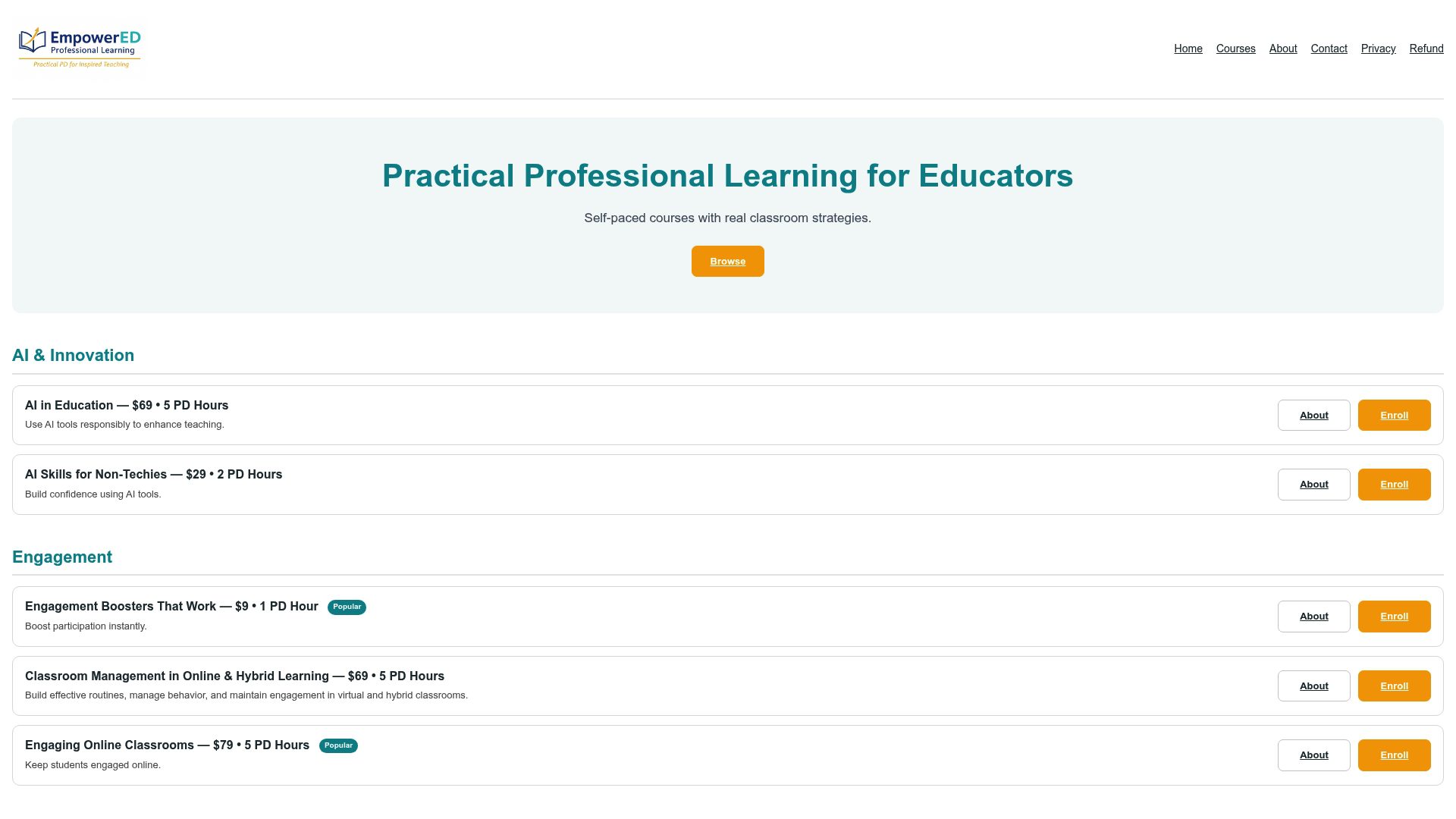
If low-stakes practice and reducing math anxiety are your bigger challenge right now, Engagement Boosters That Work focuses specifically on that piece. Courses are self-paced with instructor feedback and a PD certificate at completion, and districts can license them across a team rather than enrolling teachers one at a time. Visit the Empowered Professional Learning course catalog to find the course that matches where your classroom is right now, and get the templates into your hands before your next unit starts.
Selected Evidence and Teacher Resources
- MathWise training and neural changes in dyscalculia
- Meta-analysis on math instruction for students with learning disabilities
- Classroom accommodations for dyscalculia
- Accessibility roadmap for schools
Sources
- Math training (MathWise) and neural changes in developmental dyscalculia
- Meta-analysis: instruction that enhances mathematics performance of students with learning disabilities
- Understood