Classroom questioning strategies are deliberate techniques teachers use to promote student engagement, critical thinking, and active participation during lessons. The most effective approaches, including Socratic questioning, Pose-Pause-Pounce-Bounce, and progressive questioning, share one defining feature: intentionality. Shifting focus from “what questions should I ask” to “what evidence of student thinking do I want to see” is the single most powerful upgrade a teacher can make to their questioning practice. This guide covers concrete classroom questioning strategies examples you can apply immediately, with practical steps for every grade level and subject area.
1. Socratic questioning
Socratic questioning is the practice of using guided dialogue to lead students toward deeper analysis rather than simply recalling facts. Socratic method reshapes classroom dynamics by replacing passive listening with critical thinking through structured questions. Instead of asking “What is photosynthesis?”, a teacher using Socratic questioning asks “Why would a plant need to convert sunlight into energy rather than absorbing it directly?” The student must reason, not retrieve.
This technique works across all grade levels and subjects. In a high school history class, you might ask “What assumptions did policymakers make that led to this decision?” In a 4th-grade math class, “How do you know your answer makes sense?” Both questions demand justification, not just answers. The key is following each student response with a probing question that pushes the thinking one level further.
2. Pose-Pause-Pounce-Bounce
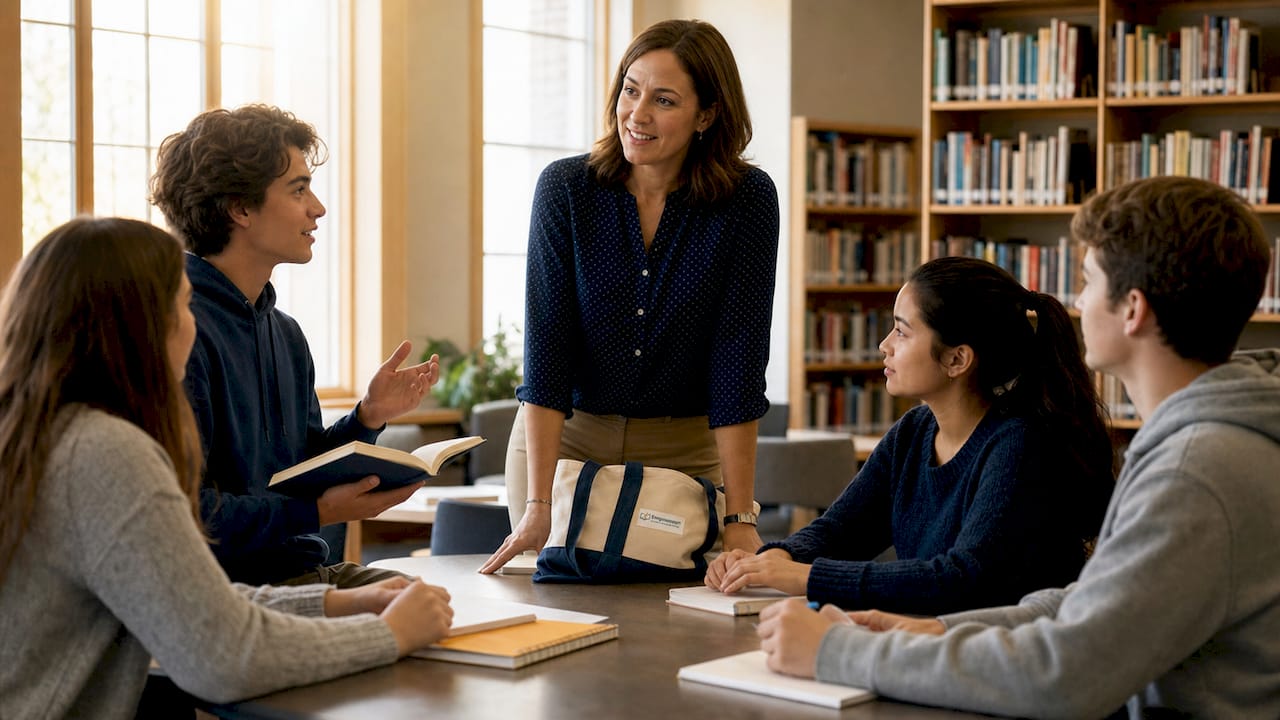
Pose-Pause-Pounce-Bounce is a structured teacher questioning technique developed to distribute participation equitably across a class. The teacher poses a question, pauses to allow thinking time, pounces on one student for an initial response, then bounces the question to a second or third student to extend or challenge the answer. This prevents the same three students from dominating every discussion.
The bounce step is where the real learning happens. When you ask Marcus “Do you agree with what Priya said, and why?”, you signal that every student is accountable for listening and thinking, not just the student who was called on first. This technique also models academic discourse. Students learn to build on, question, and refine each other’s ideas, which is a skill the Common Core State Standards explicitly require.
3. Open-ended vs. closed questions
Closed questions have one correct answer and serve a clear purpose: checking recall and confirming foundational knowledge. Open-ended questions require elaborated responses and increase discourse complexity, particularly in science and inquiry-based subjects. Both types belong in every lesson. The mistake most teachers make is overusing closed questions because they are easier to manage.
A practical rule: use closed questions to establish shared knowledge at the start of a lesson, then shift to open-ended questions once students have the foundation to reason with. “What is the water cycle?” is a closed question. “Why does the water cycle matter for communities that rely on seasonal rainfall?” is open-ended. The second question requires the first to be answered well, so sequencing matters.
Pro Tip: Before your next lesson, write out your three most important questions in advance. Label each one as closed or open-ended, and check that at least two of the three are open-ended.
4. Hinge point questions
A hinge point question is a diagnostic question placed at a critical moment in a lesson to determine whether students are ready to move forward. The term comes from the idea that the lesson “hinges” on the answer. If most students answer correctly, you proceed. If they do not, you reteach before moving on.
Hinge point questions are most effective when designed with wrong answers in mind. Each incorrect answer option should reflect a specific misconception. If a student selects “B,” you know exactly what they misunderstood, and you can address it directly. This makes hinge point questions one of the most efficient formative assessment techniques available to K-12 teachers. Tools like Mentimeter or Poll Everywhere let you collect responses in real time so you can see the full class distribution before deciding your next move.
5. Progressive questioning
Progressive questioning scaffolds student understanding by moving from recall to higher-order “why” and “how” questions within a single sequence. The structure mirrors Bloom’s Taxonomy in practice. You start with “What happened?” move to “Why did it happen?” and finish with “What would you do differently, and why?”
This sequence works particularly well in English Language Arts and social studies, where students need to understand events before they can evaluate them. A 7th-grade teacher discussing a short story might ask: “What did the character do?” then “What motivated that choice?” then “Was it the right decision given what the character knew at the time?” Each question builds directly on the last, so no student gets lost between steps.
6. Think-Pair-Share
Think-Pair-Share is one of the most widely used student participation strategies in K-12 classrooms because it gives every student processing time before public speaking. The teacher poses a question, students think independently for 60 to 90 seconds, discuss with a partner, then share with the class. This structure dramatically reduces the anxiety of cold-calling and increases the quality of responses.
The underused step is the “think” phase. Most teachers rush it. Giving students a full 90 seconds of silent thinking before partner discussion produces noticeably richer conversations. For students who are English language learners or who process more slowly, this step is not optional. It is the difference between participation and exclusion. Pairing Think-Pair-Share with culturally responsive teaching practices makes it even more inclusive.
7. How to plan and sequence questions for maximum impact
Pre-planning questions aligned to your lesson’s learning intentions is the single most reliable way to improve question quality. Teachers who plan questions in advance ask fewer low-value questions and spend more time on responses that reveal student thinking. Planning also prevents the common trap of asking questions that are either too easy or unrelated to the lesson goal.
A practical sequencing approach follows four steps:
- Anchor question: Start with a recall question to activate prior knowledge. “What do we already know about ecosystems?”
- Bridge question: Connect prior knowledge to new content. “How might adding a new predator change the ecosystem we described?”
- Challenge question: Push toward analysis or evaluation. “What evidence would you need to predict whether the ecosystem would recover?”
- Reflection question: Close the loop on learning. “What’s one thing you understood differently by the end of today’s lesson?”
This sequence aligns with the principle that higher-order questions are most effective after foundational recall is established, not before.
Pro Tip: Write your challenge question first, then work backward to design the anchor and bridge questions that make it answerable. This keeps your lesson goal visible throughout your planning.
8. Comparing questioning strategies by classroom goal
Selecting the right technique depends on what you want students to do with their thinking. The table below maps core strategies to their primary purpose, complexity level, and best-fit scenarios.
| Strategy | Primary purpose | Complexity | Best-fit scenario |
|---|---|---|---|
| Socratic questioning | Critical analysis and dialogue | High | Secondary ELA, history, ethics discussions |
| Pose-Pause-Pounce-Bounce | Equitable participation | Medium | Whole-class review, any subject |
| Hinge point questions | Formative assessment | Low to medium | Mid-lesson checks before new content |
| Think-Pair-Share | Processing and confidence | Low | Introducing new concepts, ELL support |
| Progressive questioning | Scaffolded understanding | Medium to high | Building toward complex analysis |
| Open-ended questions | Rich discussion and reasoning | Medium to high | Science inquiry, project-based learning |
Closed questions remain useful for checking basic recall and confirming shared understanding before a class moves forward. The goal is not to eliminate them but to use them as a launching pad rather than a destination. For reluctant or quiet students, Think-Pair-Share and Pose-Pause-Pounce-Bounce reduce the pressure of public performance while still holding everyone accountable for thinking.
9. Tips for increasing student participation during questioning
Effective questioning creates a responsive classroom environment where all students feel safe to participate and share ideas. These practical strategies support that goal:
- Use wait time consistently. Rushing to call on students reduces the quality of thinking. A wait time of 3 to 5 seconds after posing a question gives students the processing time they need to form a real response.
- Distribute questions equitably. Track who you call on. Teachers often unconsciously favor students seated in the front or center. A seating chart with tally marks is a simple fix.
- Redirect rather than rephrase. When a student gives a partial answer, redirect to a peer before rephrasing the question yourself. “Jaylen, what would you add to what Sofia said?” keeps more students engaged.
- Ask students to elaborate. Follow any one-word answer with “Can you say more about that?” or “What makes you think so?” Probing follow-up questions deepen student thought when initial responses are superficial.
- Monitor your talk ratio. If you are speaking more than 50% of the time during a discussion, your students are not doing enough thinking. Record a short segment of your lesson and count the ratio. The number is usually surprising.
Pro Tip: Use a Socratic circle format for complex discussions. Place a small group in the center to discuss while the outer group observes and takes notes. Then rotate. This structure builds both speaking and listening skills simultaneously.
Key takeaways
Effective classroom questioning requires pre-planned, sequenced questions aligned to learning goals, consistent wait time, and deliberate techniques that distribute participation across all students.
| Point | Details |
|---|---|
| Plan questions before the lesson | Align each question to your learning intention to avoid low-value or off-topic prompts. |
| Use wait time every time | A 3 to 5 second pause after every question improves response quality for all students. |
| Match strategy to goal | Use hinge point questions for formative checks and Socratic questioning for critical dialogue. |
| Distribute participation equitably | Track who you call on and use Pose-Pause-Pounce-Bounce to involve the full class. |
| Follow up on every response | Probing questions after initial answers reveal deeper student thinking and prevent surface-level discussion. |
What purposeful questioning has taught me
After years of working with K-12 educators, the pattern I see most often is this: teachers ask good questions, then immediately answer them. It happens fast, usually within two seconds of posing the question. The silence feels uncomfortable, so the teacher fills it. That habit, more than any other, is what limits the impact of questioning in classrooms.
The research on wait time is clear, but knowing it and practicing it are different things. I recommend teachers record themselves for just five minutes during a discussion and count how long they actually wait. Most are shocked. The discomfort of silence is real, but it is the discomfort of students thinking. That is exactly what you want.
The other shift I find transformative is treating questioning as a way to monitor student mental models rather than test knowledge. When you ask “What do you think is happening here and why?”, you are not checking a box. You are looking inside a student’s understanding to see where the gaps are. That reframe changes how teachers listen to answers. They stop evaluating and start diagnosing. The result is better follow-up questions, better instruction, and students who feel genuinely heard rather than assessed.
Pre-planning matters, but so does responsiveness. The best questioning sequences I have seen are planned at the macro level and improvised at the micro level. You know your anchor, bridge, and challenge questions. But you follow the student’s thinking, not the script. That combination of preparation and flexibility is what separates good questioning from great questioning. Pair this with classroom routines that normalize discussion, and you will see a real shift in how your students engage.
— Brian Koster, Ed.D.
Take your questioning practice further with Empoweredpl
Knowing the strategies is the first step. Applying them consistently, across different grade levels, subjects, and student needs, takes structured practice and feedback.
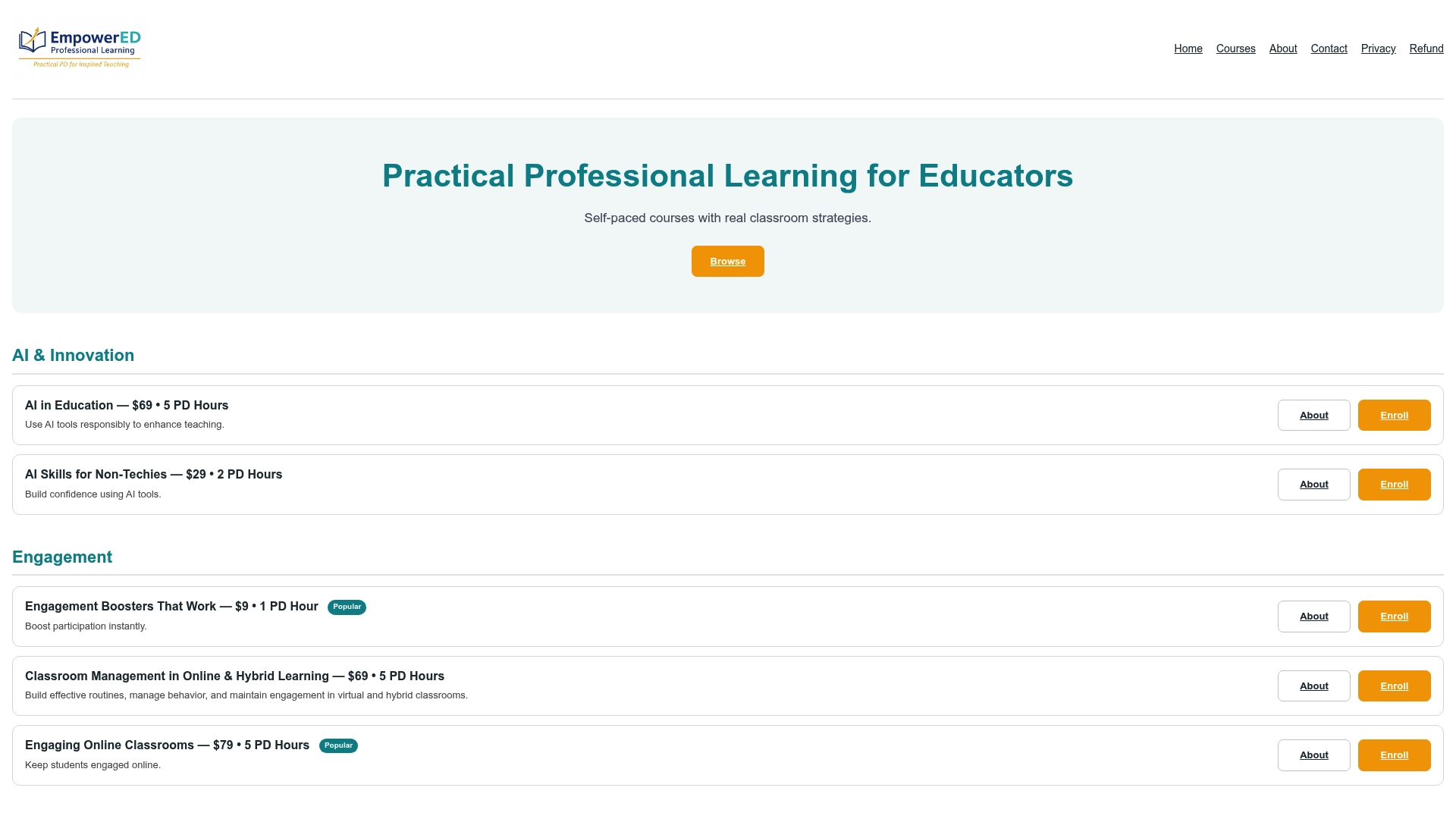
Empoweredpl offers targeted professional learning courses designed specifically for K-12 educators who want to strengthen their classroom engagement and questioning skills. Courses cover practical techniques for daily formative assessment, hybrid learning engagement, and AI-supported instruction. Each course is built for immediate classroom application, not theory. Educators who complete Empoweredpl courses consistently report that the strategies translate directly into increased student participation and clearer learning outcomes. Explore the full course catalog at Empoweredpl and find the professional development that fits your classroom goals right now.
FAQ
What are the most effective classroom questioning strategies?
Socratic questioning, Pose-Pause-Pounce-Bounce, and progressive questioning are among the most effective techniques for K-12 classrooms. Each promotes critical thinking and equitable participation when used with consistent wait time and pre-planned question sequences.
How long should a teacher wait after asking a question?
A wait time of 3 to 5 seconds after posing a question is the standard recommendation for promoting deeper student thinking. Rushing to call on students or answering the question yourself reduces the quality of responses across the class.
What is the difference between open and closed questions in teaching?
Closed questions check recall and confirm foundational knowledge, while open-ended questions require elaborated responses and generate richer discussion. Effective lessons use both types in sequence, starting with closed questions to establish shared knowledge before moving to open-ended analysis.
How can teachers get reluctant students to participate more?
Think-Pair-Share and Pose-Pause-Pounce-Bounce both reduce the pressure of cold-calling by giving students processing time and peer support before public responses. Distributing questions equitably and using probing follow-ups also signal that every student’s thinking matters.
How does questioning support formative assessment?
Hinge point questions placed at critical lesson moments reveal whether students are ready to move forward or need reteaching. Teachers who view questioning as a way to monitor student mental models, rather than simply test knowledge, gather more useful data to guide their next instructional steps. For more on this, see Empoweredpl’s guide to formative assessment techniques.