The five core types of classroom routines are entry/dismissal, transitions, instructional, materials/organization, and behavior/attention. Together, they minimize disruption and maximize learning time across every grade level.
TL;DR: Teach one arrival routine and one hand signal today. That’s enough to start.
Here are the five routine categories you’ll find explained in full below:
- Entry/dismissal — how students arrive, settle, and leave
- Transitions — moving between activities without losing momentum
- Instructional — how learning tasks are structured and run
- Materials/organization — distributing, collecting, and storing supplies
- Behavior/attention — signals and strategies that redirect and refocus
Table of Contents
- What are the main types of classroom routines?
- How do you teach a routine so it actually sticks?
- Checklists and templates you can copy and use today
- Grade-level scripts and time estimates for K–12
- What do you do when a routine stops working?
- What does research say about why routines work?
- Key Takeaways
- Routines take longer than you think — and that’s fine
- Ready to strengthen your classroom routines?
- Useful sources for further reading
What are the main types of classroom routines?
Classroom routine types fall into five clear categories, each serving a distinct purpose. Understanding each type helps you decide which ones to teach first and how to adapt them for your grade level.
Entry and dismissal routines
These routines govern how students enter and exit the classroom. A strong entry routine sets the tone for the entire period. Students know exactly what to do the moment they walk in, which means you spend less time redirecting and more time teaching.
Example (all grades): Post a “Do Now” task on the board. Students enter, sit, and begin promptly to minimize lost time.
Sample script: “When you walk in, pick up your materials from the table, go to your seat, and begin the warm-up on the board. You have three minutes.”
Research on positive greetings at the door shows that greeting each student individually as they arrive is associated with increased academic engaged time and reduced disruptive behavior. It costs nothing and takes very little time.
Transition routines
Transitions are the highest-risk moments in any classroom. When students move between activities without a clear routine, time evaporates and behavior problems spike. Transitions should be short, typically brief, using nonverbal signals and an immediate hook activity to preserve momentum.
Example (elementary): A clap pattern or countdown from five signals the end of one activity. Students freeze, eyes forward, materials down.
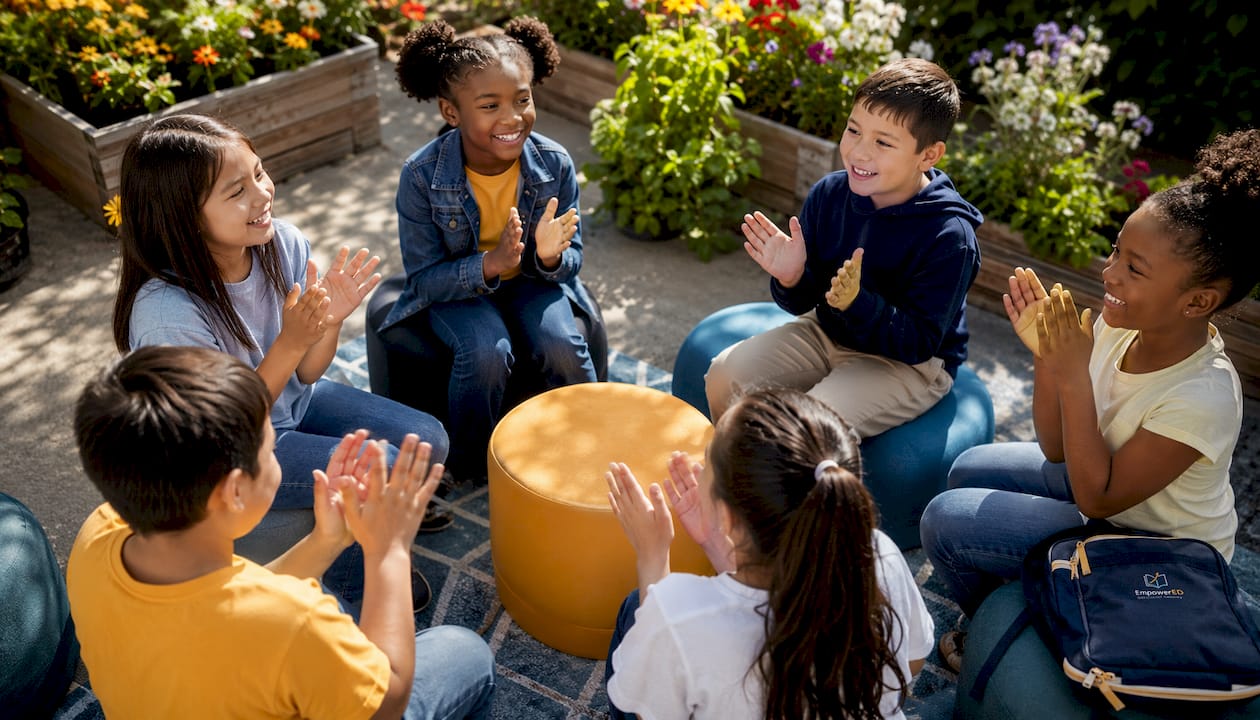
Sample script: “When I clap twice, you clap twice back. That means pencils down, eyes on me. You have 20 seconds to be ready.”
Example (secondary): A visible timer on the board counts down. Students know the next task is already posted and begin independently.
Instructional routines
Instructional routines structure how learning actually happens: how students participate in discussions, work in groups, ask questions, and respond. These routines reduce the cognitive overhead of figuring out “what are we supposed to do?” so students can focus on the content itself.
Example: A consistent question-and-answer protocol, such as Think-Pair-Share, gives every student a predictable structure for participation. Pair it with questioning strategies that prompt deeper thinking.
Sample script: “Think about the question for 30 seconds. Turn to your partner and share. I’ll call on two pairs to share with the class.”
Materials and organization routines
These routines cover how supplies are distributed, collected, and stored. Without them, five minutes disappear every time you hand out papers. With them, the same task takes under 60 seconds.

Example: Assign a “materials manager” role in each group. That student picks up and returns all supplies for the group.
Sample script: “Materials managers, please come to the supply table, collect one folder and one pencil per person, and return to your group promptly.”
Pro Tip: Label supply bins with both words and pictures. This supports English learners and early readers without any extra instruction time.
Behavior and attention routines
These are the signals and strategies you use to redirect, refocus, and acknowledge students. Hand signals, call-and-response phrases, and nonverbal cues all fall here. Visual supports like anchor charts and hand signals make expectations explicit and accessible for all learners.
Example: Teach students a “quiet signal” hand raise. When you raise your hand, students raise theirs and stop talking. No shouting required.
Sample script: “When you need to use the restroom, hold up two fingers. I’ll nod yes or shake my head no. No interrupting needed.”
How do you teach a routine so it actually sticks?
The most effective sequence for teaching any routine is: Introduce → Model → Practice → Reinforce → Reteach. This mirrors the I Do / We Do / You Do framework and works at every grade level.
Routines succeed when explicitly taught, modeled, practiced, and consistently reinforced — and when teachers break them into discrete steps and revisit them across the year. That last part matters: one week of practice is rarely enough.
Step-by-step checklist for teaching any routine:
- Identify the routine’s purpose. Tell students why this routine exists. (“This saves us five minutes every day.”)
- Break it into steps. Write each step on the board or an anchor chart. Keep it to three to five steps maximum.
- Model it yourself (I Do). Walk through the routine exactly as you expect students to do it. Be deliberate and slow.
- Model the wrong way, then the right way. Show a non-example first. Students sharpen their understanding of expectations when they see the contrast.
- Practice together (We Do). Run through the routine as a class. Narrate what you see. Give immediate feedback.
- Students practice independently (You Do). Repeat two to three times. Acknowledge correct execution specifically. (“I noticed Marcus had his materials ready in 30 seconds.”)
- Reteach when needed. If the routine breaks down, stop and reteach. That is not failure — it is the process.
Timeline for mastery: Plan to practice a new routine daily for the first one to two weeks. Most routines reach automaticity within two to three weeks of consistent daily practice. New routines are best introduced gradually to avoid overwhelming students. Reteach after breaks, after a substitute, or whenever you notice the routine slipping.
Pro Tip: Use a peer model during the “We Do” phase. Ask a student who executed the routine correctly to demonstrate for the class. Peer modeling is often more persuasive than teacher modeling alone.
Checklists and templates you can copy and use today
These templates are short enough to print, post, or paste directly into a lesson plan. Each includes a substitute-teacher version so routines hold even when you’re absent.
Entry routine checklist
Students:
- Enter quietly
- Pick up materials from the designated spot
- Go directly to your seat
- Begin the posted warm-up task
Substitute version: “The warm-up is on the board. Students know to begin when they sit down. Materials are on the supply table by the door.”
Customization prompt: For K–2, replace the written warm-up with a picture prompt or a simple sorting task at each desk. For students with IEPs, pre-place materials at their seats before they arrive.
Transition routine checklist
Students:
- Stop current task when the signal sounds
- Clear your workspace
- Move to the next location or task
- Be seated and ready within 20 seconds
Substitute version: “Use the countdown timer on the board. Students respond to a clap pattern (clap-clap / clap-clap-clap). Expect them to freeze and look at you.”
Customization prompt: For English learners, pair the verbal signal with a visual card. For secondary students, post the next task on the board so they can begin independently.
Materials distribution checklist
Materials manager role:
- Wait for the signal to collect materials
- Pick up one set per group member
- Return to the group within 45 seconds
- Return all materials at the end of the activity
Substitute version: “Materials managers are the students seated closest to the supply table. They know their role. Bins are labeled.”
Group work routine checklist
Students:
- Move to your group spot when signaled
- Assign roles (manager, recorder, reporter, timekeeper)
- Begin the task posted on the board
- Use quiet voices (level 2)
Substitute version: “Roles are posted on the group cards at each table. Students know the voice-level chart on the wall.”
Exit routine checklist
Students:
- Complete the exit ticket or reflection task
- Return materials to the correct bin
- Push in your chair
- Wait for the dismissal signal before leaving
Substitute version: “Exit tickets are in the blue folder on the desk. Students place completed tickets in the tray by the door.”
Grade-level scripts and time estimates for K–12
Matching routines to developmental level makes them faster to teach and easier to maintain. K–2 students benefit from concrete physical cues and floor spots; older students prefer posted agendas and independent warm-start tasks.
Grades K–2
Arrival script: “Find your floor spot on the rug. Criss-cross applesauce. Eyes on the morning message board.”
Transition script: “Freeze! One, two, three — eyes on me. Put your crayons in the box and walk to the reading corner.”
Cleanup script: “When the music starts, that means two minutes to clean up. Everything goes back where it belongs.”
Time to teach: Allow 10–15 minutes per routine in the first week. Expect daily reinforcement for three to four weeks.
Adaptation notes: Use picture-based anchor charts for ELs and students with IEPs. Physical demonstrations work better than verbal instructions alone at this age. Assign carpet spots with tape or labeled squares to reduce confusion during transitions.
Grades 3–5
Arrival script: “Check the board for today’s Do Now. You have five minutes. Materials are on your desk.”
Transition script: “Timer goes off — that means stop, cap your marker, and look at me. Next activity is on the board.”
Cleanup script: “Table captains, collect all materials. Everyone else, chairs in, eyes forward in 60 seconds.”
Time to teach: 5–10 minutes per routine in week one. Most routines are solid by the end of week two with daily practice.
Adaptation notes: Pair written instructions with a visual checklist posted at eye level. For small-group or tutoring settings, the same arrival and transition scripts transfer well with minor adjustments for group size.
Grades 6–8
Arrival script: “Agenda is on the board. Warm-up starts when the bell rings. No waiting for me to tell you.”
Transition script: “30-second transition. Slide your chair in, grab your notebook, and be at your next station when the timer hits zero.”
Cleanup script: “Return devices to the cart, stack your papers face-down on the corner of your desk, and be seated.”
Time to teach: 5–7 minutes per routine. Middle schoolers often need one reteach session after the first week once the novelty wears off.
Adaptation notes: Post the daily agenda in the same spot every day. Predictability reduces anxiety for students with executive function challenges. For hybrid settings, hybrid learning routines require explicit protocols for both in-room and remote students.
Pro Tip: At the middle school level, give students a brief role in designing the routine. When they help set the expectation, buy-in increases noticeably.
Grades 9–12
Arrival script: “Bell work is on the board. You have the first four minutes. This counts as a participation grade.”
Transition script: “Wrap up your discussion. In 30 seconds, I need everyone back in their seats with the reading open to page 47.”
Cleanup script: “Log out of your device, return it to the cart, and be in your seat before the bell. I dismiss you, not the bell.”
Time to teach: 3–5 minutes per routine. High schoolers respond well to rationale. Explain why the routine exists and what it saves them.
Adaptation notes: For English learners at the secondary level, provide a written version of verbal instructions. For students with IEPs, confirm that the routine’s steps are included in their accommodation plan if relevant.
What do you do when a routine stops working?
Routine failures almost always trace back to one of three causes: inconsistent enforcement, vague expectations, or transitions that drag too long. Here are the most common failure modes and immediate fixes.
Common failure modes:
- Inconsistent enforcement. Students learn quickly that the routine is optional when you skip it once. Inconsistent enforcement teaches students the routine doesn’t have to be followed. Fix: enforce the routine every single time, even when you’re rushed.
- Vague expectations. “Be ready” means different things to different students. Fix: replace vague language with observable steps. “Be ready” becomes “pencil out, notebook open, eyes on the board.”
- Transitions that take too long. If a transition regularly exceeds 60 seconds, the routine needs redesign. Fix: cap transition time at 20 seconds, use a visible timer, and have the next task posted before the signal sounds.
- Routine breakdown after a break. Students return from winter break or a long weekend and the routine feels new again. Fix: plan a five-minute reteach on the first day back. Treat it as a normal part of the school calendar.
- Noisy group work. Students don’t know what “quiet” means in practice. Fix: use a posted voice-level chart (0 = silent, 1 = whisper, 2 = partner voice, 3 = presenter voice). Reference it by number, not by telling students to “be quiet.”
Red flags that signal reteaching is needed:
- More than two teacher reminders per class period for the same routine
- Students asking what to do at a moment the routine should cover
- Transition time creeping past 45 seconds consistently
- Substitute reports that the class “didn’t know what to do”
Quick intervention script: “We’re going to pause and practice our [routine name] again. Watch me first, then we’ll do it together.” That’s it. No lecture, no frustration. Reteach and move on.
For high-energy classrooms, classroom energy management strategies can help you pair routine design with pacing adjustments that keep students focused.
What does research say about why routines work?
Structure and consistent routines increase student engagement and reduce disruptions. That finding holds across grade levels, subject areas, and classroom contexts.
A meta-analysis of 81 studies on teachers’ provision of structure found that structured classroom environments support both engagement and academic competence. Structure, in this context, is not just rules. It includes expectation-setting, monitoring, feedback, and clear routines that together create predictable learning conditions.
Explicit teaching and repeated practice of routines frees working memory so students can focus on learning rather than on logistics or behavior. That cognitive benefit compounds over time: the more automatic a routine becomes, the more mental energy students have for the actual content.
Routines also serve a social-emotional function. Predictability and consistent routines improve students’ sense of safety and readiness to learn, which supports more complex cognitive tasks. Students who know what to expect are better positioned to take academic risks.
| Evidence-based practice | What it means for routine design |
|---|---|
| Maximize structure | Build routines for every predictable transition and task, not just arrival and dismissal |
| Post, teach, and review expectations | Display routine steps visually and revisit them after breaks or when performance slips |
| Actively engage students | Design routines that get students doing something immediately, not waiting |
| Acknowledge appropriate behavior | Name and praise correct routine execution specifically, not generically |
| Respond to inappropriate behavior consistently | Use a pre-planned, calm script for routine corrections — no improvising |
These five practices come from evidence-based classroom management reviews and represent the strongest levers available to classroom teachers. Positive greetings at the door, for example, fit squarely in the “maximize structure” and “acknowledge appropriate behavior” categories simultaneously.
For a deeper look at how routines connect to student engagement strategies, the research base extends well beyond classroom management into motivation and self-determination theory.
Key Takeaways
Effective classroom routines require explicit teaching, consistent enforcement, and planned reteaching — not just establishing expectations once at the start of the year.
| Point | Details |
|---|---|
| Five core routine types | Entry/dismissal, transitions, instructional, materials/organization, and behavior/attention cover every predictable classroom moment. |
| Teach with I Do / We Do / You Do | Model the routine, practice together, then have students practice independently before expecting mastery. |
| Transitions need a hard cap | Keep transitions under 20 seconds using a visible timer and a nonverbal signal; longer transitions signal a routine that needs redesign. |
| Reteach after every break | Plan a five-minute reteach on the first day back from any break — it is a normal part of the routine cycle, not a sign of failure. |
| Empowered Professional Learning | The Engagement Boosters That Work resource pairs directly with routine implementation for K–12 teachers ready to go deeper. |
Routines take longer than you think — and that’s fine
The most common mistake teachers make with routines is expecting them to run smoothly after a week. They won’t. Two to three weeks of daily, deliberate practice is a realistic baseline for most routines. Some groups need four.
That timeline isn’t a problem with your teaching. It’s how habit formation works. Students need repetition, feedback, and consistency before a behavior becomes automatic. When a routine breaks down, the instinct is to assume students aren’t trying. The more accurate read is that the routine hasn’t been practiced enough, or that enforcement has been inconsistent.
One practical technique that speeds things up: model the wrong way before the right way. Show students exactly what the routine looks like when it fails — the slow transition, the noisy materials pickup, the wandering entry. Then show the correct version. That contrast sharpens discrimination faster than modeling the correct version alone. Follow it immediately with student practice and specific feedback.
Realistic expectation: reteaching is not a sign that the routine failed. It is the mechanism by which routines become permanent. Build reteach moments into your calendar rather than waiting for breakdown to force your hand.
Ready to strengthen your classroom routines?
Teachers who build strong routines see real gains in instructional time and classroom climate. Empowered Professional Learning offers practical, targeted resources that go beyond the basics. The Engagement Boosters That Work course gives K–12 teachers ready-to-use strategies that pair directly with the routine types covered here, from entry procedures to instructional protocols.
If you want to go deeper on classroom management, engagement, and why routines improve learning across grade levels, Empowered Professional Learning’s professional development programs are built specifically for working educators. Courses are practical, self-paced, and immediately applicable. Visit empoweredpl.com to find the course that fits your classroom needs right now.
Useful sources for further reading
These sources informed this article and offer strong next steps for teachers who want to go deeper, whether for personal practice, coaching conversations, or PLC work.
- Teaching Routines: Their Role in Classroom Management — Australian Education Research Organisation. Explains the cognitive and behavioral rationale for explicit routine instruction, including the importance of reteaching across the year.
- A Meta-Analysis of Teachers’ Provision of Structure and Student Outcomes — Synthesizes 81 studies on how structured classroom environments support engagement and academic competence.
- Classroom Routines and Procedures for Productive Learning — Edutopia. Practical guidance on visual supports, anchor charts, hand signals, and non-example modeling.
- Evidence-Based Practices in Classroom Management — Identifies five critical features of effective classroom management and their implications for routine design.
- Positive Greetings at the Door Research — Documents the association between greeting students at the door and increased academic engaged time.
- Mastering Classroom Routines for Better Learning — Practitioner-focused guide covering transition timing, nonverbal signals, and developmental adaptations.
- 70+ Must-Teach Classroom Procedures and Routines — We Are Teachers. A broad reference list of routine categories with practical examples across grade levels.
- Why Classroom Routines Improve Learning for K–12 Educators — Empowered Professional Learning. Connects routine research to practical next steps and available professional development resources.