Student-centered teaching matters because it increases student agency, engagement, and the conditions for deeper, transferable learning — when paired with structured teacher guidance and balanced assessment. That combination, not student freedom alone, is what the research consistently supports.
Here is what shifts when you make the change:
- Engagement rises. Students take more ownership of their learning, which increases both emotional investment and behavioral participation.
- Social-emotional learning (SEL) is supported. Belonging, identity, and self-regulation develop alongside academic skills.
- Assessment must change. Single high-stakes tests cannot capture growth in a student-centered system; formative and competency-based measures become central.
- Equity improves. Historically marginalized learners benefit most when instruction responds to their actual needs, cultural identities, and learning contexts.
TL;DR for teachers and families: Student-centered teaching shifts the classroom from a place where students receive information to one where they build knowledge actively, with the teacher guiding the process. The result is stronger engagement, better long-term outcomes, and a more equitable learning environment.
Table of Contents
- What is student-centered teaching, and what are its core principles?
- What does the evidence say about the benefits of student-centered teaching?
- How do you build a student-centered classroom in practice?
- How does assessment change in a student-centered classroom?
- What are the most common barriers, and how do you work around them?
- What does a student-centered lesson actually look like?
- What does the research actually show, and where are the limits?
- Key Takeaways
- A practitioner’s perspective on what actually changes
- Practical professional development for student-centered teaching
- Useful sources and further reading
What is student-centered teaching, and what are its core principles?
Student-centered teaching places the learner’s needs, interests, and agency at the heart of instructional design. The teacher does not disappear; the teacher redesigns. Instead of delivering content to passive recipients, the teacher creates conditions where students construct understanding through guided inquiry, choice, and reflection.

The contrast with teacher-centered instruction is real but not a caricature. In a teacher-centered classroom, the teacher controls the pace, the content, and the assessment. In a student-centered classroom, students share that control — within a structure the teacher deliberately builds.
The ED/ERIC synthesis identifies four widely recognized tenets of student-centered learning in U.S. practice:
- Personalization. Instruction responds to each student’s strengths, gaps, cultural background, and interests. Teachers use real-time data to differentiate, not just to sort.
- Competency-based progression. Students advance when they demonstrate mastery, not when the calendar says so. Scaffolding fades as competence grows.
- Learning anytime/anywhere. Learning extends beyond the classroom period and the school building. Community experiences, projects, and digital tools all count.
- Student ownership. Students set goals, monitor their progress, and reflect on their learning. Self-assessment is a skill, not an afterthought.
Each tenet has a direct classroom implication. Personalization means your lesson plan has multiple entry points. Competency-based progression means your rubric describes mastery levels, not letter grades. Anytime/anywhere learning means a community interview or a student-produced podcast counts as evidence. Student ownership means you teach students how to use a goal-setting template before you ask them to fill one out.
Pro Tip: Frame agency as structured choice, not open-ended freedom. When you offer three task options instead of one, students experience ownership. When you offer no structure at all, students experience anxiety. The AASA toolkit is direct on this point: high agency works best when paired with clear rubrics and benchmarks.

What does the evidence say about the benefits of student-centered teaching?
The benefits of student-centered teaching are well-documented across multiple outcome areas, though the strength of evidence varies by outcome type. Knowing the difference helps you set realistic expectations and design lessons that close the gap between engagement and achievement.
Engagement, motivation, and belonging
Student engagement is one of the most consistent findings in the literature. A review of 93 studies found convergent evidence for improved motivation, belonging, and long-term civic and life skills in learner-centered environments. The AASA toolkit reinforces this, emphasizing that belonging and identity development are core outcomes — not soft add-ons — when the teacher takes a facilitative role.
Social-emotional learning
SEL outcomes are among the strongest signals in the research base. When students feel seen, when their cultural identities are reflected in the curriculum, and when they have genuine voice in their learning, self-regulation and interpersonal skills develop alongside academic content. The Education Reimagined impact report goes further, suggesting that learner-centered education may function as a protective intervention for students facing adverse conditions — a finding with real implications for schools serving high-need communities.
Achievement gains and an important caveat
A Campbell systematic review and meta-analysis found a medium overall effect size for student-centered instruction on academic achievement. That is a meaningful result. However, the same review cautions that excessive student control over pacing can reduce gains, and that teacher guidance is often the decisive variable.
Statistic callout: The Campbell meta-analysis reports a medium overall effect size for student-centered instruction on achievement — a practically significant result, but one that depends heavily on the quality of teacher facilitation and task design.
A controlled study of ninth graders found significantly higher emotional engagement in student-centered, technology-enhanced classrooms — but emotional engagement did not directly translate into higher achievement scores within the short unit studied. Emotional engagement is a necessary condition for learning, not a sufficient one.
Pro Tip: To convert engagement into measurable achievement, align active learning tasks with explicit cognitive demands. A discussion protocol that requires students to cite evidence, a project milestone that demands a written analysis, or a peer critique that uses a standards-aligned rubric — these are the bridges between feeling engaged and demonstrating mastery.
Equity and diverse learners
The importance of student-centered learning is especially pronounced for historically marginalized students. When instruction responds to cultural identity, prior knowledge, and real-world context, students who have been underserved by standardized approaches gain the most. This is not a peripheral benefit; it is a core argument for systemic adoption.
| Outcome Area | Evidence Signal | Key Caveat |
|---|---|---|
| Emotional engagement | Strong, consistent | Does not automatically produce test-score gains |
| Motivation and belonging | Strong (93-study review) | Requires system-level supports to sustain |
| Academic achievement | Medium effect size (Campbell) | Weakens when student pacing control is excessive |
| SEL and life skills | Strong, long-term | Needs structured SEL integration, not passive exposure |
| Equity for marginalized learners | Promising, growing | Requires culturally responsive design, not just choice |
How do you build a student-centered classroom in practice?
Knowing why student-centered teaching matters is one thing. Building it into your daily practice is another. The steps below give you a concrete sequence, from lesson design to daily routines.
Step-by-step lesson design
- Start with the learning goal, not the activity. Use backwards design: identify what mastery looks like, then build the task. This keeps standards central even as student choice increases.
- Build in agency choices. Offer students two or three ways to demonstrate understanding (written analysis, visual model, oral presentation). Choice increases ownership without sacrificing rigor.
- Design scaffolded cognitive tasks. Move from structured to open-ended within a single lesson. Begin with a teacher-modeled example, move to guided practice, then release to independent or collaborative work.
- Embed formative checks. Exit tickets, quick polls, or a one-sentence summary at the end of class give you real-time data to adjust the next day’s instruction.
- Close with student reflection. A two-minute goal-check or self-assessment prompt builds the metacognitive habits that make student ownership real over time.
Daily routines that work across grade levels
Elementary (K–5): Learning menus give students a set of tasks at different complexity levels. Students choose their path, and the teacher circulates to confer. Partner talk protocols (think-pair-share with a structured prompt) build oral language and accountability simultaneously.
Middle school (6–8): Project-based units with weekly checkpoints work well. Students set a weekly goal on Monday, work through tasks with peer and teacher feedback, and present progress on Friday. The checkpoint structure prevents the “I’ll do it all at the end” pattern.
High school (9–12): Authentic, community-connected tasks sustain engagement when academic content gets demanding. Education Reimagined’s research highlights community partnerships and career-based experiences as key to helping students persist through challenge. An internship reflection, a community problem-solving project, or a public presentation to a real audience gives students a reason to push through difficulty.
Subject-specific notes
- Math: Use student-generated problem sets and error analysis. Students who explain why an answer is wrong build deeper conceptual understanding than students who simply correct it.
- ELA: Student-selected reading within a genre or theme, combined with structured literary discussion protocols, increases both engagement and comprehension.
- Science: Inquiry labs where students design the procedure (within safety parameters) develop scientific thinking more effectively than step-by-step verification labs.
Pro Tip: Protect your planning time by chunking curriculum into two-week units with a shared template. Co-planning with a colleague cuts design time in half and surfaces better ideas. The classroom engagement strategies resource from Empowered Professional Learning includes ready-to-use routines that fit directly into this workflow.
Pro Tip: For student engagement strategies that work across grade levels and subjects, Empowered Professional Learning’s K–12 guide is a practical starting point — organized by challenge type, not theory.
How does assessment change in a student-centered classroom?
Assessment is where many student-centered transitions stall. Teachers shift their instruction but keep the same end-of-unit test, and then wonder why the data does not reflect what they observed in class. The fix is a balanced assessment architecture.
A balanced system includes three layers. Formative assessments happen continuously: exit tickets, quick writes, observation notes, and peer feedback. They inform instruction in real time and give students immediate, specific feedback on their progress. Interim assessments check progress toward standards at regular intervals, using criterion-referenced rubrics rather than norm-referenced scores. Summative assessments confirm mastery at the end of a unit or course, but they are not the only evidence that counts.
The JFF assessment guidance is clear: student-centered assessment should be individualized, growth-focused, and informative to multiple audiences. Relying on a single high-stakes test undermines the autonomy and motivation that student-centered instruction builds.
Practical techniques
Self-assessment works when students have a clear rubric and have seen exemplars. Without those anchors, self-assessment produces vague responses. With them, students develop the metacognitive awareness that transfers to new tasks.
Peer assessment requires explicit training. Teach students to use a structured feedback protocol (warm feedback, cool feedback, a question) before you ask them to critique each other’s work. The quality of peer feedback improves dramatically after two or three practice rounds.
Portfolios give students a longitudinal record of growth. A digital portfolio that includes a first draft, a revision, and a reflection on what changed is more informative than any single score. It also builds the self-regulation skills the JFF report links to college and career readiness.
Public exhibitions raise the stakes productively. When students present to a real audience — parents, community members, younger students — the quality of preparation increases. The audience also provides authentic feedback that no rubric can replicate.
For grading, separate growth feedback from final grades during the learning process. Use criterion-referenced rubrics that describe what mastery looks like at each level, and align your summative assessments to the competency-based milestones you set at the start of the unit. For deeper support on formative assessment techniques, Empowered Professional Learning has a practical K–12 resource organized by technique type.
Pro Tip: Make formative feedback timely, specific, and task-focused. “Good work” tells a student nothing. “Your claim is clear — add one piece of evidence from the text to support it” tells a student exactly what to do next. That specificity is what makes feedback motivating rather than discouraging.
What are the most common barriers, and how do you work around them?
Most teachers who struggle with student-centered implementation hit the same four walls: time, assessment misalignment, classroom management concerns, and workload. Each has a practical fix.
- Time for planning. Student-centered lessons require more upfront design. Fix: start with one unit, not a full course redesign. Build one learning menu or one project cycle, collect data on what works, then expand. Co-planning with a colleague cuts the time investment significantly.
- Assessment misalignment. Standardized tests still exist, and they matter for students and schools. Fix: use student-centered methods to build the deeper understanding that transfers to any assessment format. Students who genuinely understand content perform better on standardized tests than students who were drilled on test formats alone.
- Classroom management. More student movement and choice can feel chaotic at first. Fix: establish clear protocols before you increase autonomy. Students need to know what “working independently” looks and sounds like before you release them to do it. Gradual release — I do, we do, you do — is the structure that makes autonomy safe.
- Teacher workload. Differentiated tasks and individualized feedback take time. Fix: use peer feedback and self-assessment to distribute the feedback load. Not every piece of student work needs teacher comments; some needs only a peer response and a self-reflection.
Pro Tip: Curriculum chunking is the single most effective workload protection strategy. Map your standards into two-week chunks at the start of the semester. Within each chunk, identify one student-centered routine to try. That constraint forces focus and prevents the “I need to redesign everything” paralysis that stops most transitions before they start.
For system-level change, leader support matters. Schedule flexibility, protected co-planning time, and assessment redesign at the district level are the conditions that allow individual teacher efforts to scale. Without those supports, even the most committed teachers hit a ceiling.
What does a student-centered lesson actually look like?
Three short vignettes show how the principles translate into real classroom moments.
Elementary: learning menu in a third-grade ELA class
The teacher posts a learning menu with three task options: a written response, an illustrated story map, and a recorded oral retelling. All three tasks address the same standard — identifying the central message of a text. Students choose their task, work for 20 minutes, then share with a partner using a structured prompt (“My central message is ___ because ___”).
The teacher circulates, conferring with students who need support and asking extension questions of students who finish early. Differentiation happens through the task options and the conferring conversations, not through separate worksheets. Students with IEPs or language supports have access to sentence frames and visual anchor charts. The lesson closes with a whole-class share-out and a one-sentence exit ticket.
Middle school: project-based science unit with checkpoints
An eighth-grade science class investigates local water quality over three weeks. Students form research teams, choose a specific question (pH levels, turbidity, bacterial indicators), and design a data collection plan. Weekly checkpoints require a written progress update and a peer review using a shared rubric.
The teacher’s role is to ask probing questions, flag methodological errors before they compound, and connect student findings to the relevant science standards. Multilingual learners use bilingual glossaries and have the option to present findings in their home language with an English summary. The unit culminates in a presentation to the school’s environmental club.
For teachers working with neurodiverse students, UDL and accessibility strategies from Empowered Professional Learning offer concrete differentiation moves that fit directly into this kind of project structure.
High school: community-connected authentic task
A twelfth-grade economics class partners with a local nonprofit to analyze a real budget gap. Students review financial documents, interview staff members, and propose three funding strategies. The task is authentic: the nonprofit will actually read the proposals.
The teacher provides a structured analysis framework and models the first section of the analysis with the whole class. Students work in pairs, with the teacher conferring and pushing analytical depth. The public audience — the nonprofit staff — raises the quality of student work in ways that a classroom rubric alone cannot. Students with visual learning preferences benefit from engagement tools for visual learners that help them organize complex information before writing.
Pro Tip: Align each vignette-style task to your standards map before you launch it. Write the standard number on the task sheet. Students and parents should be able to see the connection between the authentic task and the academic goal — that transparency builds trust and reduces pushback.
What does the research actually show, and where are the limits?
The research base for student-centered instruction is substantial, but it is not uniform. Understanding what the studies actually measure helps you make smarter classroom decisions.
The Campbell systematic review is the most rigorous synthesis available. It finds a medium overall effect size for student-centered instruction on achievement — a result that is practically meaningful for classroom teachers. Critically, the review also finds that the teacher’s facilitative role is often the decisive factor. More student control over pacing, without teacher guidance, can reduce achievement gains. The implication: student-centered teaching is not about stepping back. It is about stepping differently.
The ninth-grade engagement study published in Science Education adds an important nuance. Emotional engagement increased significantly in student-centered, technology-enhanced classrooms. But that emotional engagement did not directly produce higher achievement scores within the short unit studied. Emotional engagement is a precondition for learning, not a guarantee of it. Converting engagement into achievement requires tasks with explicit cognitive load and clear success criteria.
Statistic callout: A medium effect size in the Campbell meta-analysis means student-centered instruction produces a meaningful, detectable improvement in achievement — but only when teacher facilitation and task design are strong.
Education Reimagined’s review of 93 studies points to long-term and holistic outcomes: civic participation, life skills, and sustained motivation. These outcomes are harder to measure on a standardized test but are exactly what employers and colleges report needing. The JFF assessment guidance reinforces this: a balanced assessment system that includes formative checks, criterion-referenced interim measures, and judicious summative tests is the engine that makes student-centered learning work over time.
For teachers interested in how competency-based progression compares to time-based qualification models, the contrast is instructive: competency systems reward demonstrated mastery, while time-based systems reward seat time regardless of understanding.
| Claim | Study | Practical Implication |
|---|---|---|
| Medium effect size on achievement | Campbell meta-analysis (Wiley) | Strong teacher facilitation is required to realize the gain |
| Higher emotional engagement, not immediate test gains | Ninth-grade study (Wiley) | Pair engagement tasks with explicit cognitive demands |
| Improved motivation, belonging, long-term outcomes | Education Reimagined (93 studies) | Design for SEL and life skills alongside academic content |
| Balanced assessment drives student-centered success | JFF assessment report | Use formative, interim, and summative measures together |
Key Takeaways
Student-centered teaching produces stronger engagement, deeper learning, and better long-term outcomes when teachers pair student agency with structured guidance, clear rubrics, and a balanced assessment system.
| Point | Details |
|---|---|
| Agency requires structure | High student ownership works best with clear rubrics, benchmarks, and scaffolded tasks — not open-ended freedom. |
| Engagement is a precondition, not a guarantee | Emotional engagement rises quickly in student-centered classrooms, but achievement gains require explicit cognitive demands in the tasks. |
| Assessment must be balanced | Formative checks, criterion-referenced rubrics, and portfolios are necessary; a single high-stakes test cannot capture student-centered growth. |
| Equity is a core outcome | Historically marginalized learners benefit most when instruction responds to cultural identity, prior knowledge, and real-world context. |
| Empowered Professional Learning | Offers targeted PD courses in engagement, SEL, UDL, and AI integration to help educators implement student-centered practices with confidence. |
Three next steps:
- Try one routine this week. Pick a learning menu, an exit ticket, or a peer feedback protocol and run it for five days. Collect student work as data.
- Measure what changes. Track one engagement indicator (participation rate, task completion, self-assessment quality) before and after the routine.
- Join a structured PD. A short course or peer observation cycle accelerates the learning curve significantly. Empowered Professional Learning’s professional learning programs are designed specifically for this transition.
PLC reflection prompt: “Where in our current unit do students have the most agency? Where do they have the least? What would it take to shift one low-agency moment into a high-agency one this month?”
A practitioner’s perspective on what actually changes
The research on student-centered teaching is clear enough. What the literature cannot fully capture is the texture of the transition — the moment a student who has been disengaged for two years suddenly argues with a peer about evidence quality, or the week a teacher realizes their exit tickets are telling them something their gradebook never did.
The shift is not primarily about technique. It is about belief. Teachers who make the transition successfully tend to hold one conviction firmly: students are capable of more than the current system asks of them. That belief drives the design choices — the rubric that describes mastery instead of compliance, the task that connects to a student’s actual life, the feedback that says “here is your next step” instead of “here is your score.”
The caveats in the research are real and worth taking seriously. Emotional engagement does not automatically produce test gains. Excessive pacing freedom can reduce achievement. Total autonomy without structure produces anxiety, not ownership. These are not arguments against student-centered teaching; they are arguments for doing it well. The teachers who struggle are usually the ones who removed structure without replacing it with something better. The teachers who thrive are the ones who built the scaffolds first, then gradually released control.
For educators who want structured support for that process, Empowered Professional Learning offers courses built specifically for this transition — practical, evidence-grounded, and designed for the realities of K–12 classrooms.
Practical professional development for student-centered teaching
Making the shift to student-centered practice is easier with structured support. Empowered Professional Learning offers targeted online courses built specifically for K–12 educators who want practical, immediately applicable strategies — not generic theory.
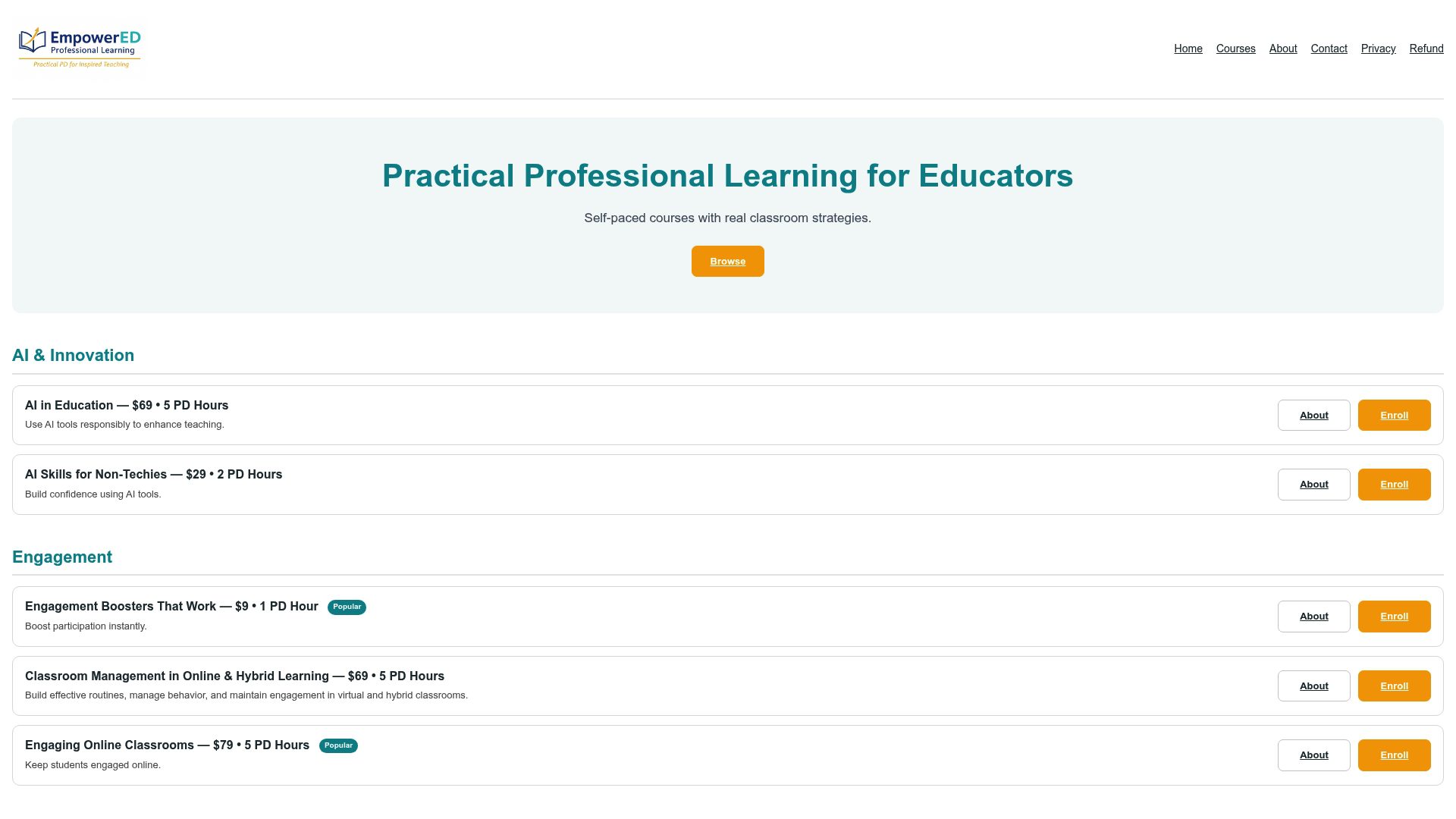
Three resources worth exploring:
- Engagement Boosters That Work: Short, classroom-ready interventions and routines organized by challenge type. Ideal for teachers who want quick wins while building toward a fuller student-centered model.
- Social-Emotional Learning and Teacher Wellness: Practical SEL integration strategies that support both student outcomes and teacher sustainability.
- AI in Education: Guidance on using AI tools to personalize learning, differentiate instruction, and reduce teacher workload — directly aligned to student-centered principles.
Each course delivers practical routines, evidence summaries, and ready-to-use templates. No fluff, no generic advice. Browse the full catalog and preview any course at Empowered Professional Learning.
Useful sources and further reading
These primary sources ground the claims in this article and are worth bookmarking for PLC reading or district-level policy conversations.
| Source | What it provides |
|---|---|
| ED/ERIC synthesis (ED567875) | Defines the four core tenets of student-centered learning with implementation guidance for U.S. educators |
| AASA toolkit: Prioritize Student-Centered Learning | System-level implementation guidance, co-creation strategies, and community partnership models |
| Education Reimagined impact report | Review of 93 studies covering motivation, belonging, SEL, and long-term civic outcomes |
| Campbell meta-analysis (Wiley) | Most rigorous effect-size analysis of student-centered instruction; highlights teacher facilitation as the key variable |
| Ninth-grade engagement study (Wiley) | Controlled comparison of emotional engagement in student-centered vs. teacher-centered technology classrooms |
| JFF assessment report | Practical guidance on balanced assessment systems, self-assessment, portfolios, and competency-based milestones |
Use these sources to support a district proposal, anchor a PLC discussion, or deepen your own understanding of the evidence base. The research is accessible, and the practical implications are clear: student-centered teaching, done well, is one of the most effective investments a teacher or school can make.
Recommended
- Student Engagement Strategies for K-12 Educators: 2026 Guide
- Educator Effectiveness Metrics Explained for K-12 Leaders – EmpowerED: Professional Development for Educators
- Professional Learning for Educators: Enhance Your Impact – EmpowerED: Professional Development for Educators
- Growth Mindset Teaching for K-12 Educators: 2026 Guide