Formative assessment is defined as an ongoing, in-process approach where teachers use formal and informal procedures during instruction to monitor student progress and provide qualitative feedback that directly adjusts teaching and learning. Unlike summative assessment, which evaluates learning after the fact, formative assessment operates in real time. The University of Melbourne describes it as both a learning activity and an assessment approach that promotes learning when integrated into curriculum routines. The University of Virginia adds that it is typically low- or no-stakes, designed so students and teachers can generate, interpret, and use evidence to decide next steps. A 2026 peer-reviewed study of 4,500 students confirmed what many educators already sense: formative assessment strategies produce measurable gains in achievement and engagement when applied with intention and consistency.
What does research say about formative assessment effectiveness?
A 2026 study of 4,500 students found that formative assessment strategies led to a 25.3% increase in academic achievement and a 31.7% increase in student engagement. Those numbers represent real classrooms, not controlled lab conditions. The largest effect size in the study (d=0.85) was linked to immediate, content-directed feedback. That means the timing and specificity of feedback matters more than the format of the assessment itself.
The same research identified equity-gap reduction as a significant benefit when schools combined digital formative tools with culturally responsive practices. Students from historically underserved groups showed the most pronounced gains. This finding shifts the conversation about formative assessment from a general teaching strategy to an equity tool with documented impact.

Frequent, ongoing formative assessment also shifts student motivation from extrinsic rewards like grades to intrinsic progress awareness. When students track their own understanding rather than waiting for a report card, metacognition improves. They begin to see learning as a process they can influence, not a verdict handed down at the end of a unit.
| Research Finding | Effect / Outcome |
|---|---|
| Academic achievement increase | 25.3% gain across 4,500 students |
| Student engagement increase | 31.7% improvement in participation |
| Immediate, content-directed feedback | Effect size d=0.85, largest in study |
| Equity-gap reduction | Greatest gains among underserved student groups |
| Motivation and metacognition | Shift from grade-focus to progress-focus |
“Immediate, content-directed feedback is the single most powerful lever in formative assessment. Everything else is scaffolding around that core mechanism.” — Springer Nature, 2026
What are common misconceptions about formative assessment?
The most persistent misconception is that formative assessment is simply another test. Teachers sometimes treat it as a data-collection event rather than an instructional decision point. The University of Virginia Teaching Hub is direct on this: formative assessment requires instructional action following evidence. Without that action, checks become performative and do not improve learning.
A second misconception is that formative assessment is something teachers do to students. In an effective formative cycle, students are active participants. They generate evidence through their responses, interpret criteria through self-assessment, and use feedback to adjust their own learning. Student self- and peer-assessment with clear criteria develops learner autonomy and strengthens the entire formative cycle.
The formative cycle has four distinct steps: collect evidence of understanding, interpret that evidence against a learning target, decide on next steps, and act on those decisions. The action step is where most implementation breaks down. Teachers collect exit tickets and never adjust the next day’s lesson. That pattern is assessment of learning dressed up as assessment for learning.
Here is what distinguishes genuine formative practice from performative checking:
- Formative: Exit ticket results prompt a re-teach or small-group pull the next day
- Performative: Exit tickets are collected, recorded, and never referenced again
- Formative: Students use a peer-feedback protocol tied to specific success criteria
- Performative: Students swap papers and mark answers right or wrong without criteria
- Formative: A digital poll mid-lesson redirects the teacher’s explanation in real time
- Performative: A digital poll generates data that sits in a dashboard unread
Pro Tip: Before selecting any formative tool, ask one question: “What will I do differently based on what I learn?” If you cannot answer that before administering the check, the check is not yet formative.
What types of formative assessment strategies work in K-12 classrooms?
Formative assessment in education covers a wide range of techniques, from quick verbal checks to structured digital tools. The key is matching the technique to the learning target and the classroom context. A minute paper works well after a direct instruction segment. A digital poll works well in hybrid or large-group settings. A structured peer-feedback protocol works well during writing or project-based work.
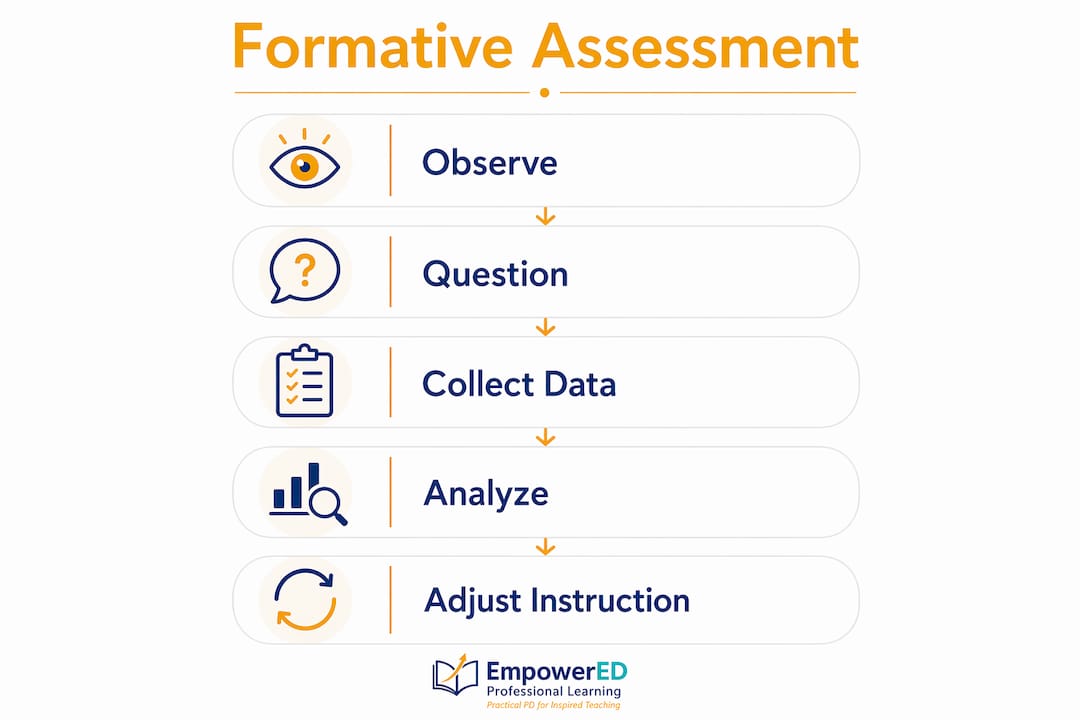
Below is a practical comparison of common types of formative assessments and their best uses:
| Assessment Type | Best Use | Primary Benefit |
|---|---|---|
| Exit tickets | End of lesson comprehension check | Quick evidence of understanding gaps |
| Digital polls (e.g., Mentimeter, Poll Everywhere) | Real-time mid-lesson checks | Immediate whole-class data |
| Minute papers | Post-instruction reflection | Surfaces misconceptions in writing |
| Peer feedback protocols | Writing, projects, presentations | Develops criteria-based thinking |
| Self-assessment checklists | Independent practice | Builds metacognition and ownership |
| Observation and questioning | Small group or discussion settings | Captures verbal and behavioral evidence |
Technology-enhanced options deserve specific attention. Tools like Google Forms, Nearpod, and Formative (the platform) allow teachers to see student responses in real time and sort them by accuracy before the class period ends. That speed is what makes content-directed feedback possible at the classroom level. Without real-time visibility, teachers are always reacting to yesterday’s data.
Cultural relevance also shapes which techniques work. A student who is reluctant to speak in whole-class discussion may respond openly in an anonymous digital poll. A student who struggles with written English may demonstrate understanding more accurately through a visual organizer or a brief verbal check-in. Effective formative practice means choosing the technique that gives the most accurate evidence from each learner, not the technique that is easiest to administer.
Pro Tip: Pair classroom routines with formative checks. When students know that every lesson ends with a two-minute reflection or exit ticket, the cognitive load of the check disappears and the quality of responses improves.
How can K-12 schools implement formative assessment at scale?
Implementation quality at scale depends more on teacher routines and leadership support than on which tools a school purchases. That finding matters because most districts invest in platforms before investing in the professional learning needed to use them well. The result is expensive software and unchanged instruction.
Sustainable implementation follows a clear sequence:
- Establish shared learning targets. Teachers cannot collect meaningful evidence if they disagree on what mastery looks like. Grade-level or department teams should align on specific, observable learning goals before selecting any formative technique.
- Build evidence-interpretation routines. Set aside structured time, in professional learning communities or team meetings, for teachers to review formative data together. Evidence interpreted in isolation rarely changes instruction. Evidence interpreted collaboratively changes systems.
- Secure leadership support. Administrators who observe classrooms with formative practice in mind, ask teachers what data they collected and what they did with it, and protect collaborative planning time send a clear signal about priorities.
- Train teachers on the full cycle. Most teacher preparation programs cover assessment design but not the interpret-and-act steps. Data-informed professional development that focuses on instructional response, not just data collection, closes that gap.
- Incorporate student voice. Schools that teach students to self-assess against clear criteria see faster gains than schools that keep assessment entirely in the teacher’s hands. Student ownership of evidence is not a soft skill. It is a structural component of an effective formative cycle.
Common barriers include limited instructional time and the dominance of summative assessment pressures. Both are real. The practical response is to embed formative checks into existing instruction rather than adding them on top. A well-designed discussion question is formative. A targeted homework problem reviewed at the start of class is formative. The goal is not more assessment. It is smarter use of the assessment moments already present in every lesson.
Pro Tip: Prioritize the quality of your instructional response over the sophistication of your tool. A sticky-note exit ticket that changes tomorrow’s lesson is more powerful than an AI-driven platform that generates reports no one reads.
Key takeaways
Formative assessment works because it links real-time evidence of student understanding directly to instructional decisions, producing measurable gains in achievement, engagement, and equity when implemented with consistent routines and leadership support.
| Point | Details |
|---|---|
| Definition and purpose | Formative assessment is an ongoing, low-stakes process that informs instructional decisions during learning, not after it. |
| Research-backed impact | A 2026 study found 25.3% achievement gains and 31.7% engagement increases, with the largest effect tied to immediate feedback. |
| The action requirement | Evidence without instructional action is performative. Every formative check must connect to a next step for teacher or student. |
| Student involvement | Self- and peer-assessment with clear criteria builds learner autonomy and strengthens the full formative cycle. |
| Scale and sustainability | Lasting implementation depends on teacher routines, collaborative data use, and leadership support, not tool selection. |
Why formative assessment is a mindset, not a checklist
I have worked with K-12 educators across a wide range of school contexts, and the pattern I see most often is this: teachers adopt a formative tool, use it faithfully for a few weeks, and then quietly abandon it when the pressure of summative testing season arrives. The tool was never the problem. The mindset was.
Formative assessment is not a technique you add to your practice. It is a way of thinking about instruction. Every time you ask a question, assign a problem, or listen to a student explain their thinking, you are generating evidence. The question is whether you use it. Teachers who internalize that framing stop asking “Which tool should I use?” and start asking “What does this student’s response tell me, and what do I do next?”
The research on growth mindset teaching connects directly here. When students experience consistent, specific feedback tied to their learning progress, they develop a more accurate and optimistic view of their own capacity. That is not a side effect of good formative practice. It is a direct outcome.
Administrators play a role that often goes underestimated. Schools where formative assessment takes root are schools where leaders ask teachers about their evidence, protect collaborative planning time, and treat instructional adjustment as a sign of professional strength, not weakness. Culture is the infrastructure. Professional learning is the maintenance. Without both, even the best formative strategies fade.
— Brian Koster, Ed.D.
Deepen your formative assessment practice with Empoweredpl
Knowing the research is one thing. Applying it consistently in your classroom is another. Empoweredpl offers targeted professional learning designed specifically for K-12 educators who want practical, ready-to-use formative assessment strategies.
The Micro-Formative Assessments That Work course ($9, 1 PD Hour) gives you quick, targeted techniques to check understanding and adjust instruction in real time. For a broader look at professional learning options, the Empoweredpl course catalog includes programs on data literacy, hybrid learning, and engagement strategies. Each course is built for immediate classroom application, so you leave with strategies you can use the next day, not just frameworks to think about.
FAQ
What is formative assessment in simple terms?
Formative assessment is an ongoing process teachers use during instruction to check student understanding and adjust teaching in real time. It is low-stakes, frequent, and focused on improving learning before a final evaluation.
How is formative assessment different from summative assessment?
Summative assessment evaluates learning at the end of a unit or course, such as a final exam or standardized test. Formative assessment happens during learning and is designed to inform instructional decisions, not assign a final grade.
What are the most effective formative assessment strategies?
Exit tickets, digital polls, minute papers, peer feedback protocols, and self-assessment checklists are all well-supported techniques. Research shows that immediate, content-directed feedback produces the largest gains, so the best strategy is the one you can act on quickly.
How do you implement formative assessment without adding more work?
Embed formative checks into existing instruction rather than treating them as separate tasks. A targeted discussion question, a brief written reflection, or a quick show-of-hands poll already present in most lessons can function as formative assessment when tied to a clear learning target and a planned instructional response.
Can students participate in formative assessment?
Yes. Student self- and peer-assessment with clear criteria is a recognized component of effective formative practice. When students understand what mastery looks like and can evaluate their own progress against it, they develop greater ownership of their learning and stronger metacognitive skills.