The most effective professional development for educators is job-embedded, sustained over time, and includes coaching or cohort-based feedback. That combination consistently changes classroom practice. One-off workshops rarely do. Federal Title II-A guidance requires PD to be sustained and collaborative, and About 67% of public K-12 teachers report that collaborative learning with colleagues improved their teaching or their students’ learning to a moderate or large extent.
Your clearest next step: identify one specific classroom challenge, a “problem of practice,” and enroll in a coached or cohort-based pathway that documents clock hours or continuing education units (CEUs). Empowered Professional Learning offers exactly this kind of classroom-ready, coached online PD, including pathways in SEL and teacher wellness, student engagement strategies, and UDL and accessibility.
- Choose PD that is sustained, not a single event.
- Require coaching, peer observation, or cohort accountability.
- Verify clock-hour or CEU documentation before enrolling.
- Start with one problem of practice and a measurable classroom goal.
Table of Contents
- What types of professional development actually work?
- How to choose PD that actually improves your teaching
- Where can educators find approved PD in the U.S.?
- What does PD cost, and how do clock hours and CEUs work?
- What does research say about effective PD design?
- Five steps to get started this week
- How to fund your professional development
- Key Takeaways
- The case for depth over breadth in teacher PD
- Empowered Professional Learning’s classroom-ready PD courses
- Useful sources and where to check state rules
What types of professional development actually work?
Not all PD formats carry the same weight. Matching the right format to your goal and schedule is the first practical decision you will make.
Self-paced online modules work well for targeted knowledge gain and micro-credentials. The caveat: research on online PD consistently shows that structured support activities, such as instructor feedback, peer reflection tasks, and scheduled checkpoints, matter more for outcomes than pacing alone. A self-paced course with no interaction is closer to a webinar recording than genuine PD.
Cohort and hybrid courses combine asynchronous content with scheduled synchronous sessions, peer work, and coaching. This format is strong for implementation and accountability. It mirrors the design principles that a synthesis of 115 studies found most effective for online teacher PD: interactivity, instructor involvement, and active tasks.

Workshops and conferences are useful for exposure and inspiration. Their impact on classroom practice is limited unless they are paired with follow-up coaching or structured application tasks.
Instructional coaching and peer observation carry the highest likelihood of changing practice when coaching is sustained and embedded in the classroom. This is the gold standard, and it is also the most time-intensive.

Professional learning communities (PLCs) and team-based learning are effective for collaborative problem-solving and local adaptation. They align well with Title II-A priorities and are often funded at the district level.
University credit and micro-credentials are useful for specialization and license renewal. Always verify clock-hour or CEU equivalency with your state licensing board before enrolling.
Three concrete examples of coached, classroom-ready pathways: Empowered Professional Learning’s SEL and teacher wellness course, Engagement Boosters That Work, and UDL and Accessibility. Each is designed for direct classroom application with certificate documentation.
| Format | Best for | Coaching included? | Credit potential |
|---|---|---|---|
| Self-paced online | Targeted knowledge, micro-credentials | Rarely (check provider) | CEUs, clock hours |
| Cohort/hybrid | Implementation, accountability | Often yes | CEUs, clock hours |
| Workshop/conference | Exposure, inspiration | Rarely | Sometimes clock hours |
| Instructional coaching | Deep practice change | Yes | Varies by district |
| PLC/team learning | Collaborative problem-solving | Peer-based | District credit |
| University credit | Specialization, license renewal | Sometimes | Graduate credit, CEUs |
How to choose PD that actually improves your teaching
A practical checklist cuts through the noise. Before enrolling, run any PD option through these criteria.
Must-have criteria:
- Sustained timeline (multiple sessions or weeks, not a single day)
- Classroom-embedded practice tasks, not just passive content
- Coaching, observation, or peer accountability built into the design
- Documented credit: clock hours, CEUs, or a certificate your district recognizes
- Alignment to your state standards, district goals, or a specific student outcome
Questions to ask any provider:
- What follow-up coaching or feedback is included after each module?
- How are classroom changes monitored during the course?
- Is there a certificate with state-recognizable clock hours or CEUs?
- Can you see a sample syllabus with specific classroom tasks?
- What evidence of teacher outcomes or case studies does the provider share?
Red flags to watch for:
- “One-shot” or single-day marketing language with no follow-up plan
- Purely passive video recordings with no interaction or reflection tasks
- Vague credentialing language or no clear paperwork for clock hours
- No instructor qualifications listed and no cohort or peer component
Personalized, competency-based pathways let educators control pace and focus, which increases relevancy and uptake. That design principle also makes it easier to tie PD directly to your specific grade level or subject area.
Pro Tip: Before you evaluate any course, write your problem of practice in one sentence: “My students struggle with X, and I want to improve Y by doing Z.” Then check whether the PD directly addresses that sentence. If it does not, keep looking.

Where can educators find approved PD in the U.S.?
Knowing where to look saves time and prevents enrolling in courses that do not count toward your license renewal.
- State education department PD catalogs and regional service centers are the most reliable starting point for verifying clock-hour or CEU approval. The U.S. Department of Education maintains a professional development resource page, and state agencies such as the North Carolina Department of Public Instruction and the Ohio Department of Education publish their own PD approval processes.
- National organizations such as the NEA provide guidance on what qualifies as high-quality PD and often list state-approved or nationally recognized programs.
- District-offered PD and school-based PLCs are frequently the easiest route to funded, approved credit. Your district PD coordinator can confirm whether a course counts toward your renewal hours before you spend time or money.
- Curated online providers with coached pathways, such as Empowered Professional Learning, offer documented certificates and clock-hour verification. Check that the provider clearly states its credentialing process on its course pages before enrolling.
- University extension programs and micro-credential marketplaces offer graduate credit and stackable credentials. Confirm transferability with your state licensing board, since not all micro-credentials are accepted for license renewal in every state.
What does PD cost, and how do clock hours and CEUs work?
Time and money are real constraints. Here is what to expect across common formats.
Typical time commitments:
- Micro-modules: 1–5 hours, useful for targeted skill-building
- Short courses: 10–30 hours, often enough for a renewal credit block
- Coached or hybrid cohorts: 30–120+ hours across a semester or year, the format most likely to produce lasting classroom change
Cost patterns:
- Free or district-funded options are available through state PD catalogs, PLCs, and Title II-A funded programs.
- Paid online courses typically range from $50 to $400 for individual enrollment.
- University credit and comprehensive coached pathways cost more; stipends and grants can offset this.
How credit is documented:
Clock hours represent one hour of approved PD activity. CEUs are a standardized unit (one CEU equals 10 contact hours) used by many providers and states. Your state licensing board or district PD coordinator sets the equivalency rules. Always request a certificate of completion and a transcript or clock-hour verification letter, and keep copies for license audits.
Funding options:
- Title II-A grants directed approximately $2.2 billion annually during fiscal years 2022 through 2024 to support teacher professional development, making it the largest federal PD funding source.
- District stipends and professional learning grants are available in many schools.
- Teacher-release time and administrator-approved PD days can offset the time cost of longer cohort programs.
- Ask your principal or PD coordinator about local funding before paying out of pocket.
What does research say about effective PD design?
The evidence points in a consistent direction. Sustained, collaborative, and job-embedded PD with coaching is more likely to change classroom practice than any other format. That finding holds across GAO meta-analyses and peer-reviewed research syntheses.
Digital formats can be just as effective as in-person PD when they include synchronous collaboration, instructor support, and active tasks. Format matters less than design. A self-paced course with structured feedback and peer reflection outperforms a passive in-person lecture every time.
Joe Schroeder of the Wisconsin Association of School Administrators recommends that educators bring a specific problem of practice to any PD experience and engage in cycles of inquiry with classroom monitoring. Activity without that structure is not impact.
About 67% of public K-12 teachers reported that collaborative learning with colleagues improved their teaching or their students’ learning to a moderate or large extent — GAO analysis of RAND survey data.
One-off workshops remain common despite this evidence, with many districts still relying on single-day events that teachers themselves rate as less useful. The gap between what research recommends and what schools deliver is real.
Pro Tip: Prioritize PD that requires you to submit classroom evidence, such as a lesson plan, student work sample, or observation notes, for feedback. Attendance-based credit alone rarely changes practice.
Five steps to get started this week
-
Write your problem of practice. Name one specific classroom challenge and a measurable goal. Example: “My 7th-grade students disengage during independent work. I want to increase on-task behavior by implementing two structured engagement strategies within six weeks.”
-
Find a coached or cohort option. Search your state PD catalog or a provider like Empowered Professional Learning for a course that explicitly includes classroom application tasks and clock-hour documentation. Check that coaching or peer feedback is built in, not optional.
-
Schedule it. Block time for practice lessons, peer observations, or reflection tasks in your calendar now. If the course requires administrator support or release time, request it in writing before you enroll.
-
Document everything. Collect your certificate of completion, clock-hour verification, and any artifacts (lesson plans, student work, observation notes). Store them in a dedicated folder for your next license renewal audit.
-
Seek funding first. Before paying out of pocket, ask your administrator about Title II-A funds, district stipends, or professional learning grants. For lower-cost options, micro-modules in the $50–$150 range are a practical starting point.
Sample funding request prompt you can copy:
How to fund your professional development
Funding is more accessible than most teachers realize. The largest federal source is Title II-A, which directed substantial federal funding annually to districts during recent fiscal years to support teacher professional learning. That money flows through your district, so your administrator or PD coordinator is the right person to ask.
Beyond Title II-A, districts often hold professional learning budgets that cover approved courses, conference registrations, and substitute costs for release time. State education departments sometimes administer competitive grants for individual teachers or school teams pursuing specialized credentials.
National professional associations, including subject-area organizations and the NEA, periodically offer scholarships or stipends for PD. University extension programs occasionally provide tuition waivers or reduced rates for cohort enrollment. If your school participates in a Title I program, those funds can also support professional learning aligned to school improvement goals.
The practical move: ask before you pay. A brief conversation with your principal or district PD coordinator often reveals funding that teachers do not know exists.
Key Takeaways
Effective professional development for educators is sustained, job-embedded, and includes coaching or cohort accountability — those three features predict classroom change more reliably than any other design element.
| Point | Details |
|---|---|
| Choose sustained, coached PD | Job-embedded PD with coaching or cohort feedback is most likely to change classroom practice. |
| Start with one problem of practice | Narrow focus to one classroom challenge and require evidence-based follow-up, not just attendance credit. |
| Verify credit before enrolling | Confirm clock-hour or CEU acceptance with your state licensing board or district coordinator first. |
| Use available funding | Title II-A, district stipends, and professional learning grants can cover most or all PD costs. |
| Empowered Professional Learning | Offers coached, classroom-ready online courses in SEL, engagement, and UDL with certificate documentation. |
The case for depth over breadth in teacher PD
Most teachers have sat through PD that felt disconnected from their actual classrooms. The problem is rarely the topic. It is the design. A full day on differentiation with no follow-up observation, no classroom task, and no peer accountability produces almost no lasting change. The research is clear on this, and so is practitioner experience.
What actually works is narrower than most PD calendars allow. Pick one problem. Work it deeply. Collect evidence from your classroom. Get feedback. Repeat. That cycle, not the number of workshops attended, is what moves student outcomes.
The instinct to cover more topics in less time is understandable, especially when administrators are trying to address multiple school improvement goals at once. But spreading PD thin is the single most common reason teachers walk away unchanged. Depth is not a luxury. It is the mechanism.
Empowered Professional Learning’s course design reflects this principle. Courses like UDL and Accessibility are built around specific classroom tasks and require teachers to apply strategies directly with their students, not just watch and take notes. That structure is what separates PD that sticks from PD that fades by Monday morning.
Empowered Professional Learning’s classroom-ready PD courses
Empowered Professional Learning publishes this guide and offers paid online professional development courses and bulk district licensing built around the design principles described here: coached, classroom-ready, and documented for credit.
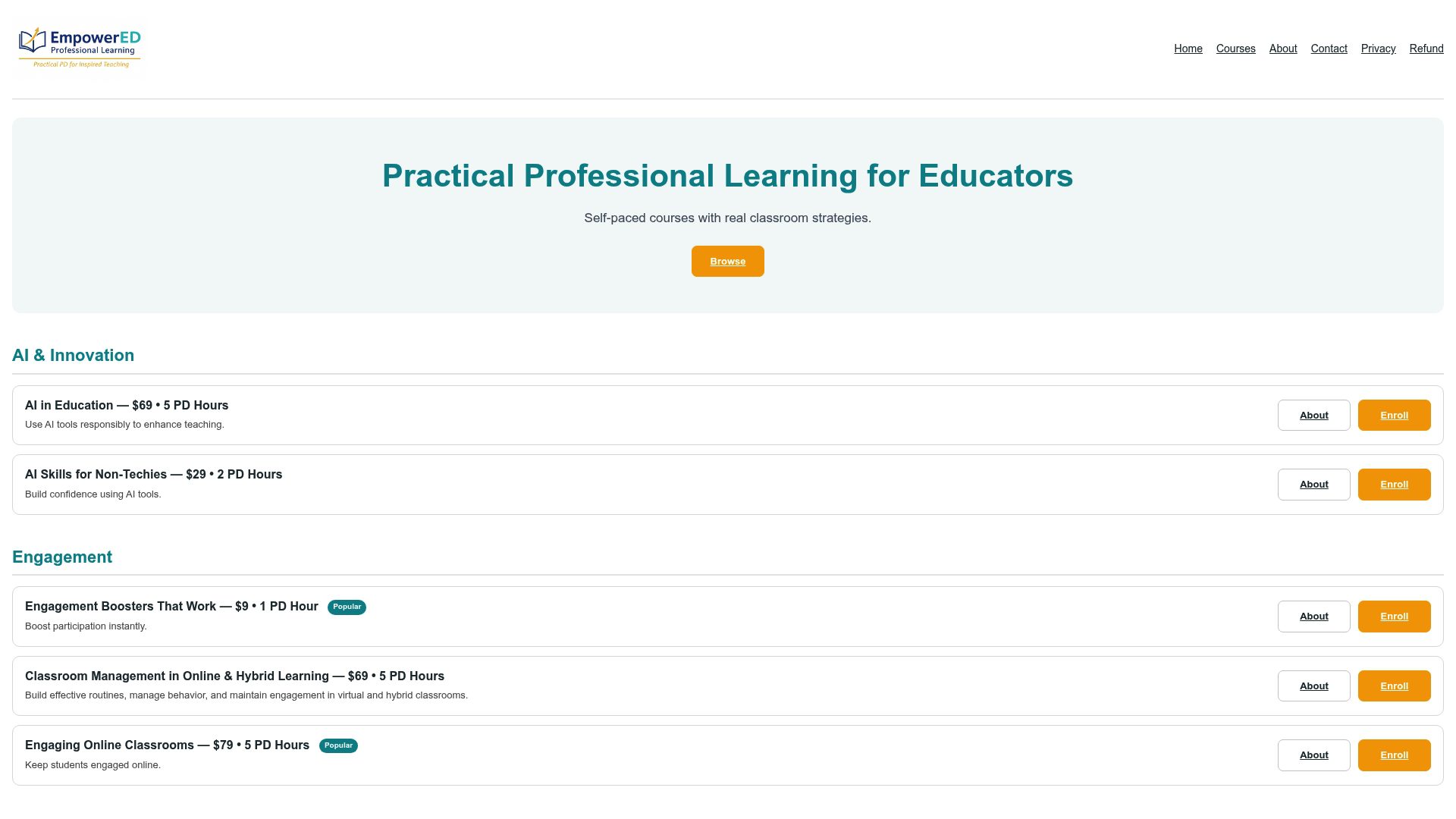
Three course pathways map directly to the PD priorities in this guide. The SEL and Teacher Wellness pathway addresses educator wellbeing and classroom climate with practical, immediately applicable strategies. Engagement Boosters That Work gives teachers concrete tools for increasing student participation, with classroom artifacts for documentation. The UDL and Accessibility course covers inclusive design with implementation tasks tied to real lesson planning.
Each course includes a certificate of completion. Contact Empowered Professional Learning’s PD coordinator to confirm clock-hour documentation for your state’s renewal requirements. View the full course catalog at empoweredpl.com to find the pathway that fits your current problem of practice.
Useful sources and where to check state rules
- GAO-26-107874: K-12 Education: Research on Effectiveness of Professional Development Is Mixed, but Teachers Find Collaborative Learning Most Useful — Primary source for the 67% collaborative PD finding, Title II-A funding figures, and federal guidance on sustained, job-embedded PD design.
- EdWeek: Plan Professional Development That You Would Want to Attend. Here’s How — Joe Schroeder’s practitioner guidance on problem-of-practice focus, cycles of inquiry, and classroom monitoring.
- EdWeek: Teachers Like It. Research Is Promising. Is This the Solution to Teacher PD? — Reporting on the prevalence of one-off workshops and teacher perceptions of collaborative PD.
- Springer: Online Teacher Professional Development: A Research Synthesis on Effectiveness and Evaluation — Synthesis of 115 studies on online PD effectiveness; key finding: interactivity and instructor support matter more than format or pacing.
- U.S. Department of Education: Professional Development Resources — Federal resource hub for PD guidance and Title II-A program information.
- North Carolina Department of Public Instruction: Professional Development — Example of a state PD approval and clock-hour verification process; check your own state’s equivalent page.
- Ohio Department of Education: Professional Development — Another state-level example for CEU and license renewal rules; use as a model for locating your state’s requirements.
This article provides general information about professional development options and is not a substitute for guidance from your state licensing board, district PD coordinator, or a qualified education advisor. Verify clock-hour acceptance and funding eligibility with the appropriate authority before enrolling.
Recommended
- Professional Learning for Educators: Enhance Your Impact – EmpowerED: Professional Development for Educators
- Growth Mindset Teaching for K-12 Educators: 2026 Guide
- Online Teaching PD for K–12: What to Pick and Why – EmpowerED: Professional Development for Educators
- Classroom Engagement Strategies for Educators: 2026 Guide – EmpowerED: Professional Development for Educators