For most K-12 educators, Empowered Professional Learning is the recommended alternative to webteaching.com: it offers instructor-guided, self-paced courses with PD certificates, practical classroom application, and district bulk licensing, covering AI in education, hybrid learning, data literacy, and more. If you need graduate credit specifically, university-partnered platforms that issue credit through an accredited institution are the right complement. Below is the full shortlist.
Top alternatives at a glance:
- Empowered Professional Learning — Best for classroom-ready, instructor-guided PD with immediate application; PD certificate and district licensing available; self-paced with facilitator feedback.
- University-partnered online PD platforms — Best for teachers who need graduate credit toward salary lane advancement; credit-bearing courses through accredited institutions; cohort or self-paced formats.
- State-approved CEU providers — Best for license renewal hours; CEU certificates accepted by most state departments of education; typically self-paced micro-courses.
- Quality Matters-aligned course providers — Best for districts prioritizing course design standards; courses reviewed against Quality Matters benchmarks for accessibility, alignment, and learner support.
- Federal and state agency learning portals — Best for free, policy-aligned PD; no credit but strong alignment to U.S. Department of Education Office of Educational Technology guidance on effective online learning.
Table of Contents
- What are the best webteaching.com alternatives for K-12 teachers?
- Detailed profiles: what each option actually offers
- How do you choose the right online PD provider?
- Why does delivery quality matter in online PD?
- Key Takeaways
- What most teachers miss when choosing online PD
- Empowered Professional Learning: a practical next step for K-12 teachers
- Authoritative sources and further reading
What are the best webteaching.com alternatives for K-12 teachers?
The table below compares the five provider categories on the dimensions that matter most to classroom teachers and district buyers. A strong delivery-quality signal is any combination of published facilitator bios, a sample syllabus, participant deliverables, and documented teacher ratings — not just a course title.

| Provider type | Best for | Format | Credit-bearing? | Price shape | Typical duration | Topics | Delivery quality signals | Credit transfer |
|---|---|---|---|---|---|---|---|---|
| Empowered Professional Learning | Classroom-ready PD, AI & hybrid learning, district teams | Self-paced, instructor-guided | PD certificate; CEU pathway available | Per course; district bulk licensing | 3–10 hours per course | AI in education, hybrid learning, classroom management, data literacy, SEL, UDL | Facilitator feedback, applied projects, published learning objectives | PD certificate accepted by most districts; check state CEU rules |
| University-partnered PD platforms | Graduate credit for salary lanes | Cohort or self-paced | Graduate credit (1–3 credit hours) | Per credit hour; varies by university partner | 4–8 weeks per credit | Varies; often literacy, curriculum design, technology | Instructor credentials, graded assignments | Transferable to salary lane; confirm with district HR |
| State-approved CEU providers | License renewal, low-cost hours | Self-paced | CEU certificate | Low per-course fee | 1–6 hours | Varies widely | Often minimal facilitator involvement | Accepted for renewal; rarely for salary lane |
| Quality Matters-aligned providers | Districts requiring design standards | Varies | PD certificate or CEU | Mid-range per course | 3–8 hours | Varies by provider | QM-reviewed alignment, accessibility (WCAG) | PD certificate; confirm district policy |
| Federal/state agency portals | Free, policy-aligned PD | Self-paced | PD certificate (no credit) | Free | 1–4 hours | EdTech, digital equity, online teaching | Published by authoritative bodies | Not credit-bearing; useful for documentation |
Detailed profiles: what each option actually offers
Empowered Professional Learning
Empowered Professional Learning is built specifically for K-12 educators who want courses they can apply in class the next day. Courses are self-paced and instructor-guided, meaning you move at your own schedule but receive personalized feedback rather than working through static slides alone. Topics span AI in education, hybrid learning, classroom management, data literacy, Universal Design for Learning, SEL, and executive function.

Best for: Teachers who want practical, classroom-ready strategies and districts building a cohesive PD plan across a team.
Credit and certificates: PD certificates are issued upon completion. CEU pathways are available; check with your state department of education for acceptance rules, since states handle CEU documentation differently (Colorado, for example, leaves CEU selection to educators but requires documentation for license renewal).
Pricing: Individual course purchase or district bulk licensing. No subscription required.
Pros:
- Courses are designed for immediate classroom application, not abstract theory.
- Facilitator feedback is built in, not an add-on.
- District bulk licensing makes team-wide PD affordable.
- Strong topic coverage: AI, hybrid learning, data literacy, SEL.
Cons:
- Graduate credit is not issued directly; teachers needing credit hours for salary lanes should pair Empowered Professional Learning with a university-partner pathway.
- Course catalog is focused on K-12 PD, so it is not a fit for higher-education faculty.
University-partnered online PD platforms
These platforms partner with accredited universities to issue graduate credit, typically 1–3 credit hours per course. Credit is the main draw: salary lane advancement at most districts requires graduate-level credit, and a PD certificate alone will not move you on the pay scale.
Best for: Teachers within a few credit hours of a salary lane increase, or those working toward a master’s degree.
Format: Cohort-based or self-paced, depending on the provider. Cohort formats usually run 4–8 weeks with weekly assignments and peer interaction.
Credit transfer: Graduate credit from an accredited institution generally transfers to salary lanes, but district HR offices vary. Always confirm the university’s regional accreditation and ask HR whether that institution’s credit is accepted before enrolling.
Pricing: Priced per credit hour; rates vary by university partner. District licensing arrangements are less common than with PD-certificate providers.
Pros:
- Graduate credit is the most direct path to salary lane advancement.
- Courses often carry rigorous design standards tied to the university’s accreditation.
Cons:
- Higher cost per course than PD-certificate options.
- Cohort schedules can conflict with teacher workloads during the school year.
- Quality varies significantly across university partners.
State-approved CEU providers
Continuing Education Units are the most common currency for license renewal in most states. CEU providers are approved by state departments of education to issue hours that count toward renewal. Pennsylvania, for example, requires providers to apply for Act 48 approval and to upload participant hours into the PERMS system within 30 days of completion. Maryland’s CPD Manual sets contact-hour minimums and requires documented learning outcomes before CPD credit is issued.
Best for: Teachers who need renewal hours quickly and at low cost.
Pros:
- Low per-course cost.
- Wide topic variety.
- Accepted for renewal in most states when the provider is approved.
Cons:
- Minimal facilitator involvement in many cases.
- CEUs rarely count toward salary lane advancement.
- Provider approval status varies by state; always verify before enrolling.
Quality Matters-aligned course providers
Quality Matters publishes a course design framework and a practical checklist of ten things to look for when purchasing online or blended courses, covering alignment to objectives, accessibility (WCAG compliance), published syllabi, and learner support resources. Providers that have had courses reviewed against this framework offer a measurable design standard.
Best for: Districts with a formal vendor evaluation process or instructional coaches who need to justify a PD purchase to administration.
Pros:
- Course design is independently reviewed, not self-reported.
- Accessibility and UDL compliance are part of the standard.
Cons:
- QM review does not guarantee strong facilitation or practical classroom application.
- Not all reviewed courses are credit-bearing.
Federal and state agency learning portals
Free PD resources from the U.S. Department of Education Office of Educational Technology and state departments of education are policy-aligned and cost nothing. They are useful for orientation to new initiatives (AI in education, digital equity, online teaching standards) but are not credit-bearing and typically lack facilitator support.
Best for: Teachers who need a quick, free introduction to a topic before investing in a paid course.
Pros: Free, authoritative, policy-aligned.
Cons: No credit, no facilitator feedback, limited depth.
Pro Tip: Match your PD format to your current workload. If you are mid-semester and stretched thin, a self-paced asynchronous course lets you work in 20-minute windows without missing a live session. Save cohort-based courses for summer or a lighter stretch of the year when you can engage fully.
How do you choose the right online PD provider?
Start with three priorities in this order: (1) credit recognition, (2) delivery quality, and (3) format fit with your schedule. Everything else is secondary.
Selection criteria checklist
- Credit recognition — Confirm whether the provider issues graduate credit, CEUs, or a PD certificate, and verify with your district HR office that the specific credit type counts toward your renewal or salary lane before you pay.
- Facilitator credentials — Look for published bios. A facilitator with classroom teaching experience and a relevant advanced degree is a stronger signal than a generic “course author” label. District leaders increasingly rely on facilitator credentials and teacher ratings rather than marketing language when approving external PD.
- Published syllabus and learning objectives — Any provider worth your time publishes these before enrollment. A published syllabus lets you confirm alignment to your district’s goals and to state standards.
- Applied projects and participant deliverables — Courses that require you to produce something you can use in class (a lesson plan, a data analysis, a classroom management protocol) deliver better transfer than courses built around video-watching and quizzes.
- Accessibility and UDL compliance — Providers that address accessibility in PD design signal that they build courses the same way they expect teachers to build lessons: with all learners in mind.
- District billing and bulk licensing — If you are purchasing for a team, confirm whether the provider offers district invoicing, purchase orders, or bulk pricing. Individual credit-card purchases at scale create administrative friction.
Questions to send to any provider before enrolling
Copy these into an email or a procurement request:
- What type of credit does this course award (graduate credit, CEU, PD certificate), and which accrediting body or state agency recognizes it?
- Can you share the facilitator’s bio and their years of K-12 classroom experience?
- Is a sample syllabus or course outline available before purchase?
- Does the course include applied projects or participant deliverables I can use in my classroom?
- What is your district billing process, and do you offer bulk or site licensing?
- Can you provide references from districts that have used this course for professional development approval?
Red flags to avoid
- No published syllabus or learning objectives before purchase.
- Facilitator credentials are absent or vague (“education professional”).
- The provider cannot confirm whether its credit is accepted in your state.
- No participant ratings, reviews, or district references are available.
- CEU upload timelines are unclear (relevant in states like Pennsylvania where providers must upload hours within 30 days).
- Course content is entirely video-based with no applied component or feedback loop.
Typical timelines and cost ranges
Micro-courses and short PD modules typically run a few hours of seat time and can be completed in a weekend or spread across a week. For-credit short courses generally span multiple graduate credit hours, which translates to several weeks of structured work at a cohort pace, or a similar time investment self-paced. Pricing varies widely: free agency portals sit at one end, per-credit university courses at the other, with PD-certificate courses from providers like Empowered Professional Learning falling in between and offering district bulk pricing that reduces per-teacher cost significantly.
Why does delivery quality matter in online PD?
Effective online professional learning requires more than recorded content. The U.S. Department of Education Office of Educational Technology is clear that high-quality online PD must be grounded in empirical learning theories, led by skilled facilitators, and include explicit norms for educator participation. Content alone does not produce classroom change. Facilitation and applied practice do.
Research signal: Federal guidance from the Office of Educational Technology identifies skilled facilitation, applied practice, and clear participation norms as the core features that separate effective online PD from passive content delivery.
District leaders have caught up to this standard. According to EdSignals, district buyers now look for concrete signals of delivery quality: teacher feedback ratings, facilitator CVs, and evidence that participant hours were documented and uploaded correctly. Marketing language does not move the needle; artifacts do.
Five features to require in any PD contract or course description
- Published syllabus with learning outcomes — confirms the course was designed intentionally, not assembled from existing content.
- Facilitator bio with K-12 classroom experience — the single strongest predictor of practical relevance.
- Sample participant products — shows what teachers actually produce, not just what they watch.
- Accessibility and UDL documentation — providers that publish classroom-ready PD modules with UDL compliance built in are modeling the same inclusive design they teach.
- Proof of district partnerships or state approval — state approval (Act 48 in Pennsylvania, CPD approval in Maryland) requires providers to meet documented standards; a provider with state approval has cleared a baseline quality bar.
Empowered Professional Learning maps directly to these signals: courses include published learning objectives, instructor-guided feedback, applied classroom projects, and topic areas aligned to current district priorities including AI in education, hybrid learning, and data literacy.
Key Takeaways
The most effective webteaching.com alternatives for K-12 teachers combine skilled facilitation, applied classroom projects, and credit types that your district HR office will actually accept.
| Point | Details |
|---|---|
| Prioritize credit recognition first | Confirm with district HR whether the provider issues graduate credit, CEUs, or PD certificates before enrolling. |
| Demand delivery quality signals | Require a published syllabus, facilitator bio, and sample participant deliverables from any provider. |
| Match format to your schedule | Self-paced micro-courses (3–8 hours) fit mid-semester workloads; cohort courses suit summer or lighter periods. |
| Check state approval status | States like Pennsylvania and Maryland require providers to meet documented standards before issuing credit hours. |
| Empowered Professional Learning | Offers instructor-guided, self-paced PD with facilitator feedback, applied projects, and district bulk licensing across AI, hybrid learning, data literacy, and SEL. |
What most teachers miss when choosing online PD
The conversation about online PD alternatives almost always centers on credit type and price. Those matter. But the question that rarely gets asked is: will this course change what I do on Monday morning?
Most passive video-based courses will not. A teacher can complete 10 hours of content, earn a certificate, and return to the classroom having absorbed information without ever applying it. The research from the Office of Educational Technology is not ambiguous on this point: facilitation and applied practice are what produce transfer. A course that asks you to produce a classroom deliverable, receive feedback on it, and revise it is doing something fundamentally different from one that asks you to pass a quiz.
The other underappreciated factor is facilitator experience. An instructor who has taught K-12 students recently understands the gap between a strategy that sounds good in a course and one that actually works with a room full of eighth graders on a Friday afternoon. That lived context shapes the feedback, the examples, and the course design in ways that a subject-matter expert without classroom experience simply cannot replicate.
For district buyers, the practical implication is this: ask for a sample participant product before approving a vendor. If the provider cannot show you what a teacher actually created during the course, the course probably did not ask teachers to create anything.
Empowered Professional Learning: a practical next step for K-12 teachers
Teachers who want classroom-ready PD without waiting for a cohort start date will find Empowered Professional Learning a strong fit. Courses cover the topics most requested by K-12 teams right now: AI in education from basics to ethical integration, classroom management in online and hybrid settings, data literacy for teachers, SEL, UDL, and more. Every course is instructor-guided with personalized feedback and a PD certificate upon completion.
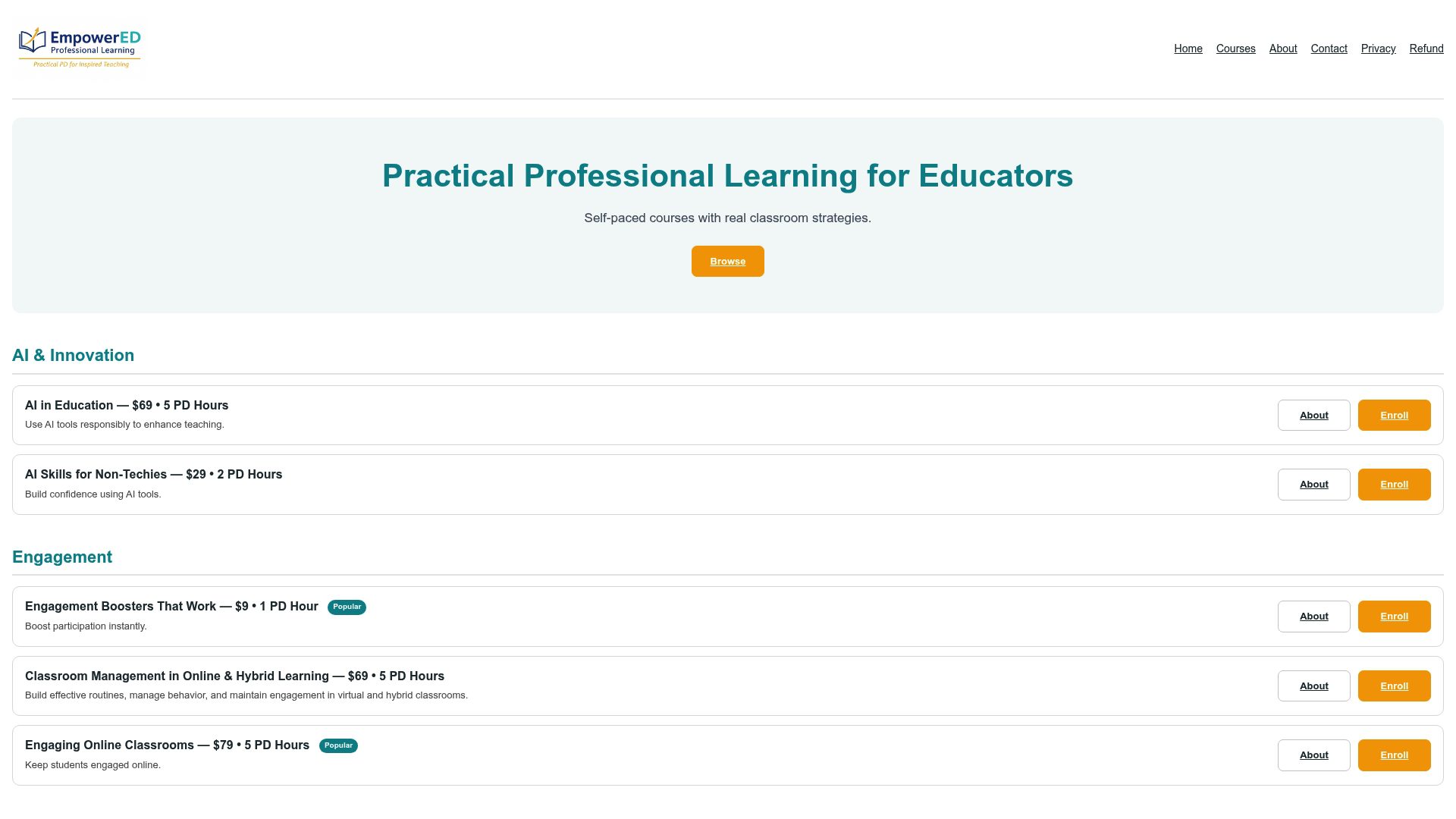
Enrollment options:
- Individual course purchase — buy a single course, complete it at your own pace, and receive a PD certificate. No subscription required.
- District bulk licensing — schools and districts can license courses for entire teams, with district invoicing available. Contact Empowered Professional Learning directly to discuss a pilot for your building or department.
- Credit-bearing pathway — pair Empowered Professional Learning courses with a university-partner credit option if graduate credit is your goal; the applied projects built into each course translate directly to graduate-level work products.
Most courses can be completed in a single weekend or spread across two to three weeks of short daily sessions. To see the full course catalog and district licensing options, visit empoweredpl.com or review the professional learning packages page for team and district pricing.
Authoritative sources and further reading
These sources help you verify credit rules, evaluate provider quality, and navigate state approval processes.
- Office of Educational Technology — U.S. Department of Education — Federal guidance on what constitutes effective online professional learning, including facilitation standards and applied practice requirements. Start here when building a district PD evaluation rubric.
- Quality Matters: Ten things to look for when purchasing online/blended courses — A practical vendor evaluation checklist covering alignment, accessibility (WCAG), published syllabi, and learner support. Useful for instructional coaches and district curriculum directors.
- Act 48 Approved Provider Guidelines — Commonwealth of Pennsylvania — Explains the provider application process, the PERMS upload requirement, and the 30-day completion window. Pennsylvania teachers should confirm their provider’s AUN and approval status before enrolling.
- Continuing Professional Development (CPD) Manual — Maryland State Department of Education — Defines creditable PD activities, contact-hour minimums, and the provider approval process for Maryland educators. Other providers must apply to MSDE before issuing CPD credit.
- Professional Development: General Accepted Activities — Colorado Department of Education — Colorado does not pre-approve CEUs but lists accepted renewal activities and documentation requirements. Useful for understanding how states vary in their approach to PD credit.
- Strengthening evidence use in professional learning — EdSignals — Industry analysis on how district leaders evaluate external PD quality, with practical guidance on the signals that matter most (ratings, facilitator CVs, documented outcomes).
- Massachusetts DESE License Renewal Guidelines — Explains Professional Development Points (PDPs) and the distinction between degree-eligible and non-degree-eligible graduate credit as of June 2026. Relevant for Massachusetts educators evaluating credit-bearing PD options.
- How to choose summer PD that’s actually worth your time — Shake Up Learning — Practitioner advice on matching PD format to teacher energy and workload; a useful read before committing to a cohort-based course during the school year.
- EmpowerED Professional Learning — Course Catalog and District Licensing — Full catalog of self-paced, instructor-guided K-12 PD courses covering AI in education, hybrid learning, data literacy, SEL, and UDL, with individual and district pricing options.
- EmpowerED: Online Professional Development for Teachers — Explains EmpowerED’s course types, delivery modes, and classroom-ready focus; useful for comparing the model against other web teaching platforms.
- Educator Effectiveness Metrics Explained for K-12 Leaders — Guidance for district leaders on measuring PD impact and what evidence to request from external vendors before approving a course for district-wide use.