Restorative circles in schools are structured group conversations, guided by a talking piece and shared agreements, that build classroom community, teach social-emotional skills, and repair harm after conflict. They work best when used at every level: daily community-building in Tier I, targeted responsive circles in Tier II, and formal conferences for serious harm in Tier III. Any teacher, coach, or administrator looking to strengthen relationships and reduce exclusionary discipline can start with them.
TL;DR:
- Effective restorative circles require all five core elements—physical setup, talking piece, group agreements, guidelines, and a consistent rhythm—to ensure broad participation.
- Facilitators must undergo ongoing, practical coaching with feedback to handle silence, disclosures, and participation challenges confidently, especially during initial attempts.
- Schoolwide implementation depends on strong leadership commitment, staff buy-in, continuous professional development, and designated coordinators tracking fidelity and outcomes.
- Regular community and responsive circles, integrated into daily routines, are more effective than sporadic sessions, with fidelity over years being crucial for significant reductions in suspension rates.
- Circle prompts tailored to students’ age and context, combined with trauma-informed phrasing and digital adaptations, significantly increase student engagement and safety.
Table of Contents
- What Makes a Restorative Circle Actually Work?
- Which Type of Circle Fits the Moment?
- How Do You Plan and Run Your First Classroom Circle?
- What Does Schoolwide Implementation Actually Require?
- What Are Some Ready-to-Use Circle Prompts?
- Why Training Determines Whether Circles Actually Stick
- Our Take on What Actually Moves the Needle
- Ready to Build Facilitation Skills That Actually Transfer to Your Classroom?
- Sources
What Makes a Restorative Circle Actually Work?
A circle is not just chairs arranged in a ring. Five elements separate a real restorative circle from an improvised discussion: the physical circle itself, a talking piece, shared guidelines, group agreements, and a predictable rhythm that repeats session after session. Skip any one of these and participation tends to skew toward the same three confident voices, which defeats the purpose. Circles are the most frequently used restorative practice in schools, and the five core elements show up consistently across effective programs.
The process itself follows four repeatable steps:
- Greeting and focusing. A brief welcome and a moment to settle attention, often with a short breathing cue or quote.
- Feelings check-in. Each student answers a quick prompt as the talking piece moves around the circle.
- Activity or discussion prompt. The heart of the session: a question, story, or task tied to the day’s purpose.
- Closing. A brief ritual or reflection that signals the circle is complete.
A ten-minute morning circle might spend two minutes on greeting, three on check-in, four on the prompt, and one on closing. The facilitator’s job is less about talking and more about equity of voice, nonjudgmental listening, and gentle timekeeping.
Pro Tip: Rehearse talking-piece etiquette before you need it. Teach a silent signal, like a raised finger or a hand on the heart, so students can show agreement or pass without interrupting the speaker. This one habit prevents most of the chaos that turns teachers off circles after a rough first try.

Which Type of Circle Fits the Moment?
Not every situation calls for the same circle. Choosing the right type matters as much as running it well.
- Community-building circles happen on a regular schedule, often daily or weekly, and function as proactive Tier I support that teaches SEL skills before problems surface.
- Responsive circles or restorative chats are short, informal conversations for emerging issues, like a small disagreement at recess that hasn’t escalated yet.
- Harm circles or restorative conferences are planned, multi-stakeholder sessions for serious incidents, bringing together the affected students, families, and sometimes administrators.
Escalation usually follows a pattern: a two-minute hallway chat resolves most friction. If tension persists into the next class period, a short responsive circle with the involved students works better. When harm is serious enough to involve families or safety concerns, a full restorative conference with trained facilitators is the right call. Responsive circles work best when teachers receive real training and coaching; without it, the practice gets inconsistent fast.
How Do You Plan and Run Your First Classroom Circle?
Running a circle for the first time feels less intimidating with a short checklist in hand.
Before the circle:
- Clear enough space for a full circle, including wheelchair access and room for any assistive devices.
- Choose a talking piece that’s meaningful or neutral, never something distracting.
- Get informal consent by explaining the purpose in trauma-informed language: “We’re going to talk about what happened, and you get to choose how much you share.”
- Line up a co-facilitator or paraprofessional support for students who need it.
Two scripts worth memorizing:
- Opening: “We’re here to check in with each other. When the piece comes to you, share as much or as little as you’re comfortable with. If you’d rather pass, just say ‘pass.’”
- Closing: “Thank you for being honest with the group today. Let’s carry that respect with us for the rest of the day.”
Difficult moments come up. Silence after a prompt is normal, give it five full seconds before moving on. A disclosure of harm or unsafe behavior means pausing the circle and following your school’s reporting protocol immediately. Non-participation is fine; forcing a student to speak undoes trust fast. For elementary grades, keep circles to 10-15 minutes; middle and high school circles can run 20-30 minutes. Weekly community circles paired with responsive circles as needed produce more consistent gains than sporadic use. Trauma-informed phrasing throughout the process, drawn from resources like trauma-informed teaching practices, makes a measurable difference in how safe students feel volunteering information.
What Does Schoolwide Implementation Actually Require?
A single teacher running great circles in one classroom is a good start. A school that sustains the practice for five years needs infrastructure. Implementation research consistently points to four essential strategies: a principal who visibly commits to the practice, staff buy-in built through modeling rather than mandate, continuous coaching rather than one-off training, and a dedicated coordinator with actual budget.
- Principal vision: public statements, protected circle time on the master schedule, and consistent follow-through when circles conflict with testing schedules.
- Staff buy-in: early adopters model circles for skeptical colleagues before any schoolwide rollout.
- Continuous PD: an initial two-day training followed by ongoing coaching, not a single workshop.
- Coordinator and funding: someone whose job description includes tracking fidelity and troubleshooting.
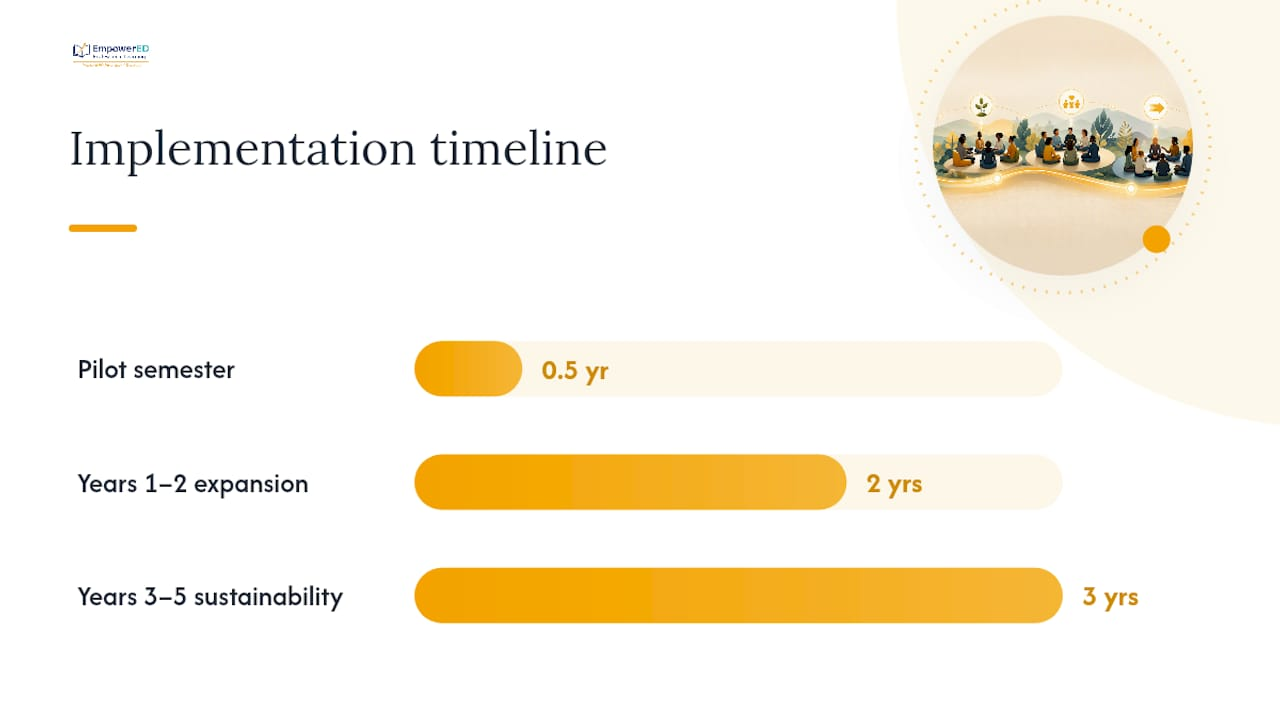
A realistic first-year roadmap looks like a pilot semester with two or three willing classrooms, expansion across a full grade level or department in years one and two, and schoolwide sustainability by years three through five with regular checkpoints. The Circle Forward model built around this exact tiered structure, pairing a restorative leadership team with coach-supported training that uses a Model-Mentor-Transfer approach: coaches model a circle, mentor a teacher through their first attempt, then transfer full ownership.
For metrics, keep it simple. Track attendance, suspension and discipline referral rates, a handful of climate survey items, and how many classrooms are running circles weekly. Program evaluations across several districts tie sustained circle use to attendance gains and suspension reductions, but only when the model runs with fidelity over multiple years, not as a one-semester experiment. A lightweight fidelity check, minutes run, percentage of students who spoke, and one follow-up action per circle, gives coordinators real data without burying teachers in paperwork.
What Are Some Ready-to-Use Circle Prompts?
Prompts are where circles either come alive or fall flat. Age-appropriate, specific language beats generic questions every time.
- Elementary check-in: “What’s one word for how you’re feeling today, and why?”
- Middle school check-in: “What’s something that took effort this week?”
- High school check-in: “What’s a moment this week you felt proud of, even a small one?”
- Community-building activity: A values circle where each student shares one value that matters to them and why, timed to roughly 15 minutes for a class of 25.
- Milling to music: Students move silently to music, then answer a prompt with whoever they’re standing near when it stops, good for mixing up social groups.
- Repair-focused sequence: “What happened? What were you thinking at the time? Who has been affected, and how? What needs to happen to make things right?”
For hybrid or remote classrooms, a shared digital “talking piece” indicator, like passing control of the microphone, keeps the structure intact. Closed captioning and extended response time support students with processing differences. Pairing circle prompts with a short read-aloud, an approach explored by partner literacy programs, gives younger students a shared reference point before they’re asked to speak personally.
Why Training Determines Whether Circles Actually Stick
Circles fail less often because of a bad prompt and more often because facilitators never got real coaching. Watching a video or reading a handout doesn’t build the confidence needed to hold silence, redirect a disclosure, or manage a circle that goes sideways. Structured coaching with feedback loops and fidelity monitoring is what separates schools where circles fade by spring from schools where they’re still running five years later.
Empowered Professional Learning built its professional development for teachers around exactly this gap: practical, classroom-ready training rather than abstract theory. Courses covering trauma-informed routines and data-informed coaching feed directly into the four essential strategies implementation leaders need. A single teacher looking to sharpen facilitation skills might start with one course; a district scaling circles across a building is better served pairing that course with ongoing coaching support, since data-informed PD helps coordinators track exactly the fidelity metrics that predict long-term success. Leaders ready to build capacity should treat PD as infrastructure, not an afterthought.
Our Take on What Actually Moves the Needle
The conventional advice on restorative circles spends too much time on the softer language, community, voice, belonging, and not enough on the mechanics that make or break a first attempt. Teachers don’t fail at circles because they lack empathy. They fail because nobody taught them how to handle eight seconds of silence without panicking, or what to do when a student discloses something serious mid-circle.
The evidence backs this up more than most conventional wisdom admits: circles work best as a sustained, coached practice, not a one-time PD checkbox. Schools that treat training as ongoing coaching, not a single workshop, are the ones still running circles years later. If you’re prioritizing anything first, prioritize facilitator confidence over prompt creativity. A mediocre prompt run by a well-trained teacher beats a brilliant prompt run by someone improvising through their first disclosure. Build the skill, and the rest of the practice follows.
— Brian Koster, Ed.D.
Ready to Build Facilitation Skills That Actually Transfer to Your Classroom?
Reading about circle structure gets you halfway there. Rehearsing the hard parts, silence, disclosures, uneven participation, is what actually builds confidence before you’re standing in front of 25 students holding a talking piece. Empowered Professional Learning’s Engagement Boosters That Work course gives teachers, coaches, and administrators classroom-ready routines and rehearsal-ready scripts they can use the same week they finish the course.
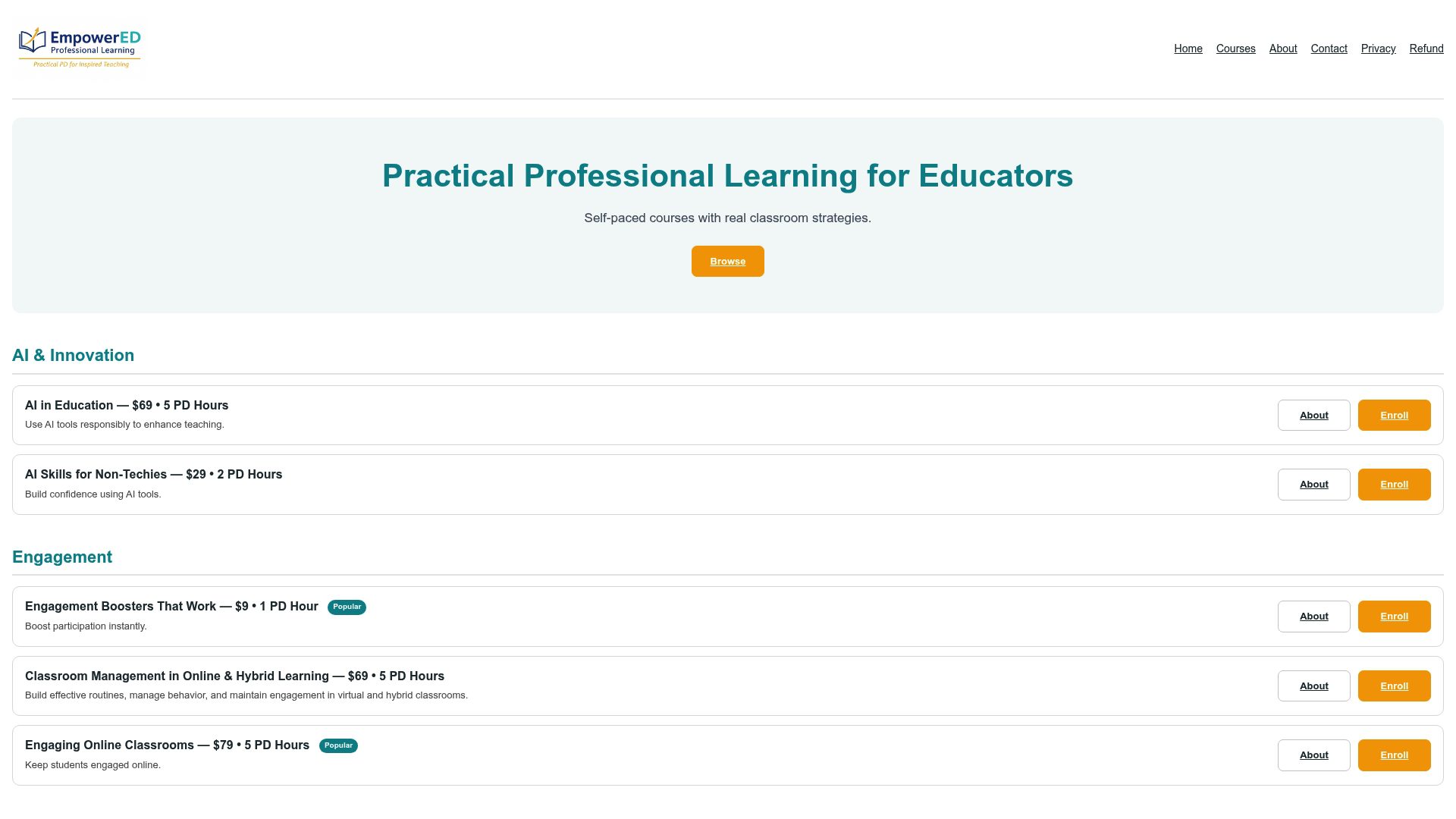
Participants gain practical facilitation techniques and inclusive engagement strategies adaptable across grade levels. Whether you’re running your first circle next Monday or coaching a whole grade level through their first semester, the course meets you where your practice actually is. Enroll now and have rehearsal-ready circle routines in hand before your next scheduled class meeting.
Sources
- Use of Restorative Justice and Restorative Practices at School: A Systematic Literature Review
- Community-Building Restorative Circles (IES REL brief)
- Restorative practices in reducing school violence: a systematic review of positive impacts on emotional wellbeing
- Circle Forward model and whole-school implementation (NIJ/CRJ report)