Ethical AI in education means using AI tools only when they support clear learning goals under meaningful human oversight, transparent data governance, and ongoing equity checks. That standard is not abstract. Right now, it requires three concrete moves: keep a teacher in the loop on any decision that affects a grade or a student record, verify how student data flows through every tool before adoption, and audit outputs for bias rather than assuming vendors already did. The rest of this guide translates those priorities into classroom policy, curriculum, and staff training.
TL;DR:
- Schools must conduct thorough data flow, FERPA compliance, and bias audits before adopting any AI tool, with ongoing monitoring and transparency.
- Assignments should focus on skills AI cannot easily replicate, while requiring students to disclose AI use and participate in process-based evaluations.
- Professional development is essential for staff to understand AI ethics, ask informed questions, and redesign assessments to prevent misuse.
- Continuous, recurring audits and stakeholder involvement are necessary to manage bias, surveillance, and workload risks effectively.
- Existing guidelines provide solid foundations, but practical training helps teachers implement principles consistently in real classroom situations.
Table of Contents
- What Are the Core Ethical Principles for AI in Education?
- How Should Classrooms Handle AI Use and Assessment?
- What Should Schools Check Before Adopting an AI Tool?
- How Do You Teach AI Ethics and Build Student AI Literacy?
- What Are the Biggest Risks of AI in Education, and How Do You Manage Them?
- How Does EmpowerED Professional Learning Support Ethical AI Adoption?
- What’s the Bottom Line for Schools Adopting AI Ethically?
- Why Most AI Ethics Guidance Fails in the Classroom
- Ready to Build Ethical AI Practices Into Your Classroom?
- Sources
What Are the Core Ethical Principles for AI in Education?
Most AI ethics frameworks were written for general use, not for classrooms full of minors with legally protected data. Translating them for education means adding a few principles that generic tech ethics documents skip entirely.
Research analyzing K-12 policy documents identifies a core set that extends beyond the usual transparency-fairness-privacy triad. A content analysis published in ScienceDirect found that education-specific frameworks consistently add pedagogical appropriateness, children’s rights, AI literacy, and teacher well-being to the standard list of Transparency, Justice, Non-maleficence, Responsibility, Privacy, Beneficence, and Freedom and Autonomy. Skipping those additions is how a district ends up with a policy written for enterprise software, not a fifth-grade classroom.
Here is what each principle actually requires when you’re the one making the purchasing or classroom decision:
- Transparency: Students and families know when AI is involved in instruction, grading, or communication, and can get a plain-language explanation of what the tool does.
- Fairness and non-maleficence: The tool’s outputs are checked for disparate impact across student groups before and after adoption, not just at launch.
- Human oversight: No AI system makes a final decision about a grade, discipline action, or special education placement without a qualified educator reviewing it.
- Pedagogical appropriateness: The tool matches how students actually learn a skill, not just what technology happens to be available.
- Children’s rights: Data practices and content exposure respect that students are minors, with protections that go beyond standard consumer terms of service.
- AI literacy: Students and staff understand, at an age-appropriate level, how these systems generate output and where they fail.
- Teacher well-being: Adoption decisions weigh workload impact on educators, not only efficiency gains for administrators.
The U.S. Department of Education’s AI report reinforces several of these directly, calling for human-in-the-loop requirements as a baseline expectation, not an optional safeguard. The report also pushes for continuous evaluation of AI systems for equity impact and stronger alignment with federal privacy law, which means FERPA compliance can’t be treated as a one-time checkbox during procurement.
The Blueprint for an AI Bill of Rights adds a useful lens here too, even though it wasn’t written for schools specifically. Its emphasis on notice, explanation, and recourse maps almost directly onto what a parent or student should be able to expect: know when AI is used, understand why it produced a given result, and have a real path to challenge it. UNESCO’s ethics guidance echoes the same emphasis on public understanding, which is a helpful reminder that transparency isn’t a legal formality. It’s a teaching moment in itself.
How Should Classrooms Handle AI Use and Assessment?
Policy documents rarely tell you how to write an assignment. That gap is where most of the real friction lives, because a well-written AI policy means nothing if the assignment itself still rewards a student for pasting in a chatbot’s answer.
Start by redesigning the assignment around a learning goal AI can’t complete on its own. If the goal is “explain the causes of the French Revolution,” a student can outsource the entire task to a language model. If the goal is “defend a specific historical claim using two primary sources you found and evaluated,” AI becomes a research aid rather than a replacement for the thinking.
A few protocols make this workable across a whole department, not just one classroom:
- Issue a written notice to students and families describing which tools are permitted, for what purpose, and how usage will be checked. Keep it short enough that families actually read it.
- Set clear citation expectations. Treat AI assistance like any other resource: students disclose what tool they used and for what part of the work, the same way they’d cite a source.
- Design at least one checkpoint into multi-step assignments — an outline, a draft, a source list — so a teacher sees the student’s thinking develop, not just a finished product that could have been generated in seconds.
- Grade the process alongside the product. A rubric that scores reasoning, sourcing, and revision catches authentic learning even when the final draft looks polished.
- Reserve high-stakes, one-shot writing prompts for in-class, unassisted conditions when AI-free evaluation is genuinely necessary.
Pro Tip: Ask students to submit a short “process note” with major assignments explaining what they tried, what didn’t work, and where they used outside help, including AI. It takes two minutes to write and makes authentic effort visible in a way a finished essay never does.
For grading AI-assisted work, resist the urge to treat any AI involvement as automatic disqualification. The PMC review of ethical challenges in K-12 settings identifies pedagogical misuse, not AI use itself, as the central concern. A student who used AI to check grammar on a well-reasoned essay is in a different category than one who submitted an AI-generated argument they can’t explain. Ask the student to walk through their reasoning verbally if the disclosure raises questions. That five-minute conversation tells you more than any detection tool. EmpowerED’s practical guide to AI in K-12 classrooms walks through sample policy language you can adapt rather than write from scratch.
What Should Schools Check Before Adopting an AI Tool?
Procurement is where good intentions meet real constraints, and it’s where most ethical failures actually originate. A tool that looks fine in a sales demo can still mishandle student data, produce biased outputs, or make decisions no teacher signed off on.
Build a checklist before you sign anything, and use it every time, not just for the first big purchase:
- Data collection and retention: What student information does the tool collect, where is it stored, how long is it kept, and can a family request deletion?
- FERPA alignment: Does the vendor contract explicitly address FERPA obligations, including what counts as a “school official” under the law for data-sharing purposes?
- Vendor disclosure of model purpose and training data: Can the vendor explain, in plain language, what the model was built to do and what data trained it?
- Human-in-the-loop requirement: Is there a guaranteed step where a qualified educator reviews any output tied to grades, placement, or discipline?
- Accessibility and civil rights compliance: Has the tool been evaluated against Section 504 and ADA requirements for students with disabilities?
- Change management: Does the vendor notify you when the underlying model or its training data changes?
The University of Illinois’s guidance on AI transparency lays out the exact questions to bring to a vendor meeting: who built the model, what data trained it, how often performance gets audited, and what recourse exists when an output is wrong or biased. Don’t accept a vague answer to any of these. If a vendor can’t explain their own model in terms a school board could understand, that’s information too.
Institutional review isn’t just a compliance exercise, either. A standing group, whether it’s a formal review board or just a data governance lead paired with a curriculum director, should sign off on new tools and revisit that approval periodically. The Johns Hopkins guidance on ethical AI implementation is direct on this point: monitoring or surveillance tools should only be adopted after being understood and agreed to by the people affected, including families and educators, not rolled out unilaterally by an IT department. That agreement step is the difference between a tool the community trusts and one that generates complaints by October.
How Do You Teach AI Ethics and Build Student AI Literacy?
You don’t need a computer science background to teach this well. What you need is a structured way to get students thinking critically about systems they already use daily, whether that’s a homework helper app or the recommendation feed on their phone.
The TEACH-RAI framework argues that responsible AI principles and AI literacy skills should be taught together, not as separate units. Students who only learn “AI can be biased” without ever seeing how bias shows up in a real output tend to forget the lesson by the next unit. Students who trace a specific biased result back to its likely cause remember it.
Three lesson structures work across grade levels with minor adjustments:
- Spot-the-bias exercises. Give students a set of AI-generated outputs, some flawed, some solid, and have them identify what went wrong and why. This works from upper elementary through high school with adjustable complexity.
- Source-tracing projects. Have students ask an AI tool a factual question, then verify the answer against primary sources. This builds both AI literacy and traditional research skills at once.
- Model interrogation discussions. For older students, walk through a real case where an algorithm produced a biased or wrong result (hiring, lending, or content moderation examples work well) and discuss what oversight could have caught it earlier.
Age-appropriate scaffolding matters here. Elementary students can grasp “computers learn from examples, and bad examples make bad guesses” through simple sorting games. Middle schoolers can handle direct discussion of how recommendation algorithms shape what they see online. High schoolers are ready for genuine case studies involving real-world algorithmic harm, paired with a discussion of what recourse should look like.
Pro Tip: Run a “spot the AI” exercise using two versions of the same short essay, one AI-generated, one student-written, and ask students to identify tells and justify their reasoning. It builds critical evaluation skills faster than any lecture on AI limitations.
Staff need parallel training, not just students, to build industry relevance in education that aligns AI ethics with practical curricular goals. The priorities that matter most are demand-side evaluation skills (knowing what to ask before adopting a tool), discussion facilitation for classroom ethics conversations, basic data literacy, and updated assessment strategies for an AI-saturated environment. A systematic literature review on AI ethics education found a persistent gap between high-level ethics guidelines and what teachers can actually implement without dedicated professional development. Closing that gap is the whole point of structured PD, not another binder of policy language nobody opens. EmpowerED’s course on evaluating AI-generated classroom content builds directly on this spot-the-bias approach with ready-made activities.
What Are the Biggest Risks of AI in Education, and How Do You Manage Them?
Four risks show up again and again in both research and classroom practice: bias, surveillance, academic integrity, and teacher workload. Each has a specific, testable mitigation, not just a general caution.
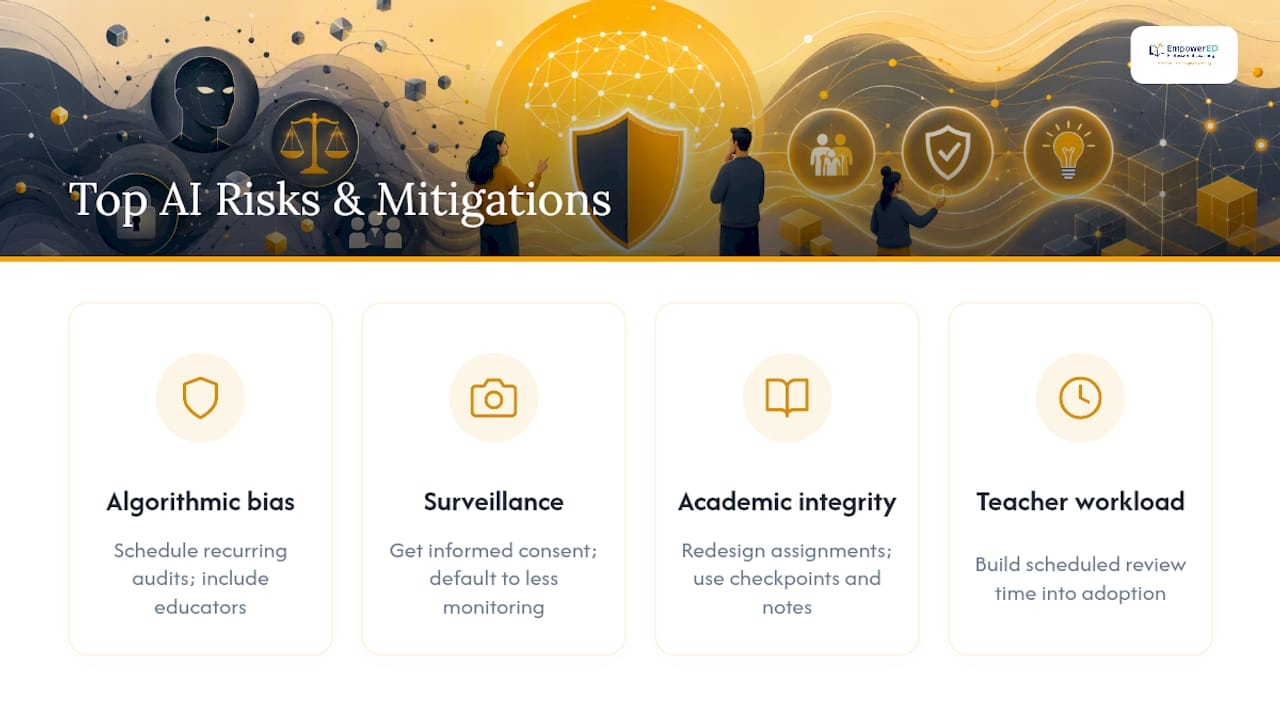
Algorithmic bias tends to cluster around demographic categories, especially for students of color and students with disabilities. The NEA’s analysis of algorithmic bias warns that unchecked bias can widen existing disparities rather than close them, and it specifically calls for ongoing audits instead of a single pre-launch check. Models drift as they’re updated, so a tool that tested clean in August can behave differently by January. Schedule audits on a recurring calendar and include educators in reviewing the results, not just a vendor’s self-reported metrics.
Surveillance and monitoring tools deserve real skepticism. Automated monitoring of student writing, browsing, or communication should be avoided unless families and staff clearly understand what’s being tracked and agree to it beforehand, per the same Johns Hopkins guidance cited above. When in doubt, the safer default is less monitoring, not more.
Academic integrity risks are real but often overstated in ways that lead to overly punitive detection tools with high false-positive rates. Assignment redesign, checkpoint drafts, and process notes catch more authentic problems than any AI-detection score, and they don’t falsely accuse students who write clean, well-organized prose.
Teacher workload and well-being is the risk that gets the least attention in policy documents, yet it shapes whether any of this actually works. If AI tools quietly take over grading judgment or lesson planning decisions because a teacher is stretched too thin to review them carefully, oversight becomes symbolic rather than real. Build review time into the schedule when a tool is adopted, not as an afterthought after problems surface.
How Does EmpowerED Professional Learning Support Ethical AI Adoption?
Every principle and protocol above requires one thing to actually stick: staff who know how to apply it under real classroom conditions, not just in a policy memo. That’s the gap Empowered Professional Learning’s courses are built to close.
The AI in Education course, developed by Brian Koster, Ed.D., walks educators from foundational AI concepts through the ethical integration questions covered in this guide: human oversight, data governance, bias auditing, and classroom policy design. It’s instructor-guided rather than a self-paced video library you forget about after week one, and it’s built specifically for K-12 application, not general corporate AI training repurposed for schools.
The course maps directly onto the staff PD priorities this guide covers:
- Facilitation skills for leading classroom discussions on AI ethics without needing a technical background.
- Data literacy basics so teachers can ask informed questions during tool procurement.
- Assessment redesign strategies for building AI-resistant, learning-focused assignments.
- Practical policy templates educators can adapt for their own classrooms rather than starting from a blank page.
Educators completing the course receive a PD certificate and personalized feedback, which matters for districts tracking professional growth hours. For schools considering a broader rollout, Empowered Professional Learning offers bulk licensing for staff teams, making it realistic to build shared AI literacy across a whole department or building rather than leaving it to individual teachers to figure out on their own. Start with a small pilot group, gather feedback, then expand once the approach fits your school’s specific needs.
What’s the Bottom Line for Schools Adopting AI Ethically?
Three actions matter more than any others this semester. First, audit your current AI tools against a real policy checklist, not a vendor’s marketing page, checking data flows, FERPA alignment, and whether a human reviews every high-stakes output. Second, pilot any new tool with a small group and built-in human oversight before a full rollout, treating the pilot as a genuine evaluation rather than a formality on the way to approval. Third, invest in staff professional development specifically on AI ethics and literacy, because policy documents alone don’t change classroom practice.
Student well-being should stay the primary metric throughout, not adoption speed or cost savings. A tool that saves ten minutes of grading time isn’t worth it if it quietly removes a teacher’s judgment from a decision that affects a student’s record.
None of this requires waiting for perfect national standards to settle. The frameworks already available from the Department of Education, the Blueprint for an AI Bill of Rights, and NEA’s guidance on bias give schools enough to act on now. What’s missing in most buildings isn’t guidance. It’s the staff capacity to apply it consistently, which is exactly what structured PD through a resource like EmpowerED’s AI for Education guide is designed to build.
Why Most AI Ethics Guidance Fails in the Classroom
The national frameworks are not the problem. ED.gov’s report, the Blueprint for an AI Bill of Rights, and NEA’s bias warnings are sound, well-reasoned documents. The problem is that almost none of them tell a sixth-grade teacher what to actually do on Tuesday morning when a student turns in an essay that reads suspiciously polished.
That gap between principle and practice is where most school AI policies quietly fail. A district adopts a values statement about “responsible AI use,” distributes it once, and assumes the job is done. Meanwhile, teachers are left improvising assignment redesigns and disclosure conversations with no shared language or template, which means practice varies wildly from one classroom to the next in the same building.
What actually works is treating ethics and literacy as one connected skill, not two separate units, exactly as the TEACH-RAI research suggests. A teacher who understands why a model produces biased output is far better equipped to write a fair classroom policy than one who only memorized a list of principles. If schools want ethical AI use to be more than a slide in an orientation deck, they need to fund the professional development that builds that connected understanding, not just publish another policy PDF.
— Brian Koster, Ed.D.
Ready to Build Ethical AI Practices Into Your Classroom?
Reading about ethical AI principles is useful. Actually applying them, under real time pressure, with real students and real vendor contracts, is a different skill entirely. That’s the gap Empowered Professional Learning’s courses close, with instructor-guided training built specifically for the classroom decisions covered throughout this guide, not generic corporate AI content repackaged for schools.
The AI in Education course walks you through exactly what’s outlined here: setting up human oversight, evaluating vendor data practices, building bias-aware assignment design, and leading student discussions on AI literacy with confidence. It’s self-paced but instructor-guided, so you get personalized feedback rather than a video series you forget halfway through, and it ends with a PD certificate you can log for your district’s professional growth requirements. If you’re leading a team, bulk licensing makes it straightforward to build shared understanding across your whole department rather than one teacher at a time. Enroll now, or start with a small pilot group in your building and expand once you see how it fits your school’s needs.
Sources
- Artificial Intelligence and the Future of Teaching and Learning — U.S. Department of Education (AI report)
- Artificial intelligence in education: Addressing ethical challenges in K-12 settings — PMC
- Bridging responsible AI and AI literacy — TEACH-RAI framework
- Effective and ethical AI implementation: what educators need to know — Johns Hopkins Education