The fastest way to start a stalled task is to shrink the first action to something almost too small to refuse, write the plan down somewhere visible, and borrow focus from another person through a timer or a co-worker. This combination, sometimes called micro-step plus externalization plus co-regulation, is backed by research on executive function and works for students, adults with ADHD, and entire classrooms. In practice it can look as simple as opening a document and typing one sentence while someone else works quietly nearby.
TL;DR:
- Micro-steps and external cues, like visible checklists or timers, are highly effective for reducing activation effort and starting stalled tasks.
- Teachers can establish consistent routines and visual prompts to lower cognitive load and improve student engagement with minimal training.
- Prompting delivers immediate short-term gains but risks dependency unless combined with teaching self-management skills for lasting independence.
- Building automatic launch routines with cues, pre-staging materials, and small rewards helps sustain task initiation over time.
- Matching strategies to environment, task type, and individual preference, plus gradual skill-building, ensures more durable improvements than quick fixes alone.
Table of Contents
- What Are the Best Task Initiation Strategies to Try Right Now?
- How Can Teachers Help Students Start Tasks in the Classroom?
- What Does the Research Say About Task Initiation Interventions?
- How Do You Build Launch Routines That Make Starting Automatic?
- How Do You Choose the Right Strategy and Know When to Get Help?
- Why Skill Building Beats Quick Fixes for Task Initiation
- Where Educators Can Learn These Strategies in Depth
- Sources
What Are the Best Task Initiation Strategies to Try Right Now?
Task initiation strategies work by lowering what researchers call activation cost, the mental effort required to move from thinking about a task to actually doing it. The clinical literature on executive function shows that this cost, not motivation or willpower, is usually the real barrier. Once you understand that, the fixes get much simpler.
Shrink the first step until it’s almost silly. Instead of “write the essay,” the task becomes “open the document and type the title.” Instead of “clean the room,” it’s “pick up five things.” The 2 minute rule and 5 minute rule work on this exact logic: commit to just two or five minutes, and let momentum take over from there. Most people who start rarely stop after two minutes. The hard part was never doing the task. It was starting it.

Externalize the plan so your brain doesn’t have to hold it. Working memory is fragile, especially under stress, so a task that only exists in your head is a task that’s easy to abandon. A visible checklist, a whiteboard menu of steps, or even three sticky notes on a monitor does the remembering for you. Pre-staging materials the night before, laying out the notebook, pen, and worksheet before bed, removes a whole layer of decisions the next morning when energy is lowest.

Borrow regulation from someone else through body doubling. Working alongside another person, even if they’re doing something unrelated, activates a kind of social accountability that solitary work doesn’t. This can happen in person at a library table or kitchen counter, or remotely through a video call where two people mute themselves and just work. Quiet co-work sessions of 25 to 50 minutes tend to outperform open-ended “let’s hang out and work” arrangements because the boundary itself creates urgency. Community reports on body doubling and remote co-regulation suggest high practical value even though controlled trials remain limited.
Manufacture urgency without manufacturing burnout. The Pomodoro Technique, 25 minutes of focused work followed by a 5 minute break, gives a stalled task an artificial deadline. Countdown timers work similarly: set 10 minutes on your phone and race the clock just to see the first paragraph written. Commitment contracts, telling a colleague or friend you’ll send a photo of your finished draft by 3 p.m., add social stakes to an otherwise private task. The key is rotating these tactics rather than leaning on one until it stops working, since novelty itself is part of what makes urgency effective.
Digital planning tools now build some of this externalization directly into software. Apps like Syncronos convert a syllabus or task list into a calendar automatically, removing the step where a task has to be translated into a plan before it can be started.
- Set a 2 minute timer and commit to only the first micro-step.
- Write the plan somewhere visible, not just in your head.
- Pair with a body double, in person or on video, for accountability.
- Rotate urgency tactics (Pomodoro, countdowns, contracts) to avoid burnout.
- Pre-stage materials the night before to remove morning decisions.
Pro Tip: Script the exact words of your first action out loud before you start. Saying “I am opening the document and typing my name” out loud, then doing it immediately, closes the gap between intention and action faster than just thinking about starting.
How Can Teachers Help Students Start Tasks in the Classroom?
Classroom task initiation strategies work best when they lower cognitive load for the whole room at once, rather than relying on one-on-one intervention every time a student freezes. A few structural moves handle most of the work.
- Build a consistent “start here” routine. The first two minutes of any independent work block should follow the same pattern every time: a visible prompt, a model sentence on the board, and silence to begin. Predictability itself reduces the decision fatigue that stalls task initiation, and classroom-tested task-initiation tactics consistently point to this kind of launch routine as the highest-leverage change a teacher can make.
- Use visual menus and micro-checklists scaled to the grade band. Younger students benefit from picture-based sequences (get materials, sit down, write name); older students do well with a three-item text checklist taped to the desk.
- Choose prompting, self-management, or structured breaks deliberately, not by habit. A randomized trial comparing these approaches in middle schoolers with ADHD found that prompting improved engagement but raised the risk of long-term dependency, while self-management taught skills that generalized beyond the classroom. Breaks were the most preferred by students but showed the weakest transfer.
- Borrow structure from HOPS and CHIEF. These manualized school interventions break assignments into steps with brief check-ins; teachers without a full program can still copy the core move, a two-minute planning check before independent work begins.
- Track one simple data point. Time-to-start, measured from when instructions end to when a pencil first moves, is easy to collect and gives a concrete signal of whether a tactic is working.
For deeper background on building these into daily practice, see how classroom routines improve learning outcomes for K to 12 students more broadly.
What Does the Research Say About Task Initiation Interventions?
The strongest evidence favors structured, manualized programs over ad hoc encouragement. HOPS and CHIEF, described in IES/WWC intervention documentation, run 11 to 16 sessions with a school mental health provider, break assignments into concrete steps, and loop in parents for monitoring. Trials tied to these programs showed measurable gains in organization and task initiation, not just short-term compliance.
A randomized classroom trial found that prompting boosted engagement in the moment but carried a real risk of dependency, while self-management training produced skills that held up over time even though students said they preferred breaks.
That distinction, immediate comfort versus durable skill, shows up across the literature. The mechanism research on executive function points to three levers that consistently move the needle: reducing activation cost through micro-steps, externalizing plans so working memory isn’t overloaded, and co-regulation that borrows another person’s structure temporarily. A separate review of ADHD executive function interventions found that combining approaches outperforms relying on any single tactic alone.
The practical takeaway for educators and clinicians: when a fast fix is needed, prompting works. When the goal is lasting independence, teaching self-management skills is worth the slower investment.
How Do You Build Launch Routines That Make Starting Automatic?
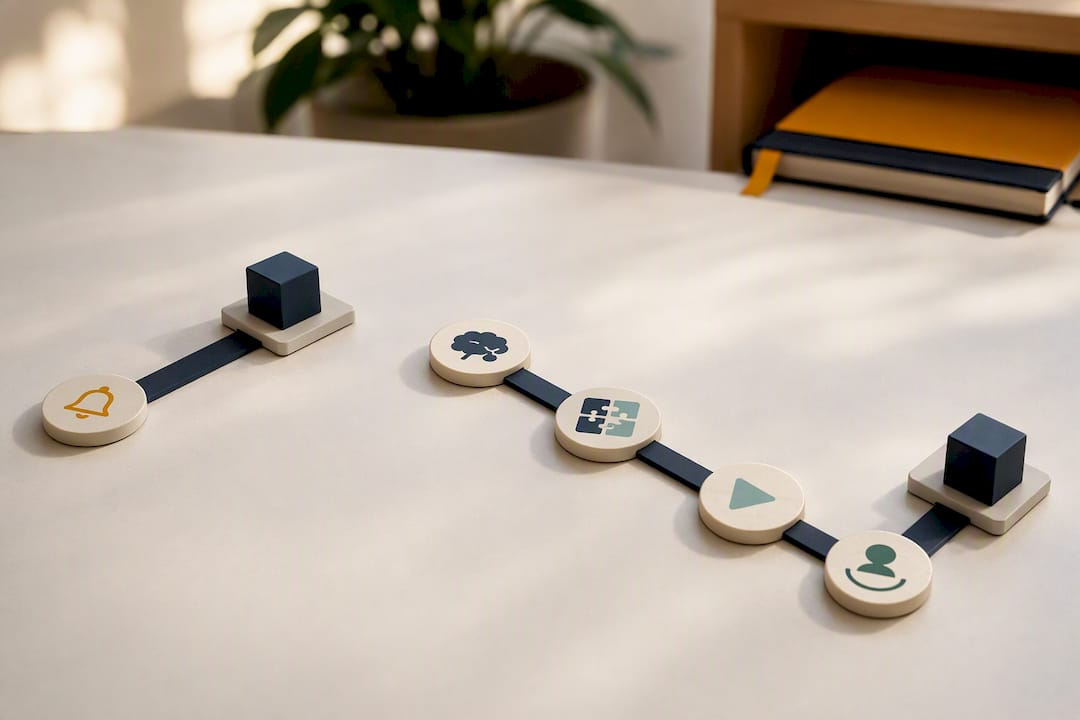
A reliable launch routine follows a simple pattern: cue, micro-action, quick reward. The cue might be sitting down at a desk or a bell ringing; the micro-action is the tiny first step; the reward can be as small as checking a box.
- Design the cue first. Pick something that already happens reliably, like walking into a classroom or opening a laptop, and attach the routine to it.
- Pre-stage every material the routine needs. A teacher laying out worksheets before the bell, or a student packing a bag the night before, removes decisions exactly when willpower is lowest.
- Stack a timer on top of the checklist. A visible countdown paired with a written first step gives both a deadline and a script, which works better than either alone.
- Watch for the three most common failure modes. Time blindness (underestimating how long a task will take), perfectionism (refusing to start until conditions feel “right”), and competing tasks (a phone notification winning the moment) each need a different fix. Time blindness responds to visible timers; perfectionism responds to lowering the bar for the first draft; competing tasks respond to physically removing the distraction before the routine begins.
Pro Tip: Keep the reward absurdly small and immediate, checking off one box, standing up for ten seconds, a sip of water. Big rewards saved for the end of a task do nothing to solve the starting problem.
More detail on building these into daily classroom life lives in this breakdown of classroom routine types.
How Do You Choose the Right Strategy and Know When to Get Help?
Match the tactic to the situation rather than picking a favorite and using it everywhere. A short decision checklist works better than intuition alone.
- Task type: open-ended creative work often needs externalization (a visible outline); repetitive tasks often just need urgency (a timer).
- Environment: noisy or distracting spaces call for body doubling or noise-canceling routines; quiet spaces may only need a checklist.
- Personal preference: some people respond better to social accountability, others to solitary structure. Test both.
- Time available: a 10 day trial of one tactic, tracking start latency and minutes on task, is enough to know if it’s working.
If a task-initiation problem persists across settings, shows up alongside other executive function struggles, or causes significant distress, that’s a signal to prioritize skill-building interventions over quick fixes and to loop in a school mental health provider or clinician for a fuller assessment. Understanding common barriers tied to neurodiverse learning helps distinguish a fixable routine problem from something that needs professional support.
Why Skill Building Beats Quick Fixes for Task Initiation
Most advice on starting tasks treats the problem as a motivation gap, something willpower or a better morning routine will fix. That framing gets the mechanism backwards. Task initiation is an executive function, and treating it as a character flaw is exactly why so many students and adults with ADHD internalize shame instead of building skills.
The uncomfortable truth in the research is that the fastest tactic, prompting, is often the weakest long-term investment. It feels like progress because engagement rises immediately, but the classroom trial comparing intervention types makes clear that without a fade plan toward independence, prompting can quietly train dependency instead of capability. Teachers who want durable change, not just a calmer Tuesday, need to teach self-management explicitly and step back deliberately, even though that path is slower and less immediately satisfying.
For educators, this means the goal isn’t finding the one perfect classroom trick. It’s building a repertoire, knowing when a two-minute rule is enough and when a student needs the fuller structure of a program like HOPS. That kind of judgment is exactly what professional development should be building.
— Brian Koster, Ed.D.
Where Educators Can Learn These Strategies in Depth
These tactics can be turned into ready-to-use classroom routines instead of leaving teachers to translate research into practice alone. Engagement Boosters That Work walks through launch routines and start-here entry points with templates for practical use. 
Social-Emotional Learning & Teacher Wellness covers the wellness side of sustaining these routines over a full school year. Universal Design for Learning (UDL) & Accessibility shows how to build task initiation supports directly into lesson design rather than adding them after the fact. AI in Education demonstrates how AI tools can externalize planning automatically, and Mathematical Thinking for Teachers applies these same scaffolds to math-specific problem-solving tasks.
Courses are self-paced with instructor feedback and include professional development certificates. Enrollment options include individual and team licensing.
Sources
For hands-on classroom tactics, see Edutopia’s task-initiation strategies. For student-facing guidance, Stanford’s Center for Teaching and Learning offers a clear starting framework. For the research base behind HOPS and CHIEF, review the IES/WWC intervention documentation and the Journal of Attention Disorders trial comparing classroom strategies directly.
- 8 classroom task-initiation strategies to help students get started
- Completing Homework by Improving Efficiency and Focus (CHIEF) / HOPS intervention description — IES WWC
- Comparison of four classroom-based strategies for middle school students with ADHD (Journal of Attention Disorders, 2022)
- Neuroscience/clinical review on executive function and initiation (PMC9953392)