Hands-on learning is education through direct action rather than passive listening. Students build a circuit instead of reading about electricity, or debate a mock trial instead of memorizing legal terms. It works because it engages both the body and the brain, but only when the doing is paired with reflection.
A National Bureau of Economic Research working paper found inquiry-based, active pedagogy raised math scores by 0.18 standard deviations and science scores by 0.14 standard deviations after one year, growing to roughly 0.39 and 0.23 standard deviations with sustained use. David Kolb’s experiential learning cycle explains why: experience alone doesn’t teach much until a learner reflects on it and connects it to a concept.
- Hands-on learning means students act, build, test, or perform, not just watch or read.
- It raises engagement and skill retention when tied to a clear learning outcome.
- Without structured reflection, the activity risks becoming busywork instead of instruction.
Key Takeaways
Hands-on learning raises engagement and measurable achievement, but only when the activity is paired with explicit reflection that connects the experience to the concept being taught.
| Point | Details |
|---|---|
| Definition matters | Hands-on learning means students act, build, or perform, not just observe passively. |
| Reflection is required | Pairing activity with structured reflection turns doing into conceptual understanding. |
| Evidence is real but bounded | Inquiry-based pedagogy raised math and science scores measurably, but gains fade without concept links. |
| Short beats long | Brief, well-structured sequences with pre and post activities outperform unstructured lab time. |
| Build the skill through PD | Empowered Professional Learning’s Engagement Boosters That Work and UDL courses help teams implement hands-on lessons consistently. |
Table of Contents
- What Is Hands-On Learning, According to Learning Theory?
- Is Hands-On Learning Effective? What the Research Shows
- Examples of Hands-On Learning Across Grades and Subjects
- How Do You Design a Hands-On Lesson That Actually Works?
- What Gets in the Way of Hands-On Learning, and How Do You Fix It?
- Why This Guidance Comes From Classroom Experience, Not Theory Alone
- What the Research Actually Tells Educators to Prioritize
- Turn This Research Into a Lesson Plan This Week
- Frequently Asked Questions
- Sources
What Is Hands-On Learning, According to Learning Theory?
John Dewey argued nearly a century ago that people learn best through direct experience tested against real consequences, a principle now called “learning by doing.” Kolb built on that idea with a four-stage cycle: concrete experience, reflective observation, abstract conceptualization, and active experimentation. A student doesn’t just complete a task. They do it, think about what happened, connect it to a bigger idea, then try a new version of it.
This is where the “hands-on versus minds-on” distinction matters. Hands-on refers to the physical or active component. Minds-on refers to the thinking that turns that activity into learning. A class can be extremely hands-on and still teach almost nothing if students never pause to ask why the experiment behaved a certain way or how it connects to the standard being taught.
Effective hands-on learning requires the teacher to act as a designer of experience: setting clear intent, sequencing complexity, scaffolding for novices, and building in time for reflection, according to a framework for enhancing student learning through hands-on and minds-on strategies.
Constructivism sits underneath all of this. Students construct understanding by connecting new information to what they already know, and the teacher’s job shifts from lecturer to designer.
- Dewey: learning happens through experience tested against consequences.
- Kolb: experience must move through reflection and conceptualization to stick.
- Constructivism: the teacher designs conditions for understanding, not just activity.
Is Hands-On Learning Effective? What the Research Shows
The short answer is yes, with real limits worth knowing before you redesign a unit. The NBER analysis of inquiry-based pedagogy remains one of the strongest data points available, showing gains that compound over time rather than fading after a single unit.
Effects are not uniform across every student or every activity. A rapid evidence assessment from University College London reviewing studies from 2013 through 2023 found experiential interventions for children ages 4 to 14 are highly varied, spanning project-based, inquiry-based, and maker approaches, with evidence quality shifting depending on design and age group. Maker-education projects tend to show the strongest motivation and self-efficacy gains among underrepresented students when the projects connect to community or identity, according to a study on integrating making into authentic science classes.
Inquiry-based, active pedagogy raised math and science test scores after one year, with effects growing after several years of sustained implementation.
The caveat matters as much as the headline number. Comparative studies published in the Journal of Research in Science Teaching show hands-on tasks sometimes produce narrow, procedural gains without deeper conceptual transfer, unless students explicitly link the activity back to the idea it’s meant to teach.
- Gains are strongest when activities are tied to explicit learning goals, not just novelty.
- Motivation and self-efficacy improvements are especially notable for lower-skill and underrepresented students.
- Weak designs with no pre or post discussion often show little to no advantage over traditional instruction.
Examples of Hands-On Learning Across Grades and Subjects
The right activity depends less on the subject and more on whether it gives students something concrete to act on and something specific to reflect on afterward.
- Elementary science: A short inquiry lab (20 to 30 minutes) using simple sensors or a planting project. Materials: seeds, cups, soil, a daily observation sheet. Scaffold: a prediction sentence written before planting and a comparison sentence written a week later.
- Middle and high school STEM: A predict-observe-explain cycle built around a guided lab, or a one-period engineering design sprint using recycled materials. Scaffold: students write a prediction, run the test, then explain any mismatch between the two.
- Wearable e-textile mini-project: A 45-minute build using conductive thread and an LED to teach basic circuits. Scaffold: a labeled diagram completed before wiring begins.
- Arts and ELA: Role-play debates, story-mapping with physical models, or performance-based projects where students stage a scene instead of writing a summary. Scaffold: a one-paragraph reflection connecting the performed choice to the text’s theme.
- Adult learners and professional development: Micro-teaching labs, practice-based simulations, or short fieldwork assignments. Scaffold: a structured debrief question completed immediately after the practice round.
Pro Tip: Keep the reflection prompt shorter than the activity itself. A single well-timed question, written right after the doing, does more for retention than a long worksheet completed the next day.
How Do You Design a Hands-On Lesson That Actually Works?
Start with the outcome, not the activity. Ask what students should be able to do differently by the end of the lesson, then build backward from that answer.

Before the activity, activate prior knowledge and model the task once so students know what success looks like. Set explicit success criteria out loud. During the activity, rotate through stations, drop in scaffolding questions, and run quick formative checks rather than waiting until the end to see who understood. After the activity, run a structured debrief protocol that forces students to connect what they observed to the concept being taught. A 2026 study on practical work duration found shorter, well-structured sequences with pre and post activities produced better content learning than long, unstructured lab time.
| Lesson Phase | What Happens | Teacher Focus |
|---|---|---|
| Before | Activate prior knowledge, model the task, set success criteria | Clarity of purpose |
| During | Station rotations, scaffolding prompts, formative checks | Active facilitation |
| After | Structured debrief, concept linking, performance-based assessment | Conceptual transfer |
- Group students in threes or fours to keep every voice active during station work.
- Use a timed micro-schedule (10 minutes per station) to prevent one group from stalling the whole room.
- Save the last five minutes for a written or verbal debrief, every time, without exception.
What Gets in the Way of Hands-On Learning, and How Do You Fix It?
Time and materials are the two most common blockers, but neither is as fixed as it feels on a Monday morning. Shorter, well-structured activity sequences with a clear pre and post component often outperform long, loosely planned lab time, per the 2026 practical work study, so trimming a two-day unit into a tighter 40-minute sequence can improve learning, not just save time.
- Swap expensive kits for low-cost materials, station rotations, or virtual simulations when budgets are tight.
- Set explicit safety expectations before any activity involving tools, chemicals, or shared equipment.
- Build in accessible entry points so every student, including those with physical or sensory needs, can participate meaningfully.
- Assess conceptual understanding directly, through a debrief question or short written explanation, not just whether the project got finished.
Pro Tip: If grading the products from hands-on work eats your planning time, tools like the ones covered in this guide to AI for automating handwritten grading can return that time to lesson design instead.
Why This Guidance Comes From Classroom Experience, Not Theory Alone
This article was written under the editorial direction of Brian Koster, Ed.D., whose background in classroom instruction and professional learning design shapes the practical framing throughout.
The research base above (NBER, UCL, peer-reviewed science education journals) tells you hands-on learning works. Turning that into a Tuesday lesson plan is a separate skill, and it’s exactly what Empowered Professional Learning’s courses target.
- Engagement Boosters That Work helps teachers structure hands-on activities that hold attention past the novelty phase.
- AI in Education shows how to use AI tools to personalize hands-on tasks without adding planning time.
- Universal Design for Learning (UDL) & Accessibility covers adapting hands-on activities so every learner has a real entry point.
- Social-Emotional Learning & Teacher Wellness addresses the fatigue that comes from managing active classrooms day after day.
Schools and districts can license these courses for full teams, which matters because hands-on learning succeeds fastest when it’s implemented consistently across a grade level, not by one teacher working alone.
What the Research Actually Tells Educators to Prioritize
The conventional advice on hands-on learning stops at “make it active.” That advice is incomplete, and the evidence above shows why. The NBER effect sizes didn’t come from activity alone. They came from inquiry-based instruction sustained over years, with structure behind it. Treating hands-on learning as a novelty day, disconnected from a debrief or a concept check, is the single biggest reason well-intentioned lessons produce excitement without retention.
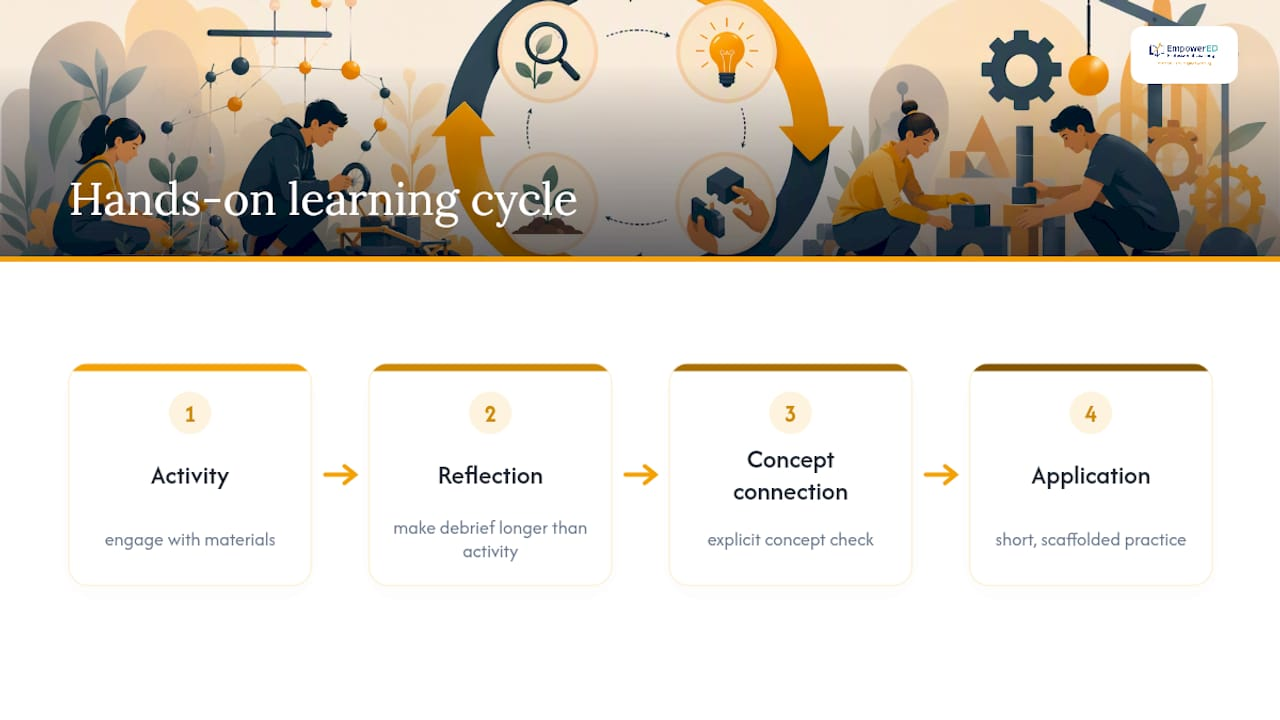
What gets underestimated is the reflection step. Teachers plan the activity for hours and the debrief for ninety seconds. Flip that ratio and the learning improves without adding a single new material or dollar of budget.
If you take one thing from this, prioritize the structure around the activity before you add more activities. A shorter, well-scaffolded lesson with a genuine debrief will outperform a flashy hands-on unit every time. Build that skill deliberately, through practice and inquiry-based lesson design, rather than assuming enthusiasm alone will carry the learning.
Turn This Research Into a Lesson Plan This Week
Reading about hands-on learning and running it well in a real classroom are two different skills, and most professional development stops at the theory. Empowered Professional Learning is built for the second part: self-paced, instructor-guided courses that give you classroom-ready strategies you can use the same week you take them.
If the design framework in this article resonated, Engagement Boosters That Work walks through exactly how to structure activities, stations, and debriefs so hands-on time produces real conceptual gains instead of just noise. Teachers juggling neurodiverse classrooms will find Universal Design for Learning (UDL) & Accessibility especially useful for adapting these activities so every student has a genuine entry point. Courses come with personalized feedback and a PD certificate, and schools or districts can license them for entire teams. Browse the current course catalog at Empowered Professional Learning and enroll in the course that matches what your classroom needs right now.
Frequently Asked Questions
What is hands-on learning in simple terms?
Hands-on learning is instruction where students physically act, build, or perform a task instead of only listening or reading, then reflect on what that experience taught them.
How does hands-on learning work in a real classroom?
It works through a cycle: students engage in an activity, reflect on what happened, connect that observation to a concept, then apply the idea in a new way, following the pattern Kolb’s experiential learning theory describes.
Is hands-on learning effective for all students?
It’s effective for most students, and research shows particularly strong motivation and self-efficacy gains for lower-skill and underrepresented students, though results vary depending on how well the activity is scaffolded.
What are some quick examples of hands-on learning activities?
Short inquiry labs, engineering design sprints, e-textile builds, role-play debates, and micro-teaching simulations for adult learners all count, provided each includes a brief reflection step.
Why choose hands-on learning over traditional lecture-based teaching?
Hands-on learning tends to raise engagement and produce measurable achievement gains over time, but it works best as a complement to direct instruction, not a full replacement for it.
Sources
- NBER working paper on inquiry-based pedagogy and student achievement
- Experiential Learning for Children Aged 4–14: Rapid Evidence Assessment (UCL)
- The Impact of Practical Work on Student Activity and Content Knowledge Learning (2026)
- Hands-On, Minds-On: Strategies for Teachers and Educational Leaders to Enhance Student Learning
Recommended
- Preparing Students for Career Success: Teaching Real-World Skills – EmpowerED: Professional Development for Educators
- Professional Learning for Educators: Enhance Your Impact – EmpowerED: Professional Development for Educators
- Active Learning Strategies for K–12 Teachers: Top 10 – EmpowerED: Professional Development for Educators