Creative expression is a core learning pathway. It strengthens cognition, executive function, language, and socio-emotional growth all at once, not as separate side effects but as one connected process. A longitudinal study of 9-year-olds found that creative expressiveness in writing predicted later English grades beyond what intelligence and motivation alone explained. Early-learning frameworks back this up structurally: many states name creative expression as its own developmental domain, worth tracking alongside literacy and math readiness.
What does that mean in a classroom? Three things stand out:
- Cognitive and executive function gains show up when children plan, revise, and sequence creative work.
- Language and literacy grow through storytelling, invented spelling, and vocabulary tied to expressive projects.
- Socio-emotional skills and motivation improve when students get low-stakes ways to represent ideas and feelings.
Key Takeaways
Creative expression drives measurable gains in executive function, language, and academic outcomes when it’s built into instruction as a sustained practice rather than an occasional project.
| Point | Details |
|---|---|
| Creative expression builds executive function | Structured arts activities exercise inhibition, working memory, and flexibility, per the Art of Learning trial. |
| Creative expression predicts literacy outcomes | Expressiveness in early writing predicted later English grades independent of intelligence. |
| Age-based indicators guide observation | Use frameworks like Domain 4: Creative Expression to track growth from symbolic play through abstract storytelling. |
| Structure and choice both matter | Design tasks with a clear constraint and an open method to target specific cognitive goals. |
| Empowered Professional Learning builds this into practice | Its UDL and SEL courses give teachers classroom-ready ways to embed creative expression across subjects. |
Table of Contents
- What Is the Role of Creative Expression in Learning?
- What Should Educators Look for at Each Age?
- How Can Teachers Build Creative Expression Into Any Subject?
- What Does the Research Actually Show?
- Why Cultural Diversity and Inclusivity Matter Here
- Why Treat Creative Expression as Core Pedagogy, Not an Add-On
- A Practical Next Step for Embedding Creative Expression
- Frequently Asked Questions
- Sources
What Is the Role of Creative Expression in Learning?
Creative expression works as a learning mechanism, not a reward for finishing “real” work first. When a child draws a story sequence, builds a structure from blocks, or improvises a rhythm, they’re engaged in multimodal meaning-making: translating an internal idea into an external form using a medium other than plain speech or text. That translation process exercises the same mental muscles teachers spend all year trying to strengthen through worksheets and drills.
Three specific mechanisms are doing the work. First, representational thinking: turning an abstract idea (a feeling, a plan, a number) into a symbol, a picture, or a gesture. Second, executive function practice: inhibition (waiting your turn in a group composition), working memory (holding a story structure in mind while illustrating it), and cognitive flexibility (switching between materials or roles mid task). Third, social rehearsal: negotiating a shared narrative or performance requires real-time communication and compromise.

A randomized controlled study of an arts-rich program called Art of Learning found that students showed greater improvement than control groups on executive function and behavioral regulation, based on teacher-reported measures. That’s a meaningful signal for anyone weighing whether arts time competes with “core” instruction or actually supports it.
These benefits map directly onto priorities every teacher already has. Vocabulary and sentence complexity grow when students narrate their own art or building projects. Problem-solving improves when a creative task has no single correct answer. Emotional regulation gets practice when a student processes a hard day through movement or color instead of words alone. Collaboration and communication sharpen during group composition or shared mural work. And engagement, the thing every lesson plan is fighting for, tends to rise sharply once students have some ownership over how they show what they know.
Pro Tip: Before assigning a creative task, decide which executive function you want it to exercise. A “wait for your turn to add to the story” activity trains inhibition; a “remember the pattern and repeat it” music activity trains working memory. Naming the target makes the activity easier to assess later.
What Should Educators Look for at Each Age?
Creative expression doesn’t look the same at 3 as it does at 10, and expecting one-size-fits-all indicators is where a lot of well-meaning observation falls apart. Age-based frameworks, including Illinois’s Domain 4: Creative Expression, give teachers language for what’s typical at each stage so scaffolding stays realistic.
Early childhood (ages 0 to 5). Watch for symbolic play (a block becomes a phone), vocal experimentation (invented songs, sound play), and mark-making that shifts from scribbles to intentional shapes. Scaffold it by narrating their play back to them and offering open materials like blocks, scarves, and washable paint rather than single-use crafts.
Lower elementary (ages 6 to 9). Look for narrative expansion (stories with a beginning, middle, and problem), invented spelling used confidently, and role play that includes negotiated rules. Try sentence-starter story chains or simple puppet retellings of a science concept.
Upper elementary (ages 9 to 11). Expect abstract storytelling, multi-step project planning, and the beginnings of real peer critique. Project-based tasks, like designing a public service poster campaign or a short claymation, give this age group room to plan and revise independently.
How Can Teachers Build Creative Expression Into Any Subject?
Creative expression works best woven into existing content, not bolted on as a separate “art hour.” A math lesson on symmetry becomes a stronger memory when students build symmetrical sculptures first. A science unit on ecosystems lands harder after students compose a short scene from a predator’s point of view. History comes alive through a debate performed in character rather than a worksheet of dates.
The key design choice is how much structure to give. Fully open tasks (“draw anything about the water cycle”) often produce shallow work because students don’t know what to focus on. Fully rigid tasks (“copy this diagram exactly”) strip out the creative and cognitive benefit entirely. The sweet spot sits in between: a task with a clear constraint and an open method, like “show three stages of the water cycle using only shapes, no words.” UNESCO’s Arts for Transformative Education model frames this well, describing structured arts learning that deliberately integrates cognitive and socio-emotional goals rather than treating creativity as free time.
Accessibility should shape the task from the start, not get added after. Universal Design for Learning principles suggest offering multiple ways to express the same understanding: drawing, building, recording an audio explanation, or acting it out. For students who struggle with verbal-only assessment, multimodal options often reduce cognitive load and reveal knowledge more accurately than a written test alone. Empowered Professional Learning’s course on designing lessons for neurodiverse learners covers this kind of adaptation in more depth.

Pro Tip: Build a short reflection question into every creative task, such as “what was one choice you made and why?” That single question turns an art project into evidence of metacognition, which is far easier to document on a report card than “made a nice drawing.”
For quick assessment, a simple checklist works better than a rubric with ten criteria: Did the student represent the concept accurately? Did they make and explain a choice? Did they revise anything after feedback? Three yes/no items, tracked over a semester, show growth clearly.
What Does the Research Actually Show?
The strongest findings cluster around three claims. Arts-rich programs improve executive function measures compared to control groups, based on the Art of Learning randomized trial. Creative expressiveness in early writing predicts academic performance years later, independent of general intelligence. And high-school arts programs are linked to gains in both creativity measures and some academic achievement outcomes, particularly where programs built cohesive peer groups around the work rather than isolated skill drills.
None of this means one art unit produces overnight gains. The research points to sustained, structured exposure, not a single project, as the driver of measurable change. Illinois’s Domain 4 framework gives a practical middle ground: use its observable indicators to document growth over weeks and months rather than waiting for standardized test results to confirm what a portfolio already shows.
Why Cultural Diversity and Inclusivity Matter Here
Creative expression is never culturally neutral. The materials, stories, and forms a classroom treats as “normal” art shape whose experience feels represented and whose doesn’t. A music unit built entirely around Western notation, for instance, can sideline students whose home traditions are oral or rhythm-based rather than sheet-based.
A decade of research using an ecological framework found that creativity in early childhood is shaped by overlapping factors, including family, community, and available materials, not just classroom instruction. That means inclusive creative expression starts with asking what forms of expression students already bring from home: storytelling traditions, music, textile work, cooking, or movement, and building those into the curriculum rather than treating them as extracurricular.
Practical steps are straightforward. Offer story prompts that don’t assume a single family structure or holiday tradition. Include music and visual art examples from multiple cultural traditions as models, not just as a unit during a designated heritage month. Let students choose materials and forms that connect to their own background when a project allows it. Inclusive creative expression also means rethinking what “good” work looks like: a critique framework focused on effort, growth, and communication of an idea serves a more diverse classroom better than one focused on technical polish alone.
Why Treat Creative Expression as Core Pedagogy, Not an Add-On
Too many schools treat creative expression as enrichment, the first thing cut when schedules tighten. That’s backward. The evidence on executive function and literacy outcomes suggests creative expression belongs in weekly planning alongside reading and math blocks, not after them. Building this into sustained practice, not one-off projects, is exactly where structured teacher training like Empowered Professional Learning’s course offerings makes the difference between a nice idea and a lasting instructional habit.
[Author qualifications and teaching experience to be added.]
A Practical Next Step for Embedding Creative Expression
Knowing the research is one thing. Building it into five class periods a week without adding to your prep load is another. Empowered Professional Learning’s course on Universal Design for Learning and accessibility walks educators through designing multimodal, creative tasks that reach neurodiverse learners without requiring separate lesson plans for different students.
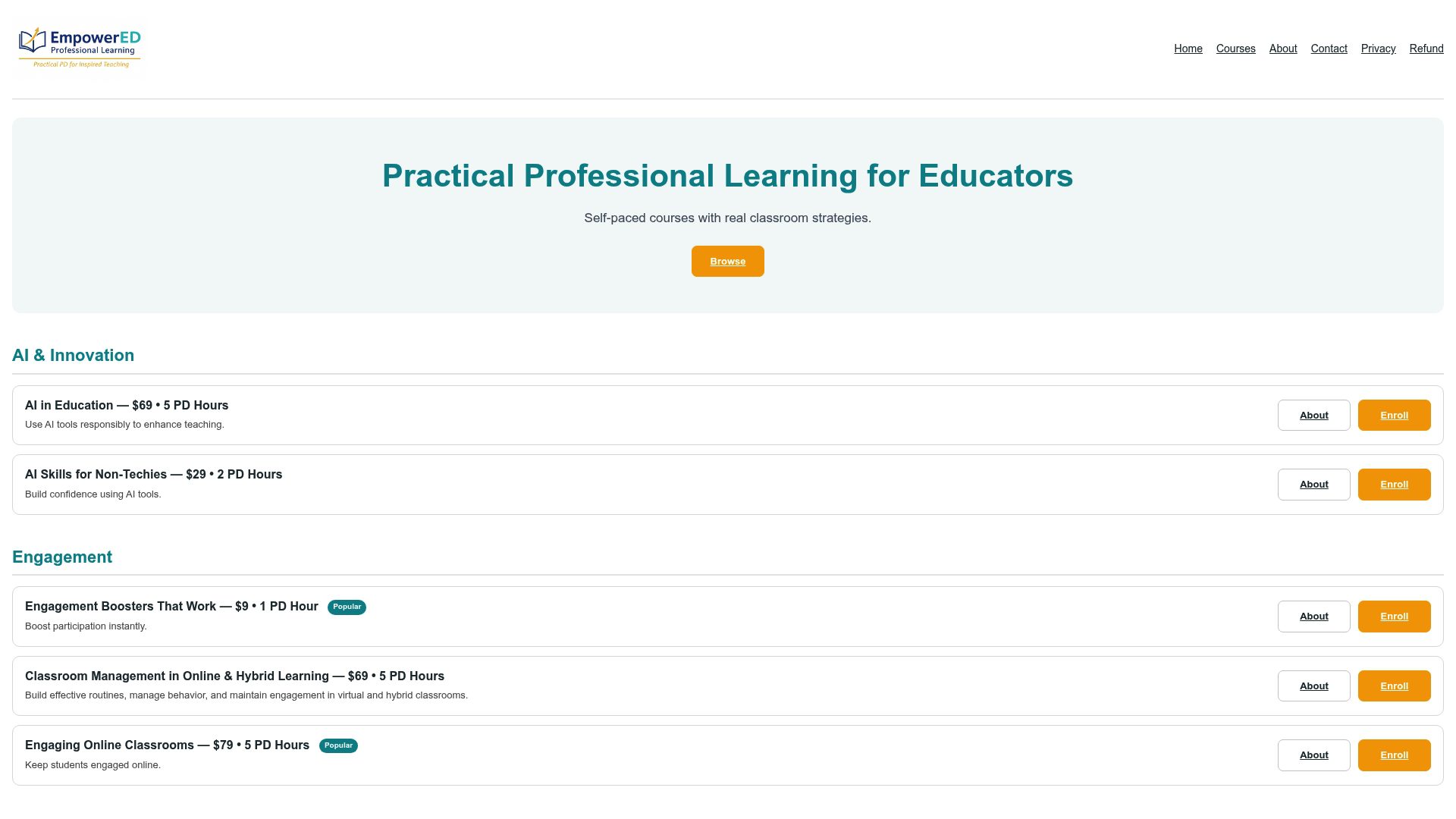
Courses are self-paced with instructor guidance, so a busy teacher can work through the material over a few weeks and walk away with usable lesson plans, assessment rubrics, and a certificate for professional development hours. Coursework focuses on immediate classroom application: you leave with materials you can use the following Monday, not just theory. For teachers looking to pair creative expression with emotional regulation goals, the Social-Emotional Learning & Teacher Wellness course covers that overlap directly.
Schools and districts can also license courses for full teams, which keeps professional development consistent across a grade level or building rather than leaving it to individual initiative. If you’re ready to see how a structured course could fit your own classroom goals, start by browsing the full course catalog to find the option that matches where you are right now.
Frequently Asked Questions
What is the role of creative expression learning in a standard classroom?
It functions as a working mechanism for building executive function, language, and social skills, not as a separate enrichment activity. Teachers who embed it into weekly instruction see it support academic goals directly.
How does creativity enhance learning across different subjects?
It gives students a second pathway to process content: sculpting a molecule, sketching a historical scene, or composing a rhythm to remember a sequence. That translation between formats strengthens memory and understanding.
At what age should creative expression activities begin?
Frameworks like Domain 4: Creative Expression track it from birth, starting with symbolic play and vocal experimentation in infancy and toddlerhood, then building toward structured storytelling and project work by upper elementary.
How can teachers assess learning through creative tasks fairly?
A short checklist works better than a lengthy rubric: check whether the student represented the concept accurately, made and explained a creative choice, and revised after feedback.
Does creative expression help students with special educational needs?
Yes. Multimodal options like drawing, building, or recording audio often let neurodiverse students demonstrate understanding more accurately than verbal-only assessments, especially when paired with UDL-based lesson design.
Sources
- Creative expressiveness in childhood writing predicts educational outcomes
- Art of Learning – An art-based intervention aimed at improving children’s executive functions
- The impacts of a high-school art-based program on academic achievements, creativity, and creative behaviors
- Arts for transformative education: a guide for teachers (UNESCO Associated Schools Network, 2024)
- Domain 4: Creative Expression (Illinois Early Learning Guidelines)
- Mapping the ecological landscape of early childhood creativity: A decade of empirical research