Project-based learning reliably increases student engagement, deepens understanding and knowledge transfer, and builds the 4Cs: critical thinking, communication, collaboration, and creativity. A combined analysis of 66 studies found a moderate positive effect on learning outcomes (SMD = 0.441), and organizations like the Buck Institute for Education have spent decades documenting which design choices produce these gains. The caveat matters just as much as the benefit: results depend heavily on scaffolding, group structure, and teacher preparation. This is exactly the gap Empowered Professional Learning’s courses are built to close.
- Stronger engagement and attendance in well-designed units
- Deeper retention and better transfer of knowledge to new problems
- Measurable gains in the 4Cs (critical thinking, communication, collaboration, creativity)
- Results depend on scaffolding, group size, and teacher readiness, not the model alone
Key Takeaways
Project-based learning improves engagement, retention, and 21st-century skills reliably, but only when teachers pair it with scaffolding, group structure, and formative assessment.
| Point | Details |
|---|---|
| Engagement rises with authenticity | Real audiences and authentic products drive attendance and participation gains documented across multiple studies. |
| Academic effects are moderate to strong | Effect sizes range from SMD = 0.441 to Hedges’ g = 1.11 depending on study design and subject area. |
| 4Cs improve with deliberate teaching | Communication, collaboration, critical thinking, and creativity scores rose above 70% in classroom PjBL studies. |
| Group size and duration matter | Groups of 4 to 5 students and units lasting 9 to 18 weeks show the strongest documented effects. |
| Teacher preparation closes the gap | Empowered Professional Learning’s courses on engagement, UDL, SEL, and AI integration address the scaffolding barriers that determine whether these benefits show up in your classroom. |
Table of Contents
- What Are the Benefits of Project-Based Learning?
- When Does Project-Based Learning Actually Work?
- What Are the Common Drawbacks of Project-Based Learning?
- What Does the Research Actually Say?
- How Do You Design a Project-Based Learning Unit?
- How Can Professional Development Support Project-Based Learning?
- Frequently Asked Questions
- Sources
What Are the Benefits of Project-Based Learning?
Engagement and attendance climb when projects feel real. A University of Michigan review of multiple studies found that well-implemented project-based learning improves attendance and engagement compared to traditional instruction. Students in a middle school science unit built around a local water-quality investigation, for example, show up because they are collecting data that matters to their own town, not filling out a worksheet.
- Deeper understanding and retention. Students who construct knowledge through a sustained project tend to retain it longer than students who receive it through lecture alone, because they’ve applied the concept in a real context.
- Knowledge transfer. A student who learns statistics by analyzing survey data for a community project is more likely to apply that skill in an unrelated context later, compared to a student who only practiced isolated problem sets.
- Improved academic outcomes. A multi-complementary study reported a strong overall effect on academic achievement (Hedges’ g = 1.11), with a moderate effect specifically in a mathematics implementation (g = 0.66).
- The 4Cs, measurably. In one secondary classroom study, student scores across creativity, critical thinking, communication, and collaboration all rose above a 70% benchmark after a project-based unit, with individual skill averages above the 70% benchmark.
- Real-world relevance and career exposure. Projects built around authentic audiences, a city council, a nonprofit, a local business, give students a preview of how their coursework connects to actual careers.
- Stronger motivation and attitudes toward learning. A 2024 meta-analysis of problem-driven methods found a small-to-moderate positive effect on student motivation (d = 0.498), with the largest gains in students’ confidence and sense that the work has value.
- Better performance in STEM and lab settings. Effects tend to be strongest in engineering, science lab, and small-group contexts, where hands-on iteration is built into the subject itself.
Statistic worth remembering: an effect size of d = 0.498 on motivation is not enormous, but it is consistent enough across studies to be a genuine planning signal, especially for classes where low student buy-in has been the main obstacle to achievement.
When Does Project-Based Learning Actually Work?
Benefits are not automatic. The Frontiers meta-analysis found effects vary by subject, group size, and project length, which means design choices carry as much weight as the model itself.
- Clear driving question. Anchor the unit to one open-ended question students can’t answer in a single lesson.
- Authentic audience. Give students a real reader or evaluator beyond you, a panel, a partner organization, a published product.
- Scaffolding and checkpoints. Build in structured skill lessons before students need them independently.
- Formative assessment throughout. Check understanding at milestones, not just at the final product.
- Group size of 4 to 5 students. This range shows up repeatedly as a sweet spot for accountability and workload balance.
- Duration of 9 to 18 weeks. Many of the strongest studied effects come from projects in this window, long enough for depth, short enough to sustain momentum.
- Subject fit. Lab science, engineering, and design courses tend to show the clearest gains.
Pro Tip: Start with one course or one unit, not a school-wide overhaul. Smaller, well-scaffolded pilots tend to produce stronger measured effects than sprawling, under-supported rollouts, largely because teachers can manage the scaffolding closely.
What Are the Common Drawbacks of Project-Based Learning?
Uneven group participation is the most cited complaint, fix it with clear individual role assignments and peer evaluation built into the grade. Time management struggles are common; milestone checkpoints every one to two weeks keep projects from collapsing at the deadline. Worries about alignment to standards or tests ease when the driving question is mapped directly to standards before the unit starts. Assessment can feel murky without a shared rubric that scores both the product and the process, including a short peer-assessment component where teammates rate collaboration quality. Resource and prep time costs are real; reusing a project across sections in future years reduces that burden significantly.
What Does the Research Actually Say?
The pattern across major analyses is consistent, if uneven in size. The problem-driven learning meta-analysis found motivation gains averaging d = 0.498. The 66-study Frontiers analysis put the combined effect on learning outcomes at SMD = 0.441. An earlier thematic review reported an even larger academic achievement effect near d = 0.71, while the 2026 multi-complementary study found g = 1.11 overall.
| Study | Effect Size | Outcome Measured |
|---|---|---|
| Problem-driven learning meta-analysis (2024) | d = 0.498 | Student motivation |
| Frontiers meta-analysis (66 studies) | SMD = 0.441 | Combined learning outcomes |
| Thematic review of PjBL | d ≈ 0.71 | Academic achievement |
| Multi-complementary study (2026) | g = 1.11 overall; g = 0.66 in math | Academic achievement |

Bigger effect sizes generally come from studies with tighter controls on subject area, group size, and duration, not from a different version of project-based learning. When you plan a unit, treat the moderate end of this range (0.4 to 0.5) as your realistic expectation, and treat the higher figures as what’s possible with strong scaffolding and a good subject fit.
How Do You Design a Project-Based Learning Unit?
- Define the learning goals first. Identify the standards and skills before you think about the project theme.
- Write a driving question. Make it open ended enough to sustain weeks of inquiry.
- Choose an authentic audience and product. Decide who will see the final work besides you.
- Plan scaffolding and checkpoints. Map out skill lessons and milestone dates across the unit’s 9 to 18 weeks.
- Build the assessment plan. Combine a product rubric, a process rubric, and a peer or self-assessment component.
- Assign group roles explicitly. Reduce free-riding by naming responsibilities up front.
- Schedule reflection and dissemination. Close the unit with student reflection and a public showcase of the work.
Edutopia’s guidance on starting with foundational “Lesson Zero” activities before the main project is a practical way to build teamwork norms early. Pairing that with a course like Preparing Students for Career Success gives you a template for authentic audience design.
A classroom practitioner’s view
Projects changed how I saw quiet students, several came alive once they had a real audience for their work. The limitation to watch is grading fairness across group members, which needs a deliberate rubric, not an afterthought. Ongoing professional learning on formative assessment made that shift possible for my team.
How Can Professional Development Support Project-Based Learning?
The gap between “project-based learning works in research” and “project-based learning works in my third-period class” almost always comes down to preparation, not motivation. Teachers need concrete strategies for group accountability, formative checkpoints, and differentiated support before a unit launches, not after it stalls.
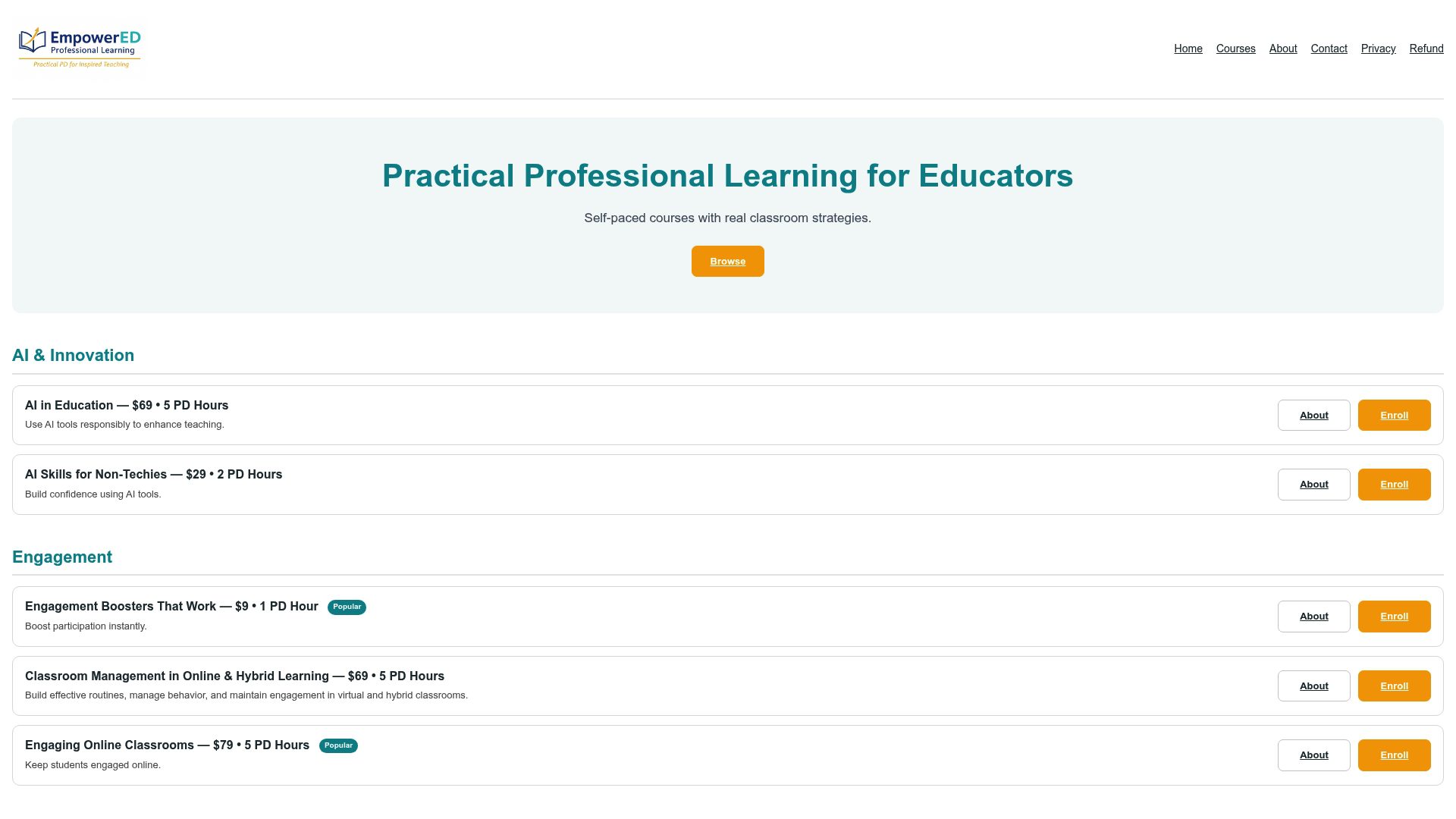
Empowered Professional Learning built courses around exactly these gaps. Engagement Boosters That Work gives you tactics for keeping student buy-in through a multi-week unit. Universal Design for Learning (UDL) & Accessibility covers how to structure group roles and project products so neurodiverse learners and students with varying needs can fully participate. Social-Emotional Learning & Teacher Wellness addresses the collaboration friction that sinks group projects, and prevents burnout during the heaviest planning weeks. And AI in Education shows you how to use AI tools ethically for feedback cycles and student production support. Every course is self-paced with personalized feedback and a PD certificate at the end. Browse the full course catalog at Empowered Professional Learning and enroll in the one that matches the barrier standing between your students and their next project.
Frequently Asked Questions
Does project-based learning actually improve test scores?
Multiple meta-analyses report positive effects on academic achievement, with effect sizes ranging from moderate (SMD = 0.441) to large (Hedges’ g = 1.11) depending on subject and implementation quality. The effect is real but not automatic; it depends heavily on how the unit is scaffolded.
How long should a project-based learning unit last?
Research points to 9 to 18 weeks as a range associated with stronger effects, long enough for genuine depth without losing student momentum. Shorter design challenges can still build early skills before a full unit begins.
What is the ideal group size for project-based learning?
Groups of 4 to 5 students appear most often in studies linked to stronger outcomes, likely because that size balances workload distribution with individual accountability.
Is project-based learning effective for every subject?
It tends to show the strongest results in STEM, engineering, and lab-based courses, where iteration and hands-on problem solving are already built into the discipline. It can work in humanities and social studies too, but the authentic product and audience need more deliberate design.

What is the biggest mistake teachers make with project-based learning?
Skipping scaffolding is the most common pitfall. Teachers who launch a project without clear milestones, defined group roles, and formative checkpoints tend to see the uneven participation and time-management problems that give project-based learning a bad reputation.
Sources
- The Effects of Problem-Based, Project-Based, and Case-Based Learning on Students’ Motivation: a Meta-Analysis | Educational Psychology Review | Springer Nature Link
- A study of the impact of project-based learning on student learning effects: a meta-analysis study | Frontiers
- Project-based learning in schools: a multi-complementary study of its effectiveness | Humanities and Social Sciences Communications | Springer Nature Link
- ERIC: Fulltext EJ1362322.pdf
- Project-based learning yields better student outcomes, studies … | University of Michigan
Recommended
- Professional Learning for Educators: Enhance Your Impact – EmpowerED: Professional Development for Educators
- Inquiry-Based Learning: A Practical Guide for Teachers – EmpowerED: Professional Development for Educators
- Active Learning Strategies for K–12 Teachers: Top 10 – EmpowerED: Professional Development for Educators
- Preparing Students for Career Success: Teaching Real-World Skills – EmpowerED: Professional Development for Educators