Well-designed collaborative learning activities reliably boost student thinking, motivation, and transferable teamwork skills. A 2023 meta-analysis published in Nature found collaborative problem-solving produced an overall effect size of ES = 0.82, with attitudinal outcomes like motivation showing an even larger gain (ES = 1.17). The Education Endowment Foundation reports collaborative approaches add roughly five months of extra progress over a school year when tasks are well structured. For educators building practical skills around this, EmpowerED Professional Learning treats collaboration as a teachable craft, not a hope-it-works classroom activity.
What three things actually improve when you use collaborative learning?
- Critical thinking and deeper conceptual understanding
- Motivation and classroom engagement
- Communication and teamwork skills students carry beyond your classroom
Effect size snapshot: ES = 0.82 overall for collaborative problem-solving, per the 2023 Nature meta-analysis. That places it among the more dependable instructional levers available to K–12 teachers.
Key Takeaways
Collaborative learning activities produce moderate-to-large gains in critical thinking and motivation, but only when tasks include positive interdependence, individual accountability, and active teacher facilitation.
| Point | Details |
|---|---|
| Evidence is strong | A 2023 Nature meta-analysis found ES = 0.82 overall, with attitudinal gains as high as ES = 1.17. |
| Facilitation is the mediator | Teacher circulation, re-voicing, and minimal intervention determine whether collaboration delivers its benefits. |
| Group size matters | The EEF recommends groups of three to five students to prevent free riding and disengagement. |
| Structure prevents pseudo-collaboration | Roles, individual accountability, and clear products separate real collaboration from unstructured group time. |
| PD accelerates results | EmpowerED Professional Learning offers classroom-ready courses on engagement, UDL, and SEL to shorten the trial-and-error phase. |
Table of Contents
- What does the research say about the benefits of collaborative learning activities?
- What are the core benefits for student thinking and engagement?
- How do you design collaborative learning activities that work?
- What is the teacher’s role in making collaboration succeed?
- How should you assess and give feedback on group work?
- What are quick collaborative activities by grade band?
- How do you get started with collaborative learning this week?
- What I’ve noticed watching teachers try this for the first time
- How can professional development speed up your collaborative learning results?
- Frequently asked questions about collaborative learning benefits
- Sources
What does the research say about the benefits of collaborative learning activities?
The strongest evidence points to moderate-to-large gains, not marginal ones. That 2023 meta-analysis found an overall effect size of ES = 0.82, and a 2026 second-order meta-analysis synthesizing multiple prior studies found a slightly more conservative but still solid ES = 0.71, with a confidence interval of 0.55 to 0.87. Two independent lines of research converging near the same range is a meaningful signal.
The EEF toolkit adds a classroom-facing number to that: roughly +5 months of progress over a school year when groups are structured and teacher-supported.
Why does it work? A PMC study found that satisfying students’ psychological needs for competence and relatedness accounts for about 52% of collaborative learning’s total effect on engagement. Peer support matters too: separate research on college English programs found collaborative activities strongly predict peer support, which in turn drives engagement.
- Not all group work counts as collaborative learning
- The 2026 synthesis found effect sizes vary meaningfully by technique and subject area
- Quality of interaction and teacher facilitation are what separate strong results from wasted class time
What are the core benefits for student thinking and engagement?
Collaborative tasks change how students process material, not just how they feel about class. Here’s what shows up consistently across the research:
- Deeper conceptual understanding and critical thinking: Group problem-solving forces students to articulate reasoning out loud, which the Nature meta-analysis links to an ES = 0.82 overall benefit.
- Stronger motivation and engagement: Attitudinal measures showed the largest gains in that same study, at ES = 1.17, suggesting collaboration moves the needle on how students feel about learning even more than on raw performance.
- Communication and teamwork skills: Students practice negotiation, active listening, and constructive disagreement, skills that transfer well beyond any single lesson.
- Better retention and transfer: Explaining a concept to a peer forces retrieval and reorganization of knowledge, reinforcing memory more than passive review.
- Built-in differentiation: Mixed-ability groups let stronger students consolidate understanding through teaching, while struggling students get peer explanations in language closer to their own.
Pro Tip: Design every group task with positive interdependence (students need each other to finish) and individual accountability (each student is assessed separately). Skip either one and you get free riders instead of collaboration.
The attitudinal gains are noted as outpacing the cognitive ones in the current evidence base.
How do you design collaborative learning activities that work?
Structure is the whole game. Unstructured group work rarely produces the benefits described above. Use this checklist when building any collaborative task:
- Set task complexity appropriately. The problem should be too big for one student to solve quickly alone.
- Build in positive interdependence. Each group member should hold a piece of information, a role, or a resource the others need.
- Require individual accountability. Pair the group product with an individual quiz, reflection, or contribution log.
- Define a clear end product. Whether it’s a shared document, a poster, or a joint presentation, ambiguity kills momentum fast.
Quick templates you can adapt this week:
- Jigsaw: Each student masters one sub-topic, then teaches it to their group.
- Think-Pair-Share: Individual reflection, paired discussion, then whole-group synthesis.
- Structured controversy: Two students argue one side, two argue the other, then the group builds a joint position.
Group size matters more than most teachers assume. The EEF toolkit recommends groups of three to five students for most classroom tasks; larger groups tend to let students hide. Assigning roles — timekeeper, recorder, summarizer, questioner — prevents the common trap of pseudo-collaboration, where students sit together but never actually think together.
Pro Tip: Don’t assume students already know how to collaborate. A short scaffolding period, often around six weeks, spent explicitly teaching active listening, paraphrasing, and questioning pays off for the rest of the year.

Once roles and interdependence are in place, most of the classroom management problems associated with group work disappear on their own.
What is the teacher’s role in making collaboration succeed?
Teacher facilitation is not a background detail. It’s a primary mediator of whether collaborative learning delivers its benefits or falls flat. Good facilitation amplifies the effect sizes discussed earlier; weak facilitation can erase them entirely.
Effective moves worth building into your routine:
- Circulate frequently using short observation cycles, especially early in a unit
- Re-voice student ideas back to the group to check understanding
- Prompt elaboration (“Say more about that” beats “Good job”)
- Intervene minimally, redirecting focus rather than solving the problem for them
Watch for these common pitfalls: pseudo-collaboration (social interaction with no real task engagement), uneven participation (one student does the work), off-task socializing, and tasks that are too simple to require real cooperation. The Digital Promise practitioner primer frames co-elaboration and structured reflection as core teacher responsibilities, not optional extras.
Pro Tip: In the first few weeks of any new collaborative structure, visit each group roughly every 90 seconds with a simple observation checklist. Frequent, brief check-ins catch pseudo-collaboration before it becomes a habit.
How should you assess and give feedback on group work?
Assess both the individual learning and the group process, using rubrics simple enough to use every week without burning out.
A compact rubric structure to adapt:
- Content accuracy: Did the individual student demonstrate mastery of the concept?
- Contribution: Did this student complete their assigned role or portion?
- Discussion quality: Did the group build on each other’s ideas, or just report separately?
- Self and peer reflection: What did the student learn about collaborating, not just the content?
Reflection prompts worth asking students: “What did your group do well together?” and “What would you change about how your group worked?” For your own planning, ask: “Where did participation drop off?” and “Which roles need clearer instructions next time?”
Weight grades to protect individual accountability, commonly splitting evaluation between an individual product and a group process score, so no student can coast entirely on a group’s effort.
What are quick collaborative activities by grade band?
Ready-to-run options across grade levels, each built around clear roles and a fast way to check learning:
- Early elementary (K–2): Partner storytelling with a “recorder” and “illustrator” role, 10 minutes, checked through a quick verbal retell.
- Upper elementary (3–5): Jigsaw reading groups where each student teaches one section, 20 minutes, checked with a one-question exit ticket.
- Middle school: Structured controversy debates on a science or social studies topic, 30 minutes, checked through the group’s written joint position.
- High school: Peer-reviewed lab analysis where students critique each other’s data interpretation, 25 minutes, checked through revised individual write-ups.
Jigsaw and structured controversy formats scale well to hybrid settings using shared documents or breakout rooms. Explore practical tech pairings in the role of digital tools in student engagement or consider EmpowerED Professional Learning’s AI in Education course for structuring AI-assisted group tasks responsibly.
How do you get started with collaborative learning this week?
Start small rather than overhauling your whole unit plan at once.
- Week 1: Pick one low-stakes activity, like Think-Pair-Share, and run it once.
- Weeks 2 to 3: Teach collaboration skills explicitly, modeling active listening and questioning.
- Weeks 4 to 5: Assign clear roles and monitor closely with short observation cycles.
- Week 6: Reflect with students on what worked, then scale up to a jigsaw or structured controversy task.
Use a minimal rubric your first time out: content accuracy and one contribution measure are enough to start.
Pro Tip: If group dynamics feel shaky, a focused PD session on engagement strategies, Universal Design for Learning, or SEL can shortcut months of trial and error. EmpowerED Professional Learning builds these modules specifically for classroom use, not theory.
What I’ve noticed watching teachers try this for the first time
Teachers who start with one small, well-structured task, rather than a full group project, see student ownership grow faster than expected. The research backs this up, but classrooms confirm it daily: kids rise to structure, not vague instructions to “work together.” Iteration matters more than perfection, and targeted professional learning shortens that iteration cycle considerably.
How can professional development speed up your collaborative learning results?
Getting collaborative learning right on the first try is hard without a template for task design, roles, and facilitation. EmpowerED Professional Learning gives K–12 teachers classroom-ready strategies instead of theory, so you can skip months of trial and error and start seeing engagement gains within a unit or two.
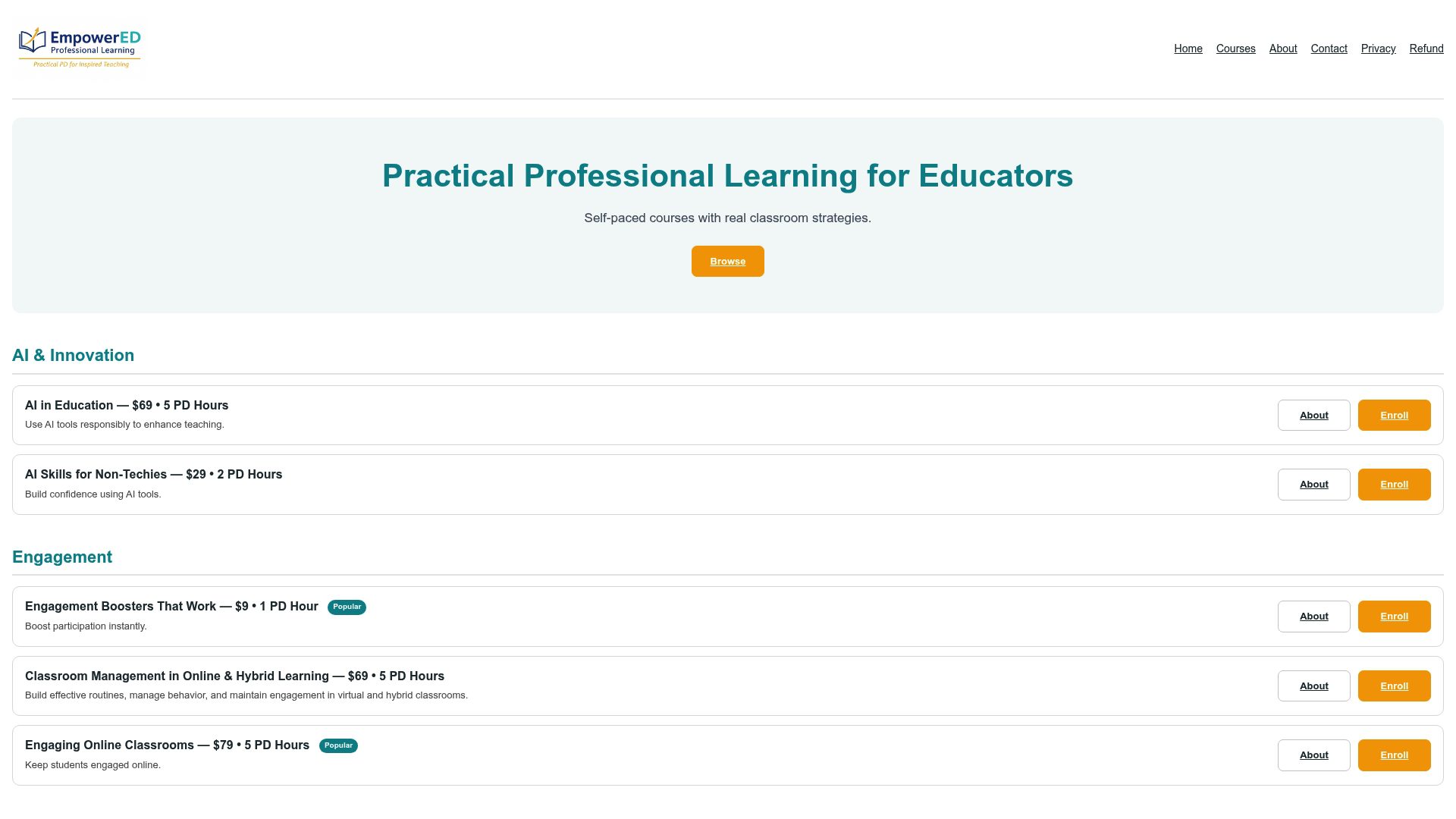
Course pathways build directly on what this article covers:
- Faster, classroom-ready application of group task design
- Scaffolded lesson templates and grading rubrics you can adapt immediately
- Support for integrating Universal Design for Learning principles into group tasks
- SEL-informed strategies for building relatedness and psychological safety in groups
- An optional module on responsible AI use in collaborative and hybrid tasks
Courses are self-paced or instructor-guided, built for individual K–12 teachers as well as school and district teams. If facilitation and engagement are your current sticking point, start with Engagement Boosters That Work and bring a structured task to your classroom by next week.
Frequently asked questions about collaborative learning benefits
What are the main benefits of collaborative learning activities?
The evidence points to three consistent gains: deeper critical thinking, stronger motivation and engagement, and improved communication and teamwork skills that transfer beyond the classroom.
How much does collaborative learning actually improve outcomes?
A 2023 meta-analysis found an overall effect size of ES = 0.82, and the EEF toolkit reports an average of about five months of additional academic progress per year.
What is the ideal group size for collaborative learning?
The EEF recommends groups of three to five students for most classroom tasks, which is small enough to prevent free riding while still allowing multiple perspectives.
Why doesn’t all group work count as collaborative learning?
Unstructured group work often lacks positive interdependence and individual accountability, two features research ties directly to measurable learning gains. Without them, students may socialize without actually engaging with the task.
How can teachers get better at facilitating collaborative learning?

Practice matters, but so does structured support. Targeted professional development, like EmpowerED Professional Learning’s courses on engagement strategies and SEL, gives teachers classroom-tested facilitation routines instead of relying on trial and error alone.
Sources
- Meta-analysis reporting collaborative problem-solving effects (Nature, 2023)
- Second-order meta-analysis on cooperative learning (Current Psychology / Springer, 2026)
- Peer collaborative learning and academic engagement: mediation by psychological needs (PMC)
- Collaborative learning approaches | EEF
- Teacher’s Roles in Supporting Collaborative Learning (Digital Promise, 2025)
Recommended
- Active Learning Strategies for K–12 Teachers: Top 10 – EmpowerED: Professional Development for Educators
- Best Webteaching.com Alternatives for K-12 Teachers – EmpowerED: Professional Development for Educators
- Blog
- Professional Learning for Educators: Enhance Your Impact – EmpowerED: Professional Development for Educators