Inquiry-based learning is a teacher-facilitated approach in which students build understanding by investigating a question or problem, gathering evidence, and explaining their findings rather than receiving information passively. Your immediate next step: replace one direct-instruction segment this week with a student-generated question and a short investigation. Here is a four-step cycle you can paste directly into any lesson plan:
- Ask: Students pose or receive a driving question.
- Investigate: Students gather evidence through observation, research, or experimentation.
- Create/Communicate: Students construct an explanation or product from their findings.
- Reflect: Students evaluate their process and revise their thinking.
That cycle is the engine. Everything else in this guide helps you run it well.
Key Takeaways
Inquiry-based learning improves student motivation, critical thinking, and retention when it is well-sequenced, scaffolded, and sustained across a school year rather than treated as a one-time activity.
| Point | Details |
|---|---|
| Start at the right level | Use Bell et al.’s four-level hierarchy and begin with confirmation or structured inquiry before moving to open inquiry. |
| Scaffold every phase | Provide question menus, CER frames, and source guides so all students can access the investigation. |
| Assess with purpose | Use a rubric that evaluates question quality, evidence use, reasoning, and reflection, not just the final product. |
| Build PD that lasts | Seek sustained, collaborative, classroom-embedded professional development rather than one-off workshops. |
| Empowered Professional Learning | Offers self-paced PD courses on engagement and AI integration that map directly to inquiry-based classroom practice. |
Table of Contents
- What is inquiry-based learning, and how does it differ from traditional instruction?
- The four levels of inquiry and how to sequence them across a unit
- How to plan an inquiry lesson using the five-phase cycle
- What does research say about the benefits of inquiry-based learning?
- Concrete inquiry lesson ideas for elementary, middle, and high school
- How teachers scaffold inquiry and assess student learning
- Practical tips for implementing inquiry and avoiding common pitfalls
- What professional development actually builds inquiry teaching capacity?
- Why inquiry matters more than ever in today’s classrooms
- Empowered Professional Learning supports your inquiry practice
- Sources
What is inquiry-based learning, and how does it differ from traditional instruction?
Inquiry-based learning is defined as active learning that begins with a question, problem, or scenario. The teacher acts as a facilitator rather than a lecturer. Students drive the investigation, construct explanations from evidence, and share their reasoning with peers.
Three characteristics separate inquiry from conventional direct instruction:
Student questioning. In a traditional lesson, the teacher owns the questions. In inquiry, students generate or co-construct the central question. A fourth-grade class studying weather does not receive a definition of condensation; instead, students ask, “Why does the outside of a cold glass get wet?”
Evidence-based explanations. Students must support claims with data, observations, or sources. Opinion alone does not count. This shifts the cognitive work from recall to reasoning.
Teacher as facilitator. The teacher designs the conditions for discovery, curates resources, asks probing questions, and provides targeted mini-lessons when students hit knowledge gaps. Lecturing still has a place, but it is a scaffold, not the default mode.
A systematic literature review on inquiry-based pedagogies confirms that inquiry promotes higher-order thinking and collaborative knowledge construction, but only when implemented with intentional design and scaffolding. Inquiry alone is not a magic solution.
The four levels of inquiry and how to sequence them across a unit
Bell et al.’s four-level hierarchy gives teachers an operational rubric for designing tasks that build student capacity progressively, from high teacher support to high student ownership.
| Level | Name | What the Teacher Provides | What Students Decide | Example Activity |
|---|---|---|---|---|
| 1 | Confirmation | Question, procedure, expected result | Carry out the steps and confirm | Elementary: students follow a recipe to observe how yeast produces gas |
| 2 | Structured | Question and procedure | Collect data and form conclusions | Middle: students use a set protocol to test which soil type retains water best |
| 3 | Guided | Question only | Design the procedure and draw conclusions | High school: students design an experiment to test a variable in photosynthesis |
| 4 | Open | Nothing prescribed | Generate the question, design the study, and communicate findings | Any grade: student-led research project on a community issue |
Most teachers make one critical mistake: they skip straight to Level 4 before students have the habits or background knowledge to succeed. Start at Level 1 or 2 for a new topic or a new class, then move up deliberately across a unit or semester.
Pro Tip: Run a confirmation inquiry at the start of a new unit to activate prior knowledge and build procedural confidence. Students who feel competent at Level 1 take more intellectual risks at Level 3.
How to plan an inquiry lesson using the five-phase cycle
Guided inquiry paired with explicit foundational teaching and a five-phase cycle is a reliable classroom model. Pure discovery, without structure, underperforms on novel content. Use this sequence as your planning checklist:
-
Engage. Hook students with a provocative question, a discrepant event, or a short video clip. Teacher action: surface prior knowledge and generate curiosity. Formative probe: “What do you already think you know about this? What surprises you?”
-
Explore. Students investigate with materials, data sets, or sources. Teacher action: circulate, ask clarifying questions, and resist giving answers. Checkpoint: listen for misconceptions and note which groups need a targeted mini-lesson.
-
Explain. Students share findings and the teacher introduces formal vocabulary and concepts that connect to what students discovered. Teacher action: connect student language to disciplinary language. Probe: “How does your evidence support that claim?”
-
Elaborate. Students apply their understanding to a new problem or context. Teacher action: design a transfer task that is slightly more complex than the original investigation. Checkpoint: use exit tickets to check for transfer.
-
Evaluate. Students and teacher assess understanding through a performance task, reflection journal, or peer discussion. Teacher action: use a rubric aligned to the driving question. Probe: “What would you do differently if you ran this investigation again?”
The Exploratorium’s Institute for Inquiry resources offer ready-made facilitation guides and activity models that map directly to this cycle.
What does research say about the benefits of inquiry-based learning?
The evidence is encouraging, and it comes with important conditions.
A Nature study on long-term inquiry-based science education found that IBSE implementations are associated with improved student motivation and better knowledge retention in STEM subjects, with benefits increasing when schools sequence inquiry from confirmation to guided and open levels. Subject- and gender-linked differences in outcomes can be reduced by starting with lower-level inquiry tasks that build confidence before moving to open investigation.
The systematic review on inquiry-based pedagogies identifies the instructional design as the active ingredient. Scaffolds, sequencing, and structured reflection drive the gains. Inquiry without those elements produces inconsistent results.
Research signal: Long-term, well-sequenced inquiry implementations show gains in motivation and retention in STEM, particularly when confirmation and structured inquiry precede open inquiry.
On the cognitive side, inquiry builds critical thinking, evidence evaluation, and argumentation skills that transfer across subjects. On the affective side, students who investigate real questions report higher ownership of their learning. These student engagement gains are most durable when inquiry is a regular classroom practice, not a one-off project.
One honest limit: inquiry takes more time than direct instruction for the same content coverage. Teachers who implement it successfully protect that time by aligning inquiry tasks directly to priority standards rather than treating inquiry as an add-on.
Concrete inquiry lesson ideas for elementary, middle, and high school
These three lesson starters are ready to adapt. Each includes a driving question, student product, time estimate, and materials.
-
Elementary (Grades 2–4): “Why do some objects float and others sink?”
Driving question: What properties determine whether an object floats? Student product: a labeled diagram with a written claim and evidence. Time: multiple class sessions. Materials: tubs of water, a set of classroom objects, a data recording sheet. -
Middle school (Grades 6–8): “How does our local water quality compare to EPA standards?”
Driving question: Is the water in our community safe to drink? Student product: a data report with a recommendation addressed to a real or simulated audience. Time: multiple class periods. Materials: water testing kits, EPA water quality data (publicly available online), graphing tools. -
High school (Grades 9–12): “What factors predict a student’s academic success?”
Driving question: Which variables most strongly correlate with GPA in our school? Student product: a statistical analysis and a short presentation with policy recommendations. Time: multiple weeks. Materials: anonymized school data or publicly available datasets, spreadsheet software.
Cross-curricular example (Science + ELA, Grades 5–7): Students investigate local biodiversity, collect field observations, and write a persuasive letter to a local government agency. The science standard covers ecosystems; the ELA standard covers argument writing with evidence. Both are assessed on the same student product.
Differentiation note: For students who need additional support, pre-select sources and provide a structured note-taking template. For advanced learners, remove the template and ask them to design their own data collection tool. Digital tools such as Google Slides, Padlet, and Canva help students communicate findings in multiple formats.
How teachers scaffold inquiry and assess student learning
Scaffolding is what separates productive struggle from frustration. Here is a practical breakdown by phase, followed by assessment options.
Scaffolds by phase:
- Engage: Provide a question menu if students struggle to generate their own. Use a KWL chart to surface prior knowledge.
- Explore: Model how to evaluate a source before students work independently. Offer sentence starters for recording observations.
- Explain: Use a claim-evidence-reasoning (CER) frame to structure written explanations.
- Elaborate: Pair students strategically so a stronger researcher works alongside a stronger writer.
- Evaluate: Share the rubric before the task begins, not after.
Questioning strategies are the teacher’s most powerful tool during inquiry. Classroom questioning strategies such as Socratic prompts (“What evidence would change your mind?”), productive notices (“I notice your data shows a pattern — what do you make of that?”), and wait time of at least five seconds after a question significantly increase the quality of student responses.
Sample inquiry assessment rubric:
| Criterion | Developing | Proficient | Advanced |
|---|---|---|---|
| Driving question | Question is too broad or too narrow to investigate | Question is testable and connected to the topic | Question is original, testable, and shows disciplinary thinking |
| Evidence use | Claims lack supporting evidence | Claims are supported by relevant evidence | Claims are supported by multiple, evaluated sources |
| Reasoning | Explanation restates evidence without analysis | Explanation connects evidence to a claim | Explanation addresses alternative explanations |
| Reflection | Student describes what they did | Student identifies what they learned | Student identifies how their thinking changed and what they would do differently |
Pro Tip: Use a two-minute “exit reflection” at the end of each inquiry session: ask students to write one thing they found and one question they still have. This metacognitive habit, where students reflect on their own thinking process, is central to turning activities into lasting learning.

Practical tips for implementing inquiry and avoiding common pitfalls

Getting inquiry right the first time is rare. These planning and pacing strategies reduce the most common problems.
Planning checklist before you launch:
- Align the driving question to a priority standard, not a peripheral one.
- Run a brief prior-knowledge check (a poll, a quick write, or a sorting activity) to gauge where students start.
- Gather or pre-approve materials and sources so students are not searching aimlessly.
- Decide in advance which level of inquiry (1–4) fits this class at this point in the year.
- Build in at least one reflection checkpoint per session.
Common pitfalls and short fixes:
- Insufficient scaffolding: Students go off-task or produce shallow work. Fix: add a structured note-taking template and a mid-investigation check-in.
- Skipping reflection: Students complete the activity but do not consolidate learning. Fix: protect the last five minutes of every session for a written or verbal reflection.
- Weak question design: The driving question is too vague (“What is pollution?”) or too narrow to sustain investigation. Fix: test your question against this standard: can students investigate it with available resources in the available time?
- Equity gaps: Students with limited background knowledge or language supports fall behind. Fix: provide vocabulary scaffolds, bilingual glossaries, and tiered source sets.
Sample pacing for a two-week inquiry unit:
- Days 1–2: Engage (hook, prior knowledge, driving question)
- Days 3–6: Explore (investigation, data collection, source evaluation)
- Days 7–8: Explain (share findings, teacher connects to formal concepts)
- Day 9: Elaborate (transfer task or extension problem)
- Day 10: Evaluate (performance task, reflection, peer feedback)
What professional development actually builds inquiry teaching capacity?
One-off workshops on inquiry rarely change classroom practice. Research from the Oxford Research Encyclopedia of Education is clear: professional development that is systematic, collaborative, and classroom-embedded produces stronger improvements in inquiry teaching than isolated training events. The key feature is that teachers investigate their own practice in peer groups, much like their students investigate questions.
What effective PD for inquiry looks like in practice:
-
Sustained cycles over time. A semester-long learning community outperforms a two-day summer institute. Teachers need time to try a strategy, observe results, and adjust.
-
Practitioner inquiry. Teachers design a small classroom inquiry of their own: they pose a question about their practice, collect student work as data, and share findings with colleagues.
-
Coaching and classroom-embedded collaboration. An instructional coach or peer observes an inquiry lesson and provides specific, evidence-based feedback on questioning moves and scaffolding choices.
-
Shared lesson design. Teams co-plan an inquiry unit, teach it in parallel, and debrief using student work. This is sometimes called collaborative inquiry or lesson study.
PD vetting checklist for school leaders:
- Does the PD extend beyond a single session?
- Does it include time for teachers to practice and reflect on classroom implementation?
- Does it connect to teachers’ actual curriculum and standards?
- Does it include peer collaboration, not just individual learning?
For teacher professional development that meets these criteria, look for programs that embed coaching, provide PD certificates, and offer follow-up support rather than one-and-done training.
Why inquiry matters more than ever in today’s classrooms
The case for inquiry is not just about test scores. Students who learn to ask good questions, evaluate evidence, and revise their thinking are building skills that transfer to every subject and every stage of life. That is the real promise of inquiry-based learning.
A single inquiry project does not transform a classroom. A consistent culture of questioning does. Teachers who start small, with a single guided inquiry task in one unit, and then build from there, tend to see the most durable gains in student engagement and critical thinking.
The workload concern is real. Designing good inquiry takes planning time that many teachers do not have in abundance. The practical answer is to start with Level 2 structured inquiry, use an existing lesson as the base, and add a student-generated question and a reflection prompt. That is a meaningful shift without a complete redesign.
Empowered Professional Learning supports your inquiry practice
Ready to bring inquiry-based strategies into your classroom with confidence? Empowered Professional Learning offers self-paced, instructor-guided online courses built specifically for K-12 educators who want practical, immediately applicable skills.
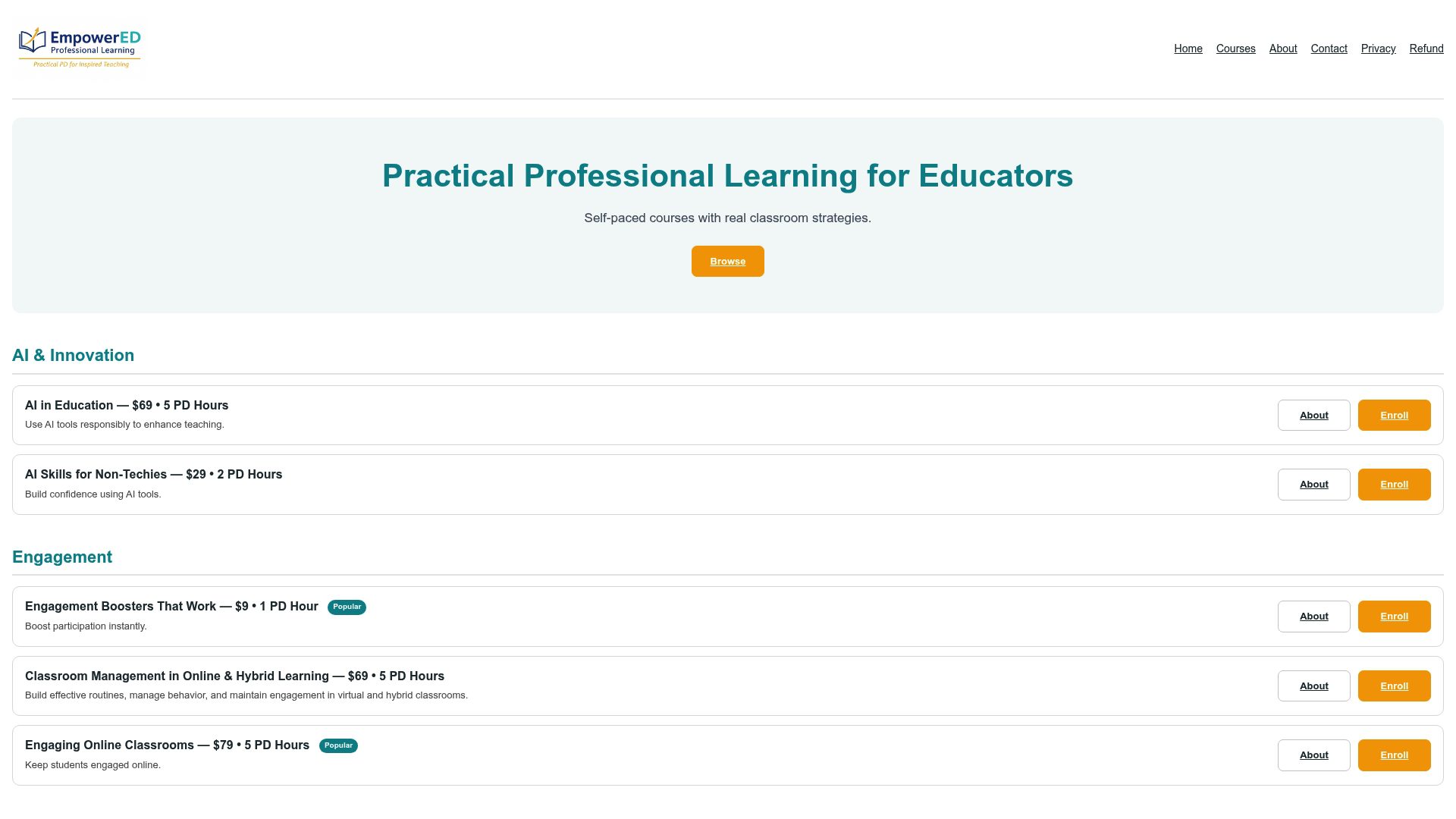
The Engagement Boosters That Work course gives you concrete strategies for increasing student participation that align directly with inquiry-based approaches. For teachers integrating technology into inquiry tasks, the AI in Education course covers ethical, practical applications of AI tools for student research and formative assessment. Every course includes personalized feedback and a PD certificate. Schools and districts can access bulk licensing for team-wide professional learning. Browse the full course catalog at Empowered Professional Learning and enroll in the course that fits your next instructional goal.
Sources
- Systematic literature review on inquiry-based pedagogies — integrated framework
- What Is Inquiry-Based Learning? A Teacher’s Evidence-Based Guide — Tutero
- The impact of long-term inquiry-based science education on students’ motivation and knowledge acquisition — Nature
Recommended
- Professional Learning for Educators: Enhance Your Impact – EmpowerED: Professional Development for Educators
- Active Learning Strategies for K–12 Teachers: Top 10 – EmpowerED: Professional Development for Educators
- Classroom Questioning Strategies Examples for K-12 Teachers
- Professional Development for Educators: A Practical 2026 Guide – EmpowerED: Professional Development for Educators