Extending the pause after a question from one second to three or five seconds reliably produces longer, more thoughtful student answers, more voluntary participation, and fewer blank stares. This is not a soft classroom management tip. It is one of the most replicated findings in education research, and it costs nothing to implement.
The action is simple: after you ask a question, silently count to yourself, watch for a visual cue, or glance at a small timer, and hold off for 3 to 5 seconds before calling on anyone. Do the same after a student finishes answering, before you respond or move on. That second pause, often skipped entirely, is where the real thinking happens.
Key Takeaways
Extending wait time from the natural average of under one second to a deliberate 3 to 5 seconds is one of the highest-leverage, lowest-cost changes a teacher can make to student thinking and participation.
| Point | Details |
|---|---|
| Pause length matters | Natural pauses average about 0.9 seconds; target 3 to 5 seconds after questions and after student answers. |
| Two types of wait time | Wait Time I follows your question; Wait Time II follows the student’s answer, and both drive gains. |
| Response quality jumps | Classic research links extended pauses to very large increases in response length. |
| Start with one strategy | Try a silent count, visual timer, or think-pair-share micro-protocol in a single class period first. |
| Watch for diminishing returns | Pauses stretched too long can increase off-task behavior instead of improving answers. |
| Build the habit with support | Empowered Professional Learning’s short PD modules pair the research with coaching cycles so extended wait time becomes a lasting classroom routine. |
Table of Contents
- Why Wait Time Matters in Classrooms: The Research Base
- What Happens in a Classroom When You Extend Wait Time?
- Wait Time I vs. Wait Time II: What’s the Difference?
- How Do You Actually Build Wait Time Into a Lesson?
- When Does Wait Time Backfire in the Classroom?
- How Can Teachers Practice and Measure Wait Time?
- What Does Wait Time Sound Like in a Real Lesson?
- Turn Wait-Time Research Into a Practiced Classroom Habit
- Where to Read More on Wait Time Research
- Frequently Asked Questions
- Sources
Why Wait Time Matters in Classrooms: The Research Base
Teachers typically wait less than a second on average before calling on a student or jumping in with an answer themselves. That number comes from decades of classroom observation, and it has proven remarkably stable across grade levels and subjects, as summarized in research on wait time and authentic learning. Less than a second is barely enough time to process a question, let alone construct a reasoned response.
Mary Budd Rowe’s original research in the 1970s set the baseline for everything that followed. Rowe trained teachers to extend their pauses to three seconds or longer and documented dramatic shifts in classroom discourse, including longer responses, more speculative thinking, and a rise in evidence-based reasoning, detailed in her landmark study on wait-time and instructional variables. Her findings held up because they were simple to test and easy to replicate: change one variable, the pause length, and watch the discourse transform.
A more recent systematic review of wait time in the questioning of children synthesized 26 studies and confirmed the pattern still holds. When both the pause after a question and the pause after a response exceeded three seconds, classroom discourse improved consistently. The review also flagged an important nuance: forensic and clinical interview settings, where children are questioned about sensitive events, sometimes call for pauses closer to 10 seconds. Classrooms are not interview rooms, but the underlying principle transfers: complex or emotionally weighted questions need more room to breathe.
| Wait Time | Typical Outcome | Source |
|---|---|---|
| ~0.9 seconds (natural average) | Short, guessed, or incomplete answers | Kent State CTL |
| 3 seconds | Noticeably longer responses, fewer “I don’t know” answers | Rowe, 1972 |
| 3–5 seconds | Higher-order thinking, more unsolicited responses, increased participation | PMC systematic review |
| ~10 seconds (specialized contexts) | Used in forensic interviews with children, not standard classroom practice | PMC systematic review |

Statistic callout: Classic studies tracing back to Rowe’s original work report very large increases in response length when teachers moved from near-instant pauses to the 3 to 5 second range. That is not a marginal gain. It is the difference between a one-word guess and a full explanation.
What Happens in a Classroom When You Extend Wait Time?
The benefits of wait time show up fast, often within a single lesson, and they are easy to spot once you know what to look for.
- Student responses get longer and more detailed, moving from single words to full explanations.
- Unsolicited responses increase, meaning students start volunteering ideas without being called on.
- “I don’t know” answers drop noticeably, according to the IRIS Center’s summary on wait time.
- Student-to-student interaction rises, with kids responding to each other instead of only to you.
- Confidence improves, particularly among students who normally sit out of discussion.
Teacher behavior shifts too, and this part often surprises new practitioners. Teachers who consistently extend wait time end up asking fewer total questions, but the questions they ask are more probing and more focused on reasoning rather than recall. Research on wait time in English-medium-instruction science classrooms found that longer pauses predicted richer, more linguistically complex student output even more strongly than the use of higher-order questions themselves, based on a study of wait time in EMI science classes. The pause itself did heavier lifting than the question’s design.
Statistic callout: In classrooms where mean wait time crossed the 3-second threshold, review literature on wait time and cognitive-level learning found higher-cognitive-level outcomes became measurably more likely across K–12 science and math settings.
To judge the effect in a single lesson, track two simple indicators: average response length (are students speaking in full sentences instead of fragments?) and participation spread (are the same three hands going up, or is the pool widening?).

Wait Time I vs. Wait Time II: What’s the Difference?
Wait Time I is the pause after you ask a question and before anyone speaks. Wait Time II is the pause after a student finishes answering, before you respond, correct, or move to the next student. Most PD on this topic focuses entirely on Wait Time I and ignores Wait Time II, but research on authentic learning and wait time treats the second pause as equally critical. It is Wait Time II that opens space for elaboration, for a classmate to add on, or for the original student to extend their own thought.
The 3 to 5 second guideline is not a rigid number. Use it as a range tied to question complexity:
- Short factual recall (“What year did the war end?”): aim closer to 3 seconds.
- Synthesis or reasoning questions (“Why did the treaty fail?”): aim closer to 5 seconds, sometimes longer.
- Younger students, English learners, or multi-step problems: give slightly more processing time than the standard range, since translation and working memory demands add cognitive load.
Longer is not always better. A systematic review notes that transferability across contexts requires caution: what works in a science classroom discussion does not automatically scale to every setting, and gains from extended pauses are not purely linear. Beyond an optimal point, added silence stops producing better answers and starts producing restlessness.
How Do You Actually Build Wait Time Into a Lesson?
Knowing the number is easy. Holding the silence in a room full of twenty-five kids staring back at you is the hard part. These strategies make it stick.
- Silent counting: Count to yourself, “one-Mississippi, two-Mississippi,” after every question you ask.
- Visual countdown: Project a simple timer or hold up a colored card that signals “thinking time in progress.”
- Think, then pair, then share: Give individual think time before any talking starts, so students construct an answer before feeling pressure to speak it aloud.
- Write, turn, share: Have students jot a quick response before turning to a partner, which slows the pace naturally and gives reluctant speakers a script.
- Timers and apps: A visible classroom timer removes the guesswork and makes the pause feel intentional rather than awkward.
A simple micro-protocol you can try tomorrow: Silent 3s → Think 30s → Pair 60s → Share 30s. Ask the question, hold three seconds of silence, give 30 seconds of individual think time, 60 seconds to compare answers with a partner, then open it to the room for 30 seconds of share-out. The whole cycle takes about two minutes and keeps momentum from collapsing into dead air.
Nonverbal habits help you tolerate the silence without filling it. Look down at student work, jot a quick note, or simply keep counting in your head. According to research on wait time practice, teachers who rehearse these habits are far more likely to sustain the practice past the first few weeks. Pairing wait time with active learning strategies like structured pair-share keeps energy up even when the room goes quiet.

Pro Tip: Pick one visible cue, a colored card, a timer light, or a hand signal, and explain it to students explicitly before you start. Tell them, “When you see this, I’m giving you time to think, not ignoring you.” Naming the silence removes the awkwardness for everyone.
When Does Wait Time Backfire in the Classroom?
Wait time is not automatically beneficial just because it is longer. Pushed past its useful point, extended silence creates new problems.
- Awkward silence anxiety: Some students, especially those unaccustomed to being asked to think before answering, interpret the pause as pressure rather than support.
- Off-task behavior: If a pause drags on too long without structure, attention drifts and side conversations start.
- Reduced attending: Some classroom studies note that pauses stretched well beyond the optimal range can reduce, rather than increase, student focus.
- Diminishing returns on low-level recall: For simple factual questions, waiting far longer than 3 to 5 seconds does not meaningfully improve the answer and can just stall the lesson.
Mitigate these traps with structure, not by abandoning the practice. Offer an explicit “I pass” option so students who genuinely need more time are not put on the spot indefinitely. Use pair-share to keep everyone cognitively engaged during the pause instead of just sitting in silence. Scaffold complex questions with a sentence starter or a visual so the thinking has somewhere to go. And rehearse the expectation early in the year, because research on classroom conditioning shows students accustomed to instant answers may initially need even more than 3 to 5 seconds while they recalibrate. Wait time alone will not transform a lesson; it has to pair with targeted classroom questioning strategies and consistent routines to deliver its full benefit.
How Can Teachers Practice and Measure Wait Time?
Turning wait time into a habit takes deliberate practice, not good intentions. Try this two-week cycle:
- Week 1, Days 1 to 3: Pick one class period per day and focus only on Wait Time I. Use a timer or silent count after every question.
- Week 1, Days 4 to 5: Add Wait Time II. Practice pausing after a student’s answer before responding.
- Week 2, Days 1 to 3: Invite a colleague to observe one lesson and tally pause lengths using a simple checklist.
- Week 2, Days 4 to 5: Reflect using your own notes and your peer’s observation data, then adjust question types based on what you noticed.
A simple observation checklist should track:
- Average pause length after each question (in seconds)
- Average response length (words or full sentences vs. fragments)
- Participation distribution (how many different students responded)
- Frequency of “I don’t know” answers
- Number of unsolicited student replies
You do not need sophisticated tools to gather this. A phone camera propped in the corner of the room for one lesson, or a simple minute-by-minute tally sheet, gives you enough data to spot a trend. Small sample sizes are fine here; you are looking for a shift in pattern, not statistical proof. Share what you find in a professional learning community meeting, where colleagues can compare notes and troubleshoot together, and use the data to adjust which question types get the longest pauses. Pairing this tracking with existing formative assessment techniques makes the whole cycle easier to sustain.
What Does Wait Time Sound Like in a Real Lesson?
Elementary read-aloud (Wait Time I: 3s, Wait Time II: 3s)
Teacher: “Why do you think the character felt scared right there?” (Silent count to three.) Student: “Because it was dark and she was alone.” Teacher: (Pause three seconds.) “Tell me more about what made you think that.” If silence extends past 5 seconds, offer a scaffold: “Look back at the picture. What do you see on her face?”
Middle-school science (Wait Time I: 4s, Wait Time II: 4s)
Teacher: “What would happen to the plant if we removed it from sunlight for a week?” (Pause four seconds, scan the room, do not call a name yet.) Student: “It would probably turn yellow and stop growing.” Teacher: (Pause again.) “What’s actually happening inside the plant that causes that?” If no one responds, offer an “I pass” option and return to that student later.
High school Socratic discussion (Wait Time I: 5s, Wait Time II: 5s)
Teacher: “Is the narrator reliable in this passage? Defend your answer with textual evidence.” (Pause five full seconds; resist the urge to rephrase immediately.) Student: “I don’t think so, because he contradicts himself on page 40.” Teacher: (Pause five seconds.) “Can someone build on that or push back?”
Cross-curricular quick-check (Wait Time I: 3s)
Teacher: “Turn and tell your partner one thing you’re still unsure about from today’s lesson.” (Give 3 seconds before starting the turn-and-talk timer.) This format works for any subject and doubles as a fast formative check.
Designing a Micro-PD Cycle for Schoolwide Wait Time Adoption
A single teacher trying wait time alone gets individual gains. A school that trains an entire staff gets a shift in culture. Here is a compact model instructional coaches can run:
- Research brief (10 minutes): Share the core findings, the 0.9-second baseline and the 3 to 5 second target, using the evidence above.
- Modeling (15 minutes): A coach or lead teacher demonstrates Wait Time I and II in a short video clip or live demo.
- Practice with peer feedback (30 minutes): Teachers pair up, practice asking questions with a visible timer, and give each other feedback on pause length.
- Action planning (15 to 30 minutes): Each teacher commits to one class period per day for a two-week trial and identifies how they will track it.
Follow the initial session with a three-week coaching cycle: observe a baseline lesson, coach using specific pause-length feedback, give teachers time to practice, then reflect using video clips or observation checklists as evidence. Evaluate progress by looking for actual changes in pause duration and the quality of student responses, not just teacher self-report. Short, focused professional learning modules built around a single, measurable practice like this tend to stick far better than a one-time workshop that never gets revisited.
A Teacher’s Case for Trying This Now
I have watched plenty of research-backed strategies get filed away because they sounded like extra work. Wait time is the rare exception: it asks you to do less, not more. You are not adding a new activity to an already packed lesson plan. You are simply holding still for a few extra seconds you were probably rushing through anyway.
Try this for two weeks: pick one class period a day, commit to a silent count of three after every question, and jot down one observation each day, longer answers, more hands up, a student who spoke who normally does not. Do not aim for perfection. Aim for noticing the pattern.
Bring what you find to your next PLC meeting. Someone else on your team is almost certainly rushing through the same silence you were, and hearing “it actually worked in my third-period class” from a colleague changes practice faster than any research citation ever will.
Turn Wait-Time Research Into a Practiced Classroom Habit
Reading about wait time and actually rewiring a decade-old teaching reflex are two different challenges. Most PD stops at the research summary and leaves you to figure out the coaching and practice on your own. Empowered Professional Learning is built around closing that exact gap: short, classroom-ready modules that pair the evidence with modeling, peer practice, and a structured feedback cycle so the new pause length survives past week one.
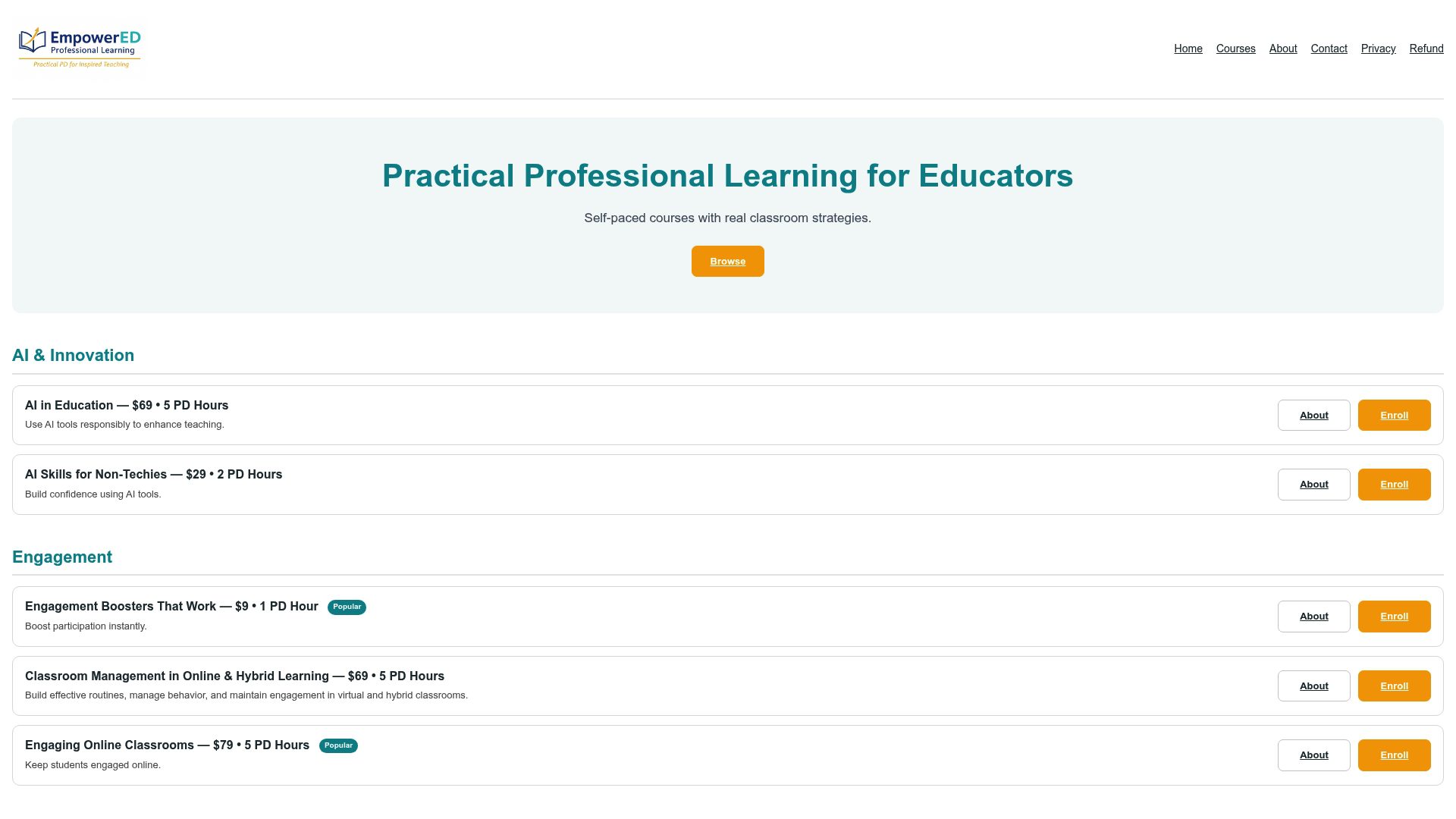
The Engagement Boosters That Work resource gives you concrete techniques that stack directly on top of a wait-time routine, from questioning sequences to participation structures that keep a paused classroom on task rather than drifting. If you are also exploring how technology fits into faster, better formative feedback, the AI in Education course walks through practical, ethical ways to use AI tools to track response patterns and free up your attention for the pause itself. Both are self-paced, include personalized feedback, and end with a certificate your school can count toward PD hours. Visit Empowered Professional Learning to browse the full course catalog and find the module that matches where your classroom is right now.
Where to Read More on Wait Time Research
- Wait-Time and Rewards as Instructional Variables (Rowe, 1972): The foundational study that established the link between longer pauses and richer classroom discourse.
- IRIS Center fundamental skill sheet: Wait time: A practitioner-friendly summary from Vanderbilt with clear K–12 recommendations and observable behavior changes.
- The Role of Wait Time During the Questioning of Children: A Systematic Review: A synthesis of 26 studies confirming the 3 to 5 second guideline and noting context-specific exceptions.
- Extending the Silence (Edutopia): A practitioner piece with classroom-ready framing for introducing longer pauses.
- Wait Time: Making Space for Authentic Learning: A university resource detailing both Wait Time I and II with practical classroom application.
Frequently Asked Questions
Why does wait time matter in classrooms?
Wait time matters because extending the pause after a question from under a second to 3 to 5 seconds gives students the processing time needed to construct fuller, more reasoned answers, which research consistently links to longer responses, higher participation, and stronger higher-order thinking.
How long should a teacher wait after asking a question?
Aim for 3 to 5 seconds, leaning toward 3 seconds for simple factual recall and closer to 5 seconds for questions requiring synthesis or reasoning, adjusting slightly longer for younger students or English learners.
What is the difference between Wait Time I and Wait Time II?
Wait Time I is the pause after you ask a question and before a student answers. Wait Time II is the pause after a student finishes speaking and before you respond, which is equally important for elaboration but often overlooked.
Can wait time be too long?
Yes. Pauses stretched well past the optimal range can increase off-task behavior and offer no added benefit for simple recall questions, so wait time works best when paired with structure like think-pair-share rather than open-ended silence.
How can I practice wait time without slowing my whole lesson down?
Start with one class period a day and one simple protocol, such as a silent three-second count followed by a quick pair-share, and track average response length and participation for two weeks before expanding the practice further.
Sources
- Wait-Time and Rewards as Instructional Variables: Their Influence on Language, Logic, and Fate (Rowe, 1972)
- Wait Time: Making Space for Authentic Learning (University resource)
- The Role of Wait Time During the Questioning of Children: A Systematic Review
- IRIS Center fundamental skill sheet: Wait time
- Extending the Silence (Edutopia)
Recommended
- 15 Classroom Management Techniques for K–12 Teachers – EmpowerED: Professional Development for Educators
- Classroom Routine Types Explained: Scripts for K–12 – EmpowerED: Professional Development for Educators
- Classroom Energy Management for K-12 Educators: 2026 Guide – EmpowerED: Professional Development for Educators
- Why Classroom Routines Improve Learning for K-12 Educators