Student engagement is defined as the cognitive, behavioral, and emotional involvement of students in their learning activities, and it is the single strongest predictor of academic achievement in K-12 classrooms. Research consistently links high engagement to better grades, stronger attendance, and greater persistence through academic challenges. Tools like Kahoot and Socrative, methods like Accountable Talk, and frameworks like Total Participation Techniques give educators concrete ways to move every student from passive observer to active learner. This guide draws on 2026 research findings to give you practical, tested strategies for building that engagement every day.
What is student engagement and why does it matter?
Student engagement operates across three dimensions: cognitive (mental effort and thinking), behavioral (participation and attendance), and emotional (sense of belonging and interest). All three must be present for learning to stick. A student who shows up but mentally checks out is behaviorally engaged but cognitively absent. That distinction matters because it changes which intervention you choose.
The academic stakes are real. Interactive technology tools like Socrative increase attendance and involvement by over 20% in some settings. That is not a marginal gain. It represents the difference between a student who earns credit and one who does not. When you understand engagement as a three-part construct rather than a single behavior, you can diagnose problems more precisely and target your response.

Motivation, self-efficacy, and resilience are the psychological core of engagement. Self-efficacy, the belief that effort will produce results, determines whether a student even attempts a difficult task. Resilience determines whether they continue after a setback. Both are teachable, and both respond directly to classroom conditions you control.
What psychological factors drive student engagement?
The psychological predictors of engagement are not abstract. Motivation, self-efficacy, and resilience are the three strongest positive predictors, with effect sizes ranging from β=0.166 to β=0.972 across a recent meta-analysis. That range tells you something important: no single factor works the same way for every student, which means one-size-fits-all engagement programs consistently underperform.
Here is how each factor functions in the classroom:
- Motivation is the engine. Intrinsic motivation, driven by curiosity and personal relevance, produces deeper learning than extrinsic rewards like grades or stickers. Choice-based assignments and project topics tied to students’ own communities are reliable ways to activate it.
- Self-efficacy determines effort. Students with high self-efficacy choose harder tasks, persist longer, and recover faster from failure. You build it through mastery experiences, meaning small, achievable wins that accumulate into confidence.
- Psychological resilience supports persistence. Students who have practiced bouncing back from setbacks stay engaged when content gets difficult. Normalizing mistakes through growth mindset teaching is one of the most direct ways to build this capacity.
The practical implication is clear: targeting psychological supports in your classroom is not soft work. It is the prerequisite for every other engagement strategy to function. A student who believes they cannot succeed will not respond to even the best collaborative learning design.
Pro Tip: Before introducing a new engagement strategy, assess where your students sit on self-efficacy. A quick anonymous survey with three questions about confidence, effort, and belonging takes five minutes and tells you which psychological lever to pull first.
Which teaching strategies most effectively enhance student participation?
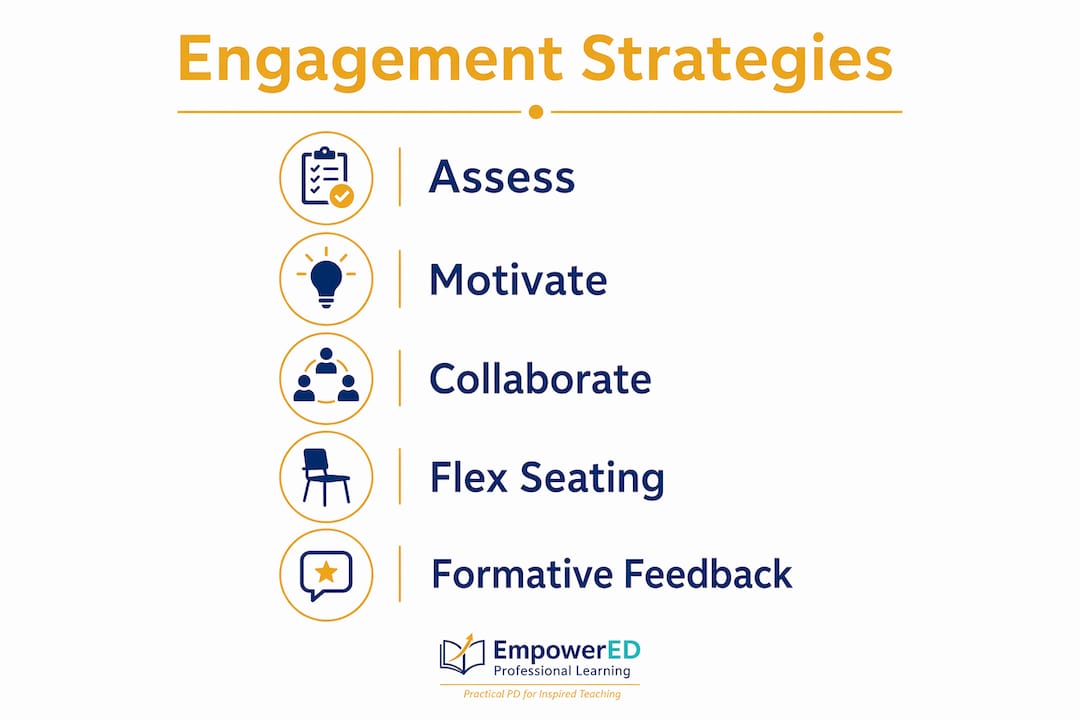
Evidence-based pedagogy gives you a ranked picture of what works. Authentic problem-solving produces the strongest effect on student persistence and critical thinking (β=0.364), followed by collaborative learning (β=0.325), and formative feedback (β=0.200). Each strategy works through a different mechanism, and combining all three produces compounding results.
Here is a practical sequence for integrating all three:
- Start with an authentic problem. Ground the lesson in a real scenario students recognize. A math class analyzing local traffic data, a science class testing water quality from a nearby creek. Authentic context activates intrinsic motivation before instruction begins.
- Structure collaborative learning around the problem. Assign roles within small groups: researcher, recorder, presenter, questioner. Role assignment prevents the common failure mode where two students do all the work and the rest disengage.
- Deliver formative feedback during the process, not just at the end. Exit tickets, mini-whiteboards, and daily formative checks give you real-time data on where students are struggling so you can redirect before confusion becomes disengagement.
- Use Total Participation Techniques to verify cognitive engagement. Chalkboard splash and similar techniques capture responses from 100% of students simultaneously, not just the three who raise their hands. This closes the gap between visible participation and actual thinking.
| Strategy | Effect size (β) | Primary mechanism |
|---|---|---|
| Authentic problem-solving | 0.364 | Activates intrinsic motivation and relevance |
| Collaborative learning | 0.325 | Builds social engagement and accountability |
| Formative feedback | 0.200 | Supports self-regulation and sustained effort |
Physical environment also matters. Flexible seating arrangements that allow students to shift between independent, partner, and group configurations reduce the friction of transitioning between these strategies. A classroom designed for one mode of learning limits the strategies you can deploy.
Pro Tip: Pair authentic problem-solving with a brief “expert share” at the end of each unit, where student groups present their findings to a real audience, such as another class, a school administrator, or a community partner. External audiences raise the stakes and sharpen motivation without adding grading burden.
How does teacher-student relationship quality affect engagement?
Teacher-student relationship quality is not just a nice-to-have. Structural equation modeling shows it fully mediates the effect of peer relationships on engagement and partially mediates the effect of grit, with a direct path coefficient of β=0.567. In plain terms: even a highly motivated, gritty student will disengage if the teacher-student relationship is weak. The relationship is the channel through which everything else flows.
Practical ways to build high-quality rapport include:
- Two-by-ten conversations. Spend two minutes for ten consecutive school days talking with a disengaged student about anything they choose. Research on this approach consistently shows it shifts student behavior and attitude within two weeks.
- Consistent, predictable routines. Students who know what to expect from you feel psychologically safe. Classroom routines reduce anxiety and free up cognitive space for learning.
- Culturally responsive acknowledgment. Recognize students’ cultural backgrounds, family structures, and community contexts as assets in the classroom. Students who see their identity reflected in the curriculum and in teacher interactions report significantly higher emotional engagement.
- Equitable participation structures. Cold calling combined with Think-Pair-Share preparation reduces participation anxiety and signals to every student that their voice is expected and valued.
“The quality of the teacher-student relationship is the single most powerful school-based factor in determining whether students choose to engage or withdraw.”
Cultural and contextual considerations shape how rapport is built. In some communities, direct eye contact signals respect; in others, it signals challenge. In some family cultures, questioning a teacher is encouraged; in others, it is discouraged. Knowing your students’ backgrounds allows you to build connection on their terms, not just yours.
What communication techniques promote equitable student participation?
Accountable Talk is a structured communication framework that uses categorized sentence starters to scaffold student-to-student and student-to-teacher dialogue. Sentence starters for agreement, clarification, and extension give students the language they need to participate confidently, especially students who are learning English or who have historically been quiet in class.
The three core categories of Accountable Talk starters are:
- Agreement and addition: “I agree with ___ because…” or “Building on what ___ said…”
- Clarification and questioning: “Can you explain what you mean by…?” or “I’m not sure I understand…”
- Extension and challenge: “Another way to think about this is…” or “What evidence supports that?”
Posting these sentence starters visibly in the classroom removes the cognitive barrier of not knowing how to enter a conversation. Teachers who use this approach report deeper conversations and increased student confidence, particularly among students who previously avoided participation.
The “Be an Active Learner” approach complements Accountable Talk by setting explicit behavioral expectations for listening, responding, and building on peers’ ideas. When both frameworks are modeled consistently, students internalize the norms and begin holding each other accountable without teacher prompting.
Pro Tip: Introduce one category of Accountable Talk starters per week rather than all three at once. Students who are overwhelmed by new language tools tend to avoid using them. A gradual rollout builds fluency and confidence before adding complexity.
Key takeaways
Effective student engagement requires targeting psychological factors, evidence-based pedagogy, strong teacher-student relationships, and structured communication simultaneously.
| Point | Details |
|---|---|
| Engagement has three dimensions | Address cognitive, behavioral, and emotional involvement to produce lasting academic gains. |
| Psychological factors are foundational | Build self-efficacy and resilience before expecting engagement strategies to work. |
| Authentic problem-solving leads | It produces the strongest effect on persistence and critical thinking among all pedagogical strategies. |
| Teacher-student relationships are the channel | Rapport mediates the impact of peer support and grit on engagement with a path coefficient of β=0.567. |
| Structured talk reduces barriers | Accountable Talk sentence starters increase confident participation, especially for quiet or reluctant students. |
What I’ve learned about sustainable engagement after years in K-12 classrooms
Most engagement failures I have observed are not strategy failures. They are sequencing failures. Teachers introduce collaborative learning before students trust each other. They deploy Kahoot before students believe their answers matter. They ask for participation before they have built the psychological safety that makes participation feel worth the risk.
The research on data integration for engagement confirms what experienced educators already sense: disengagement rarely appears without warning signs. Attendance dips, assignment completion rates drop, and participation patterns shift weeks before a student fully withdraws. Schools that connect academic data with engagement signals can intervene early. Most schools are not doing this yet, and that gap costs students.
My honest observation is that technology tools get overemphasized in professional development conversations about engagement. Kahoot is useful. Socrative is useful. But a student who does not trust their teacher will not be reached by a polling app. Relationship comes first. Data comes second. Technology amplifies what is already working; it does not create engagement from nothing.
The most durable engagement I have seen in K-12 classrooms comes from teachers who treat engagement as an ongoing diagnostic practice, not a one-time intervention. They use formative assessment types daily to read the room, adjust instruction, and signal to students that their understanding matters. That signal, repeated consistently, builds the trust that makes everything else possible.
— Brian Koster, Ed.D.
Build your engagement practice with Empoweredpl
Knowing the research is the starting point. Implementing it consistently across a full school year is the real work, and that is where targeted professional learning makes the difference.
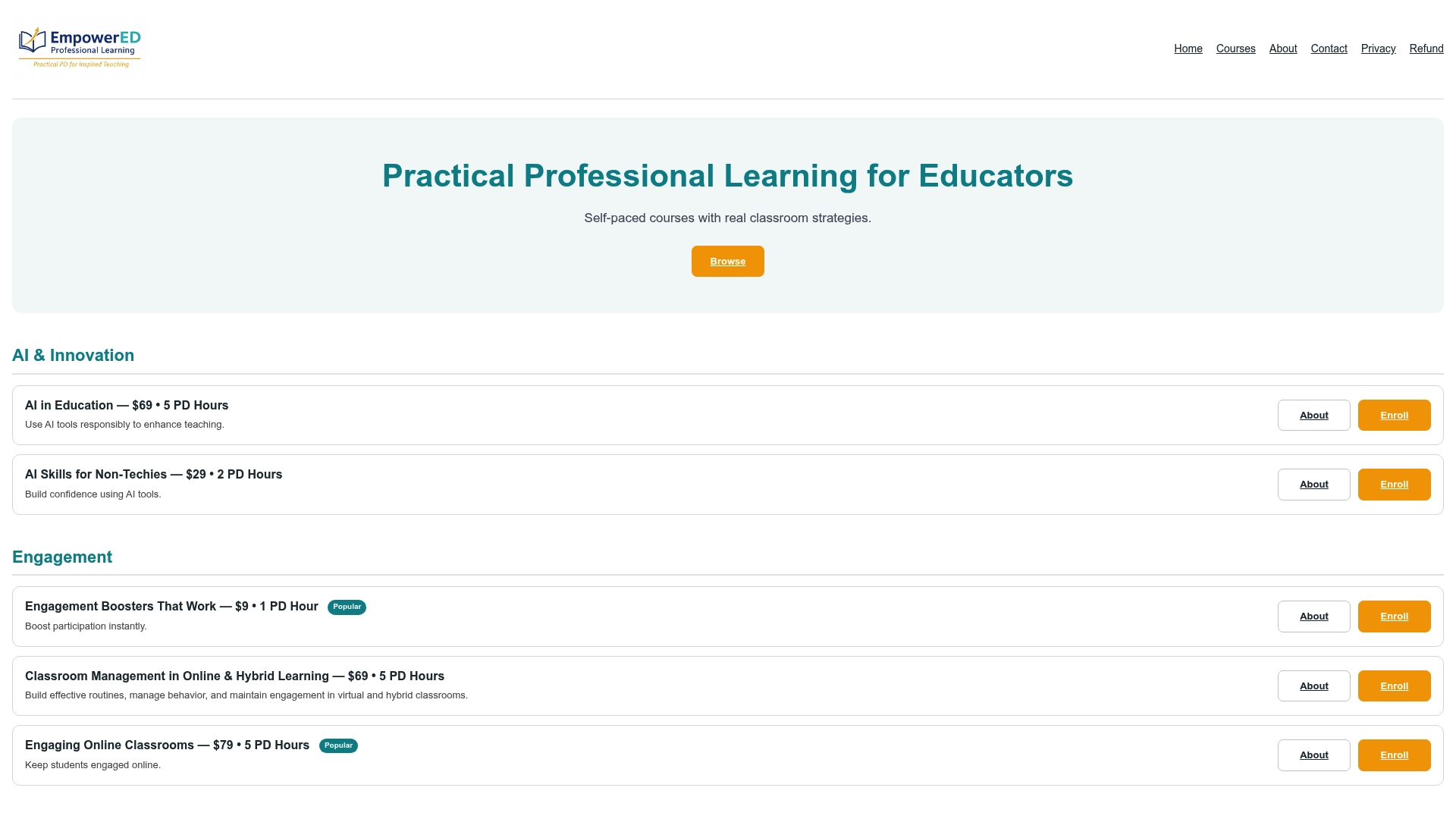
Empoweredpl offers practical online courses built specifically for K-12 educators who want to move from theory to classroom application. The hybrid learning routines course addresses participation structures across in-person and remote settings. The data-informed professional development course helps school leaders use engagement data to support teachers proactively. Every course is designed for immediate classroom use, not abstract reflection. Educators who complete Empoweredpl courses consistently report that strategies are ready to use the next school day. Explore the full course catalog at Empoweredpl and find the right fit for your immediate needs.
FAQ
What is the definition of student engagement?
Student engagement is the cognitive, behavioral, and emotional involvement of students in their learning activities. All three dimensions must be present for engagement to translate into academic achievement.
What are the most effective ways to engage students in K-12 classrooms?
Authentic problem-solving, collaborative learning, and ongoing formative feedback are the three most effective pedagogical strategies, with effect sizes of β=0.364, β=0.325, and β=0.200 respectively. Combining all three produces the strongest results.
How does the teacher-student relationship affect engagement?
Teacher-student relationship quality fully mediates the effect of peer relationships on engagement and partially mediates the effect of grit, with a direct path coefficient of β=0.567. Strong rapport is the prerequisite for most other engagement strategies to work.
What is Accountable Talk and how does it improve participation?
Accountable Talk is a structured communication framework using categorized sentence starters for agreement, clarification, and extension. Teachers report that it produces deeper conversations and increased confidence, particularly among students who typically avoid participation.
How can schools use data to support student engagement?
Linking student information systems with engagement signals like attendance and assignment completion allows schools to identify disengagement early and deliver personalized outreach before students fully withdraw.