A CEU, or continuing education unit, is a standardized measure of professional development time: one CEU equals 10 contact hours, with each contact hour representing 60 minutes of real instructional time. Most states accept CEUs toward license renewal, but the required totals, categories, and approved providers vary by state. Your next move is simple: pull up your state’s renewal cycle, confirm which categories you still need, and start saving every certificate you earn.
TL;DR:
- CEUs are based on contact hours, with one CEU equal to 10 contact hours of instruction, requiring verification of actual instructional time.
- State requirements vary widely, with some states emphasizing clock hours rather than CEUs and mandating specific category hours like STEM or wellness.
- Most professional development activities qualify if they have documentation such as transcripts, detailed certificates, and clear course descriptions from approved providers.
- A rough conversion shows that 3 CEUs are approximately equal to one semester hour of graduate credit, but district-specific rules may differ for salary or endorsement purposes.
- Teachers should verify their state’s renewal details, track earned credits proactively, and carefully choose PD that aligns with both licensing and career advancement goals.
Table of Contents
- What Is a CEU for Teachers, Exactly?
- Doing the Math: CEUs, Contact Hours, and Graduate Credits
- How State Renewal Rules Differ (and Where to Check Yours)
- How to Earn CEUs and Keep Them Audit-Ready
- CEUs vs. Graduate Credits: Which One Do You Actually Need?
- Your Renewal Cycle Checklist
- How EmpowerED Courses Map to Common Renewal Categories
- Appealing a Denied CEU Credit
- Using CEUs Strategically, Not Just for Compliance
- Where to Start Earning CEUs That Actually Help Your Classroom
- Sources
- FAQ
What Is a CEU for Teachers, Exactly?
The International Association for Continuing Education and Training set the standard most states and providers still use: 1 CEU equals 10 contact hours of instruction, and a contact hour is 60 minutes of actual learning time, not just time on a roster. That distinction trips people up. A three-hour workshop with a 30-minute lunch break usually counts as 2.5 contact hours, not three.
Federal guidance for early-education programs treats CEUs the same way, folding them into professional development records that programs must document for audits. Activities that typically qualify include:
- District-run workshops and full-day PD sessions
- Accredited online courses with a completion assessment
- Conference sessions with sign-in sheets or attendance verification
- University-administered noncredit coursework
- State-approved e-learning modules tied to your license area
Activities that usually don’t count: unstructured planning time, staff meetings, and informal mentoring without a syllabus or sign-in record.
Doing the Math: CEUs, Contact Hours, and Graduate Credits
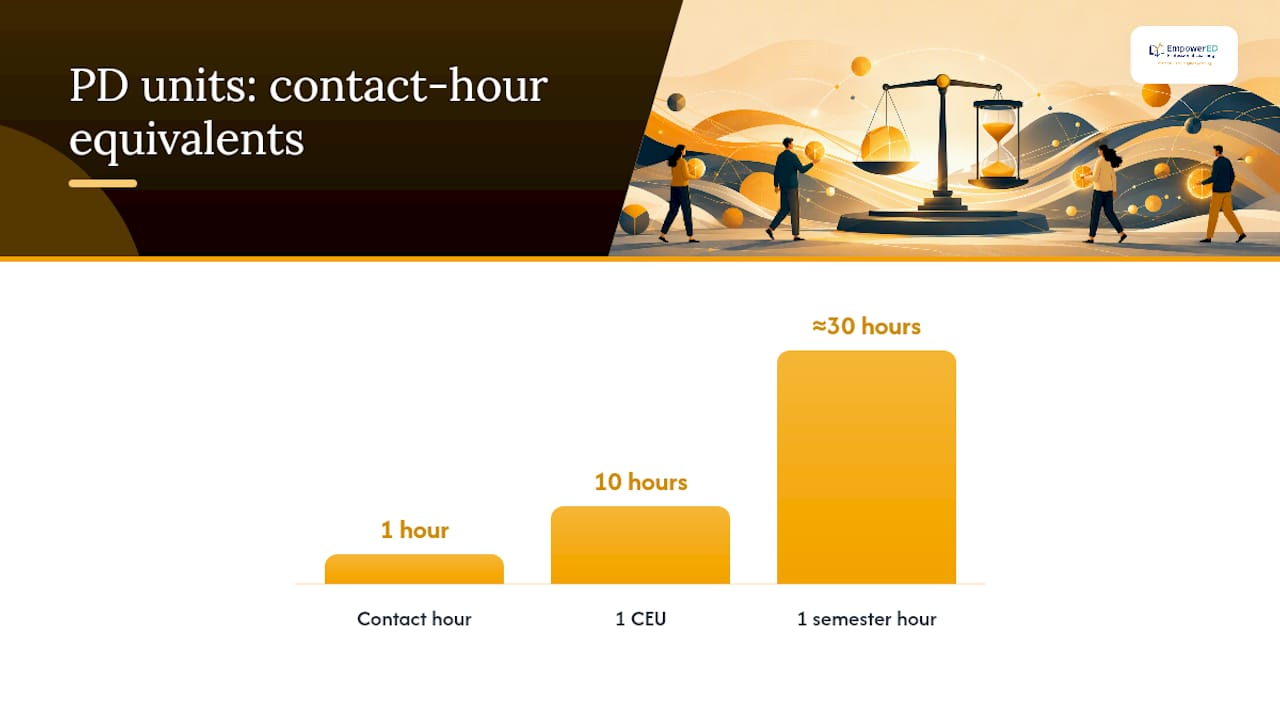
Once you know the base conversion, translating any PD activity into CEUs is arithmetic. A six-hour Saturday workshop equals 0.6 CEU. A 20-hour online course equals 2.0 CEUs. Multiply hours by 60 minutes to check the math, then divide by 10 to land on your CEU figure.
Graduate credit works on a different scale, and districts frequently ask teachers to convert one into the other for salary-lane purposes. The commonly used rule of thumb is that 3 CEUs is roughly equivalent to 1 semester hour of graduate coursework, though your district or state may apply its own conversion table.
Quick conversion reference: 1 CEU = 10 contact hours = 600 minutes of instruction. Roughly 3 CEUs lines up with 1 semester hour of graduate credit.
A few worked examples:
- 40 hours of summer institute training = 4.0 CEUs
- 4.0 CEUs ÷ 3 ≈ 1.33 semester hours (approximate, check your district’s table)
- 18 CEUs = 180 contact hours, a figure that shows up directly in at least one state’s renewal rule
How State Renewal Rules Differ (and Where to Check Yours)
No single national rule governs teacher recertification. Renewal cycles commonly run 2 to 5 years, and the CEU or clock-hour totals required inside that window shift from state to state. Washington’s system runs on clock hours rather than CEUs, where 60 minutes typically equals 1 clock hour, and the state sets specific totals for renewal periods. Ohio takes a different structure: certain license renewals accept a substantial number of CEUs or an equivalent amount of coursework, and the Local Professional Development Committee, or LPDC, has to verify what you submit.
Many states also mandate hours in specific topic categories rather than letting you bulk-load one subject. A state might require dedicated hours in reading instruction, equity, or STEM alongside your general PD total, which means a single 20-hour AI course won’t satisfy every box on its own.
Three concrete steps to confirm your own requirements:
- Bookmark your state Department of Education’s licensure or renewal page. This is the primary source, not a forum post or a PD vendor’s blog.
- Contact your district HR office or LPDC directly. They know which local rules layer on top of state minimums.
- Verify provider approval before you enroll. A course can be excellent and still get rejected if the provider isn’t on your state’s approved list.
How to Earn CEUs and Keep Them Audit-Ready
Not every certificate holds up under scrutiny. Providers that routinely produce acceptable documentation include accredited universities, state-approved PD vendors, your own district’s PD office, and established online platforms built specifically for educator licensure. Guides on teacher continuing education consistently point to the same pattern: the strongest proof includes a transcript or certificate showing hours completed, the instructor’s name, provider contact information, and a syllabus or description of learning objectives.
Here’s a practical sequence for staying organized:
- Confirm the activity qualifies before you enroll, ideally with a quick email to your LPDC or district PD office.
- Complete the course or workshop, keeping any assessment or reflection component finished, since some certificates only release after that step.
- Save the certificate immediately in a dedicated folder, digital or physical, labeled by renewal cycle year.
- Log the hours in your district’s tracking system, if one exists, the same week you finish.
- Cross-check the total against your state’s category requirements each fall, not the month before renewal.
Pro Tip: Email your LPDC or district PD coordinator before you pay for a course whenever you’re unsure it qualifies. A five-minute question up front beats an appeal after your certificate gets rejected.
CEUs vs. Graduate Credits: Which One Do You Actually Need?
CEUs and graduate credits solve different problems. CEUs satisfy license renewal in most states and cost less in both time and money. Graduate credits carry more weight for salary-lane advancement and are almost always required for adding an endorsement or moving to a higher degree tier on your district’s pay scale.
The two aren’t interchangeable everywhere. Salary lane movement typically requires coursework tied directly to your licensure area or classroom assignment, and a stack of unrelated CEUs won’t move you up a lane even if it renews your license just fine.
Quick decision rules:
- If your goal is simply staying licensed, CEUs from any state-approved provider generally work.
- If your goal is a salary bump or new endorsement, check whether your district requires an official university transcript.
- Red flag: if your HR office asks for a transcript and you only have a certificate, the credit likely won’t transfer to your pay scale, even though it may still count for renewal.
Your Renewal Cycle Checklist
Builds your plan in this order, and you avoid the last-minute scramble that catches so many teachers off guard:
- Find your renewal date on your license or your state DOE portal.
- Count backward to see how many years remain in your cycle.
- List the exact CEU or clock-hour total required, plus any mandated categories.
- Schedule approved activities across the full cycle instead of cramming them into the final year.
- Log certificates as you earn them, not in a shoebox to sort later.
Pro Tip: Set a recurring calendar reminder eighteen months before your renewal date. That gives you enough runway to fix a shortfall in any single category without panic-enrolling in whatever’s available.
The most common pitfall isn’t laziness. It’s assuming last year’s CEUs automatically apply to the current cycle when a state resets its category requirements between renewal periods.
How EmpowerED Courses Map to Common Renewal Categories
Three EmpowerED course areas line up directly with categories that show up across state renewal rules. Universal Design for Learning (UDL) & Accessibility fits the special education and inclusive-instruction hours many states require. Social-Emotional Learning & Teacher Wellness covers the SEL or educator wellness hours a growing number of districts now mandate. AI in Education addresses instructional technology PD, a category state approval lists increasingly recognize.
Each course produces a completion certificate listing hours and course content, which is the exact documentation format LPDCs and district HR offices ask for. Educators who’ve taken these courses describe them as immediately usable in the classroom rather than theoretical, which matters when you’re choosing PD that has to justify both your time and your renewal hours.
Appealing a Denied CEU Credit
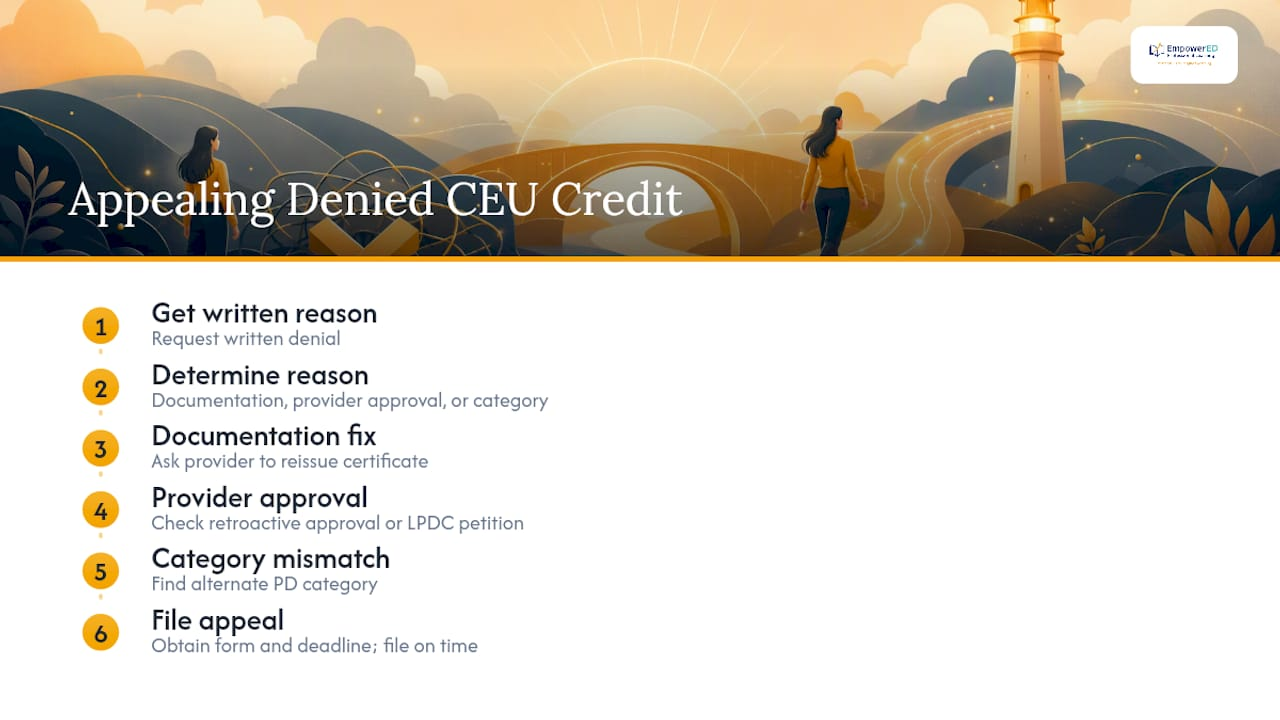
Districts and states reject CEU submissions more often than teachers expect, usually for one of three reasons: the provider wasn’t on the approved list, the certificate lacked required details, or the activity didn’t align with a mandated category.
If your LPDC or state denies credit, start with the paper trail. Request the specific reason in writing rather than accepting a verbal explanation, since written denials usually cite the exact policy section you failed to meet. That reason determines your next move.
If the issue is documentation, ask the original provider for a corrected certificate that includes the missing detail: instructor name, exact hours, or learning objectives. Most established providers reissue certificates quickly once they know what’s missing.
If the issue is provider approval, check whether your state has a retroactive approval process. Some states let LPDCs petition on a teacher’s behalf for a one-time exception, particularly when the course content clearly matches licensure requirements even though the provider wasn’t formally listed.
If the issue is category mismatch, look for an alternate category the same hours might satisfy. A course rejected as “instructional technology” might still qualify under general elective PD hours, depending on your state’s structure.
Every state handles formal appeals’ differently, so your LPDC or district HR office is the authority on the actual appeals procedure, not a general PD guide. Ask for the appeal form and deadline in the same conversation where you learn about the denial. Waiting risks missing the window entirely, since most appeal processes carry a filing deadline tied to your renewal date.
Using CEUs Strategically, Not Just for Compliance
The teachers who get the most out of CEUs treat them as a lever, not a chore. Choose courses that fix a real classroom problem, and the hours pay you back twice: once at renewal, once in your teaching. Pairing that mindset with courses that also support salary-lane goals is worth exploring on EmpowerED’s professional learning catalog.
— Brian Koster, Ed.D.
Where to Start Earning CEUs That Actually Help Your Classroom
Most PD feels like a box to check. EmpowerED Professional Learning is built by educators specifically so the hours you log also change what happens Monday morning in your classroom, not just what’s on your renewal paperwork.

Three course areas map directly to renewal categories teachers ask about most. Universal Design for Learning (UDL) & Accessibility runs $79 and targets special education and inclusive-instruction hours. Social-Emotional Learning & Teacher Wellness runs $49 and fits SEL or wellness mandates now common across districts. AI in Education: From Basics to Ethical Integration runs $69 and addresses instructional technology PD.
Every course produces a completion certificate with course hours and content clearly listed, ready to hand to your LPDC or district HR office as documentation. If you’re combining courses to hit a category total, the full professional learning catalog lets you mix and match without a subscription. Browse the current course lineup and pick the one that matches the category you’re still short on.
Sources
- Continuing Education Unit (CEU) Credit for Professional Development | Head Start
- Educator clock hour information | OSPI
- Renew an advanced, associate or professional license | Ohio SBOE
- What Are CEUs in Education and How Do They Work? | CLIMB
FAQ
How Many CEUs Equal One Credit Hour?
There’s no single national answer, since it depends on whether “credit hour” means a semester hour or a contact hour. Using the common academic rule of thumb, 3 CEUs is roughly equivalent to 1 semester hour of graduate credit, though your district may use a different table.
What Is the 70/30 Rule in Teaching?
This isn’t a standard CEU or licensure term, and definitions of it vary widely depending on who’s using it. If you’ve seen it referenced for classroom instruction ratios, check with your district for their specific definition rather than assuming a universal meaning.
How Are CEU Credits Determined?
CEU totals come directly from contact hours: one CEU equals 10 contact hours, with each contact hour representing 60 minutes of actual instructional time. A provider calculates your CEUs by tallying verified instructional minutes and dividing by 600.
How Many Hours Is 10 CEU?
Ten CEUs equal 100 contact hours, using the standard 1 CEU to 10 contact hours conversion. At 60 minutes per contact hour, some states’ renewal totals come close to this amount over a full multi-year cycle.
Can EmpowerED Course Certificates Be Used for State Renewal?
EmpowerED completion certificates list course hours and content, the documentation format most LPDCs and district HR offices request. Whether a specific course satisfies your state’s renewal requirement depends on your state’s approved-provider rules, so confirm with your LPDC before enrolling if you’re unsure.