Data-informed staff professional development is the systematic use of varied educational data, including student assessment results, classroom observations, and teacher reflections, to tailor teacher learning and improve instructional outcomes. This approach, also called data-driven teacher training in research literature, moves beyond generic workshops to target the specific needs of individual educators. A meta-analysis of 27 studies found that PD focused on teacher data use produces a medium-sized positive effect (g = 0.41) on student achievement. That number means schools using this approach can expect measurable gains in student performance, not just teacher satisfaction scores. Effective practices like instructional coaching cycles and professional learning communities (PLCs) are the delivery vehicles that make this evidence base real in your building.
What tools and data types are essential for data-informed professional development?
Data-informed staff professional development depends on collecting the right evidence before designing any learning experience. Four data streams form the foundation: student assessment data, structured classroom observations, teacher self-reflections, and digital usage logs from learning platforms. Each source tells a different part of the story, and no single stream is sufficient on its own.
Understanding the core data sources
Student assessment data, from tools like Illuminate Education or Renaissance Star assessments, reveals where students are struggling and points directly to the instructional skills teachers need to develop. Classroom observation data, gathered through rubrics like the Danielson Framework or the CLASS tool, captures what is actually happening in instruction. Teacher reflections and self-assessments add the practitioner’s perspective, surfacing beliefs and confidence gaps that observation alone cannot detect. Usage logs from platforms like Google Classroom or Canvas show engagement patterns that can indicate whether teachers are applying new skills.

A study of 37 elementary teachers found that integrating student data, observations, and reflections into PD decisions increased teacher pedagogical and professional competence by approximately 14%. That gain came specifically from combining data streams, not from using any single source. The DigCompEdu framework, developed by the European Commission’s Joint Research Centre, provides a structured lens for assessing digital competence specifically, which is increasingly relevant as schools expand technology use.
| Data Type | Primary Use | Key Limitation |
|---|---|---|
| Student assessment scores | Identify instructional skill gaps | Lags behind real-time classroom practice |
| Classroom observations | Capture live instructional behaviors | Observer bias can affect reliability |
| Teacher self-reflections | Surface beliefs and confidence levels | Self-reporting may not match actual practice |
| Digital usage logs | Track platform engagement and skill application | Does not measure quality of use |
| Formative feedback data | Monitor progress during PD itself | Requires consistent collection protocols |
Pro Tip: Triangulate at least three data streams before finalizing any PD focus area. Relying on a single source, like test scores alone, risks designing training that addresses symptoms rather than root causes. Intelligent triangulation of multiple evidence sources produces far more reliable decisions.
How can schools integrate data-informed strategies into PD planning?
Translating data into a PD plan requires a structured process, not just a review of spreadsheets at a faculty meeting. The goal is to connect what the data reveals about teacher learning needs to specific, sustained professional learning experiences. This is where many schools fall short: they collect data but skip the deliberate planning step that makes it useful.
Start by analyzing your combined data sources to identify patterns across classrooms and grade levels. Look for clusters of need rather than isolated individual gaps. If observation data shows that three-quarters of your math teachers struggle with questioning techniques, that is a school-wide PD priority, not a coaching conversation for one person.
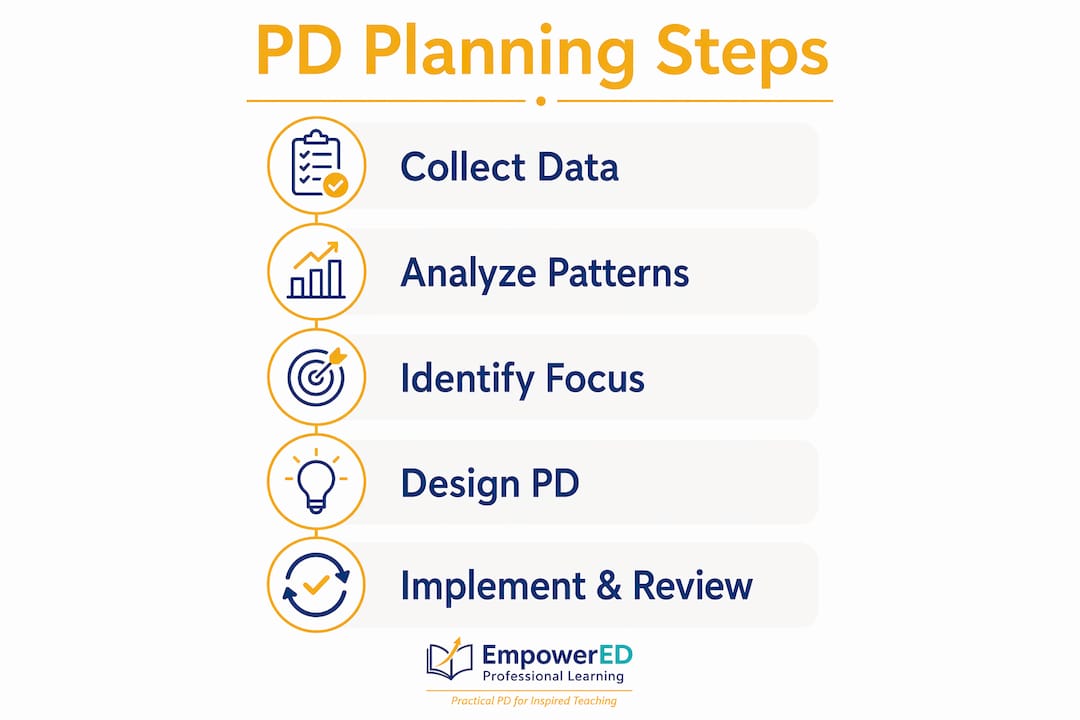
Next, design PD content that directly addresses the identified gaps. If formative assessment techniques are a weak point, build sessions around specific strategies like exit tickets, cold calling protocols, or peer assessment structures. Align each PD session to a measurable teacher behavior, not just a topic. This specificity is what separates evidence-based professional growth from generic training days.
Critical planning considerations include:
- Align data to goals. Every PD objective should trace back to a specific data finding. If you cannot name the data source that justifies a session, reconsider whether it belongs in the plan.
- Set observable teacher outcomes. Define what teachers will do differently in the classroom, not just what they will know after training.
- Involve teachers in the process. Teachers who help interpret the data and co-design the PD are far more likely to engage with it. PLCs are an effective structure for this collaboration.
- Plan for sustained follow-up. One-time workshops rarely produce lasting change. Build in coaching cycles, peer observation, and check-ins over at least a semester.
- Involve school leaders. Principals and instructional coaches must be active participants, not just schedulers. Their presence signals that PD is a professional priority.
What are effective ways to deliver and reinforce data-informed PD for lasting impact?
Delivery model matters as much as content. The research on sustained coaching and PLCs is clear: districts that moved away from one-time workshops to job-embedded, ongoing feedback models saw better teacher data use and stronger implementation of new practices. Three delivery models stand out for their effectiveness in K-12 settings.
Micro-learning cycles break PD into short, focused learning segments tied to a single skill or strategy. The SmartPD model, which uses AI-assisted micro-learning aligned to the DigCompEdu framework, produced statistically significant improvements in teacher digital competence within just two weeks. That speed matters in schools where time is the scarcest resource.
Instructional coaching cycles pair teachers with a coach for observation, feedback, and goal-setting conversations grounded in classroom data. This model works because it is personalized and continuous. A coach who reviews both student data and observation notes before a feedback conversation can connect the dots in ways a workshop facilitator cannot.
Professional learning communities create the peer accountability structure that sustains change over time. When teachers analyze student work together, set shared goals, and report back on what they tried, the data becomes a living part of professional culture rather than an annual report.
Here is a practical sequence for integrating coaching and feedback into your PD delivery:
- Collect baseline data from observations and student assessments before the PD cycle begins.
- Share findings with teachers in a collaborative review session, focusing on patterns rather than individual performance.
- Deliver targeted PD content tied directly to the identified gaps, using micro-learning formats where possible.
- Schedule a classroom observation within two weeks of the initial PD session.
- Hold a coaching debrief using the observation data and any new student outcome data collected since the training.
- Adjust the next PD session based on what the follow-up data shows about implementation progress.
Pro Tip: Personalized micro-cycles of PD reduce teacher cognitive overload and increase engagement. Keep individual learning segments under 20 minutes and tie each one to a specific classroom application teachers can try the same week.
What common challenges arise in data-informed PD and how to troubleshoot them?
Even well-designed PD programs run into predictable obstacles. Knowing what to watch for lets you address problems before they undermine the entire effort.
The most common failure is the one-and-done workshop. Surveys of teachers consistently show that PD perceived as irrelevant or lacking follow-up is ineffective, regardless of how well the session itself was designed. A single training day, even an excellent one, does not change instructional habits without reinforcement. The fix is structural: build follow-up into the PD calendar before the first session happens.
A second challenge is using the wrong data. Schools sometimes design PD around the data they have rather than the data they need. If your only source is annual state test scores, you are working with information that is months old and too broad to drive specific instructional decisions. Investing in more frequent, classroom-level data collection, through formative assessment tools or structured observation cycles, pays dividends in PD relevance.
A third challenge is teacher resistance, which often signals that the data was used to evaluate rather than support. When teachers feel that observation data or student scores will be used against them, they disengage from the process. Framing data as a shared diagnostic tool, not a performance metric, changes that dynamic.
| Challenge | Root Cause | Practical Solution |
|---|---|---|
| One-and-done PD | No follow-up built into the plan | Schedule coaching cycles and PLCs before PD launches |
| Irrelevant training content | Data not connected to real classroom needs | Triangulate multiple data sources before planning |
| Teacher resistance | Data perceived as evaluative | Position data as a shared diagnostic, not a judgment |
| Lack of implementation | No accountability structure | Use PLCs for peer reporting and shared goal-setting |
| Slow competence growth | Generic delivery formats | Shift to personalized micro-learning and AI feedback tools |
Key takeaways
Data-informed staff professional development produces measurable gains in both teacher competence and student achievement when it combines triangulated data sources, sustained coaching models, and personalized delivery formats.
| Point | Details |
|---|---|
| Triangulate data sources | Combine student assessments, observations, and reflections for reliable PD decisions. |
| Plan for sustained follow-up | One-time workshops rarely change practice; build in coaching cycles from the start. |
| Use micro-learning for delivery | Short, focused learning segments tied to specific skills increase engagement and speed competence growth. |
| Involve teachers in data review | Co-designing PD from shared data increases teacher buy-in and implementation rates. |
| Address resistance early | Frame data as a diagnostic support tool, not an evaluation instrument, to maintain trust. |
Why data culture matters more than any single PD program
I have worked with schools that had excellent data systems and terrible PD outcomes, and schools with modest tools that produced remarkable teacher growth. The difference was never the platform. It was whether the adults in the building trusted the data and each other enough to act on it honestly.
The research on strong implementation context confirms what I have seen directly: the design of the PD matters, but the culture around data use matters just as much. Schools that treat data as a shared professional resource, rather than an administrative requirement, get more out of every coaching conversation and every PLC meeting.
I am also direct about the role of technology here. AI-assisted tools like SmartPD are genuinely useful for scaling personalized feedback and reducing the time coaches spend on logistics. But technology does not replace the human judgment a skilled instructional coach brings to a post-observation conversation. The best approach pairs both: use analytics in faculty training to surface patterns and personalize content, then use human coaching to interpret and apply those insights in context.
My honest advice to administrators: stop asking whether you have enough data to start. You almost certainly do. The harder question is whether you have the structures, the trust, and the sustained commitment to act on what the data tells you. That is where the real work of evidence-based professional growth happens.
— Brian Koster, Ed.D.
How Empoweredpl supports data-informed staff development
Empoweredpl builds professional learning programs specifically for K-12 educators who want to move beyond generic training days. Their courses address real classroom challenges, from data literacy and formative assessment to engagement in hybrid learning environments, with content that teachers can apply immediately.
If your school is ready to build a sustained, data-informed PD culture, Empoweredpl’s professional learning programs offer structured courses with practical frameworks, coaching support, and tools aligned to current research. Educators report direct, same-week application of strategies learned. For schools working in hybrid settings, the hybrid learning routines course provides targeted support for using student data effectively across both in-person and remote contexts.
FAQ
What is data-informed staff professional development?
Data-informed staff professional development is the use of multiple evidence sources, including student outcomes, classroom observations, and teacher reflections, to design and deliver targeted teacher learning. It is the recognized industry standard for evidence-based professional growth in K-12 settings.
How does data-driven teacher training improve student outcomes?
A meta-analysis of 27 studies found that PD focused on teacher data use produces a medium-sized positive effect (g = 0.41) on student achievement. The gains are strongest when PD is sustained, specific, and tied to real classroom data rather than generic content.
What data sources should schools use for PD planning?
Schools should triangulate at least three sources: student assessment data, structured classroom observations, and teacher self-reflections. A study of 37 elementary teachers showed that combining these streams increased teacher competence by approximately 14%.
Why do one-time workshops fail to change teaching practice?
One-time workshops lack the follow-up and reinforcement that behavior change requires. Teacher surveys consistently show that PD without sustained coaching, peer accountability, or connection to real classroom challenges is perceived as irrelevant and produces little lasting change.
How can AI tools support analytics in faculty training?
AI-assisted tools like SmartPD use micro-learning and formative feedback aligned to frameworks like DigCompEdu to personalize PD at scale. Research shows these tools can produce statistically significant improvements in teacher digital competence within two weeks of use.