Growth mindset teaching is defined as the practice of helping students believe their intelligence and abilities can develop through effort, effective strategies, and feedback. Psychologist Carol Dweck introduced this framework through decades of research at Stanford University, and neuroscience has since confirmed that the brain physically changes in response to challenge and learning. A 2026 study of 600,000 students across 79 countries found that students with growth mindsets show higher academic resilience and achievement, especially when their peers share the same beliefs. For K-12 teachers, this is not a motivational concept. It is a teachable, measurable skill set that directly affects student engagement, persistence, and outcomes.
What is growth mindset teaching and why does it work?
Growth mindset teaching is grounded in three core components: effort, strategy, and feedback. Students learn that working hard matters, but working smart matters more. When a student hits a wall in algebra, growth mindset teaching does not tell them to try harder. It teaches them to ask: “What strategy have I not tried yet?”
The neuroscience behind this approach is concrete. Learning difficulties produce real brain changes, and explaining this to students makes the concept tangible rather than abstract. When a student understands that struggling with a concept is literally building new neural pathways, the struggle becomes purposeful rather than threatening.
“The view you adopt for yourself profoundly affects the way you lead your life.” — Carol Dweck, Mindset: The New Psychology of Success
Research confirms the academic impact. Data from over 300,000 students showed growth mindset correlations of .27 to .28 with improvements in math and language arts performance. That is a meaningful effect size for a belief system that costs nothing to teach. Growth mindset is especially effective for lower-achieving and disadvantaged students, where it functions as a cost-effective, targeted tool when integrated properly into instruction rather than applied as a blanket solution.
The contrast with a fixed mindset is direct. Fixed mindset students interpret difficulty as evidence of low ability. They avoid challenge, give up quickly, and see effort as pointless. Growth mindset students interpret the same difficulty as a signal to adjust their approach. That single cognitive shift changes how students engage with every lesson you teach.

Common misconceptions that undermine growth mindset teaching
The most widespread mistake educators make is treating effort praise as growth mindset teaching. Telling a student “You worked so hard!” is not the same as teaching growth mindset. Effort praise without strategy guidance can actually frustrate students who are trying hard but still failing. Genuine growth mindset teaching shows students how to change their strategy when they are stuck.
Several other misconceptions consistently derail implementation:
- Growth mindset is not binary. A student can have a growth mindset in writing and a fixed mindset in math. Mindset is domain-specific, and effective teaching targets the specific subject area where a student holds limiting beliefs.
- Hollow encouragement creates a “false” growth mindset. Posting motivational quotes and saying “You can do anything!” without connecting it to specific learning strategies produces no measurable change.
- Isolated lessons do not work. A single growth mindset workshop or unit does not build durable change. School-wide consistency is required to shift student beliefs over time.
- Mindset language without context backfires. Overusing phrases like “growth mindset” without tying them to real learning moments teaches students to perform the language, not internalize the belief.
Pro Tip: Audit your own feedback this week. Count how many times you praise effort versus strategy. If the ratio is heavily effort-focused, you have a concrete starting point for change.
The most effective growth mindset teaching is woven throughout the curriculum, not delivered as a standalone lesson. When a student struggles with a reading passage, that moment is the growth mindset lesson. The classroom culture you build around struggle, feedback, and revision is the real curriculum.
Practical strategies for implementing growth mindset in K-12 classrooms
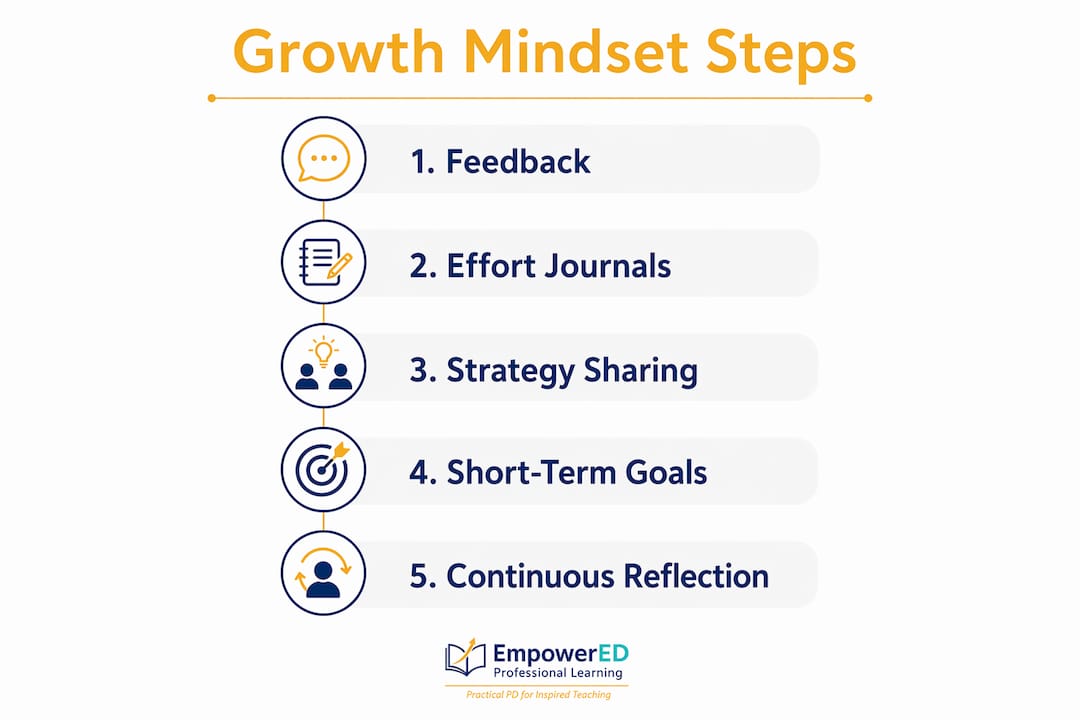
Effective implementation requires daily, structured practice. Here is a sequenced approach that works across grade levels:
- Start with morning mindset checks. A two-minute written or verbal prompt at the start of class sets the cognitive tone. Ask students: “What is one thing you want to understand better today?” This takes under five minutes but, practiced consistently, produces neuroplastic changes over 21 to 66 days.
- Use effort journals. Students record what strategies they used, what worked, and what they will try differently. This builds metacognitive awareness, which is the ability to monitor and adjust your own learning process.
- Design for productive struggle. Give students tasks at the edge of their current ability. Teacher Daniel Burke-Aguero notes that rescuing students too early undermines the productive struggle that builds real learning. Resist the urge to step in the moment a student looks confused.
- Reframe language around “yet.” “I can’t do this” becomes “I can’t do this yet.” This single word shift is not a trick. It signals that the learning process is ongoing and that current inability is not permanent.
- Set short-cycle goals. Daily and weekly goal setting breaks abstract growth into trackable steps. Younger students especially need concrete, immediate targets they can monitor themselves.
- Share your own learning stories. When you tell students about a skill you struggled to develop, you model that difficulty is normal and that adults continue to grow. This is one of the most underused tools in growth mindset teaching.
- Use tiered challenges. Offer tasks at three levels of complexity and let students choose their entry point. This removes the stigma of difficulty and builds self-regulation.
Pro Tip: Pair effort journals with a weekly two-minute share. Students who hear peers describe strategy adjustments internalize the process faster than those who only write privately.
The table below summarizes the most practical classroom strategies by grade band:
| Strategy | Best for grades | Time required |
|---|---|---|
| Morning mindset check | K-12 | 2-5 minutes |
| Effort journal | 3-12 | 5-10 minutes |
| “Yet” language reframing | K-12 | Ongoing |
| Short-cycle goal setting | K-8 | 5 minutes weekly |
| Tiered challenge tasks | 4-12 | Planning time only |
| Teacher learning stories | K-12 | 2-3 minutes |
You can also explore how classroom routines improve learning to see how these strategies fit into a broader daily structure that supports student mindset development.
How feedback styles shape growth mindset development
Feedback is the most direct lever teachers have for influencing student mindset. The difference between fixed feedback and growth feedback is not subtle. Fixed feedback evaluates the person. Growth feedback evaluates the process.
Fixed feedback sounds like: “You’re so smart,” “You’re a natural at this,” or “That was too hard for you.” Each of these statements, however well-intentioned, teaches students that their ability is a fixed trait being observed and judged.
Growth feedback sounds like: “You used a different approach this time and it worked,” “What strategy helped you get unstuck?” or “This draft shows you revised your argument. What changed in your thinking?” This type of feedback teaches students that their actions and choices drive their outcomes.
The “Not Yet” grading model, used in standards-based assessment systems, replaces failing grades with “Not Yet” to signal that mastery is the goal and the student has not reached it yet. This approach, combined with formative assessment techniques that provide frequent, specific feedback, keeps students oriented toward progress rather than performance.
Growth mindset also promotes adolescent well-being through hope and proactive self-improvement. Students who receive consistent growth-oriented feedback develop stronger goal pursuit behaviors and greater resilience under academic pressure. That is a measurable outcome beyond test scores.
Key takeaways
Growth mindset teaching works when it is embedded in daily feedback, classroom routines, and school culture rather than delivered as a one-time lesson or motivational exercise.
| Point | Details |
|---|---|
| Definition is precise | Growth mindset teaching develops belief in effort, strategy, and feedback as drivers of ability. |
| Research supports it at scale | A 2026 study of 600,000 students confirmed growth mindset links to higher resilience and achievement. |
| Effort praise is not enough | Process-focused feedback that teaches strategy adjustment produces stronger results than effort praise alone. |
| Mindset is domain-specific | Students may hold growth beliefs in one subject and fixed beliefs in another; target teaching accordingly. |
| Consistency drives results | School-wide integration over weeks and months creates durable mindset change; isolated lessons do not. |
What I have learned from watching growth mindset teaching succeed and fail
I have seen growth mindset teaching transform classrooms, and I have seen it become wallpaper. The difference is almost never about the quality of the initial training. It is about what happens on day 22, when the novelty has worn off and a student is still failing the same type of problem.
The teachers who make it work do not treat growth mindset as a unit they teach in September. They treat it as a lens they apply every time a student hits a wall. They have internalized the feedback language so thoroughly that it comes out naturally during a math lesson, a writing conference, or a hallway conversation.
What I would caution against is the performance of growth mindset. When teachers use the vocabulary without the substance, students notice. They are perceptive about authenticity. If you tell a student their struggle is valuable while simultaneously showing frustration that they are behind, the message they receive is the nonverbal one.
My practical advice: start with your own feedback language before you teach students anything about mindset. Record yourself during one class period and count how many times your feedback references ability versus strategy. That data will tell you more than any professional development session. Peer collaboration among teachers to share and critique feedback practices is the most underused professional development tool in this space. Find one colleague willing to do this with you, and you will improve faster than any workshop will make you.
— Brian Koster, Ed.D.
Build your growth mindset teaching practice with Empoweredpl
Knowing the research is the starting point. Embedding it into your daily classroom practice is where the real work happens.

Empoweredpl offers targeted professional development designed specifically for K-12 teachers who want practical, immediately applicable strategies. The hybrid learning routines course gives you structured classroom procedures that reinforce growth mindset principles across in-person and remote settings. Educators who complete Empoweredpl courses consistently report that the strategies translate directly into their classrooms the following week. If you are ready to move from understanding growth mindset to teaching it with confidence, explore Empoweredpl’s full course catalog and find the professional learning that fits your immediate needs.
FAQ
What is growth mindset teaching in simple terms?
Growth mindset teaching is the practice of helping students believe their abilities can develop through effort, strategy, and feedback rather than being fixed at birth. It is grounded in Carol Dweck’s research and supported by neuroscience showing the brain changes in response to learning challenges.
How is growth mindset different from fixed mindset in the classroom?
Students with a fixed mindset avoid challenge and interpret difficulty as evidence of low ability, while students with a growth mindset treat difficulty as a signal to adjust their approach. Teachers can shift this by changing how they give feedback and design learning tasks.
What are the most effective growth mindset strategies for K-12 teachers?
The most effective strategies include process-focused feedback, effort journals, short-cycle goal setting, productive struggle tasks, and consistent use of “yet” language. Daily routines practiced over 21 to 66 days produce measurable changes in student mindset and behavior.
Does growth mindset teaching actually improve academic performance?
Yes. Data from over 300,000 students showed growth mindset correlates at .27 to .28 with improvements in math and language arts. The effect is strongest for lower-achieving students when growth mindset is integrated into instruction rather than taught as a standalone concept.
How long does it take to see results from growth mindset teaching?
Research indicates that consistent daily routines produce neuroplastic changes over 21 to 66 days. School-wide integration over a full academic year produces the most durable results, while isolated lessons or one-time workshops show minimal long-term impact.