Teacher professional development (PD) is the structured, ongoing process by which educators build the knowledge, skills, and practices needed to improve student learning. The single most important design principle, supported by decades of research: PD must be sustained, content-focused, and job-embedded, with active practice and feedback built in. One-shot workshops rarely change classroom behavior. Sustained cycles do.
Three things you can act on right now:
- Prioritize job-embedded coaching over stand-alone workshops when choosing or requesting PD.
- Require any PD program to include modeling of the exact technique, followed by your own practice and feedback before the session ends.
- Align every PD goal to a specific curriculum unit or student learning gap, not to a general theme.
Pro Tip: Before your next PD session, email your principal one sentence: “I’d like to practice [specific technique] in my classroom this week and get feedback from a coach or peer. Can we schedule 20 minutes?” That single request starts a coaching cycle.
Key Takeaways
Effective teacher professional development requires sustained, content-focused, job-embedded learning with active practice and feedback, and well-designed PD is associated with a 0.18 SD gain in student achievement per 1 SD improvement in teacher-level outcomes.
| Point | Details |
|---|---|
| Sustained PD outperforms workshops | Single-session workshops rarely change classroom practice; multi-month cycles with coaching produce measurable shifts. |
| IGTP audit prevents common failures | Check that any PD addresses Insight, Goals, Techniques, and Practice; missing the Practice component is the most common reason PD does not stick. |
| Collaborative PD is teachers’ top choice | About 67% of teachers in a RAND survey said collaborative learning improved their teaching or student learning, making PLCs a strong first investment. |
| Student gains may lag one year | The IES early reading trial showed teacher practice change before student score gains; sustain the PD cycle past the first year before evaluating student impact. |
| Empowered Professional Learning fits the model | Empowered Professional Learning’s instructor-guided, classroom-ready courses address all seven LPI features and include personalized feedback and PD certificates. |
Table of Contents
- What does “development of teaching” actually cover?
- Why investing in teacher PD produces real results
- What makes professional development effective?
- What PD formats are available, and when should you use each?
- How to choose or design PD that actually works
- A sample PD program model you can adapt
- How to measure whether PD changed teaching and learning
- Applying new PD learning in your classroom right away
- How Empowered Professional Learning aligns to the research
- What the research gets right, and where implementation usually fails
- Practical PD courses built for K–12 educators
- Sources
What does “development of teaching” actually cover?
The phrase “development of teaching” and the more formal term teacher professional development are used interchangeably in U.S. education policy and research. Both refer to any deliberate, structured effort to improve an educator’s instructional practice. That is broader than credential programs (which confer a license) and narrower than informal hallway conversations, though informal peer learning does contribute.
PD operates at several levels simultaneously:
- Individual: A teacher pursues a course, reads research, or works with a coach on a specific skill.
- Team/grade-level: A department uses a professional learning community (PLC) to analyze student work and adjust instruction together.
- School-wide: A principal organizes a shared instructional focus, common observation protocols, and aligned coaching.
- System/district: A district designs a multi-year PD sequence tied to curriculum adoption and school improvement goals.
Stage models of teacher development
Researchers have proposed several frameworks describing how teachers grow over a career. The most commonly cited models share four to six stages:
- Survival/Novice: New teachers focus on classroom management and basic lesson delivery. PD need: structured mentoring and clear routines.
- Consolidation: Teachers stabilize routines and begin experimenting. PD need: peer observation and targeted skill-building.
- Renewal: Experienced teachers seek new strategies to re-engage. PD need: content-focused workshops, PLCs, and leadership opportunities.
- Maturity/Mastery: Veteran teachers refine practice and mentor others. PD need: peer coaching roles, curriculum leadership, and research engagement.
Some models add a fifth “expert” or “distinguished” stage for teachers who lead school-wide instructional improvement. Knowing which stage describes your current context helps you choose PD that fits. A first-year teacher needs mentoring and modeling; a ten-year veteran often needs collaborative inquiry and leadership stretch.
Why investing in teacher PD produces real results
The evidence that well-designed PD changes teaching practice is solid. The evidence that it directly raises student test scores is real but more conditional.
A meta-analysis of 46 experimental PK–12 math and science PD studies found that a 1 standard-deviation improvement in teacher-level outcomes is associated with an average 0.18 standard-deviation gain in student achievement. That is a meaningful signal: improving what teachers know and do moves the needle for students. The relationship is not automatic, though. Effect sizes vary widely across studies, and the authors note that context and study design affect results.
The IES early reading study adds an important caveat. A large randomized trial of two early reading PD interventions found that teachers gained knowledge and improved some instructional practices, but student achievement gains were not statistically significant at the end of one year. That result does not mean PD failed. It means one year of PD, even well-designed PD, may not be enough time for practice change to fully reach student outcomes. Intensity, focus, and sustainment all matter.
U.S. policy context: Title II-A
Federal Title II-A funds are the primary federal stream for teacher PD in U.S. public schools. The GAO review found that Title II-A’s requirements — evidence-based, sustained, data-driven, and classroom-focused — help districts use funds for higher-quality PD rather than one-time events. When you are making the case for PD funding to a school leader, framing your request around these four criteria increases the likelihood of approval.
What makes professional development effective?
The Learning Policy Institute’s synthesis of 35 rigorous studies identifies seven features that co-occur in effective PD programs. A separate systematic review coding 104 randomized trials developed the IGTP framework (Insight, Goals, Techniques, Practice) to explain why those features work. Together, they give you both a checklist and a mechanism.
The seven features and what to do with each
- Content-focused: PD centers on the subject matter teachers teach and the specific ways students learn it. Action: Before enrolling in any PD, ask “Does this address the content my students struggle with most?”
- Active learning: Teachers analyze student work, practice new strategies, and receive feedback rather than passively listening. Action: Require at least one practice-and-feedback cycle in any session you attend.
- Collaboration/job-embedded: Learning happens with colleagues, tied to real classroom challenges. Action: Pair any external PD with a follow-up PLC session where you apply and debrief the strategy.
- Models of practice: Effective PD shows teachers what the strategy looks like in action, not just describes it. Action: Ask providers to include video or live demonstration of the technique before you practice it.
- Coaching and expert support: An instructional coach or content expert provides ongoing, in-classroom guidance. Action: Identify one coach or peer who will observe you using the new technique within two weeks of the PD.
- Feedback and reflection: Teachers receive specific, timely feedback and have structured time to reflect. Action: Use a brief written reflection (three sentences) after each classroom application.
- Sustained duration: High-quality PD unfolds over months, not hours. Action: Decline any PD that ends with a single session and offers no follow-up structure.
How IGTP maps to these features
The IGTP framework explains the mechanism behind the features. Insight (I) builds awareness of a gap between current and desired practice. Goals (G) set a specific, measurable target. Techniques (T) introduce the instructional strategy. Practice (P) embeds that strategy in real classroom use with feedback. Programs that address all four components are more likely to produce lasting practice change. The most common failure point is skipping P: teachers learn a technique but never practice it under observation, so it never sticks.
Pro Tip: When designing or evaluating a PD sequence, run the IGTP audit: write one sentence for each letter describing what the program does. If you cannot write the P sentence, the program is incomplete.
What PD formats are available, and when should you use each?
Different formats serve different goals. Choosing the right format for your specific need is as important as choosing the right content.
| Format | Best for | Practical constraints | When to use it |
|---|---|---|---|
| Workshops (single or multi-day) | Introducing a new technique or framework to a large group | Low transfer without follow-up; high cost per teacher if off-site | Launching a new curriculum or strategy; works best paired with coaching |
| Instructional coaching | Changing specific classroom practices | Requires trained coaches; time-intensive; 1:1 or small group | When a teacher needs to shift a persistent habit or implement a complex strategy |
| Professional learning communities (PLCs) | Collaborative curriculum work and data analysis | Needs structured protocols; can drift without facilitation | Ongoing, school-year-long improvement cycles; analyzing student work |
| Classroom observation visits | Learning from peer practice; reducing isolation | Requires coverage; scheduling complexity | When teachers benefit from seeing a strategy modeled in a real classroom |
| Online/self-paced courses | Flexible skill-building on specific topics | Low accountability without coaching layer; variable quality | Individual skill gaps; hybrid or remote teams; cost-constrained contexts |
| Graduate degree programs | Deep content or pedagogical knowledge | High cost; long duration; limited immediate classroom transfer | Career advancement; specialized content expertise |
| Conferences | Exposure to new ideas; networking | Expensive; low transfer without follow-up plan | Renewal stage teachers; identifying new directions for team PD |
Online PD for K–12 educators has expanded significantly and can deliver high-quality content when it includes structured practice, feedback, and a coaching layer. Self-paced formats work best when paired with a job-embedded application plan rather than used as a stand-alone experience.
How to choose or design PD that actually works
A clear decision framework prevents the most common mistake: choosing PD based on convenience rather than fit.
Decision framework
- Define the goal: What specific student learning gap or instructional challenge are you addressing? Name it in one sentence.
- Map to content: Does the PD address the subject matter and grade level where the gap exists?
- Select the format: Which format best supports the goal given your time, budget, and coaching resources?
- Build in practice and feedback: How will teachers practice the technique and receive feedback before the PD cycle ends?
- Plan for sustainment: What happens in months two through six? Who provides coaching, and how often?
- Define measurement: How will you know if practice changed? What student data will you track?
Evaluation checklist: questions to ask any PD provider
- What is the evidence base for this program? Can you share a study or evaluation report?
- Does the program include modeling of the exact instructional technique?
- Is coaching or expert support included, or is it an add-on?
- How many hours of contact time does the program require, spread over how many months?
- How does the program align to our current curriculum and student data?
- How do you measure teacher practice change?
Red flags to watch for
- A single-day workshop with no follow-up structure.
- No classroom modeling or demonstration of the technique.
- No alignment to your school’s curriculum or student learning goals.
- Provider cannot name a peer-reviewed study supporting the program.
- No mechanism for teacher practice or feedback during the program.
Funding notes
Title II-A funds require PD to be evidence-based, sustained, data-driven, and aligned to school improvement goals. Framing your PD request using those exact criteria increases approval chances. The GAO review confirms that districts using Title II-A for sustained, coherent PD sequences report better outcomes than those using it for one-time events. A practical tip: attach your PD request to a specific student data point (e.g., “our grade 4 reading fluency scores dropped 8 points”) to make the case concrete.
One important tension: research from a study on teacher PD preferences found that teachers often prefer shorter, one-shot workshops, while research consistently favors sustained PD. Acknowledging that preference gap with your team, and explaining why sustained formats produce better outcomes, helps build buy-in before a multi-month cycle begins.
A sample PD program model you can adapt
This model follows the IGTP structure and incorporates all seven Learning Policy Institute features. It is designed for a grade-level team of four to eight teachers, with one instructional coach.
Core components
- Content focus: One specific instructional strategy tied to a current curriculum unit (e.g., structured academic discussion for reading comprehension).
- Modeling session: Coach or lead teacher demonstrates the strategy in a real or simulated classroom.
- In-class rehearsal: Each teacher practices the strategy in their classroom within one week of modeling.
- Coaching cycles: Coach observes each teacher once every three weeks and provides written feedback within 48 hours.
- PLC reflection: Team meets every two to three weeks to share student work samples and adjust the strategy.
- Data review: Team reviews a common student assessment at the midpoint and end of the semester.
Sample semester timeline
- Week 1: Kick-off session. Coach models the strategy. Teachers observe and ask questions. Each teacher sets one specific practice goal.
- Week 2: Teachers implement the strategy in their classrooms. Coach conducts first brief observation (15 minutes) for each teacher.
- Weeks 3–4: First PLC reflection. Teachers share early student work samples. Coach provides group feedback on common patterns.
- Month 2: Second coaching observation cycle. Individual feedback conferences. Teachers adjust based on student data.
- Month 3: Mid-semester data review. Team analyzes common assessment results. Adjust strategy application if needed.
- Months 4–5: Third coaching cycle. Teachers begin peer observation pairs. PLC shifts to student work analysis.
- Month 6: Final data review. Team documents practice changes and student outcome shifts. Plan next cycle.
Metrics to track
- Teacher practice: Observation rubric score on the target strategy (collected at weeks 2, 6, and 12).
- Teacher reflection quality: Depth of written reflections after each classroom application.
- Student participation: Frequency of student academic talk or task engagement during the target strategy (collected by coach during observations).
- Student assessment: Common formative assessment scores at midpoint and end of semester.
- Fidelity: Percentage of planned coaching observations completed on schedule.
For classroom-ready PD modules that fit this structure, Empowered Professional Learning offers self-paced courses with instructor feedback that can serve as the content-focus layer in a program like this.
How to measure whether PD changed teaching and learning
Measurement does not need to be complex. It needs to be consistent and tied to the goals you set at the start.
Short, mid, and long-term measurement plan
- Short-term (weeks 1–4): Practice change. Use a classroom observation rubric focused on the target strategy. Score teachers on frequency and quality of use. Collect at least two observation data points before drawing conclusions.
- Mid-term (months 2–3): Classroom indicators. Track student engagement proxies: participation rates, task completion, quality of student work samples. These shift faster than test scores and give early signal.
- Long-term (months 4–6+): Student outcomes. Analyze common formative assessment scores and, where available, benchmark or summative data. Compare to prior-year baseline.
Interpreting effect sizes
The meta-analytic finding of a 0.18 SD student achievement gain per 1 SD improvement in teacher outcomes is a useful benchmark. In practical terms, a 0.18 SD gain is roughly equivalent to moving a student from the 50th to the 57th percentile. That is a real, meaningful shift at scale, even if it looks modest in a single classroom.
Statistic to share with your principal: A 0.18 SD student achievement gain per 1 SD improvement in teacher-level PD outcomes, drawn from a meta-analysis of 46 experimental PK–12 math and science studies.
The IES early reading study is a useful reminder that student achievement gains may not appear until the second year of sustained PD. If your first-year data shows teacher practice change but not yet student score gains, that is expected. Stay the course.
Fidelity checks
- Confirm coaching observations are happening on schedule (monthly review of observation logs).
- Confirm PLC meetings are using structured protocols, not drifting into logistics.
- Confirm teachers are applying the target strategy in the specific lesson types it was designed for.
Applying new PD learning in your classroom right away
The gap between a PD session and actual classroom change is where most learning is lost. These steps close that gap.
Action plan for applying one new technique
- Name the technique you will apply and the specific lesson where you will use it (e.g., “structured turn-and-talk during the close reading lesson on Tuesday”).
- Set one observable goal for that lesson: what will students be doing differently if the technique works?
- Prepare the materials the technique requires (sentence starters, discussion prompts, timer).
- Teach the lesson and note one moment where the technique worked and one where it did not.
- Write three sentences after the lesson: what happened, what you would change, and what you will try next time.
- Share your notes with a peer or coach before your next PLC meeting.
Microteaching protocol for PLCs
Microteaching is a structured rehearsal format where a teacher practices a five to ten minute segment of a lesson with peers acting as students, followed by immediate feedback. The protocol:
- Teacher states the technique and the goal (one minute).
- Teacher delivers the micro-lesson (five to eight minutes).
- Peers give structured feedback: one specific strength, one specific suggestion (five minutes).
- Teacher reflects aloud on what they would adjust (two minutes).
This protocol, grounded in active learning strategies used in effective PD, takes less than 20 minutes and produces faster practice change than passive observation alone.
Reflection prompts
After your first two or three applications of a new technique, use these prompts:
- What did students do that showed the technique was working?
- Where did the lesson stall, and what caused it?
- What would I change about my setup or delivery next time?
- What do I need to learn more about to use this technique well?
Pace yourself. Trying to apply three new strategies at once produces none of them well. Pick one technique per four to six week cycle and build it to automaticity before adding the next.
How Empowered Professional Learning aligns to the research
The research characteristics described above are not abstract ideals. They translate directly into course and program design decisions. Empowered Professional Learning builds its courses around these principles.
| Research characteristic | How Empowered Professional Learning addresses it |
|---|---|
| Content-focused | Courses target specific instructional challenges: AI integration, engagement, data literacy, hybrid management, UDL, SEL, and executive function. |
| Active learning | Courses include application activities and reflection prompts tied to real classroom scenarios, not passive video viewing. |
| Job-embedded practice | Each course provides classroom-ready strategies teachers can apply in the next lesson, with implementation guidance. |
| Models of practice | Course content demonstrates techniques in context, showing what effective use looks like before asking teachers to try it. |
| Feedback and reflection | Instructor-guided courses include personalized feedback on submitted work, not just automated quizzes. |
| Sustained engagement | Self-paced format allows teachers to return to content across weeks, fitting PD into a school schedule rather than requiring a single block. |
| PD certificates | Courses award certificates that satisfy many district PD hour requirements, supporting Title II-A documentation. |

Schools and districts interested in a pilot can explore Empowered Professional Learning’s professional learning programs, which include bulk licensing options for teams. Individual teachers can browse the full course catalog at Empoweredpl.

What the research gets right, and where implementation usually fails
The seven features from the Learning Policy Institute and the IGTP framework are well-supported. The research on what effective PD looks like is clearer than it has ever been. The problem is not knowledge. It is execution.
Most PD failures happen at the same point: the transition from the training room to the classroom. A teacher learns a strategy, practices it once in a workshop, and then returns to a schedule with 28 students, three preps, and no coach. The strategy disappears within two weeks. This is not a motivation problem. It is a structural one.
The preference gap identified in research on teacher PD preferences matters here. Teachers often prefer shorter, more flexible PD, and that preference is rational given their workload. The answer is not to dismiss sustained PD as impractical. It is to design sustained PD that respects teacher time: shorter, more frequent touchpoints rather than multi-day retreats, coaching embedded in existing schedules, and PLCs that replace rather than add to meeting time.
One more thing practitioners underestimate: the sequencing of PD features matters as much as their presence. Insight before goals. Goals before techniques. Techniques before practice. Running those steps out of order, say, introducing a technique before teachers understand why their current approach has a gap, produces resistance rather than uptake. The IGTP sequence is not arbitrary. It reflects how adults change behavior.
Practical PD courses built for K–12 educators
Empowered Professional Learning offers self-paced, instructor-guided online PD courses designed specifically for K–12 teachers, coaches, and administrators. Every course is built around classroom-ready strategies with immediate application potential, covering topics from AI in education and student engagement to data literacy, hybrid learning, UDL, and SEL.
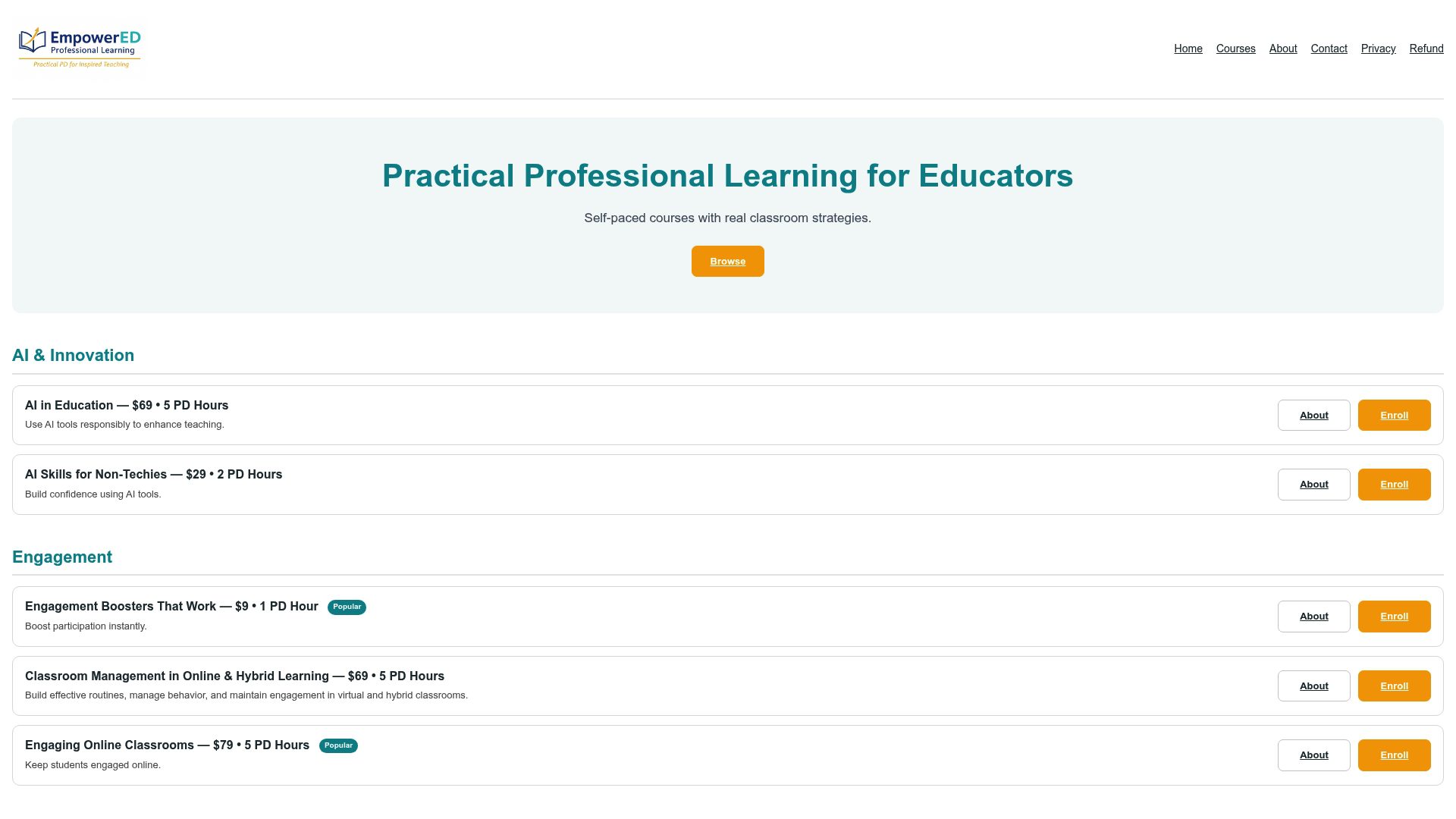
Unlike generic PD resources, Empowered Professional Learning courses include personalized instructor feedback and award PD certificates that meet most district documentation requirements. Schools and districts can access bulk licensing for teams, making it straightforward to run a structured pilot without a large upfront commitment.
Suggested next steps for schools:
- Review the professional learning course catalog and identify two or three courses aligned to your current school improvement goals.
- Contact Empowered Professional Learning about bulk licensing options for your grade-level team or department.
- Schedule a brief kickoff conversation to align course content to your existing curriculum and coaching structure.
Individual teachers can enroll directly in any course and begin applying strategies in their classroom within the first session.
Sources
- Effective Teacher Professional Development
- What are the Characteristics of Effective Teacher Professional Development? A Systematic Review and Meta-analysis
- The Impact of Two Professional Development Interventions on Early Reading Instruction (IES study)
Recommended
- Professional Development for Educators: A Practical 2026 Guide – EmpowerED: Professional Development for Educators
- Growth Mindset Teaching for K-12 Educators: 2026 Guide
- Online Teaching PD for K–12: What to Pick and Why – EmpowerED: Professional Development for Educators
- Professional Development for Teachers: Practical, Research-Backed Options – EmpowerED: Professional Development for Educators