Learning for teaching means sustained professional learning that changes what you actually do in the classroom. It is the recognized industry term for this practice: teacher professional learning (also called professional development, or PD). Here is where to start right now:
- Identify one specific classroom problem you want to solve (low engagement, inconsistent feedback, unclear instructions).
- Choose a job-embedded PD format that fits your schedule (coaching, a professional learning community, or a structured online course with practice tasks).
- Set a 6–8 week cycle to test one new technique, observe results, and adjust.
Pro Tip: The highest-return small test is a 2-week rehearsal plus peer feedback cycle. Teach a short segment, get a colleague to observe or watch a recording, and revise before repeating. Two weeks is enough to see whether a technique is taking hold.
Key Takeaways
Effective teacher professional learning requires sustained, job-embedded design with coaching, rehearsal, and feedback built in — not a single workshop day.
| Point | Details |
|---|---|
| Sustained design beats one-shot workshops | PD lasting 6+ weeks with practice tasks consistently outperforms single-day formats in classroom transfer. |
| IGTP balance drives impact | Programs addressing all four purposes (insight, goal, technique, practice) are more likely to produce lasting change. |
| Most teachers value collaboration | GAO-cited RAND survey data show most teachers find collaborative PD most useful for improving instruction. |
| An 8-week cycle is a practical unit | Plan, rehearse, observe, and iterate across 8 weeks to collect real evidence and maintain momentum. |
| Empowered Professional Learning fits the model | Courses include practice tasks, personalized feedback, and classroom-ready content aligned to evidence-based PD design. |
Table of Contents
- What does “learning for teaching” actually cover?
- Why teacher learning matters for students, teachers, and schools
- What does the research say about professional development effectiveness?
- What design features make professional development effective?
- Which PD models reliably support classroom change?
- Practical strategies you can test in your classroom this week
- How do you choose a high-quality PD program?
- How to implement a PD cycle that actually sticks
- What targeted PD actually changes in practice
- Empowered Professional Learning courses built for this kind of growth
- Sources
What does “learning for teaching” actually cover?
Teacher professional learning spans three broad phases: preservice (preparation before entering the classroom), in-service PD (formal training during a teaching career), and job-embedded learning (ongoing inquiry and practice woven into daily work). According to ScienceDirect’s overview of teacher learning, this is a continuous, career-long process, not a single event.
Most educators are familiar with the one-shot workshop: a full day on a new curriculum, a speaker on differentiation, then back to class on Monday with no follow-up. Research consistently shows that format rarely changes practice. Sustained PD, by contrast, builds in practice opportunities, coaching, and feedback over weeks or months.
| Feature | One-Shot Workshop | Sustained Professional Learning |
|---|---|---|
| Duration | 1 day or less | 6+ weeks, often a semester |
| Practice opportunities | None during the session | Repeated, classroom-embedded |
| Follow-up | Rare | Structured (coaching, PLCs, check-ins) |
| Likely classroom transfer | Low | Moderate to high |
A few terms appear throughout this guide and in most PD literature:
Job-embedded PD happens during the school day, tied directly to what teachers are teaching right now. Coaching means an instructional coach or peer observing and giving structured feedback on classroom practice. A PLC (professional learning community) is a team of teachers who meet regularly to examine student data and refine instruction together. Collaborative learning refers to any PD format where teachers work with peers rather than receiving information passively.
Why teacher learning matters for students, teachers, and schools
Professional learning helps teachers refine their practice, and that refinement connects to student learning gains. The connection is real, though the strength of the effect depends heavily on how the PD is designed. Teachers who engage in sustained, collaborative learning tend to report higher confidence, stronger instructional skills, and greater satisfaction with their work.
According to a GAO synthesis of meta-analyses and RAND survey data, many teachers said collaborative PD improved their teaching or their students’ learning to a moderate or large extent. That is a strong signal from practitioners, and it aligns with what the research on design features shows.
The benefits show up across three groups:
For teachers:
- Stronger instructional skills and confidence in specific techniques
- Higher retention rates when PD is connected to real classroom challenges
- Greater sense of professional agency and self-efficacy
For students:
- More consistent use of effective teaching strategies
- Better feedback loops and formative assessment practices
- Increased engagement when teachers apply new approaches
For school leaders:
- Improved alignment between instruction and school or district standards
- A shared professional vocabulary across grade levels and departments
- Evidence of growth that supports teacher evaluation conversations
What does the research say about professional development effectiveness?
Professional development is generally associated with improved student outcomes, but the effect varies significantly by design. Programs that include multiple, well-chosen mechanisms consistently outperform those built around a single approach.
The IGTP framework, developed by Sims, Fletcher-Wood, and colleagues, organizes PD mechanisms into four purposes: Insight (building awareness of a problem), Goal-directed behavior (motivating change), Technique (teaching a specific skill), and Practice/embedding (supporting repeated use until it becomes routine). Programs that address all four purposes are more likely to show positive effects than those that address only one or two.
Programs that incorporate more mechanisms across the IGTP framework tend to be more effective, according to a systematic review that coded PD programs for 14 distinct mechanisms. Neglecting any one purpose increases the chance that teachers revert to old habits once the PD ends.
A meta-analytic test of the IGTP framework found that PD including rehearsal, feedback, modeling, and practical social support is more likely to change classroom practice than content delivery alone. The effect sizes reported in review literature are modest on average, which is worth understanding clearly: a small average effect across many programs still means some well-designed programs produce meaningful gains, while poorly designed ones produce little.
The GAO report also highlights a persistent gap between what the evidence recommends and what districts actually fund. Title II-A dollars, the primary federal funding stream for teacher PD, are commonly used for short workshops rather than the sustained, job-embedded models that research supports. Districts that align scheduling and mentoring structures to support collaboration report better implementation fidelity.
What the evidence does not resolve:
- Effect sizes vary widely across subject areas, grade levels, and school contexts
- Most rigorous studies focus on literacy and math; evidence in other content areas is thinner
- Teacher motivation and school culture moderate how well any PD design works in practice
What design features make professional development effective?
Effective PD combines multiple elements working together. The Learning Policy Institute’s review of 35 rigorous studies identifies seven shared features: content focus, active learning, collaboration, coaching and expert support, feedback and reflection, sustained duration, and coherence with school goals.
No single feature is sufficient on its own. A program with strong content but no practice opportunities, or with collaboration but no feedback, tends to fall short.
Checklist for evaluating a PD plan:
- Duration of at least 6–8 weeks, with multiple sessions (not a single day)
- Active learning tasks: teachers practice the technique, not just hear about it
- Coaching or peer observation built into the cycle
- Job-embedded tasks tied to current classroom content
- Structured rehearsal opportunities before full classroom implementation
- Feedback loops: someone reviews practice and responds with specific guidance
- A measurement plan: how will you know if it worked?
- Alignment to school or district instructional priorities
Here is what that looks like in practice. A middle school science teacher wanted to improve the quality of student discussion. Her coach modeled a structured discussion protocol during a planning period, then the teacher rehearsed it with a small group of colleagues playing the role of students. The coach observed the first real classroom attempt and gave written feedback within 24 hours. By week four, the teacher was running the protocol independently and student talk time had increased noticeably. The coaching plus rehearsal combination, not the protocol itself, drove the change.
Pro Tip: If resources are limited, add coaching before adding more content. A teacher who already knows a technique but has no feedback on their execution will plateau. One observation cycle with specific feedback often unlocks more growth than an additional workshop day.
When building a PD sequence from scratch, prioritize in this order:
- Identify the specific classroom technique you want teachers to use.
- Add at least one rehearsal opportunity before classroom implementation.
- Build in a feedback mechanism (peer observation, video review, or coach debrief).
- Schedule a follow-up session at weeks 4 and 8 to examine student work together.
Which PD models reliably support classroom change?
Job-embedded coaching, professional learning communities, and sustained blended programs consistently show up in the research as formats that produce classroom change. One-time workshops and passive online modules rarely do, unless they are part of a larger, structured sequence.
Common PD formats and when they fit best:
- Instructional coaching: Best for individualized practice change. A coach observes, models, and gives feedback on specific techniques. High impact, but requires trained coaches and protected time.
- Professional learning communities (PLCs): Best for team problem-solving around student data. Teachers examine work together, set shared goals, and hold each other accountable. Works well when the team has a clear protocol and a skilled facilitator.
- Workshops: Useful for topical exposure and building shared vocabulary. Rarely sufficient alone. Pair with coaching or PLC follow-up to increase transfer.
- Online courses (self-paced or instructor-guided): Flexible and accessible. Most effective when they include practice tasks, feedback, and a structured implementation cycle rather than passive video watching.
- Lesson study: Best for refining a specific lesson or unit. Teachers co-plan, one teaches while others observe, then the group debriefs. Common in math and science.
EdWeek’s 2026 reporting confirms that teachers favor collaborative, classroom-focused formats. Federal guidance is actively encouraging districts to fund team-teaching and collaborative planning time through Title II-A.
| Goal | Recommended Format |
|---|---|
| Improve classroom management | Instructional coaching with observation cycles |
| Strengthen formative assessment | PLC with student work protocols |
| Differentiate instruction | Blended course plus lesson study |
| Integrate AI tools ethically | Online course with practice tasks and peer discussion |
| Build engagement strategies | Workshop series plus coaching follow-up |


Practical strategies you can test in your classroom this week
Three strategies are worth practicing right now: an active learning routine, a formative assessment loop, and a differentiated launch. Each can be tested in a short cycle without overhauling your existing lessons.
Strategy 1: The 3-2-1 Active Learning Routine
Research on active learning in education shows that even small structural changes, like adding a brief retrieval or reflection task, improve retention and engagement.
- At the end of a lesson segment (10–15 minutes), ask students to write: 3 things they learned, 2 questions they still have, 1 connection to something they already knew.
- Collect responses on an exit slip or digital form.
- Use the questions to open the next lesson.
One-week experiment: Run this for five consecutive lessons. Count how many student questions you can address in the next day’s opening. Track whether the quality of questions changes by day five.
Strategy 2: The Formative Feedback Loop
- Pose a single, specific question mid-lesson (not at the end).
- Give students 90 seconds to respond in writing or on a whiteboard.
- Scan responses quickly, identify the two most common misconceptions, and address them before moving on.
One-week experiment: Use this in one class period daily. Note which misconceptions recur. By Friday, you will have a clear picture of what the class has not yet consolidated.
Strategy 3: The Differentiated Launch
- Open a lesson with three entry points: a visual prompt, a written prompt, and a discussion question, all addressing the same concept.
- Let students choose their entry point.
- Bring the class together after five minutes to share what each group noticed.
Differentiation does not require three separate lesson plans. Offering multiple entry points to the same concept gives students agency while keeping the class working toward the same learning goal. The key is that all three paths lead to the same discussion.
On AI tools in instruction: AI tools like ChatGPT or Google Gemini can support lesson planning, generate differentiated prompts, or provide instant feedback on student writing drafts. Use them as a planning aid, not a replacement for teacher judgment. Be transparent with students about when and how AI is used in your classroom, and check your district’s acceptable use policy before introducing any AI-generated content. Empowered Professional Learning’s AI in Education course covers ethical integration practices in depth.
Pro Tip: Run each strategy for exactly two weeks before deciding whether to keep it. One week is not enough to separate novelty effects from genuine learning gains. Two weeks gives you a real signal.
How do you choose a high-quality PD program?
Prioritize job-embedded, evidence-aligned, practice-focused programs. That single rule eliminates most low-quality options immediately.
Evaluation checklist:
- Program lasts at least 6 weeks (not a single day or weekend)
- Includes active practice tasks, not just content delivery
- Offers coaching, peer observation, or structured feedback
- Aligns to your current teaching assignment and student population
- Has a measurement component (pre/post assessment, classroom observation rubric)
- Cites evidence from peer-reviewed research or rigorous program evaluations
- Provides a PD certificate and, ideally, graduate credit or clock hours
Ten questions to ask a PD provider or district leader:
- How long is the program, and how many contact hours does it include?
- What practice opportunities are built in before classroom implementation?
- Is there a coaching or feedback component? Who provides it?
- How is the program aligned to our school’s current instructional priorities?
- What evidence supports this program’s effectiveness?
- How will we measure whether it worked?
- What support is available after the formal program ends?
- Can teachers choose their focus area, or is it one-size-fits-all?
- Is the content specific to our grade level and subject area?
- What do teachers who have completed this program say about classroom transfer?
Red flags to watch for:
- No follow-up after the initial session
- Vague claims about “research-based” content with no citations
- No practice tasks or classroom application built into the design
- A single-day format presented as sufficient for lasting change
- No measurement plan or way to assess impact
How to implement a PD cycle that actually sticks
An 8-week cycle (plan, rehearse, observe, iterate) is a practical unit for change. It is short enough to maintain momentum and long enough to collect real evidence.
8-Week Implementation Timeline:
- Week 1 (Plan): Identify the specific technique. Review any relevant content (article, video, or course module). Set a measurable goal (e.g., “Students will respond to at least one mid-lesson check per class period”).
- Week 2 (Rehearse): Practice the technique with a colleague or in a low-stakes setting. Get initial feedback before using it with students.
- Weeks 3–4 (Implement): Use the technique in class. Keep brief notes after each lesson (what worked, what did not, student responses).
- Week 5 (Observe): Invite a peer or coach to observe one lesson. Use a simple observation form focused on the target technique.
- Week 6 (Debrief): Review observation notes and your own lesson reflections together. Identify one specific adjustment.
- Week 7 (Iterate): Apply the adjustment. Collect a student work sample or exit slip data to document change.
- Week 8 (Measure and share): Compare week 1 and week 8 data. Share findings with your PLC or department team.
Scheduling and funding notes:
- PLCs work best in 45–60 minute weekly blocks. If that is not available, two 25-minute check-ins per week can substitute.
- A sample PLC agenda: (5 min) share one classroom observation from the week; (20 min) examine student work against the shared goal; (15 min) plan one adjustment for next week; (5 min) assign roles for the next meeting.
- Title II-A funds are the primary federal source for teacher PD. Districts commonly use them for substitute coverage during PLC time, coaching positions, and course fees. Ask your district’s curriculum director which activities are currently approved under your Title II-A plan.
- Educator effectiveness metrics can help school leaders document PD impact in a format that connects to evaluation systems.
What targeted PD actually changes in practice
The most underrated shift that comes from well-designed PD is not the technique itself. It is the teacher’s relationship to evidence about their own practice.
Most teachers receive feedback infrequently and in high-stakes contexts (formal evaluations). When coaching and peer observation become routine, feedback loses its evaluative weight and becomes a tool for learning. That shift changes how teachers respond to difficulty. Instead of attributing a struggling lesson to student behavior or curriculum quality, they ask: what did I do, and what could I adjust?
The IGTP framing captures why this matters. A teacher who gains insight into a problem (students are not retaining vocabulary) but has no technique to address it will feel frustrated. A teacher who learns a technique (spaced retrieval practice) but has no practice/embedding support will use it once and revert. All four purposes need to be present for change to hold.
Three lessons that transfer to most PD contexts:
- What to adapt: The specific technique matters less than the feedback loop around it. A mediocre technique practiced with good feedback outperforms an excellent technique practiced in isolation.
- What resists change: Classroom routines that have been in place for years do not shift after one rehearsal. Plan for at least three to four full implementation cycles before judging whether a technique is working.
- Measurement insight: The most useful data is often the simplest. A weekly exit slip or a tally of student talk time tells you more than a formal assessment, and it is available the same day.
Empowered Professional Learning courses built for this kind of growth
Empowered Professional Learning offers self-paced, instructor-guided online courses that align directly with the design features this guide describes: practice tasks built into every module, personalized feedback, PD certificates, and content tied to real classroom challenges. The courses are built for K–12 teachers who want to apply what they learn the same week they learn it.
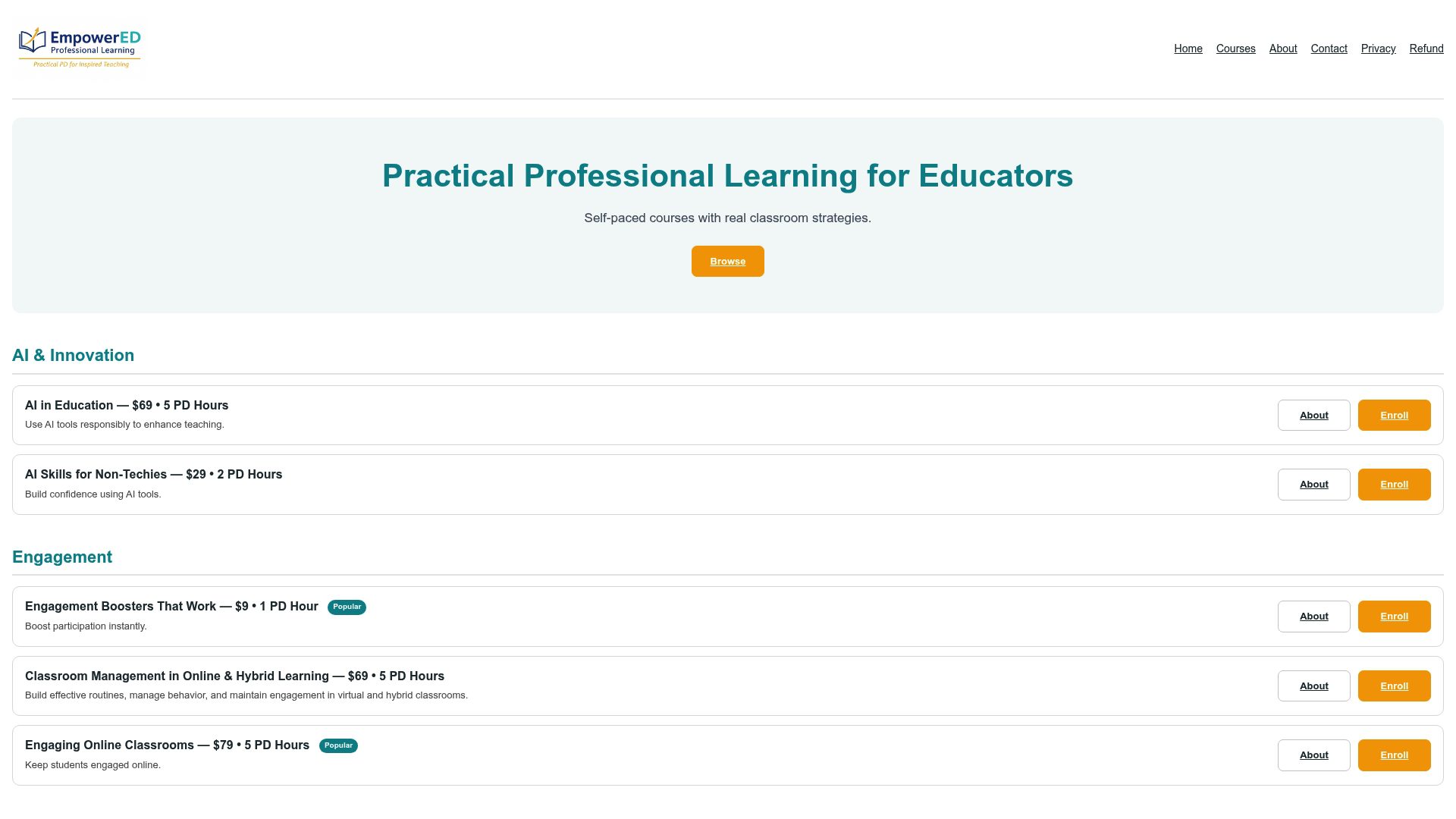
Two courses worth starting with:
- AI in Education: From Basics to Ethical Integration: Covers practical AI integration for K–12 classrooms, including ethical use, prompt design, and classroom-ready applications. Designed for teachers at any tech comfort level.
- Engagement Boosters That Work: Short, tactical strategies for increasing student participation, with immediate classroom application. A strong starting point for teachers running the 8-week cycle described above.
For teachers ready to act: enroll in one course, run the 8-week implementation cycle with that course’s core technique, and bring your results to your next PLC meeting. For school leaders looking to scale, Empowered Professional Learning offers bulk licensing for teams and districts. Visit the professional learning hub to review course options and district partnership details.
Sources
- K-12 EDUCATION: Research on Effectiveness of Professional Development Is Mixed, but Teachers Find Collaborative Learning Most Useful (GAO-26-107874)
- Effective Teacher Professional Development (Learning Policy Institute)
- What are the Characteristics of Effective Teacher Professional Development? A Systematic Review and Meta-analysis
- Teachers Like It. Research Is Promising. Is This the Solution to Teacher PD? (EdWeek)
Recommended
- Professional Learning for Educators: Enhance Your Impact – EmpowerED: Professional Development for Educators
- Professional Development for Educators: A Practical 2026 Guide – EmpowerED: Professional Development for Educators
- AI for Education: A Practical Guide for Educators – EmpowerED: Professional Development for Educators
- Growth Mindset Teaching for K-12 Educators: 2026 Guide