For effective special education professional development, prioritize sustained, job-embedded PD that includes coaching and performance feedback. A single workshop rarely changes classroom practice. The format that most consistently produces measurable results pairs active skill-building with follow-up coaching tied to real student data. Before purchasing any course or program, take three immediate steps:
- Check for coaching or implementation support built into the program, not offered as an add-on.
- Verify CEU or state approval status with your district’s HR or licensure office before enrolling.
- Request a sample module or district pilot to confirm the content aligns with your IEPs, student population, and school goals.
Organizations like the National Center for Special Education Research (NCSER), state Department of Education PD libraries, and frameworks like Universal Design for Learning (UDL) provide the clearest benchmarks for what quality looks like.
Key Takeaways
Effective special education professional development requires sustained, job-embedded coaching paired with active skill practice, CEU verification, and a clear plan for measuring classroom transfer.
| Point | Details |
|---|---|
| Prioritize coaching over workshops | Sustained coaching with performance feedback produces the highest implementation fidelity. |
| Verify CEUs before enrolling | Confirm state approval status and collect a completion certificate, roster, and course ID for licensure records. |
| Plan for generalization | Choose programs that explicitly train skills across multiple students and settings, not just one context. |
| Measure fidelity and student outcomes | Track teacher fidelity and IEP goal progress in short cycles to confirm PD is transferring to practice. |
| Empowered Professional Learning | Offers CEU-documented, district-licensable courses in UDL, SEL & wellness, and math instruction for special educators. |
Table of Contents
- What formats of special education professional development are available?
- How to choose high-quality, effective special education PD
- Common PD topics every special educator should know
- CEUs, state approvals, and documenting PD for licensure renewal
- Where to find trusted special education PD in the U.S.
- What does special education PD typically cost, and how long does it take?
- How to make PD stick in the classroom
- What the research actually shows about PD effectiveness
- How to get PD approved and purchased in your district
- Questions to ask when evaluating any PD provider
- How to integrate PD learning into your daily teaching routine
- Funding sources and grants for special education PD
- What actually moves the needle in special education PD
- Empowered Professional Learning offers practical, skills-focused courses for special educators
- Sources
What formats of special education professional development are available?
PD for special educators comes in several formats, each suited to a different goal and context. Choosing the right format matters as much as choosing the right topic.
- Webinars (live or recorded): Best for awareness-building and introducing a new topic. Low cost, easy to access, but limited transfer to classroom practice without follow-up.
- Self-paced online courses: Ideal for teachers who need flexibility. Effective when courses include practice tasks, reflection prompts, and instructor feedback.
- Cohort or coaching models: The strongest format for skill change. Teachers learn together over weeks, apply skills between sessions, and receive feedback on implementation.
- In-person trainings: Useful for hands-on skill practice, especially behavioral supports or structured literacy. Requires substitute coverage and travel budget.
- Conferences: Good for networking and exposure to new research. Rarely sufficient alone for skill transfer.
- On-demand libraries: Practical for district-wide access. Most effective when paired with a facilitated PLC structure.
Research on teacher career phases shows that early-career teachers need structure and classroom management skills, while mid-career teachers benefit more from leadership pathways and renewal opportunities. Format selection should reflect that reality.
| Format | Accessibility | Coaching/Feedback | Cost | Likely Classroom Transfer |
|---|---|---|---|---|
| Live webinar | High | Low | Low | Low |
| Self-paced online | High | Medium | Low–Medium | Medium |
| Cohort with coaching | Medium | High | Medium–High | High |
| In-person training | Low | Medium | High | Medium–High |
| On-demand library | High | Low | Low–Medium | Low without PLC |

How to choose high-quality, effective special education PD
The clearest answer from the research: require PD to be learner-centered, content-focused, provide opportunities to practice with feedback, and be sustained within job-embedded settings. NCSER’s synthesis of special education PD research identifies these four adult-learning elements as the most consistently linked to positive teacher outcomes.
Statistic to know: A large majority of students with disabilities receive some instruction in general education classrooms, with many spending most of their school day there. That scale makes inclusive instruction training not optional but necessary for every educator on a school’s staff.
Behavioral-skills training — modeling, roleplay, and performance feedback — produces higher implementation fidelity than passive methods like lectures or assigned reading. Coaching dosage matters too. Programs that include multiple coaching cycles across a semester outperform single-session models on every fidelity measure.
A 2025 meta-analysis found mean effects favoring teacher-related measures (g ≈ 0.53) and smaller average effects on direct student outcomes (g ≈ 0.17). PD that includes active participation and targeted content shows the strongest teacher effects. That gap between teacher and student outcomes is a signal: fidelity of implementation in the classroom is the critical mediator.
Checklist for vetting any PD provider:
- Does the program include CEU documentation or state approval?
- Are coaching hours specified, not vague?
- Is there a plan for assessing transfer to classroom practice?
- Does the provider cite peer-reviewed or NCSER-aligned evidence?
- Can you access a sample module before purchasing?
Pro Tip: When negotiating with a PD vendor, ask for a district pilot of 3–5 teachers before committing to a full license. Vendors with strong programs will agree. Those who resist are worth scrutinizing.
Common PD topics every special educator should know
Special education training programs cover a wide range of skills. The topics below appear most frequently in high-quality PD catalogs and align directly to IEP goals, inclusive instruction, and federal compliance.
- Universal Design for Learning (UDL) & Accessibility: Designing multiple means of representation, expression, and engagement so all learners can access content. Practical skills include flexible assessment design and barrier-removal audits. Explore UDL and accessibility courses to see how this translates to classroom-ready units.
- Behavior supports and positive behavior interventions: Implementing function-based behavior plans, de-escalation strategies, and Tier 2/3 supports within MTSS frameworks.
- Autism spectrum disorder: Understanding evidence-based interventions aligned to NIMH clinical guidance, including naturalistic developmental behavioral interventions and structured teaching approaches.
- Transition planning: Building post-secondary goals into IEPs, coordinating with vocational rehabilitation, and teaching self-determination skills.
- Social-Emotional Learning (SEL) & Teacher Wellness: Strategies for building student self-regulation alongside teacher stress management and burnout prevention. SEL and teacher wellness courses address both sides of that equation.
- Inclusive instruction: Co-teaching models, differentiated instruction, and scaffolding for students with diverse learning profiles in general education settings.
- Data-based decision making: Using progress monitoring data, curriculum-based measures, and IEP goal tracking to adjust instruction in real time.
- Mathematical Thinking for Teachers: Building conceptual understanding of math for educators who support students with learning disabilities in numeracy and problem-solving. Math instruction courses address this directly.
Example course titles to search for or request from providers:
- “Implementing UDL in Inclusive Classrooms”
- “Behavior Support Planning for Students with Significant Needs”
- “Data-Driven IEP Goal Writing and Progress Monitoring”
- “SEL Strategies for Students with Emotional and Behavioral Disorders”
- “Co-Teaching Models for Special and General Educators”
CEUs, state approvals, and documenting PD for licensure renewal
Verify the PD provider’s CEU or state approval status before purchasing. If the provider cannot confirm approval in your state, request a formal verification letter and a searchable course ID you can submit to your district’s HR or licensure office.
Documents to save after completing any PD:
- Completion certificate with provider name, course title, date, and CEU/PD hours
- Course roster or attendance record (for live or cohort formats)
- Learning products you created during the course (lesson plans, data tools, reflection logs)
- Supervisor or coach verification form, if required by your district
Store files in a clearly named folder: [LastName]_[CourseTitle]_[Year]_Certificate.pdf. Keeping a running log in a shared Google Sheet or district HR portal prevents last-minute scrambles at renewal time.
Steps to get a course approved by your district’s licensure office:
- Confirm the course provider’s accreditation or state approval status.
- Download the course syllabus, learning objectives, and CEU documentation.
- Submit a pre-approval request to your HR or professional development coordinator before enrolling.
- Complete the course and collect all required documentation.
- Submit the completion certificate and any required reflection or application evidence to the licensure office.
- Request written confirmation that the hours have been recorded in your file.
Where to find trusted special education PD in the U.S.
Start with sources that already vet for quality. The following are reliable starting points for finding continuing education for special educators:
- Council for Exceptional Children (CEC): Offers member discounts on conferences, webinars, and on-demand resources. Membership also provides access to peer-reviewed journals and standards-aligned PD.
- State DOE PD libraries: States like Massachusetts and Colorado maintain on-demand special education webinar libraries and approval lists districts use to vet CEU credit. Check your state’s special education department page directly.
- NCSER research summaries: Use NCSER findings to evaluate whether a provider’s approach is evidence-aligned before purchasing.
- University extension programs: Many state universities offer graduate-credit or CEU-bearing courses in special education topics, often at lower cost than private vendors.
- Empowered Professional Learning: Offers self-paced online PD with instructor guidance, CEU documentation, and district licensing options across UDL, SEL, math instruction, and more.
Quick vetting tips for district buyers:
- Look for “research-backed” or “evidence-based” labels with citations, not just marketing language.
- Request a sample module before signing any contract.
- Ask whether the program includes coaching cycles or implementation support.
- Check whether member or bulk-purchase discounts apply to district-wide licensing.
What does special education PD typically cost, and how long does it take?
Expect a wide range. The main cost driver is coaching and sustained support, not content delivery alone.
- Free or low-cost: State DOE webinars, recorded conference sessions, and CEC member resources. Typically 1–3 hours. Useful for awareness but limited for skill change.
- Short self-paced courses: $50–$300 per educator. Typically 3–10 hours. Effective when paired with a follow-up coaching structure.
- Cohort models with coaching: $300–$1,500 per educator. Typically 6–12 weeks. Strongest format for implementation fidelity.
- District licensing bundles: Negotiated pricing based on seat count. Often includes facilitation support, reporting dashboards, and CEU documentation for all participants.
Procurement tips for faster district approval:
- Identify the budget line (Title I, IDEA Part B, professional development allocation) before submitting a purchase request.
- Attach the provider’s course syllabus and evidence base to the requisition.
- Request a pilot cohort of 3–5 teachers to generate local outcome data before a full rollout.
- Build the purchase timeline around your district’s fiscal year cycle — most approvals move faster when submitted before March.
How to make PD stick in the classroom
Couple PD with job-embedded coaching, classroom observation, and short data cycles. Without that structure, most learning from workshops fades within weeks.
Implementation steps:
- Create a written implementation plan within 48 hours of completing PD, naming the specific strategy, the student group, and the first lesson where you will apply it.
- Schedule at least two coaching cycles in the four weeks following PD, with a peer or instructional coach observing and providing feedback.
- Identify a fidelity measure — a brief checklist of the strategy’s key components — and use it during observations.
- Track a short-cycle student outcome measure (IEP goal progress, behavior incident frequency, quiz scores) weekly for the first month.
Statistic to keep in mind: Because many students with disabilities spend a significant portion of their day in general education settings, implementation fidelity in those classrooms directly affects the majority of students on special education caseloads. Fidelity data collected in general ed settings is not optional.
Measurement checklist:
- Teacher fidelity to the target strategy (observed, not self-reported)
- Student IEP goal progress (bi-weekly data points)
- Behavior incident frequency (if behavior is the focus)
- Student engagement indicators (participation rate, task completion)
Pro Tip: Block 20 minutes of your existing planning time each week as “PD application time.” Label it on your calendar. Treating it as a scheduled commitment, not an intention, is what separates educators who sustain new practices from those who revert to old habits by November.
Use data-informed PD planning tools to build this cycle into your school’s existing structures.
What the research actually shows about PD effectiveness
Behavioral-skills training combined with sustained coaching is the most consistently supported approach in the special education PD literature. Passive methods — lectures, assigned readings, one-time workshops — produce weaker and less durable effects.
A comprehensive meta-analysis found that training models incorporating modeling, roleplay, and performance feedback produced higher implementation fidelity than passive approaches. A systematic review of 52 studies found that most PD programs did not intentionally plan for generalization of teacher skills. When programs did include generalization strategies — such as training across multiple students, settings, and using mediating prompts — transfer improved, though results remained mixed.
Key findings and their implications:
- Teacher effects are stronger than student effects. A 2025 meta-analysis reported mean effects of g ≈ 0.53 for teacher measures and g ≈ 0.17 for student measures. Classroom fidelity is the bridge between those two numbers.
- Active participation matters. PD that requires teachers to practice skills, not just observe them, produces stronger outcomes.
- Generalization must be planned. Without explicit strategies to transfer skills across students and settings, implementation often stays narrow.
- Coaching dosage is a variable, not a constant. More coaching cycles, spaced over time, outperform intensive single-session feedback.
| Research finding | Implication for PD selection |
|---|---|
| g ≈ 0.53 mean effect on teacher measures | Choose PD with measurable teacher skill outcomes, not just awareness goals |
| g ≈ 0.17 mean effect on student measures | Pair PD with classroom fidelity monitoring to close the gap |
| Most studies lack generalization planning | Ask providers how they support transfer across students and settings |
| Behavioral-skills training outperforms passive methods | Require modeling, roleplay, and performance feedback in any coaching model |
How to get PD approved and purchased in your district
Most district approval processes follow a predictable sequence. Moving through it efficiently requires front-loading the documentation.
- Identify the funding source first. IDEA Part B funds, Title II-A, and local professional development allocations are the most common. Confirm which applies with your special education director or budget office.
- Complete a pre-approval form. Most districts require this before enrollment. Attach the course syllabus, learning objectives, CEU documentation, and provider credentials.
- Get supervisor sign-off. Your building principal or special education coordinator typically signs off on individual requests. District-wide purchases route through the curriculum or HR office.
- Submit the purchase requisition. Include vendor contact information, total cost, number of seats, and the budget line code.
- Confirm the approval in writing. Email confirmation from HR or the PD coordinator protects you if questions arise at renewal.
For district buyers purchasing licenses for a team, request a formal proposal from the provider that includes a scope of work, deliverables, timeline, and evidence base. That document becomes the backbone of your board approval packet if the purchase exceeds your district’s direct-purchase threshold.
Questions to ask when evaluating any PD provider
These questions work equally well for individual teachers vetting a course and district buyers reviewing a vendor proposal.
- What evidence base supports this program? Ask for citations, not just the word “research-based.”
- What does coaching or follow-up support look like? Get specifics: number of sessions, format, who delivers it.
- How is implementation fidelity measured? A provider without a fidelity tool is selling awareness, not skill change.
- What student outcome data has the program produced? Look for disaggregated data on students with disabilities specifically.
- Is the program approved for CEU credit in your state? Confirm the approval number or letter.
- Can you access a sample module before purchasing? Any quality provider will say yes.
- What is the cancellation or refund policy? Especially relevant for district contracts.
- Does the program align to your district’s current strategic plan or school improvement goals? Alignment increases the likelihood of administrative support and sustained use.
How to integrate PD learning into your daily teaching routine
The gap between “I learned this in a workshop” and “I use this every day” closes when PD learning is embedded in existing routines, not added on top of them.
Concrete strategies that work:
- Attach new strategies to existing lesson structures. If you learned a UDL technique, apply it to a lesson you already teach rather than building a new one from scratch. Familiarity with the content lets you focus on the new method.
- Use your IEP meeting prep time as a PD application checkpoint. Before each IEP meeting, review one strategy from recent PD and note whether you have data showing its use.
- Build a “strategy of the month” into your team’s PLC agenda. One teacher demonstrates the strategy, the group discusses application, and everyone commits to trying it before the next meeting.
- Keep a one-page implementation log. Date, strategy used, student response, and one adjustment for next time. Five minutes of reflection after a lesson is more useful than a two-hour end-of-semester review.
Educator effectiveness metrics can help you align these daily practices to your formal evaluation cycle, making PD visible to administrators without extra reporting burden.
Funding sources and grants for special education PD
Several federal and state funding streams are specifically available for special education professional development. Knowing which to request saves significant time during budget season.
- State special education set-aside grants: — Many state DOEs offer competitive grants for districts implementing evidence-based practices. Check your state’s special education department grant page annually.
When writing a grant application or budget justification for PD, cite NCSER research findings and your district’s student outcome data to strengthen the case for sustained, coaching-based programs.
What actually moves the needle in special education PD
The evidence on what works is clearer than most PD catalogs suggest. Sustained, coaching-embedded programs with explicit generalization planning outperform one-time workshops on every meaningful measure. Yet most districts still default to the one-day in-service model because it is cheaper and easier to schedule.
The real cost of that choice shows up in IEP data. When teachers attend a workshop on behavior support but never receive coaching on implementation, students with the most complex needs are the ones who absorb the gap. The research on generalization of evidence-based practices makes this concrete: most PD programs do not plan for transfer, and when they do, results improve but are still inconsistent. That is not an argument against PD. It is an argument for being specific about what you require from it.
Career stage matters too. A first-year special educator needs classroom management and IEP writing survival skills. A ten-year veteran needs renewal, leadership, and advanced instructional design. Treating both with the same catalog is a missed opportunity. The most effective district PD plans differentiate by stage, just as good instruction differentiates by learner.
Empowered Professional Learning offers practical, skills-focused courses for special educators
Special educators need PD that is specific, practical, and ready to use the next school day. Empowered Professional Learning delivers exactly that: self-paced, instructor-guided online courses built for K–12 educators, with CEU documentation, personalized feedback, and district licensing options.
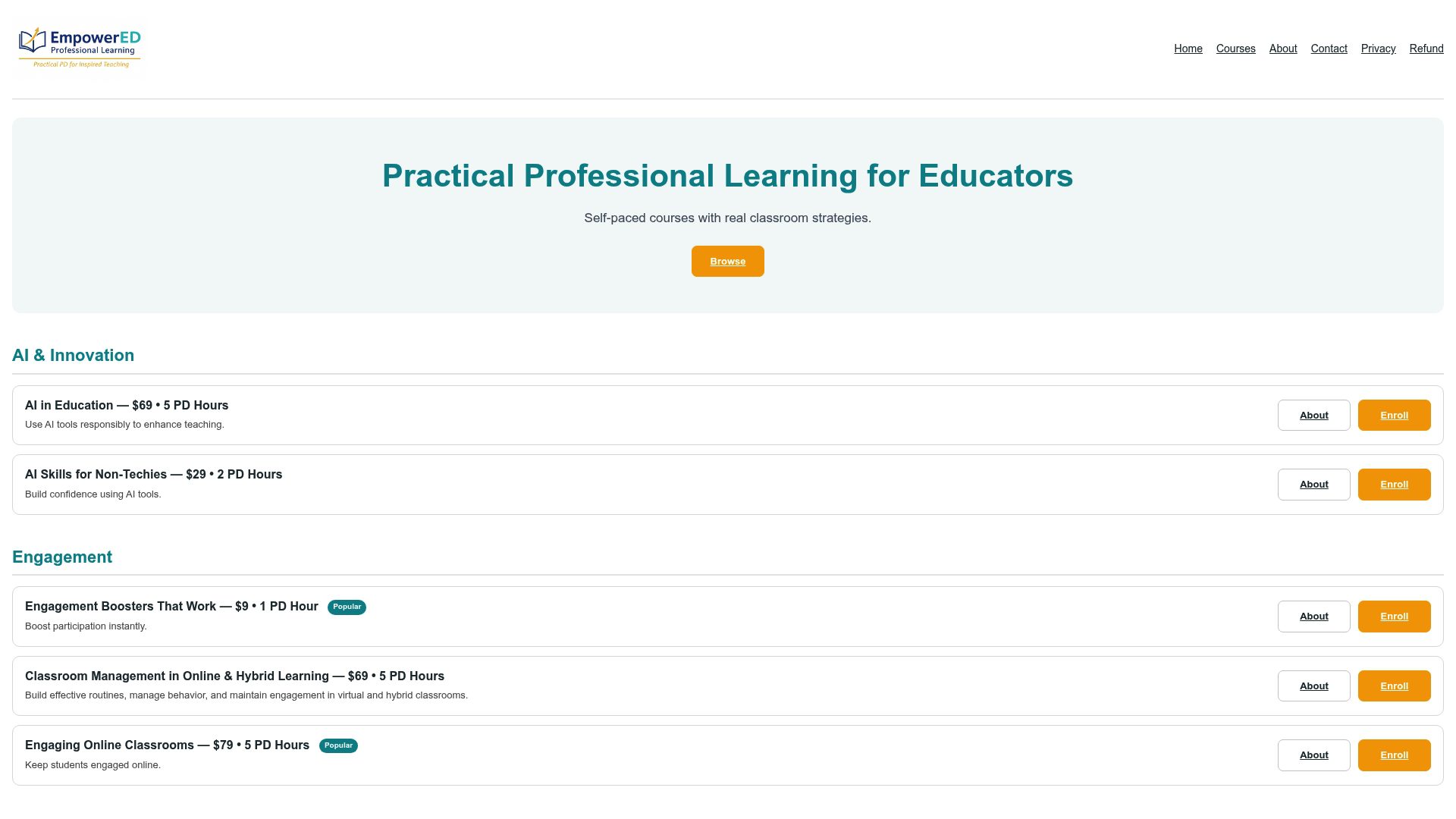
Three course categories align directly to the evidence-based priorities in this guide. UDL and accessibility training gives educators the concrete design skills to make instruction accessible for all learners. SEL and teacher wellness courses address both student regulation strategies and the staff retention challenge districts face. Mathematical thinking for teachers builds the conceptual foundation educators need to support students with math-related learning disabilities.
District buyers can request a pilot cohort, review the full course catalog, or contact the team directly to discuss bulk licensing and CEU documentation for your staff.
Sources
- A Summary of Professional Development Research National Center for Special Education Research FY 2006 – FY 2016
- Training Studies in Special Education: A Comprehensive Review and Meta-Analysis
- High-Quality Special Education Professional Development Improves Teacher and Student Outcomes
- Teachers’ careers go through phases. They need support in each
Recommended
- Professional Development for Educators: A Practical 2026 Guide – EmpowerED: Professional Development for Educators
- Professional Learning for Educators: Enhance Your Impact – EmpowerED: Professional Development for Educators
- Professional Development for Teachers: Practical, Research-Backed Options – EmpowerED: Professional Development for Educators
- Online Teaching PD for K–12: What to Pick and Why – EmpowerED: Professional Development for Educators