Multiple means of engagement is the Universal Design for Learning principle covering the “why” of learning: it asks teachers to offer varied, supported ways for students to find purpose, sustain effort, and stay emotionally ready to learn. Used well, it lifts motivation, reduces avoidance, and keeps more students in the work when it gets hard. This guide maps those benefits directly to CAST’s Guideline 7, 8, and 9 so you can choose strategies on purpose, not by chance.
TL;DR:
- Tailoring strategies to specific engagement barriers ensures relevant support for students, such as choice menus for interest or clear checkpoints for effort.
- Using small, repeatable practices like goal-reflect cycles or belonging rituals can significantly enhance engagement without major curriculum redesigns.
- Limiting choice options, pairing them with decision rubrics, and explicitly teaching self-regulation improves student autonomy and reduces overwhelm.
- Effective feedback should focus on effort, strategy, and progress, with students more likely to revise work and persist when supported appropriately.
- Building a foundation of emotional safety and routines should precede interest and persistence strategies to maximize student engagement success.
Table of Contents
- Why learner variability makes engagement the starting point
- Matching classroom strategies to each engagement checkpoint
- Small, copy-ready ways to build engagement into any lesson
- How to offer choice without overwhelming students
- What feedback and assessment need to look like
- Behind this guide: credentials and next steps for your school
- What most engagement advice gets backwards
- Turn these strategies into a full classroom plan
- Sources
Why learner variability makes engagement the starting point
Every classroom has a full range of interests, backgrounds, and emotional needs walking through the door at once. Designing a lesson for an “average” student ignores that range and builds barriers for the students on either side of it. CAST’s UDL Guidelines treat this variability as the norm, not the exception, and organize engagement into three linked checkpoints:
- Guideline 7, welcoming interests and identities: build in choice and relevance so students see themselves in the work, not just content that speaks to a hypothetical typical learner.
- Guideline 8, sustaining effort and persistence: set clear goals, break tasks into checkpoints, and add scaffolds so effort doesn’t stall out when a task gets harder.
- Guideline 9, emotional capacity: create safety, predictable routines, and moments of genuine joy so students have the internal bandwidth to take academic risks.
The CAST 3.0 update sharpened this further by naming intersecting identities directly as part of that variability, pushing engagement past “make it interesting” and into “make it identity-affirming.”
Matching classroom strategies to each engagement checkpoint
Picking a strategy at random rarely fixes the actual barrier a student is facing. A student who is bored needs something different from a student who is anxious, and a student who has given up needs something different from both. Organizing your options by CAST checkpoint keeps the choice purposeful.
- Recruit interest (Guideline 7). Offer choice menus for how students demonstrate learning, bring in guest perspectives connected to students’ communities, and open units with authentic, real-world problems instead of abstract prompts. University UDL modules point to service learning and project-based assignments as reliable ways to raise relevance fast.
- Sustain effort and persistence (Guideline 8). Use tight, visible goals, midpoint checkpoints, and cooperative structures like think-pair-share or jigsaw groups, then layer in graduated supports for students who stall.
- Build emotional capacity (Guideline 9). Predictable routines, belonging rituals (a two-minute check-in, a class norm-setting activity), and playful low-stakes practice all give students room to fail safely before it counts.
In hybrid settings, the same three checkpoints hold. A recorded choice board covers Guideline 7 for asynchronous learners, a shared progress tracker covers Guideline 8, and a weekly video check-in covers Guideline 9 without requiring everyone online at once.
Pro Tip: Before adding a new engagement activity, name the barrier it’s meant to remove. “Students seem checked out” points to Guideline 7; “students quit halfway through” points to Guideline 8. Matching the fix to the barrier beats layering on more activities.
Small, copy-ready ways to build engagement into any lesson
You don’t need a full curriculum overhaul to put multiple means of engagement to work. A handful of repeatable, small patterns will get you most of the benefit for a fraction of the planning time.
- Choice board exit ticket. Give three ways to show understanding, such as a written summary, a two-minute voice memo, or a quick sketch with labels. This costs roughly ten minutes to set up and directly supports Guideline 7.
- Goal, checkpoint, reflect cycle. Open a task with a one-sentence goal, insert a midpoint checkpoint where students self-rate progress, and close with a thirty-second reflection. This targets Guideline 8 and works equally well in a live classroom or a discussion board.
- Two-minute belonging ritual. Start class with a rotating low-stakes question, like a favorite small win from the week, before moving into content. This is a Guideline 9 pattern that takes almost no prep once you build a rotation of prompts.
- Multimodal hook. Open a unit with a short podcast clip, a role-play scenario, or a one-image prompt instead of text alone, matching common UDL implementation examples across university and K to 12 settings.
- Low-bandwidth variant. For remote or spotty connectivity situations, swap video hooks for a downloadable image or a text-based scenario, and replace live checkpoints with an asynchronous form students submit on their own time. Our guide to digital tools in student engagement covers more adaptations for hybrid classrooms.
Treat the first three as quick tweaks you can add to tomorrow’s lesson. The multimodal hook and low-bandwidth variant take more planning, so save those for a unit-level redesign rather than trying to retrofit them overnight. Implementation guides consistently recommend starting with one small step rather than rebuilding an entire course at once, and that advice holds here too.
How to offer choice without overwhelming students
Choice is one of the most talked-about engagement tools, and also one of the most misunderstood. Handed to students without support, a wide-open menu of options can raise anxiety instead of motivation, especially for students who already struggle with executive function. The fix isn’t less choice, it’s more structure around it.
- Limit the menu. Three well-designed options beat ten scattered ones. Fewer choices, each with a clear purpose, reduce the mental load of deciding.
- Pair choice with a decision rubric. A short rubric that maps each option to what it’s best for (a project for hands-on learners, an essay for written processors) helps students choose based on fit, not guesswork.
- Teach the self-regulation sequence explicitly. Goal-setting, a midpoint check, and a closing reflection should be taught as skills, not assumed. Practitioner guidance on UDL Principle 1 frames this scaffolding as essential, not optional, for choice to build autonomy instead of stress.
- Model the process once before releasing it. Walk through choosing an option out loud, then hand over control gradually with formative feedback along the way.
Pro Tip: If a student freezes when given options, that’s a self-regulation gap, not a motivation problem. Our self-regulation strategies guide has templates for goal-setting and reflection prompts you can hand a struggling student on the spot.
What feedback and assessment need to look like
Feedback that only marks answers right or wrong does little to keep a student in the fight. Feedback aimed at strategy, effort, and visible progress does more to build persistence, and UDL-aligned assessment guidance recommends pairing that feedback with multiple ways to demonstrate mastery, not just one test format.
Watch for these observable signs that engagement strategies are actually working:
- Students revise work after feedback instead of abandoning it.
- Students attempt a harder option on a choice menu over time.
- Peer support shows up unprompted, students helping classmates without being asked.
- Students articulate their own goals in their own words during checkpoints.
Behind this guide: credentials and next steps for your school
This guide draws on CAST’s UDL Guidelines and reflects the practical, classroom-tested approach of Brian Koster, Ed.D., whose work centers on turning UDL research into steps teachers can use the same week. Empowered Professional Learning built its Universal Design for Learning course around exactly this kind of guideline-to-practice mapping. If your school team is ready to move past reading about UDL and into applying it, that course is a direct next step, and it pairs well with a broader look at engagement strategies for K to 12 educators.

What most engagement advice gets backwards
Most engagement advice treats motivation like a mood you set with a fun opener, then hopes it lasts. That’s backwards. Guideline 8 exists precisely because interest fades the moment a task gets hard, and no amount of clever hooks fixes that without checkpoints, clear goals, and graduated supports built into the middle of the work, not just the start.

The other place conventional advice falls short is choice. Plenty of well-meaning teachers hand students five project options and call it engagement, then wonder why some students shut down instead of choosing. Choice without a decision rubric and an explicit self-regulation sequence isn’t UDL, it’s just more decisions for a student who may already be stretched thin.
If you’re starting from scratch, prioritize Guideline 9 first. A student who doesn’t feel safe or steady in your room won’t engage with interesting content or persist through a well-scaffolded task, no matter how well designed either one is. Get routines and belonging right, then layer in interest and persistence strategies on top. That order matters more than most engagement checklists let on, and it’s the sequence worth teaching to any staff just starting UDL work.
— Brian Koster, Ed.D.
Turn these strategies into a full classroom plan
Reading about Guideline 7, 8, and 9 is one thing. Building them into your weekly lesson plans without spending your whole prep period redesigning units is another. Empowered Professional Learning’s self-paced courses close that gap with classroom-ready strategies you can apply the same week you take them, not months later.
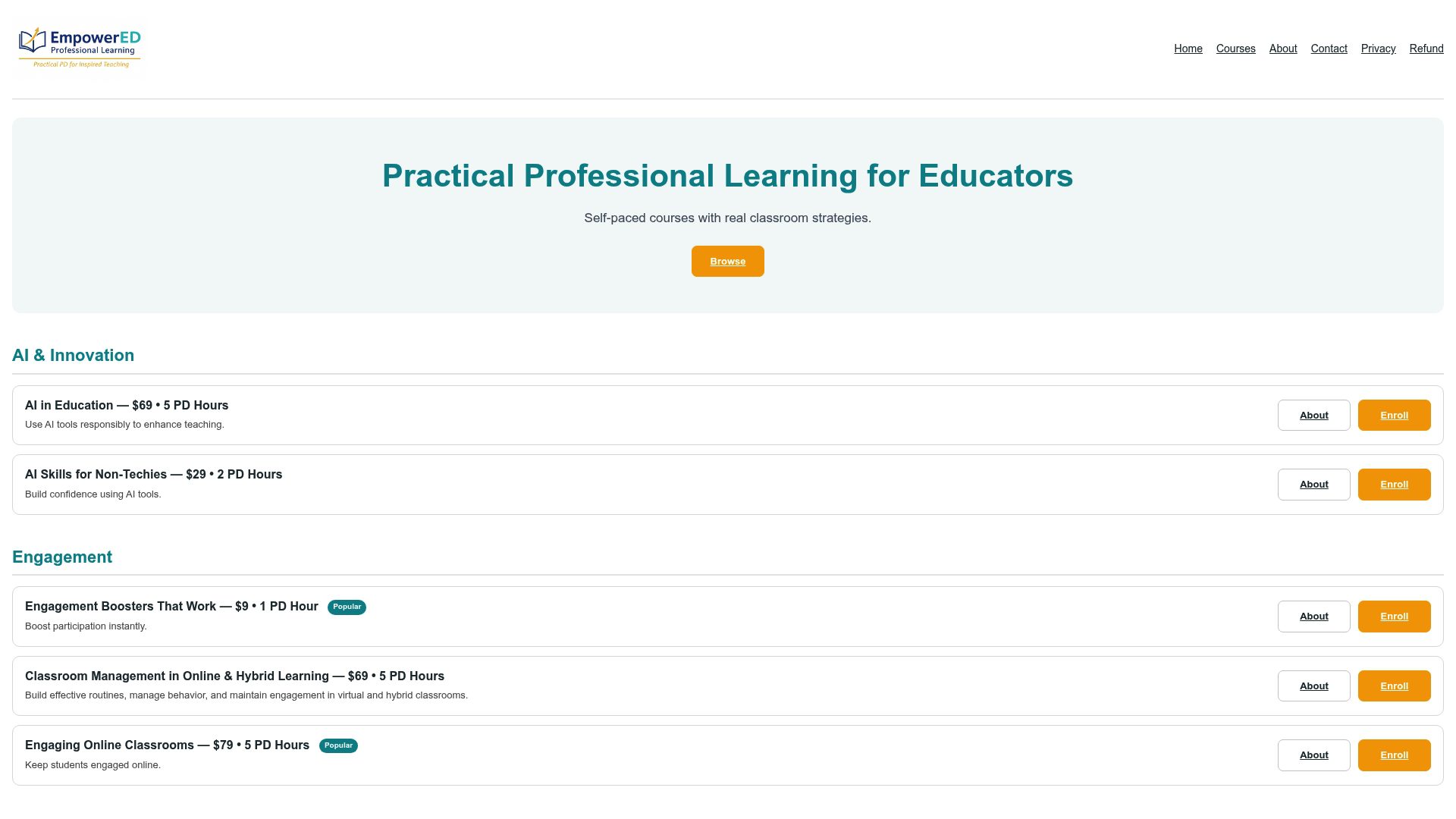
The Universal Design for Learning (UDL) & Accessibility course walks instructional designers and classroom teachers through the full engagement framework with guided practice, not just theory. If you want something narrower and faster, Engagement Boosters That Work focuses specifically on the classroom-ready techniques covered here, built for teachers and PD leads who want results before the next unit starts. Both are self-paced with instructor feedback, so you can start this week and apply what you learn before your next lesson plan is due.
Sources
- Engagement | CAST UDL Guidelines
- Multiple Means of Engagement | UDL Modules
- Universal Design for Learning (UGA teaching resources)
Recommended
- Student Engagement Strategies for K-12 Educators: 2026 Guide
- The Role of Digital Tools in Student Engagement – EmpowerED: Professional Development for Educators
- Classroom Engagement Strategies for Educators: 2026 Guide – EmpowerED: Professional Development for Educators
- Engaging Online Classrooms — Strategies for Engagement – EmpowerED: Professional Development for Educators